
Free Flight: Duration
Bob Meuser
Electronic Timer, At Last!: The Seelig Multi-Function Timer has established itself as the way to control the complex timing functions associated with gas-power models used in international competition: auto-rudder actuation, auto-stabilizer actuation, engine cut-off, and dethermalizer actuation. Still, anything less than 100% reliability means at least the destruction of a model that took a 100 hours to build and tune, and perhaps a shot at the World Championship. With every kid in the block owning a digital electronic wristwatch, and with four-function calculators now selling for under $10, the question naturally arises: "Isn't there some way we could replace all this clockwork with an all-electronic thingamajig?" Nowadays, the electronics is relatively easy using integrated circuit components. But the ICs required to do the job, in their conventional packaging, add up to a fair amount of weight, and there remains the problem of some sort of a mechanical actuator. Specially-built ICs are out of the question unless one is willing to order 100,000 or so at a crack.
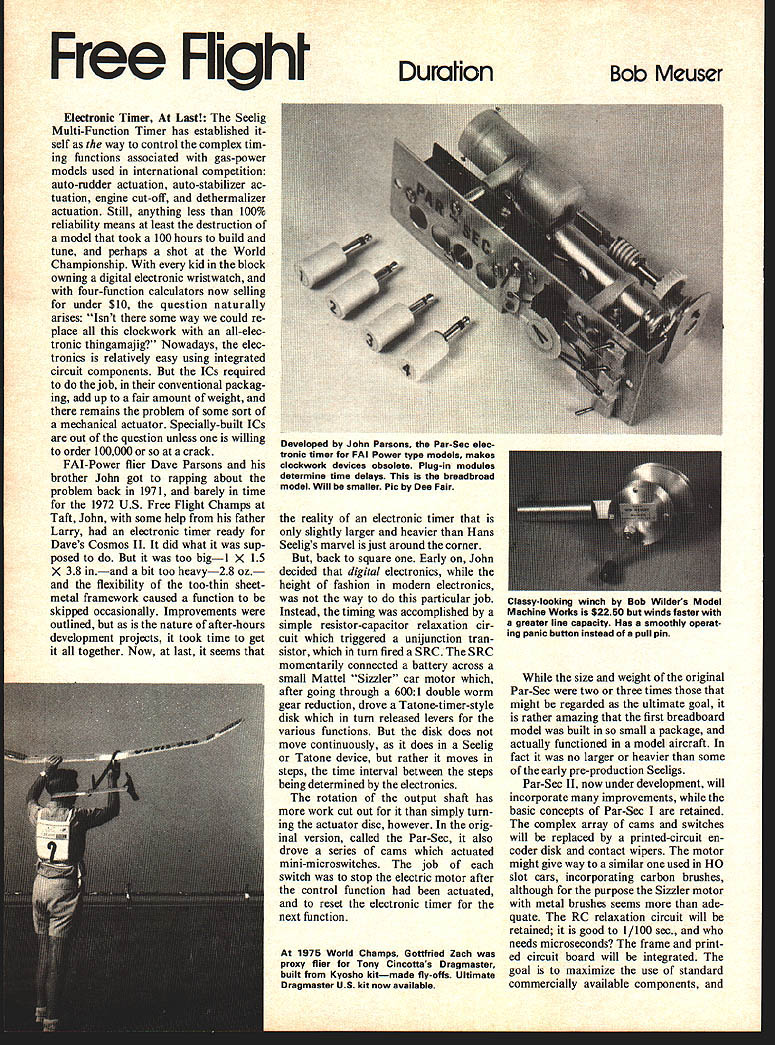
FAI-Power flier Dave Parsons and his brother John got to rapping about the problem back in 1971, and barely in time for the 1972 U.S. Free Flight Champs at Taft, John, with some help from his father Larry, had an electronic timer ready for Dave's Cosmos II. It did what it was supposed to do. But it was too big — 1 x 1.5 x 3.8 in — and a bit too heavy — 2.8 oz. — and the flexibility of the too-thin sheet-metal framework caused a function to be skipped occasionally. Improvements were outlined, but as is the nature of after-hours development projects, it took time to get it all together. Now, at last, it seems that the reality of an electronic timer that is only slightly larger and heavier than Hans Seelig's marvel is just around the corner.
But, back to square one. Early on, John decided that digital electronics, while the height of fashion in modern electronics, was not the way to do this particular job. Instead, the timing was accomplished by a simple resistor-capacitor relaxation circuit which triggered a unijunction transistor, which in turn fired a SCR momentarily connected a battery across a small Mattel "Sizzler" car motor which, after going through a 600:1 double worm gear reduction, drove a Tatone-timer-style disk which then released levers for the various functions. But the disk does not move continuously, as it does in a Seelig or Tatone device, but rather it moves in steps, the time interval between the steps being determined by the electronics.
The rotation of the output shaft has more work cut out for it than simply turning the actuator disc, however. In the original version, called the Par-Sec, it also drove a series of cams which actuated mini-microswitches. The job of each switch was to stop the electric motor after the control function had been actuated, and to reset the electronic timer for the next function.
While the size and weight of the original Par-Sec were two or three times those that might be regarded as the ultimate goal, it is rather amazing that the first breadboard model was built in so small a package, and actually functioned in a model aircraft. In fact it was no larger or heavier than some of the early pre-production Seeligs.
Par-Sec II, now under development, will incorporate many improvements, while the basic concepts of Par-Sec I are retained. The complex array of cams and switches will be replaced by a printed-circuit encoder disk and contact wipers. The motor might give way to a similar one used in HO slot cars, incorporating carbon brushes, although for the purpose the Sizzler motor with metal brushes seems more than adequate. The RC relaxation circuit will be retained; it is good to 1/100 sec., and who needs microseconds? The frame and printed-circuit board will be integrated. The goal is to maximize the use of standard commercially available components, and simplify the construction to the extent that any modeler with the skill and tools required to build an FAI Power model can rebuild his own timer as well. Electrical power will be furnished by non-vented button-type nickel-cadmium rechargeable cells. A single charging will be sufficient for many flights, but the pack will be easily replaced with a set of freshly charged cells. Although the tiny button nickel-cads are not commonly quick-charged, it might turn out to be possible to do that safely, and avoid the small hassle of changing bats every 10 or 20 flights. Or perhaps the somewhat larger vented cells will be used.
A more complete disclosure will appear in Free Flight, the NFFS Digest, in the near future. A full-length "how-to" article can't quite be put together in time for the 1976 NFFS Symposium Report, but one is planned for the 1977 Report. We hope you can hold your breath that long.
Meanwhile, while you're holding your breath, you might find the well-documented story of the development of the Seelig timer well worth reading. It appears in the 1975 NFFS Symposium Report—164 king-size pages of the latest and finest in Free Flight model aviation—still available for $7. For book rate postage, add 50¢, and for first class or air mail anywhere in the world, add $1.50. Order from NFFS Plans and Publications, 5641 Diamond Hts. Blvd., San Francisco, CA 94131.
FF Duration/Meuser
Considerably more inertia—flywheel effect—than the FAI winch, but that, I think, is simply a natural consequence of the faster gearing.
Bob also does custom and short-run machine shop work at reasonable prices. Check with Bob Wilder's Model Machine Works, 2010 Boston, Irving, TX 75061.
Booms, and Such/ NFFS Supplies now carries three different sizes of tapered fiberglass-phenolic tubes to be used as tailbooms. All are 42-in. long. The smallest, tapering from .53 in. to .29 in. diameter and weighing 33 grams, popular with
Free Flight: Duration
Latest Seelig multi-function timer has established itself as the control for complex timing functions associated with gas-power models used in international competition—auto-rudder actuation, auto-stabilizer actuation, engine cut-off, dethermalizer actuation. Still, anything less than 100% reliability means at least destruction; a model that took 100 hours to build and tune could be shot. With World Championship kids back owning digital electronic wristwatches and four-function calculators now selling under $10, the question naturally arises: Isn't there some way to replace clockwork with an all-electronic thingamajig?
Nowadays electronics are relatively easy using integrated-circuit components (ICs). The ICs required for the job in conventional packaging add up to a fair amount of weight and the actuator remains a problem. Specially-built ICs are out of the question unless you are willing to order 100,000 units. FAI-power flier Dave Parsons and his brother John got rapping about the problem back in 1971, barely in time for the 1972 US Free Flight Champs at Taft. John, with some help from father Larry, had an electronic timer ready. Dave's Cosmos II did what it was supposed to do, but it was too big—10 x 15 x 38 in.—and a bit too heavy, 28 oz. Flexibility and too-thin sheet-metal framework caused functions to be skipped occasionally. Improvements of this nature, after-hours development projects, took time to get together. Now, at last, Seeligian reality seems slightly larger and heavier than Hans Seelig's marvel just around the corner back then.
Early on John decided digital electronics were the height of fashion in modern electronics, but for this particular job timing was accomplished with a simple resistor-capacitor relaxation circuit triggered by a unijunction transistor. When it turned on, a silicon-controlled rectifier (SCR) momentarily connected the battery across a small Mattel Sizzler car motor. After going through a 60:1 double worm-gear reduction it drove a Tatone-timer-style disk which released levers for various functions. The disk does not move continuously, as does the Seelig Tatone device, but rather moves in steps, the time interval between steps being determined by the electronics. The rotation output shaft has the job of simply turning the actuator disc.
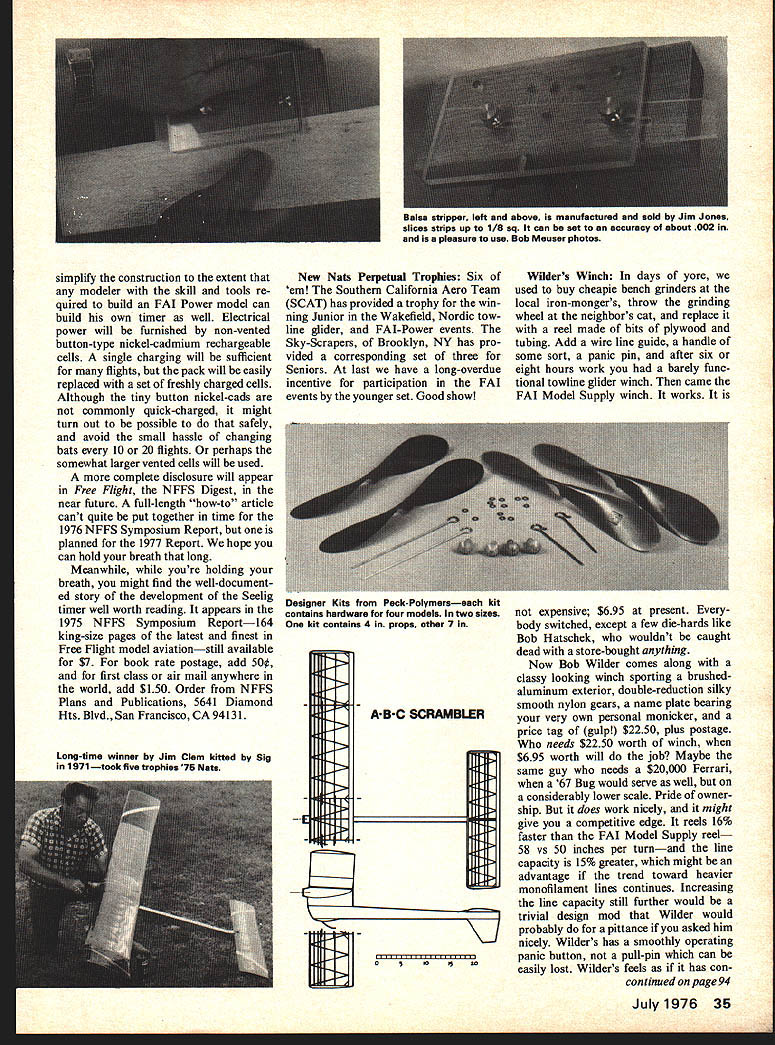
However, the original version, called Par-Sec, also drove a series of cams which actuated mini-microswitches. The job of the switch was to stop the electric motor after a control function actuated and to reset the electronic timer for the next function. At the 1975 World Champs Gottfried Zach's proxy flier, Tony Cincotta's Dragmaster, built from a Kyosho kit, made fly-offs. The ultimate Dragmaster, which helped earn Bob Isaacson a spot on the last U.S. World Champs team, has had complete deluxe versions, selling for a (phew!) $22.50, including shipping, includes both strip-wood and cut-out parts, plus plans. The partial kit, selling for $12.50, includes only the machine-cut carved parts. Plans sell for $2.50. (California residents add 6% tax.)
Machine-cut parts, of the finest quality—balsa, spruce, and plywood—are supplied by Mike Taibi's Superior Aircraft Products. We haven't seen the kit, but what kind of pedigree we expect the "how" to turn into a "wow" when you open the box. Sold only by direct mail: RM Enterprises, 10726 Arrowroot, Temple City, CA 91780.
Some early pre-production Seelig Par-Sec II units now under development will incorporate improvements while the basic concepts of Par-Sec are retained. The complex array of cams and switches will be replaced by a printed-circuit encoder disk and contact wipers. The motor might give way to a similar unit used in HO slot cars incorporating carbon brushes, although the purpose Sizzler motor with metal brushes seems adequate. The RC relaxation circuit will be retained; good to 1/100 sec, it needs microseconds frame timing. A printed circuit board will be integrated with the goal of maximizing the use of standard commercially available components.
Developed by John Parsons, the Par-Sec electronic timer for FAI-power type models makes clockwork devices obsolete. Plug-in modules determine time delays. Will smaller models be able to use them? Time will tell. Bob Wilder's Model Machine Works S2250 winch winds faster and has greater line capacity, and has a smoothly operating panic button instead of a pull pin to simplify construction to the extent the modeler skill and tools required to build an FAI-power model are reduced. A modeler can build his own timer as well.
Electrical power will be furnished by non-vented button-type nickel-cadmium rechargeable cells. A single charging will be sufficient for several flights and the pack will be easily replaced with a set of freshly charged cells. Although tiny button nickel-cads are commonly quick-charged, it might turn out possible to safely avoid the small hassle of changing batteries for 10–20 flights; perhaps somewhat larger vented cells will be used. Complete disclosure will appear in Free Flight and the NFFS Digest in the near future; a full-length how-to article couldn't quite be put together in time for the 1976 NFFS Symposium Report. fuss of doublers. It's an old trick, but a good one.
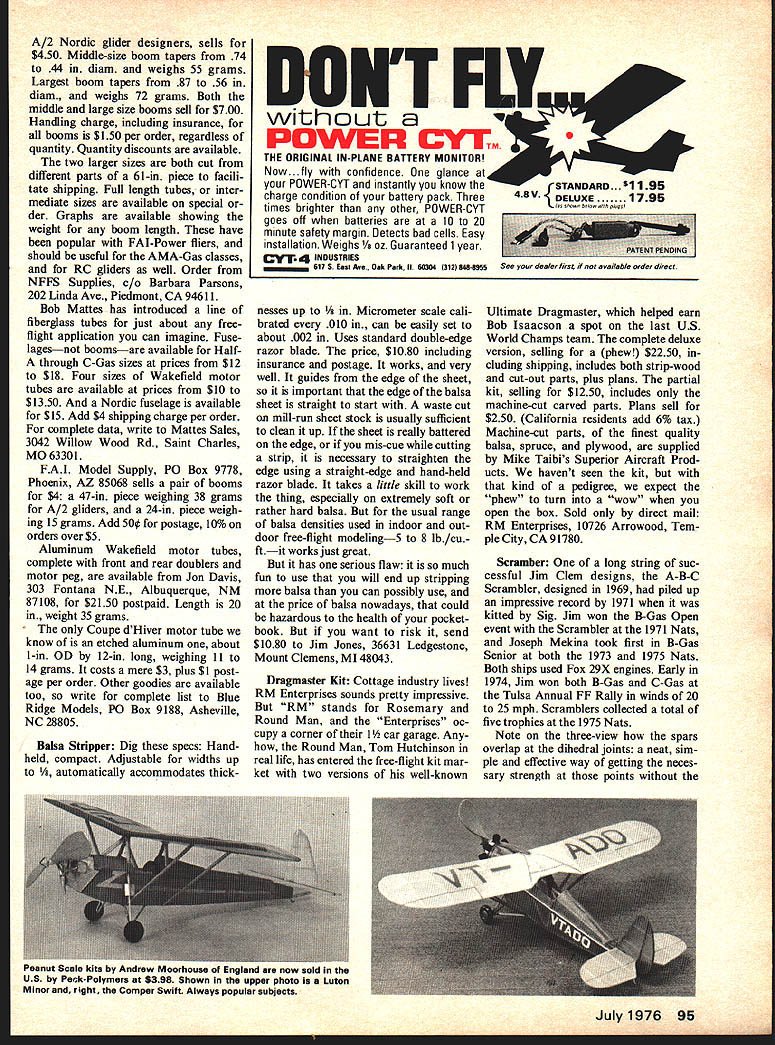
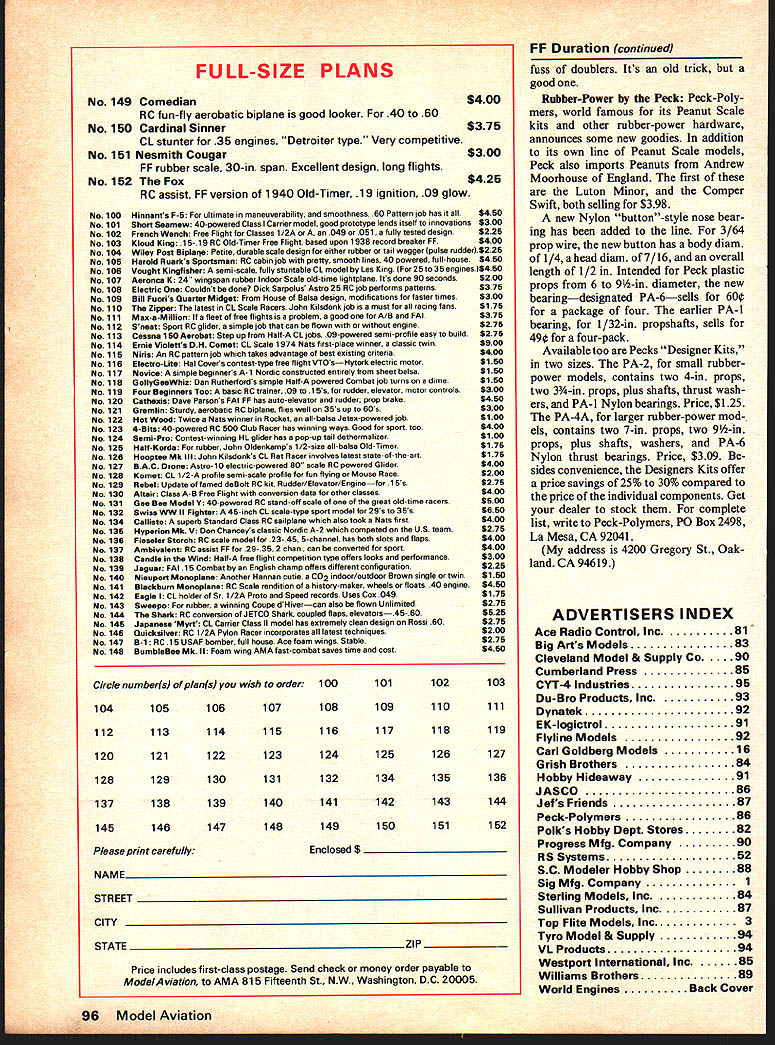
Rubber-Power by the Peck: Peck-Polymers, world famous for its Peanut Scale kits and other rubber-power hardware, announces some new goodies. In addition to its own line of Peanut Scale models, Peck also imports Peanuts from Andrew Moorhouse of England. The first of these are the Luton Minor, and the Comper Swift, both selling for $3.98.
A new Nylon "button"-style nose bearing has been added to the line. For 3/64 prop wires, the new button has a body diameter of 1/4, a head diameter of 7/16, and an overall length of 1/2 in. Intended for Peck plastic props from 6 to 9-1/2 in. diameter, the new bearing—designated PA-6—sells for 60¢ for a package of four. The earlier PA-1 bearing, for 1/32-in. propshafts, sells for 49¢ for a four-pack.
Available too are Peck's "Designer Kits" — in two sizes. The PA-2, for small rubber-power models, holds two 5-in. props, a rubber, 3/32-in. propshaft, plus shafts, thrust washers, and PA-1 Nylon bearings. Price, $1.25. The PA-4A, for larger rubber-power models, contains two 7-in. props, two 9-1/2-in. props, plus shafts, washers, and PA-6 Nylon thrust bearings. Price, $3.09. Besides its wide convenience, the Designer Kits offer a price savings of 25% to 30% compared to the price of the individual components. Get yours while they last. For complete list, write to Peck-Polymers, P.O. Box 2498, La Mesa, CA 92041.
(My address is 4200 Gregory St., Oakland, CA 94619.)
Transcribed from original scans by AI. Minor OCR errors may remain.

