
Free Flight: Duration
Harry Murphy
NFFS for 1986
I had lots of good things to tell you about National Free Flight Society (NFFS) doings for 1986, but my alternate-month co‑contributor, Bob Meuser, beat me to it! His January 1986 column details NFFS' new discount membership plan, nominations for Model of the Year, and Free Flight Hall of Fame awards.
Memberships and contact information:
- Mail NFFS memberships to: NFFS, 8383 Zancanaro Ct., Citrus Heights, CA 95610.
- Single membership: $15.
- Multiple (new, not renewal) memberships mailed in the same envelope:
- 3 at $13.50 each
- 4 at $12 each
- 5 at $10 each
Other submissions:
- Model of the Year nominations: Gilbert Morris, 2810 Brackley Rd., Columbus, OH 43220.
- Free Flight Hall of Fame nominations (notify by January 1, 1986): Tony Italiano, 1655 Revere Dr., Brookfield, WI 53005.
Both of these NFFS traditions recognize contributions to the heritage of Free Flight. They are more meaningful when everyone participates in the nomination process, whether individually or through a club.
Commercial thermalmeter
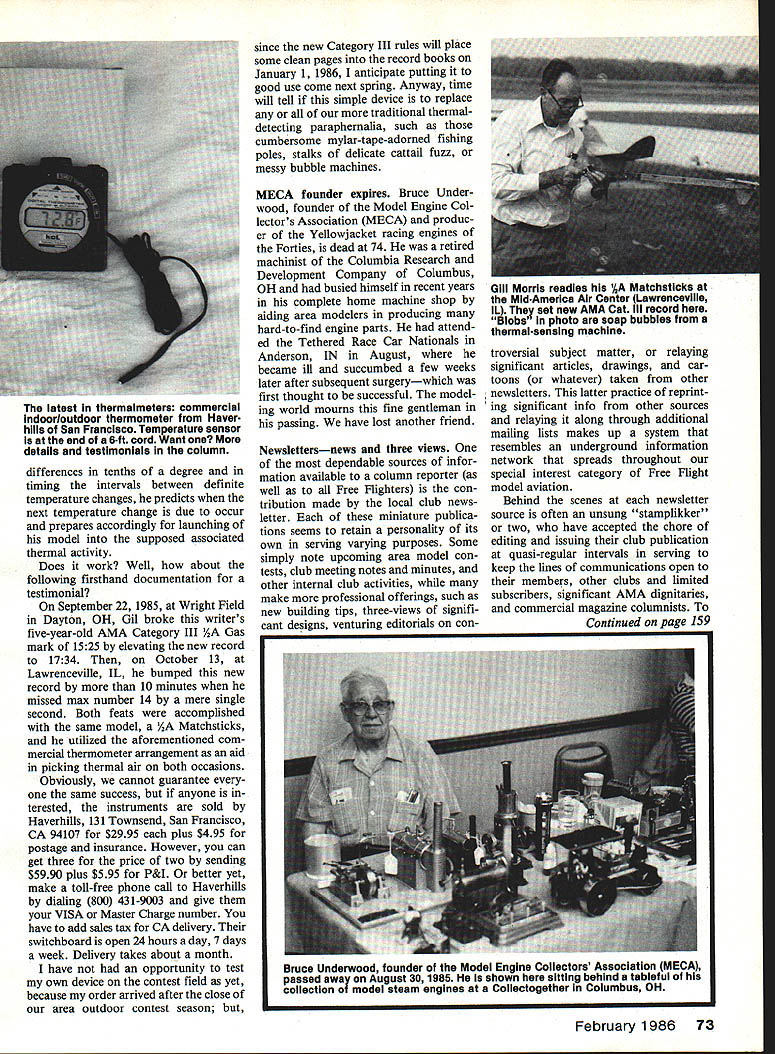
Gil Morris recently sent me a magazine advertisement for an indoor/outdoor digital thermometer with a separate thermistor, and I ordered one. The unit has a sensitive LCD readout showing temperature changes to tenths of a degree in Fahrenheit or centigrade; the thermistor is on a six‑foot lead. The instrument is about 1.5 times the size of a stopwatch and includes a clock feature.
Gil’s intended use was to identify thermal activity for FAI power contests. He attached the readout to a short dowel with the thermistor a couple of feet up the shaft (FAI rules permit thermal‑detecting devices no higher than 6 feet above ground). By observing temperature changes in tenths of a degree and timing intervals between changes, he predicts when the next change is due and launches accordingly.
Documented results (firsthand):
- September 22, 1985, Wright Field, Dayton, OH — Gil broke the writer’s five‑year‑old AMA Category III AA Gas mark of 15:25, raising it to 17:34.
- October 13, Lawrenceville, IL — he increased the record to 18:10, missing a max number (14) by only one second.
Instruments are sold by Haverhills, 131 Townsend, San Francisco, CA 94107: $29.95 plus $4.95 postage & insurance. Three for the price of two: $59.90 plus $5.95 P&I. Toll‑free: 800‑431‑9003 (VISA/MasterCharge accepted; add CA sales tax where applicable). Switchboard open 24/7. Delivery takes ~1 month.
I have not yet tested my own device at the contest field (it arrived after the outdoor season), but with new Category III rules effective January 1, 1986, I expect to put it to good use next spring. Time will tell whether this simple device will replace traditional thermal detectors such as mylar‑tape fishing poles or cattail‑fuzz stalks.
MECA founder expires
Bruce Underwood, founder of the Model Engine Collectors' Association (MECA) and maker of Yellowjacket racing engines of the 1940s, has died at 74. A retired machinist from Columbia Research and Development Company in Columbus, OH, he spent recent years in his home machine shop helping local modelers produce hard‑to‑find engine parts. He fell ill after attending the Tethered Race Car Nationals in Anderson, IN, in August and succumbed a few weeks later following surgery. The modeling world mourns a fine gentleman and friend.
Newsletters — news and three views
One of the most dependable information sources for a column reporter (and for all Free Flighters) is the local club newsletter. Each publication develops its own personality and purpose. Some simply note upcoming contests and club business; others offer building tips, three‑views of designs, editorials on controversial subjects, or reprints of significant articles, drawings, and cartoons from other newsletters. This reprinting creates an underground information network that spreads throughout Free Flight.
Behind each newsletter are often unsung editors and volunteers who accept the chore of producing the publication at quasi‑regular intervals, keeping communications open among members, other clubs, AMA dignitaries, and commercial magazine columnists. To recognize these faithful servants of the grassroots, I’m starting a series to spotlight different newsletters; this column is the first.
Spotlight: Phoenix Model Airplane Club (PMAC)
Our initial spotlight is on Arizona’s Phoenix Model Airplane Club (PMAC). The club’s current president is Ken Kear, and the newsletter is co‑edited by Sal Fruicano and Hermann Andresen. To subscribe, send $4 to Sal at 6146 E. Cactus Wren Rd., Scottsdale, AZ 85253.
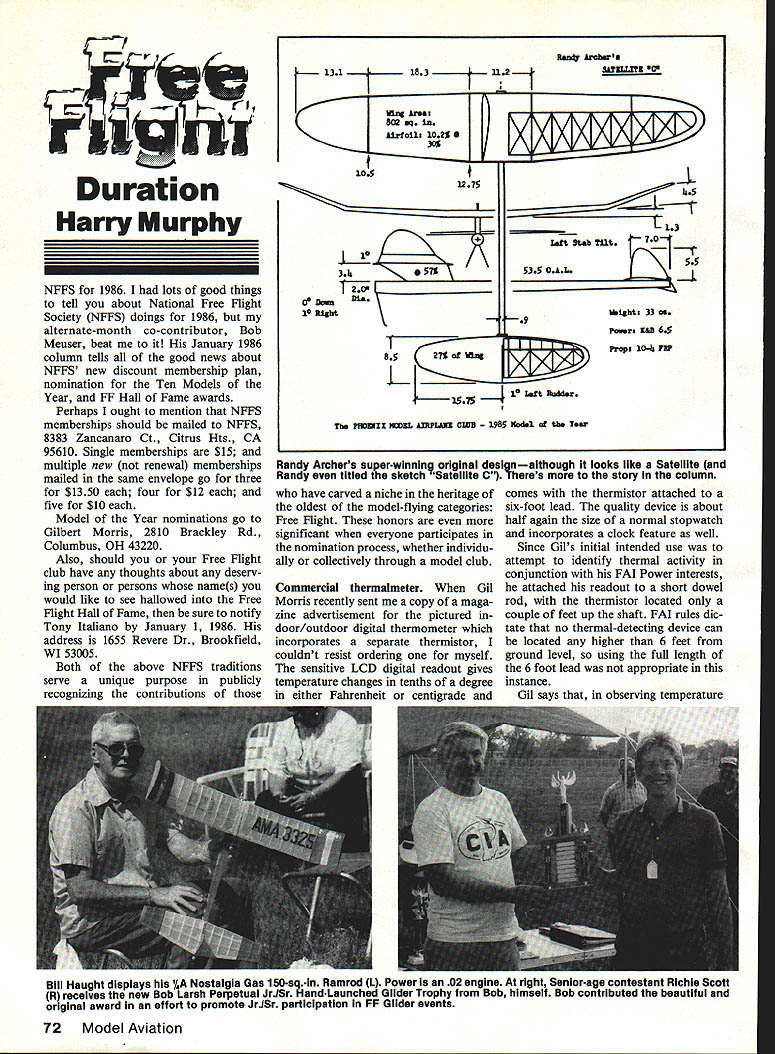
Notable members include former editor Al Dibber, Free Flight Gas competitors Toby Blizzard and Randy Archer, and ex‑Hoosier Larry Fry (a significant Class C competitor at past AMA Nats and Free Flight Champs). From a recent issue of the PMAC newsletter we pulled a three‑view of Randy Archer’s 802‑sq.in. design. Although often called a Satellite look‑alike, Randy had not seen Satellite plans until recently; his model’s construction and airfoil choices are unorthodox and original, adapted to accept mylar film coverings. The Phillips‑entry airfoil is not from Satellite plans.
Randy’s success stems from attention to fuel selection, engine modifications, and handmade fiberglass props. The model is flown right‑to‑left, with a quarter turn to the right under power on a nine‑second engine run (Category II), then about a four‑second delay before the VIT (variable‑incidence tail) kicks the stab up. The ship climbs in a tight right spiral; after power cut it eases into a very flat, steady glide and can hold for long periods in mild Arizona lift. As it slows it begins a left turn into the wind to search for thermal air. I’ve seen the model perform — its climb is impressive, aligning with Randy’s philosophy that lots of initial altitude can compensate for other design shortcomings.
We thank Randy and the PMAC for being our first featured club. Expect another spotlight in the next column.
Nats site inquiry
At the Tri‑County Aero Club’s Annual Free Flight Meet (October 12–13), both the Mayor of Lawrenceville, IL and the manager of the Mid‑America Air Center asked whether AMA might be interested in hosting a Nats at their facility. The site offers ample concrete runways, hangar space, central geography, and nearby utilities. A possible restriction is adjacent crops during the traditional late July/early August Nats dates; this might be mitigated by substituting a SAM Champs (Old‑Timers prefer a June schedule). The Champs aren’t due in the Midwest until 1988, but the site has potential if local hospitality holds up.
Readers write
Reader responses are always welcome. A recent in‑person reply came from Leo Sullivan, who showed me an early strapless magnesium‑crankcase Bantam engine he bought new in the early 1940s. He had reworked the rear rotor by enlarging the kidney‑shaped hole ends to improve performance — something I only figured out 40 years later.
We received many letters about methods for stripping old doped silkspan or tissue from model frameworks; everyone seems to have a preferred technique. Previously I thought fine‑grit sandpaper and elbow grease were the only reliable way, but a recent mishap with a Comet Zipper forced me to try paint remover again.
My procedure with a thin liquid remover (Red Devil Liquid #99) worked well:
- Use a thin liquid remover rather than a semi‑paste to reduce mess.
- Leave the old covering intact initially to prevent stripper from running into glue joints.
- Slop the stripper over areas bonded to balsa (planked center, leading/trailing edges, rib tails), working about a quarter‑panel at a time.
- Let soak a few minutes, then pierce an open framework area and peel away adjacent covering. The covering often came off like adhesive tape.
- Let the framework dry overnight, then finish‑sand and prepare for new covering.
Liquid #99 evaporates quickly and leaves little residue, simplifying prep for new dope. Protect metal fittings with cellophane tape and use minimal stripper. If the old covering is removed while still damp, a dusting of dope may remain but can be removed with mineral spirits. Caution: Liquid #99 can partially remove modern fabric adhesives from balsa if left on too long.
Zeek saga
The saga of Lew Mahieu’s Zeek design resurfaced recently. Bill Cranford — who bought the original Zeek copyrights from Lew Mahieu and Ray Accord in the early 1950s — produced a second A/B kit under Premium Manufacturing Company. That second kit was distinguishable by a larger stab. Bill claims to have created the conventional 1/2A Zeek and the Zeebin derivative and to have pioneered die‑cutting methods.
Bill remembered Lew as a superb builder and flier, though some of Lew’s designs were hard to duplicate and fly competitively. At the time, there was little development in .09 engines, so Bill felt the market for a commercial .09 Zeek or larger B/C version was limited. He built several 1/2A Zeek versions, some with undercambered airfoils; kit ribs were flat‑bottom due to the limitations of early steel‑ruled die work. Bill has sent previously unpublished 1/2A Zeek and Zeebin plans to John Pond — perhaps they will surface soon.
Miscellaneous notes
- Props can wobble if the two blades don't pull evenly. One remedy is using a Teflon sleeve around the prop bearing to solve insertion problems and reduce friction from side loads when right or left thrust is applied. There are several reasons props wobble; we can take a detailed look at this next time.
- Late flash: Selected indoor fliers have been asked to comment on the proposed indoor schedule for the 1986 Indoor Nats. This is an unprecedented opportunity and indicates AMA is trying to improve the Indoor Nats. Contact: Bud Tenny, P.O. Box 545, Richardson, TX 75080.
Transcribed from original scans by AI. Minor OCR errors may remain.

