
Free Flight: Duration
Bob Meuser
LET'S SEE — it must have been about 1933 when I first attended a model airplane contest. That would have put me at age 11; it seems about right. It was what we would now call a slope-soaring contest; I don't know what they called it then. I remember the guys tossing their models from the top of a hill, then running like dickens to retrieve them. I don't know whether the name of the game was Distance or Flight Duration.
After the meet I found one of the models just sitting on the trail. There was no name or address on it; I made no terrific attempt to find the owner. I never flew it, but I sure drooled over it a lot. The memory is dim, but I distinctly recall the model having continuously curved dihedral. The wing was stick-and-tissue. This model, or perhaps another at the meet, had a name painted on it—Effe Narf. Spelling not guaranteed; heaven only knows what it meant. How in the world would I remember a dumb thing like "Effe Narf"—or that my phone number at the time was Andover 3013—when I sometimes have trouble remembering my current one? Anyhow, if any single event kicked me into model aviation, that has to be it.
Magnet steering (F1E) — slope soaring revisited
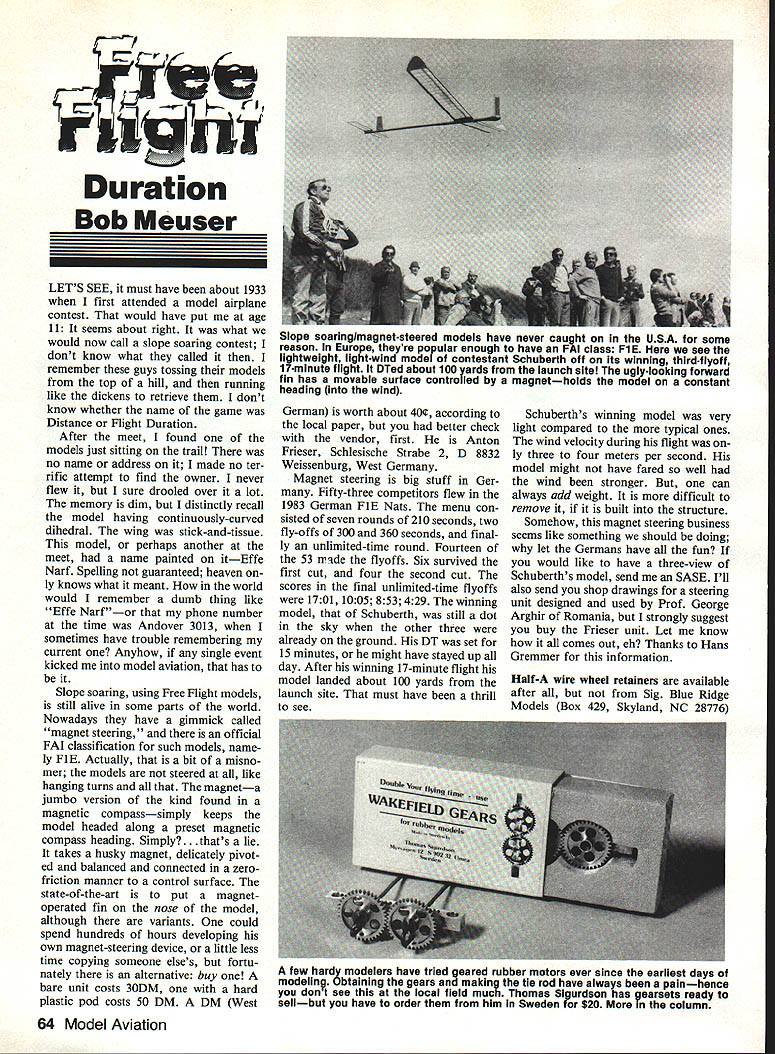
Slope soaring using free-flight models is still alive in some parts of the world. Nowadays there is a gimmick called "magnet steering," and there is an official FAI classification for such models: F1E. The name is a bit of a misnomer; the models are not actively steered. A jumbo magnet—similar in principle to that in a magnetic compass—simply keeps the model headed along a preset magnetic compass heading. That "simply" is deceptive: it takes a husky magnet, delicately pivoted and balanced and connected in a zero-friction manner to a control surface. The state-of-the-art is to put a magnet-operated fin on the nose of the model, although there are variants.
One could spend hundreds of hours developing a magnet-steering device or spend considerably less time copying someone else's. Fortunately, there is an alternative: buy one. A bare unit costs about 30 DM; one with a hard plastic pod costs about 50 DM. (A DM — West German mark — was worth about $0.40 according to local papers; check with the vendor.) Vendor: Anton Frieser, Schlesische Strabe 2, D-8832 Weissenburg, West Germany.
Magnet steering is big in Germany. Fifty-three competitors flew in the 1983 German F1E nationals. The contest format included:
- Seven rounds of 210 seconds
- Two fly-offs of 300 and 360 seconds
- A final unlimited-time round
Fourteen made the fly-offs; six survived the first cut and four the second. Scores in the final unlimited-time fly-offs were: 17:01, 10:05, 8:53, 4:29. The winning model (Schuberth's) was still a dot in the sky when the other three were already on the ground. His DT was set for 15 minutes, or he might have stayed up all day. After his winning 17-minute flight his model landed about 100 yards from the launch site — a real thrill to see.
Schuberth's model was very light compared to more typical ones. The wind during his flight was only about three to four meters per second. His model might not have fared so well had the wind been stronger. You can always add weight; it's far more difficult to remove weight built into the structure.
If you want a three-view of Schuberth's model, send an SASE and I'll send one. I'll also send shop drawings for a steering unit designed and used by Prof. George Arghir of Romania, though I strongly suggest buying the Frieser unit if available. Let me know how it comes out. Thanks to Hans Gremmer for this information.
Half-A wire wheel retainers
Half-A wire wheel retainers are available after all, but not from Sig. Blue Ridge Models:
- Blue Ridge Models, Box 429, Skyland, NC 28776
Both outfits mentioned elsewhere have extensive lines of Free Flight kits, materials, and hardware items; write for their catalogs — and don't be ashamed to send them a buck for the trouble. I don't know their catalog prices off the top of my head, but even if they were free it would cost about a quarter for a stamp and envelope.
Nostalgia, revisited
Introduced some five years ago, the Nostalgia events—standing midway between Old-Timer and current competition "gas" events—have gained a firm, yet somewhat slippery, foothold. Many Nostalgia models would fare well in current competition if flown with more modern engines by better fliers.
Certification of eligibility for specific model designs and engines has become a bit of a problem, especially with respect to borderline cases. Not an easy job; they're working on it continuously. George French's Dixielander seems to have created a huge brouhaha. A new list will be published Real Soon Now, or thereabouts. If you have questions or answers about borderline cases, write to Ralph Prey, 4859 West 97th Street, Inglewood, CA 90301. But don't bug him about the Dixielander (unless your name is George French).
Firewalls and blind-nuts
Cut out the plywood according to the plan, install the specified blind-nuts (a.k.a. T-nuts), and you are in business — except when the nuts strip or the plywood delaminates when drilling the holes. The quality control on commercially available blind nuts is not always terrific. Check yours before use.
Ways to avoid plywood tear-out:
- Use an oversize plywood blank, drill the holes, then trim the plywood to final size so holes aren't near edges.
- If you must cut to size first, saturate areas near the holes with CyA instant glue and then drill.
- A hybrid approach (Ed Hopkins, via Ralph Prey's Satellite): use an oversize blank, soak both surfaces with CyA at the nut positions, drill the holes, then trim to size.
If weight reduction is critical, consider abandoning metal nuts and simply tapping the plywood. Several applications of CyA followed by tapping yield a nearly-metallic tapped hole—adequate for many applications (though perhaps not for the largest engines).
Electric propulsion in Free Flight
A decade or so ago electric propulsion for Free Flight seemed like a solution in search of a problem. Now it appears to be taking hold. Electric power has made a firm foothold in RC; why not in FF?
At the entry level, for the price of a Radio Shack generic motor (less than a buck at the time) and some one-shot batteries scrounged from a roll of Polaroid instant-film packs, you can get a small FF model into the air with gusto.
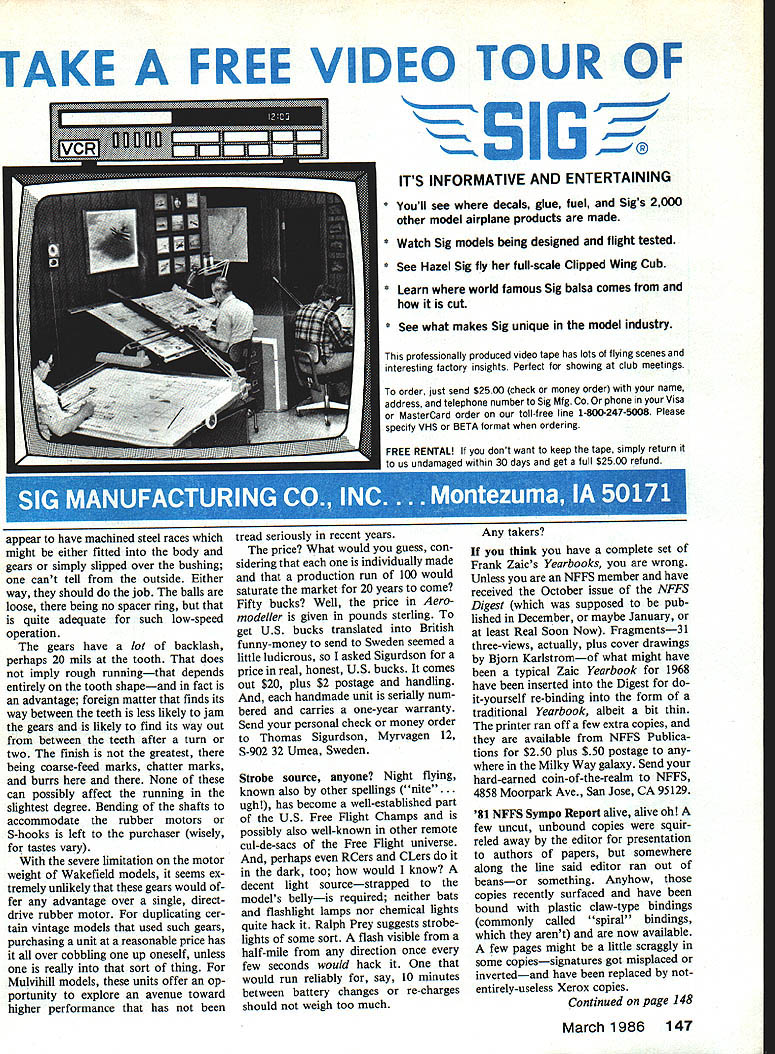
A high-end system—geared motor with samarium-cobalt permanent magnets, a fiberglass folding prop, Ni-Cads, and ground-support gear—could run a bit over $200. For half that you can build a reasonably competitive system and, on a good day, beat the high-end setups.
Don Hughes has been running a series of articles about FF electric propulsion in Free Flight (the NFFS Digest). Slick-cover model magazines have run regular or occasional articles on electric propulsion. Give it a try.
Call for papers — Sympo 86
If you might have something to contribute to the 1986 NFFS Symposium Report, tell the editor about it. Finished papers should be in the editor's hands before April 1, 1986. Subjects can range from far-out theoretical topics to down-home practical techniques for making models fly despite theory. Contact:
- W. Hewitt Phillips, 310 Manteo Ave., Hampton, VA 23361
- Phone: (804) 723-5382
Please get those papers in Real Soon Now.
Wakefield gears and geared rubber motors
The idea of using gears to let the propeller turn at a different rate than the rubber motor, or to connect several motors to a single prop, goes back to the turn of the century. On occasion such devices have been highly successful; in other instances, total failures.
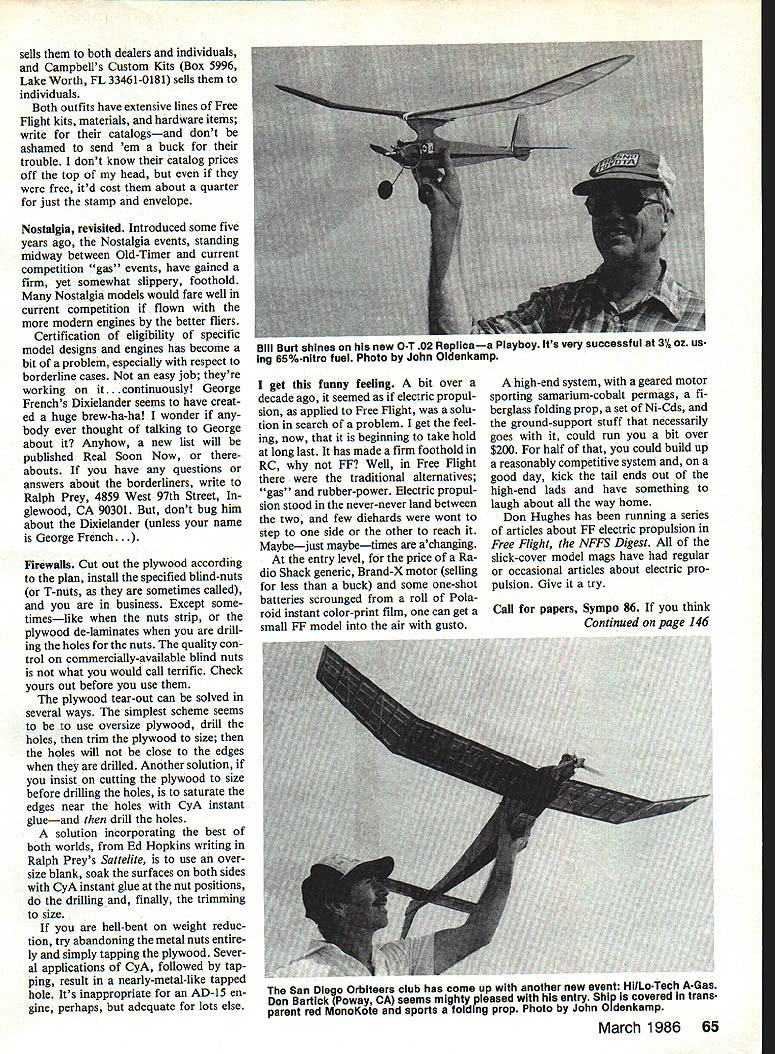
"Return gears" — the type described here — helped Anne Eilla win the Wakefield trophy in 1950 and were popular in that era. With this arrangement the gear-set is in the rear of the aircraft. One motor drives the gearbox and the gearbox drives a second rubber motor that runs forward to an anchor at the front of the aircraft. The effect is that of a motor twice the length of a single motor producing the same torque. The notion that such an arrangement will automatically double flight time is a myth: it would only be true if the gearbox and second motor weighed nothing.
Return gears offer potential advantages when applied properly. Trade-offs include the labor required to manufacture the gear-set and the need for proper machine tools; home-brew units often fail. If you can buy a professionally made unit, it's a different ball game.
Thomas Sigurdson's gear unit (described in Aeromodeller) is said to be based on a design by Thomas E. Murphy from the 1951–52 Frank Zaic Yearbook. Sigurdson's unit incorporates Murphy's best features but is not identical. Sigurdson's unit is riveted together. The body is an aluminum bar that supports two brass (or bronze) bushings riveted in place. The bushings form journals for the motor shafts; the gears run on the outside of the bushings. There is no rigid connection between the gears and the shafts: the crooked ends of the shafts fit into loose holes near the outside of the aluminum gears, producing a sort of universal-joint action. Wear of the motor-shaft journals does not affect gear alignment. Rubber-motor tension transmits from the motor shafts to the gears via collars on the shafts; ball thrust bearings take the axial load and the whole unit runs with low friction.
Wakefield-gear units are not simple nor cheap, but in the right application they can be very effective. If you decide to try one, consider buying a professionally made unit unless you have the proper tools and experience.
Geared motor availability
Few hardy modelers have tried geared rubber motors much since the earliest days because obtaining gears and making tie rods has always been a pain. Thomas Sigurdson has gearsets ready to sell, but you have to order them from Sweden — about $20. Sigurdson sells to both dealers and individuals. Campbell's Custom Kits sells to individuals; contact:
- Campbell's Custom Kits, Box 5996, Lake Worth, FL 33461-0181
Both outfits have extensive lines of Free Flight kits, materials, and hardware items; write for their catalogs and don't be ashamed to send them a buck for the trouble.
Strobe source — night flying
Night flying (also spelled "nite" or "nigth" in some circles) is a well-established part of the U.S. Free Flight Champs and probably in other areas as well. A decent light source strapped to the model's belly is required; neither battery-powered flashlight lamps nor chemical lights are ideal. Ralph Prey suggests strobe lights of some sort — a flash visible from half a mile in any direction once every few seconds would do the job. One thing that will run reliably for about 10 minutes between battery changes or recharges and not weigh too much is needed.
Frank Zaic Yearbook fragments and NFFS publications
If you think you have a complete set of Frank Zaic's Yearbooks, you are probably wrong. Unless you are an NFFS member and received the October issue of the NFFS Digest, fragments (31 three-views plus cover drawings by Bjorn Karlstrom) of what might have been a typical Zaic Yearbook for 1968 were inserted into the Digest for do-it-yourself re-binding into a traditional Yearbook form (albeit thin). The printer ran off a few extra copies; they are available from NFFS Publications for $2.50 plus $0.50 postage. Send payment to:
- NFFS, 4858 Moorpark Ave., San Jose, CA 95129
'81 NFFS Symposium Report — reprints available
A few uncut, unbound copies of the '81 NFFS Symposium Report were squirreled away by the editor for presentation to authors. Those copies recently surfaced and have been bound with plastic claw-type bindings (commonly called "spiral" bindings), though they are not true spiral bindings. A few pages in some copies might be scraggly (signatures misplaced or inverted) and have been replaced by Xerox copies, but the reports are available.
Transcribed from original scans by AI. Minor OCR errors may remain.

