

Free Flight: Duration
Harry Murphy
Inspiration
It is the day after Christmas as I begin this column. Outside, nickel-size snowflakes have been falling heavily for an hour or so, and the pesky things have already built up a fluffy white blanket on the ground to a depth of two or three inches. As the family is out running around returning all of their gifts that were either too large or too small, I sit here staring through the window of my workshop, nursing a miserable head cold, and wondering how they ever proved that no two snowflakes are ever alike.
Anyhow, as the year-end yuletide seasonal rush ebbs, it is once again time to clean out the field box, spruce up the workshop, and dust off the workbench to make ready to begin building that new model that I always start every New Year's Day. I am not a superstitious person, but beginning the new year by starting a new model has been a tradition with me for many more years than I care to admit. Some years this effort might consist of only a pad full of computations and a few lines drawn on shelf paper, while in other years it might have meant the actual construction of a stab or a wing half or the beginning of a fuselage.
Over-the-top!
The new year is also a time to ponder the lessons learned and experience mental flinches at the possible blunders or mistakes that were made in the previous contest season. Any design errors are to be remedied before the action begins once again in the ensuing months, or we can probably expect similar results as per the previous season.
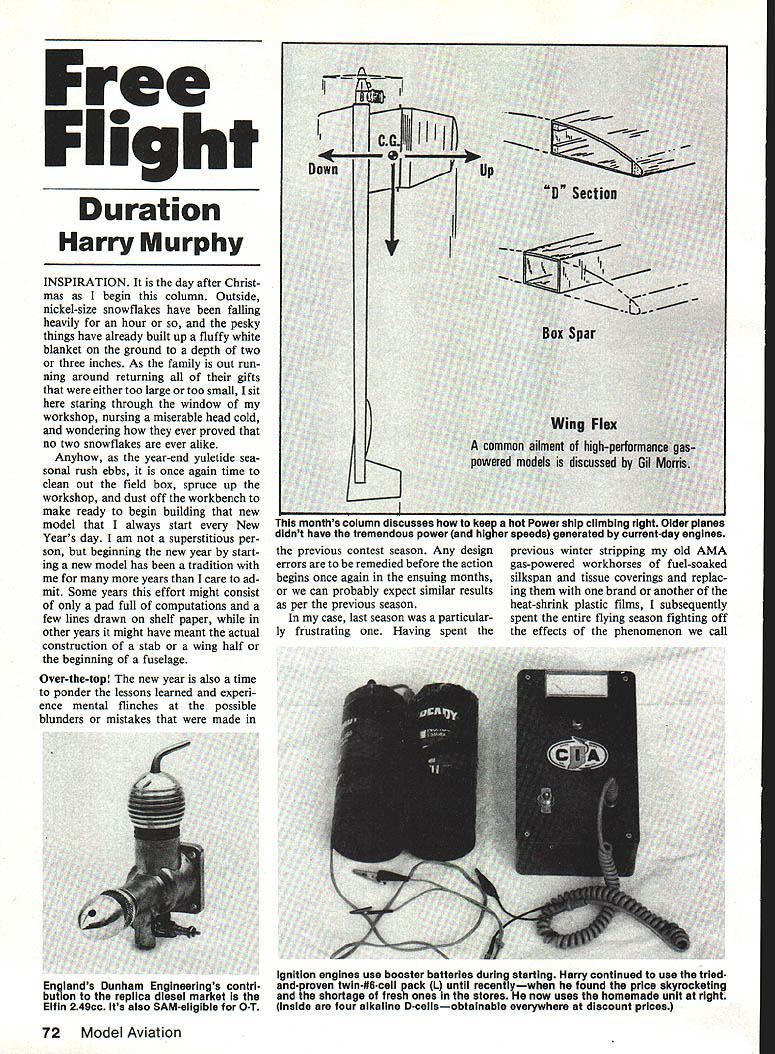
In my case, last season was a particularly frustrating one. Having spent the previous winter stripping my old AMA gas-powered workhorses of fuel-soaked silkspan and tissue coverings and replacing them with one brand or another of the heat-shrink plastic films, I subsequently spent the entire flying season fighting off the effects of the phenomenon we call wing flex. Older planes didn't have the tremendous power (and higher speeds) generated by current-day engines.
An exchange of notes with superflier Gil Morris last month must have produced huge tear stains on my stationery as I explained my dilemma. In return I received a five-page reply with the subject and the following itemized excerpts. Gil says:
- Micafilm, like Mylar, keeps out wind and rain but contributes no structural strength. Silkspan and dope are still the best coverings for structural purposes and torsional strength.
- A model going straight up under power with the position of the CG (center of gravity) really doesn't matter if acting someplace pylon-parallel fore-and-aft on the fuselage — no consequence. Down equals up in the zero-lift condition. However, what is important is the wing remaining in the zero-lift condition. If the lifting surface would loop, conversely a zero-lift-condition forward pitch moment wants to twist the wing toward washout, thus causing the nose-drop over-the-top effect that follows.
- A wing pitching moment applied will first diverge twist toward washout. If the twist is sizable it will resonate at a flutter frequency determined by the spring constant of the wing structure and the weight distribution of the wing itself. Actually, a lucky wing flutters because you instantly know you may have a diverging problem. Sneaky ones can diverge without flutter and can lead to a crash. Mine didn't flutter. Gil: "What brand booze do you recommend?" — H.M.
- Originally the Toothpicks design would occasionally go over-the-top. I kept beefing up the wing until it was impossible to twist and it still went over-the-top. It took two years to learn the stabilizer airfoil was too thick and would produce the same symptoms. This came from thinning the stab airfoil to the case where I now use either semi-symmetrical or full-symmetrical stab airfoils.
- The thing to look for is—when the engine quits, if the nose momentarily pulls up, then the wing may be diverging or the stab airfoil is too thick, or both.
- Correcting the stab is simple. All that is necessary is to strip the covering and round the bottom of the ribs a bit; then recover. The wing may take some doing — such as planking the leading edge back to the main spar on both the top and bottom, thereby making this section a closed box or a "D-shaped" section. If the box isn't closed, it won't do much good. Rather than use all of that planking, I prefer a wide main spar and web the ribs for the closed-box configuration. Diagonal ribs help, too.
- I feel that the time of day has something to do with the problem, as well. If your model is suspect of having "wing flex" difficulties, you should find that it is more likely to go over-the-top in the cool air (as in the morning or evening) than at midday, because your engine is putting out more horsepower with higher volumetric efficiency (it intakes more air and fuel).
Gil offers a few additional opinions to the effect that the new high-powered engines placed in models that were originally designed for less-powerful engines have caused similar problems, particularly in the AMA gas categories. FAI fliers really haven't felt the problem too much because they have weight to spare, and everything gets planked anyway. Also, he feels that the really hot ships are easier to fly than the sport stuff once you get the technical problems ironed out because the hot stuff seems to ignore gravity and bores a hole in whatever direction you throw it. Finally, Gil makes an astute observation: in the future, we should expect greater advancements in the AMA gas categories compared to FAI, as the AMA categories are unlimited and free of design restrictions.
Watch it!
Our alternate-month FF Duration co-author, Bob Messer, sent an anguished note which proclaimed his abject sorrow at having allowed a bit of erroneous information to creep into his March column: he mentioned (on page 147) that some copies of an old NFFS Sympo Report were available — and it should have been the 1971 edition (not 1981!). Shall we let him off the hook? All in favor, say "Aye."
The Elfin Edge
The Society of Antique Modelers (SAM) requires gas-powered models to meet a minimum weight requirement of eight ounces per square foot of wing area. This would normally include an ignition engine, the model itself, and the necessary ignition accessories of coil, condenser, batteries, wiring, etc. Since the ignition paraphernalia runs at about a constant five ounces no matter if the model is a small Class A or a large Class B or C, it is generally much easier to build a Class B or C model to their weight minimums than it is to keep a Class A model from being overweight because the ignition-accessory-to-total-weight ratio is much less on the larger models.
For instance, a Playboy Senior at 800 square inches must weigh a minimum of 44.4 ounces regardless of the ignition powerplant utilized, and a five-ounce ignition system is only about 11% of the total weight. However, in 280- to 360-square-inch Class A models with their minimum weight ranges within 15.5 and 20 ounces respectively, the effect of a five-ounce ignition system is more like a third to a quarter of the model's total weight.
Obviously, one method to ensure your Class A model does not tip the scales to excess is to use a diesel engine and forego the added weight of the five-ounce ignition system. Diesels offer other advantages as well, in that they run at a constant speed and do not experience many of the unpredictable ills associated with ignition systems, therefore offering more consistent flights. The major disadvantage to diesels for SAM usage to date has been that those that are eligible are too difficult to find — that is, until now!
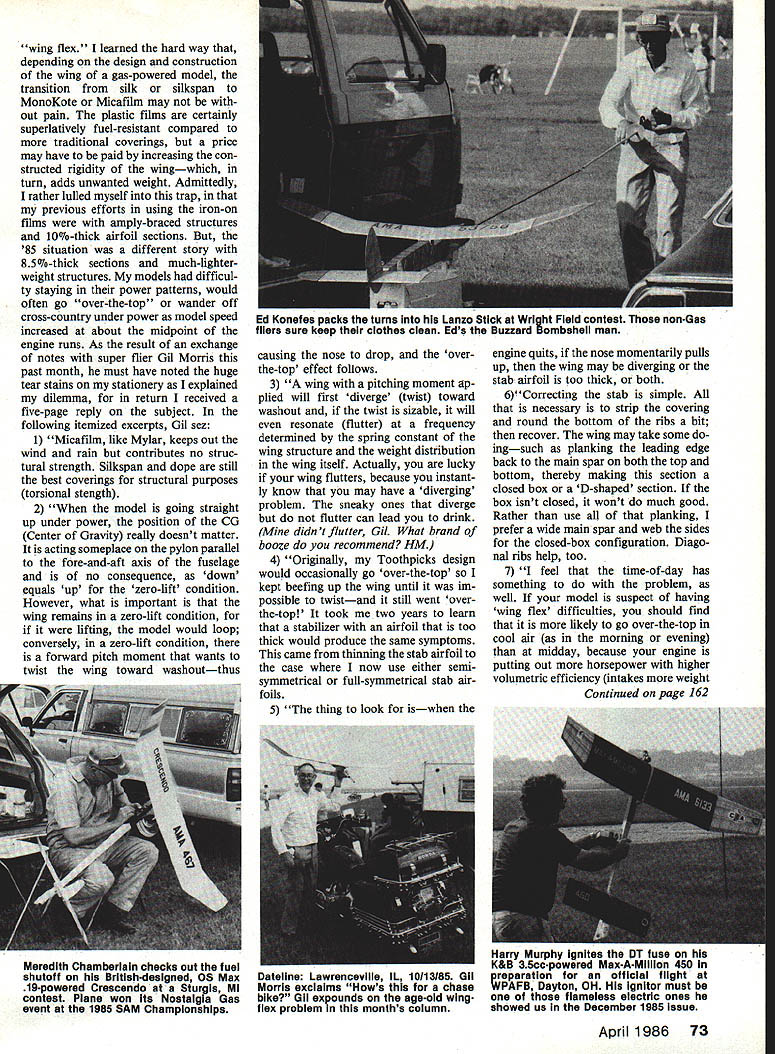
Dunham Engineering of England recently began offering a reproduction of the little Elfin 2.49cc diesel. The original Elfins were quite popular in the late Forties, and Dunham's current replica edition has been deemed Old-Timer-eligible by SAM's engine-approval committee. Bruce Augustus won the Class A Pylon event at the '85 SAM Champs using an Elfin 2.49cc in a Playbox Junior to attest to the engine's contest capability. Should you be having overweight difficulties with your CL A Old-Timer models, then you might be interested in this diesel alternative. The U.S. Elfin distributor for Dunham is Tregler's R/C Supply, 5831 McKnight, Houston, TX 77035 (713-729-5652). They list for $75 plus $4 postage and handling.
Three-volt booster batteries
Our individual approaches to these things in our hobby never seem to change and are often traditions or rituals in nature, even though more effective alternatives may be available. A typical example had been my annual practice of replacing my two 1-1/2-volt No. 6 dry cells, which are wired in series to serve as a 3-volt booster battery system for starting ignition engines.
For years, my procedure each spring was to deposit my old batteries into the family trash can regardless of their condition and promptly check out the local hardware stores for fresh replacements. In recent years, replacements had been increasingly more difficult to find — plus the prices were escalating out of sight! Also, I began to notice a lot of dust already on the supposed new batteries, which indicated that turnover on store shelves for this article was not what it once was. Therefore, I could not be spending good money for not-so-fresh batteries — or maybe older batteries than the ones that I had just discarded! Consequently, it was time to seek alternatives.
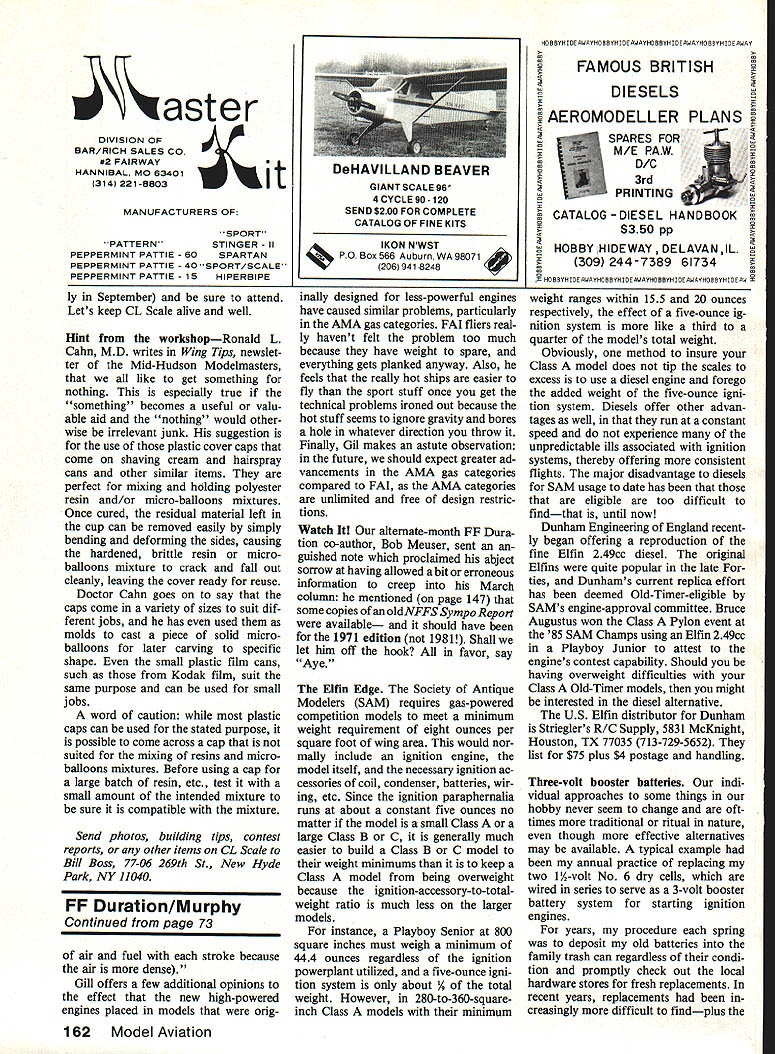
The result of my search was the assembly shown in the accompanying photo which shows the old alongside the new. The "new" is a plastic box containing four D-size alkaline flashlight batteries retained in a plastic four-cell holder with the package wired to produce three volts. To add some additional utility and sophistication to the device, I mounted an On-Off switch, a momentary push-button switch, a 0–5 volt meter, and a female phono plug takeoff to the top panel. All these parts were found at a Radio Shack outlet store, along with the commercial lead-out wire which incorporates a molded-on male phono plug on the end of the coiled two-wire lead and has medium-size alligator clips on the opposite end of its six-foot length.
The shelf-life on alkaline batteries is tremendous, and D-size alkaline batteries are constantly on sale at discount department stores, permitting at least a dozen to be purchased for the price of two of the old No. 6 variety. If I suspect the effectiveness of my booster system, should I encounter a cranky-starting engine, I simply press the momentary switch button to check the resultant voltage output of the four cells contained within the box. A club decal strategically placed adds a nice cosmetic touch to the device, as well. The total assembly is much lighter in weight and much more convenient than my old booster system — and, more important, it hasn't failed me yet. Try it! You'll like it.
Newsletter of the month
As stated in my last column, I intend to spare a little space on each of those occasions to recognize the "missile of the grassroots media," the Free Flight newsletter — as well as those unsung editors who in spite of wind, rain, or fear of plagiarism keep the lines of communication open to all the little nooks and crannies of the Free Flight activity.
This month's "hats off" goes to a rather new publication, SEKS Talks — the voice of the Smyrna, Georgia-based South Eastern Kamikaze Squadron, whose current president is Bob Baker. The publication is a quarterly, ably edited by traveling sales representative Jim Walston. The parent club is literally Old-Timer oriented, as it represents Chapter 47 of SAM (Society of Antique Modelers), complete with distinctive letter-type on their "SEKS symbols" (decals) and T-shirts. Their quality publication is chock full of photos, modeling hints, area Free Flight activities, and an abundance of Georgia humor thrown in. In the words of Editor Walston, "You can become a SEKS supporter for only $2.75 per year." The address is: SEKS Talks, 725 Cooper Lake Road S.E., Smyrna, GA 30080.
Equal time
O-O-O-H, that smarts! That photo caption in the January issue (page 62), in which Associate Editor Ross McMullen singled out this writer as his stooge to exercise one of those subtle safety pitches, really pricked my pride. I couldn't get to a copy machine fast enough to make a copy of the photo in question (on which I scribbled a few nasties) and fire the missile off to ye olde editor with the next-mail truck leaving for the East Coast. As I relayed to Ross: "I'm holding the model over my head, at arm's length, and I'm wearing safety glasses. What more would you want?"
Well, anyway, we can be too careful; however, there is a certain amount of danger attached to any machine, and certainly the machinations associated with our hobby demand respect. Then, again, the sure way to "play it safe" is to take up the violin or the piano instead... See ya downwind!... (that is, if I still work here, anymore.) (You do. RMCcL.)
Harry Murphy 3824 Oakwood Blvd. Anderson, IN 46011
Transcribed from original scans by AI. Minor OCR errors may remain.

