
Free Flight: Duration
Harry Murphy
NFFS Awards
Gilbert Morris, chairman of the NFFS (National Free Flight Society) Ten Models of the Year Award Committee, has released the 1986 selections:
- International Class
- F1A (Nordic) — Model of World Champion Yue Liang (People's Republic of China)
- F1B (Rubber) — AA-27 with variable-pitch and delay prop, Aleksandar Andrukov (U.S.S.R.)
- F1C (Power) — Model of 1985 World Champion Nikolay Nakonechny (U.S.S.R.)
- AMA Outdoor
- Large Power — Satellite C (Modified) by Randy Archer
- Small Power — Uranus by Joe Wagner
- Rubber — Terrible Coupe by Charles Markos
- Indoor
- Rubber — Le Ordinaire II by Cezar Banks
- Hand-Launched Glider — Super Swoop Series by Bernard Boehm
- Ornithopter — Fancy Girl (pusher/canard) by Frank Kieser
- Special Award
- Circle Towhook — Robert Hatschek
Formal presentations were made in July at the annual NFFS meeting at the AMA Nats in Lake Charles, LA. Congratulations to the awardees and appreciation to the committee for their selections.
Satellites
Jack Morehead recently sent a Satellite 320 MA-A Free Flight Gas kit — a sensational, very complete kit with handpicked, cut and sanded balsa and plywood parts, nicely sorted and bagged, plus decals and rolled plans. All that’s required to finish the model is adhesive, sandpaper, covering and a couple of weekends.
- Satellite 320 full kit: $27.95 + $2.50 postage & handling
- Satellite series (Bill and Bob Hunter designs):
- A/B-size "450" full kit: $39.95
- B/C/D-size "788" full kit: $59.95
- "788" short-kit (cut-out parts only): $44.95
Kits are excellent; Jack is to be commended for keeping this proven design available. Order from: Jack's Models, 4036 West 173rd Place, Torrance, CA 90504. (California residents: add 6% sales tax.)
K&B engine for Class A
K&B is again producing a limited run of their 3.25 cc engine. Order direct from the factory: $90 + $2 postage & handling. A Satellite 450 powered by an interchangeable K&B 3.5 or 3.25 remains a popular combination.
Editor's note
Newcomers should note AMA engine-displacement limits:
- Class A: .200 cu in
- Class B: .201–.300 cu in
Conversion examples:
- 3.25 cc = .198 cu in
- 3.5 cc = .214 cu in
U.S.A. FAI status vs. World Class
The 1985 World Free Flight Championships (Livno, Yugoslavia) prompted a short assessment by Jerry Murphy (published in The Max-Out). His firsthand observations compare current U.S. FAI competition to world-class standards.
FIA — Nordic (F1A)
- The circle-tow was dominant at that level.
- The "zoom launch" was used by all who made the flyoffs.
- Yue Liang’s winning model was similar to current U.S. models but incorporated a two-position stabilizer and increased incidence on the tow; reduced incidence after the zoom allowed the hook to open and the model to settle into its glide.
- Jerry believes U.S. models are not far behind in basic design, but the zoom launch technique and movable stab/wing structures are areas for improvement.
F1B — Wakefield
- Jerry feels current U.S. Wakefield trends are not producing World Class models compared to Russia, Germany (including East/West distinctions at the time), Israel, China and Switzerland.
- Top teams used a combination of:
- VIT (variable-incidence tail)
- Auto-pitch propellers
- Delayed prop starts
- Russian technique (noted as particularly effective):
- Prop blades launched locked in an extended feathered pitch for minimum drag.
- A hand-launch heave followed; ~1 second and ~15 ft later a timer started the prop, producing a strong continued climb via a torque-actuated variable-pitch prop.
- Reiner Hofsass and Lothar Döring used torque-actuated variable-pitch props (without delayed start). Subtle innovations (quick-change preloaded motor tubes, Russian front-end designs) were also noted.
- Bob White was reportedly the only constant-geometry model to reach the four-minute flyoff; Jerry sees that as near the practical limit without additional gadgetry.
- Jerry’s benchmark: to stay competitive in Wakefield for 1987, entrants should attain regular flights of at least 5½–6 minutes.
F1C — Power
- Top F1C models showed more dependable and consistent trim.
- Jerry assessed U.S. Power models as behind world-leaders, though Ken Paul’s model climbed competitively—engine/power inconsistencies limited him to 14th.
- Stunt systems were spectacular: some models climbed slightly rearward (about 100° off the normal 90° up), and on engine cut performed an outside Y-loop, rolling out with an additional ~20 ft of gain.
- For 1987, Jerry expects world-class power ships to be built of materials that remain dimensionally stable with temperature (stiff, high modulus) to hold trim at very high speeds.
Summary and team organization
- Overall, the U.S. is reasonably competitive in two of the three international events but is lagging on innovative technology across many design areas.
- A recurring criticism: U.S. team organization tends to break down during the flyoff rounds when participants are widely dispersed along the flight line. Jerry suggests more emphasis on flyoff support conditions in the domestic team-selection program to avoid repeating this predictable problem.
Newsletter of the month
The material above was taken from The Max-Out, the newsletter of the Colorado-based Magnificent Mountain Men. Jerry Murphy is the author and current president; Gary Burgham is vice-president and Rick Pangell is the newsletter editor. Subscription: $6/year payable to Gary Burgham at 250 Silver Spring Drive, Colorado Springs, CO 80909.
The club’s interests span indoor to intense FAI participation. If you’re returning to the hobby and want companionship or local flying sites, The Max-Out group is recommended.
Commercial thermals, revisited
- Correction: There is no FAI rule restricting the mounting height of thermal sniffers; Ian Kaynes (editor, Free Flight News) correctly noted this. My earlier report lacked the distinction between FAI rules and U.S. team rules.
- The 1985 U.S. FAI Free Flight Team Selection Program states:
- "No stationary thermal sniffers or other stationary thermal-sensing devices will be allowed in the launch area. Hand-held equipment is permitted in the launch area provided it does not exceed six feet in height."
- Starline International (Sal Francuanco and Steve Riley, Scottsdale, AZ) offers a device similar to one reported previously:
- $32.50 each, postage paid
- $49.95 postpaid for a DIY kit including thermometer, two-piece eight-foot pole and probe mount
- Starline International: 6146 East Cactus Wren Road, Scottsdale, AZ 85253
Wing-spoiler DT (dethermalizer)
Many vintage Old-Timer and Nostalgia gas designs have bottom-mounted stabilizers, which complicates use of common stab-mounted dethermalizers. Solutions seen include trailing parachutes, stabs that flip 220° backward, or wings whose leading edges pop up — each with mixed acceptance.
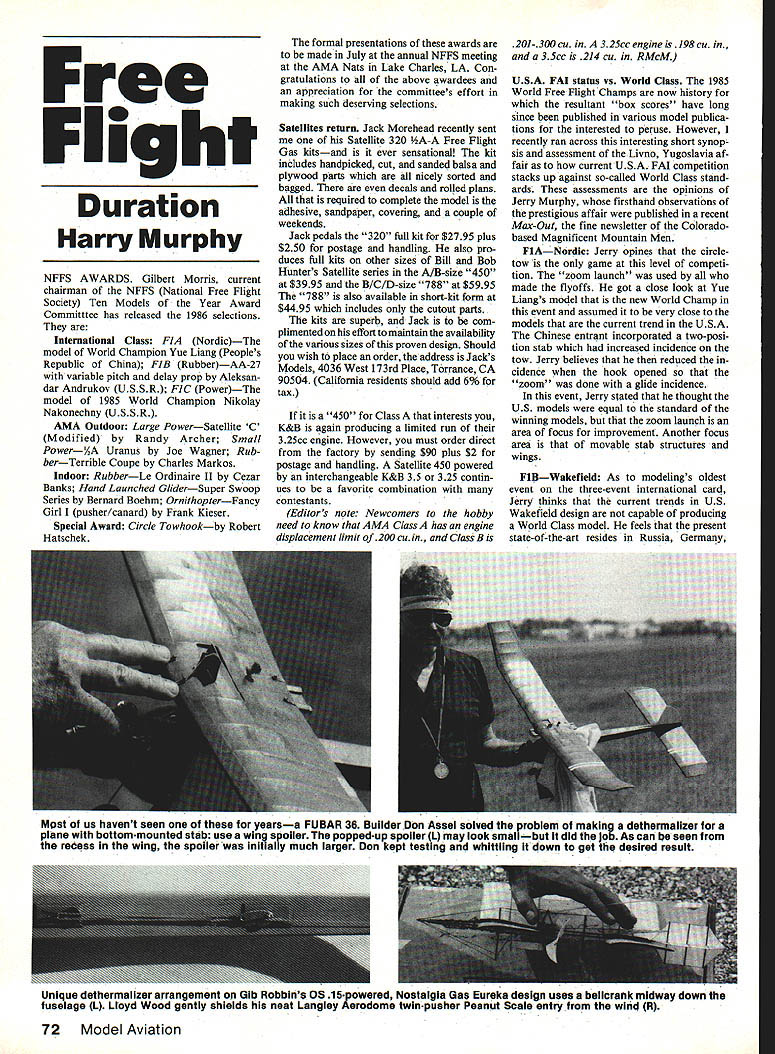
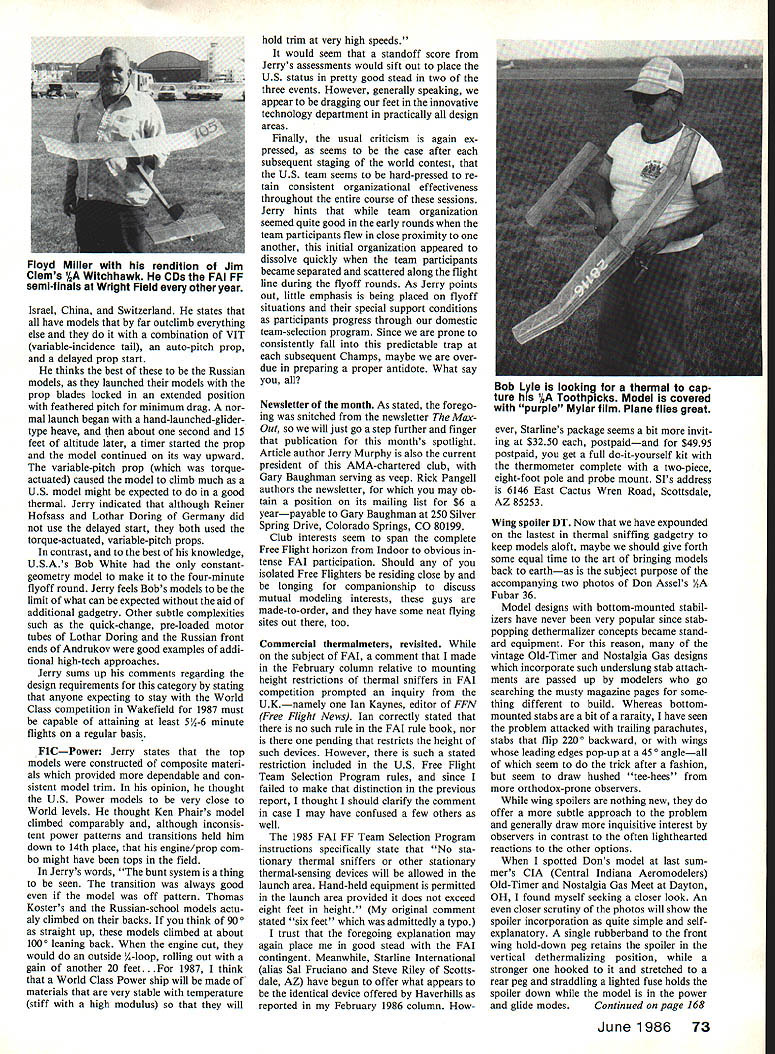
Don Assel’s approach on his FAF 36 is a subtle and effective wing-spoiler dethermalizer:
- The spoiler mounts on the bottom, made from a metal gear with small piano-wire lugging.
- A light spring and felt pad hold it in position.
- A molded plastic lift-release mechanism activates at a preset height, popping up a small spoiler that produces drag and spoils lift, causing the model to settle.
- Don originally used a larger spoiler that caused a steep dive; he trimmed it down until a safe descent rate was achieved. The recess in the wing shows the original larger size.
Nats notes
Be aware of schedule changes for the AMA National Championships in Lake Charles, LA (50th Nats celebration year):
- Indoor events: three days beginning Saturday, July 26
- Outdoor events: will start Monday, July 28 (moved forward from Tuesday), running through Friday, August 1
- Monday, July 28 will have a one-day overlap of indoor and outdoor events — check the Official Nats Schedule (printed in the April 1986 "Competition Newsletter," page 111) for specific events.
NFFS Special Events at Nats
Terry Rimert advises the NFFS special-event program will include:
- Indoor and Outdoor Ornithopter
- Helicopter
- Autogiro
- Unlimited Rubber
- Embryo Endurance
- Multiple Team
- Korda Open Rubber
- Sig Mini-Maxer
- 7-11 Rubber Distance
- Rubber Speed
- HLG Team
Volunteers are needed for timing and directing events. If you attend Nats, look for the daily NFFS-sponsored-event schedule and offer to help.
Corrections and acknowledgments
A couple of errors from a previous column are corrected:
- The "Buzzard Bombshell man" reference should have named Joe (not Ed) as the Bombshell guy.
- The narrator of the NFFS film is Shane (not Sean).
My apologies for both errors.
Gotcha again, Boss — and thanks to Ross McMullen (Associated Editor) for his patient handling of our copy and captions.
Transcribed from original scans by AI. Minor OCR errors may remain.

