
Free Flight
Duration
Harry Murphy
FUN! — Comet Sparky fun‑fly
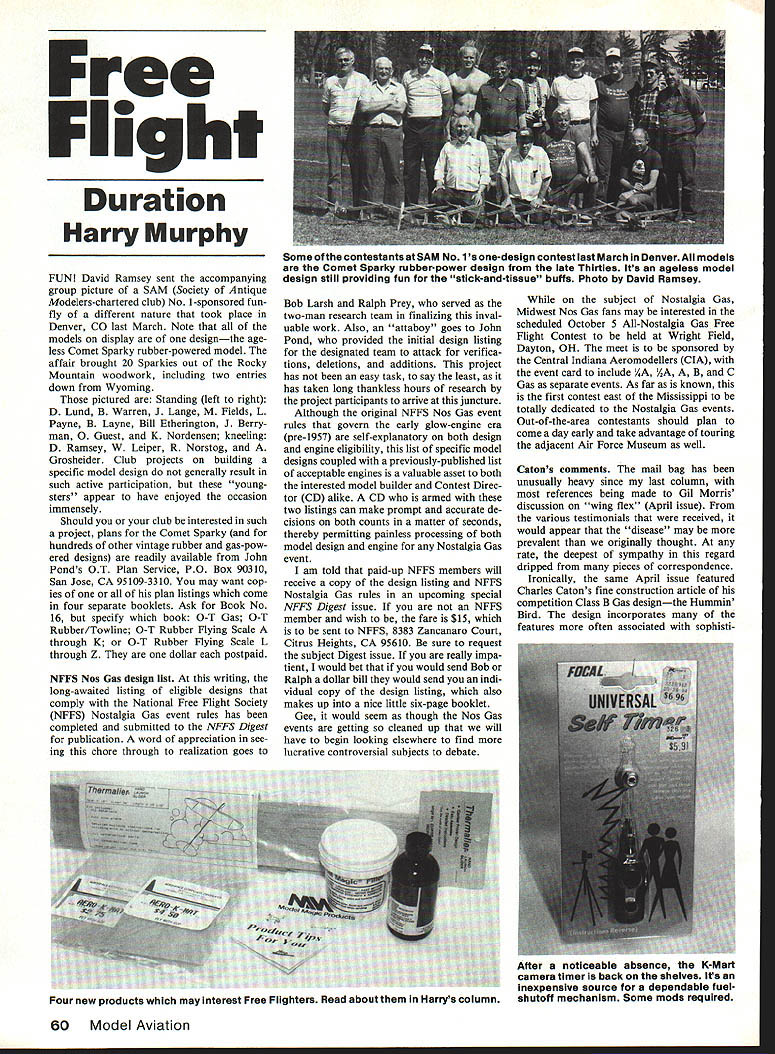
David Ramsey sent the accompanying group picture of a SAM (Society of Antique Modelers‑chartered club) No. 1‑sponsored fun‑fly of a different nature that took place in Denver, CO last March. Note that all of the models on display are of one design — the ageless Comet Sparky rubber‑powered model. The affair brought 20 Sparkies out of the Rocky Mountain woodwork, including two entries down from Wyoming.
Those pictured are:
- Standing (left to right): D. Lund, B. Warren, J. Lange, M. Fields, L. Payne, B. Layne, Bill Etherington, J. Berryman, O. Guest, K. Nordensen
- Kneeling: D. Ramsey, W. Leiper, R. Norstog, A. Grosheider
Club projects to build a specific model design generally do not result in such active participation, but these "youngsters" appear to have enjoyed the occasion immensely.
Plans for the Comet Sparky
If you or your club are interested in such a project, plans for the Comet Sparky (and for hundreds of other vintage rubber and gas‑powered designs) are readily available from John Pond's O.T. Plan Service, P.O. Box 90310, San Jose, CA 95109‑3310. You may want copies of one or all of his plan listings, which come in four booklets. Ask for Book No. 16, but specify which book:
- O‑T Gas
- O‑T Rubber/Towline
- O‑T Rubber Flying Scale A through K
- O‑T Rubber Flying Scale L through Z
They are one dollar each, postpaid.
NFFS Nos Gas design list
At this writing, the long‑awaited listing of eligible designs that comply with the National Free Flight Society (NFFS) Nostalgia Gas event rules has been completed and submitted to the NFFS Digest for publication. A word of appreciation goes to Bob Larsh and Ralph Prey, who served as the two‑man research team in finalizing this invaluable work. Also, an "attaboy" goes to John Pond, who provided the initial design listing for the designated team to verify, delete, and add entries. This project has not been an easy task; it has taken long, thankless hours of research by the participants to arrive at this juncture.
Although the original NFFS Nos Gas event rules that govern the early glow‑engine era (pre‑1957) are self‑explanatory on both design and engine eligibility, this list of specific models coupled with a previously‑published list of acceptable engines is a valuable asset to both the interested model builder and the Contest Director (CD). A CD armed with these two listings can make prompt and accurate decisions on both model design and engine eligibility, thereby permitting painless processing for any Nostalgia Gas event.
Paid‑up NFFS members will receive a copy of the design listing and NFFS Nostalgia Gas rules in an upcoming special NFFS Digest issue. If you are not an NFFS member and wish to be, the fee is $15 sent to NFFS, 8383 Zancanaro Court, Citrus Heights, CA 95610. Be sure to request the subject Digest issue. If you are impatient, you might try sending Bob or Ralph a dollar and they may send an individual copy of the design listing, which also makes up into a nice little six‑page booklet.
All‑Nostalgia Gas contest (Midwest)
Midwest Nos Gas fans may be interested in the scheduled October 5 All‑Nostalgia Gas Free Flight Contest to be held at Wright Field, Dayton, OH. The meet is sponsored by the Central Indiana Aeromodellers (CIA), with the event card to include A, A2, B, C Gas, and Nos Gas separate events. As far as is known, this is the first contest east of the Mississippi to be totally dedicated to the Nostalgia Gas events. Out‑of‑the‑area contestants should plan to come a day early and take advantage of touring the adjacent Air Force Museum as well.
Caton's comments
The mail bag has been unusually heavy since my last column, with most references being made to Gil Morris' discussion on "wing flex" (April issue). From the various testimonials that were received, it would appear that the "disease" may be more prevalent than originally thought. At any rate, the deepest sympathy in this regard is offered.
Ironically, the same April issue featured Charles Caton's fine construction article on the competition Class B Gas design — the Hummin' Bird. The design incorporates many of the features more often associated with sophisticated FAI Power models, such as geodetic wing construction, semi‑cowled engine, VIT gadgetry (Variable Incidence Tail), the use of carbon fibers, etc.
So, it was somewhat surprising that one of the replies to Gil Morris' discussion came from the Hummin' Bird's author/builder, who promptly confessed that since his featured article had been submitted for publication, he had already gone to shaping the bottom of the forward portion of the wing as well as the top to complete the D‑section for increased rigidity. In Charlie's opinion, "wing flex" is a very real problem with fast‑climbing models—particularly when hot engines and VIT systems (resulting in less decalage under power) enable such fantastic model speeds.
He also stated that additional headaches can be caused by "stab flex," which can result from a structure that is just plain too flimsy. The symptoms are a slight looping tendency toward the end of the engine run if the model speed exceeds the strength of the stabilizer. He noted that when he once experienced the late‑looping problem on a Satellite, he first surmised that the model had too much stab angle. Consequently, he kept lowering the stab incidence—but without success—until the stab actually crushed itself under the resultant deflection load. All of the ribs were broken in several places, even though the model did not crash.
Charlie convinced himself that the twist toward the washout side simply crushed the structure. He further indicated that he had not experienced the phenomenon until he began attempting to build ultra‑light stabilizers and using 3/8‑inch polyester film for coverings to aid in controlling the C of G (Center of Gravity) of the model. As he aptly states: "It is just another example of the subtle problems that can plague those of us who pretend to be Free Flight designers."
Yeah, Charlie, but ain't we got fun in doing it?
Big birds
A single contest doesn't necessarily set standards for those that follow, but here is an interesting statistic that caught my attention. The Southwest Regionals has been considered the "big bash" of the winter for many years, as it continues to draw many of Free Flight's "big shooters" to Buckeye, AZ each January. Event tallies as to the number of contestants that enter each of the various events are always of interest to Contest Directors and modelers alike, as these statistics are often used to assess future event structures and participation planning.
Would you believe that Class D Gas outdrew all other AMA Gas events including the usually dominant A event? Is this a freak or a trend? Are the "biggies" really on the comeback? Are some of us finally getting around to designing and building that one last "big job" with the "Honker .60" before moving to shuffleboard and beachcombing the Florida sands?
Over the years, gas‑powered behemoths and gliders have never taken a back seat to any spectator event of our hobby. Remember those Comet Sailplanes, Gools, and Satellite 1300s? Even now, the "big bangers" of RC Scale hold the spotlight of popularity in that category of events. Any advocate of Old‑Timer RC Assist surely has at least one or two 10‑footers in his competition stable. So, it would not be unreasonable to expect a similar swing in competition Free Flight to increase popularity of the "big birds."
This may be the place to ask my question one more time: Is anyone interested in four‑cycle Free Flight?
What's new?
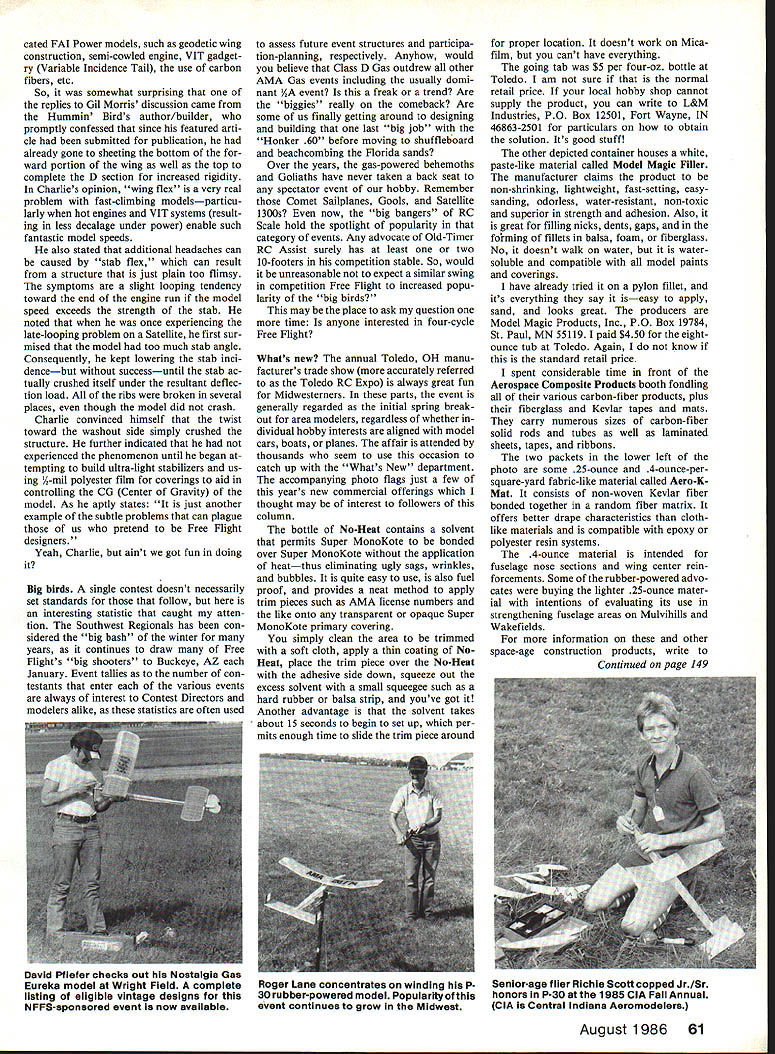
The annual Toledo, OH manufacturer's trade show (more accurately referred to as the Toledo RC Expo) is always great fun for Midwesterners. In these parts, the event is generally regarded as the initial spring break‑out for area modelers, regardless of whether individual hobby interests are aligned with model cars, boats, or planes. The affair is attended by thousands who seem to use this occasion to catch up with the "What's New" department. The following are a few of this year's new commercial offerings that may be of interest.
- No‑Heat (L&M Industries)
A solvent that permits Super MonoKote to be bonded over Super MonoKote without the application of heat—thus eliminating ugly sags, wrinkles, and bubbles. It is easy to use and provides a neat method to apply film pieces such as AM license numbers onto any transparent or opaque covering film. Clean the area, apply a thin coating of No‑Heat, place the trim piece adhesive side down, squeeze out excess solvent with a small squeegee, and you're done. The solvent takes about 15 seconds to begin to set up, allowing time to slide the trim piece for proper location. It doesn't work on Micafilm. At Toledo the going tab was $5 per four‑ounce bottle. If unavailable locally, write to L&M Industries, P.O. Box 12501, Fort Wayne, IN 46863‑2501.
- Model Magic Filler (Model Magic Products, Inc.)
A white, paste‑like material claimed to be non‑shrinking, lightweight, fast‑setting, easy‑sanding, odorless, water‑resistant, non‑toxic, and superior in strength and adhesion. Good for filling nicks, dents, gaps, and forming fillets in balsa, foam, or fiberglass. It is water‑soluble and compatible with all model paints and coverings. Tried on a pylon fillet—easy to apply and sand. Producers: Model Magic Products, Inc., P.O. Box 19784, St. Paul, MN 55119. Price at Toledo: $4.50 for an eight‑ounce tub.
- Aerospace Composite Products (Aerospace Composite Products)
Various carbon‑fiber products, fiberglass and Kevlar tapes and mats, carbon‑fiber sheets and tubes, laminated sheets, tapes, and ribbons. The Aero‑KMat (.25‑ and .4‑ounce‑per‑square‑yard) is a non‑woven Kevlar fiber in a random matrix offering good drape and compatibility with epoxy or polyester resins. The .4‑ounce material is intended for fuselage nose sections and wing center reinforcement; the lighter .25‑ounce material may be useful strengthening fuselage areas on Mulvihills and Wakefields. For information write: Aerospace Composite Products, 28 Crosswood Road, Farmington, CT 06032.
- Thermailer (Curtis Model Products)
A new hand‑launched glider kit from Ken Curtis, 10105 Hamilton Hills Lane, Indianapolis, IN 46250. The Thermailer spans 18 in. and has a wing area of 56 sq. in. Influenced by the once‑popular Eagle, Ken's variation has a D‑T system and a fuselage nose design that improves the roll‑trim transition at the top of the climb. The kit contains all balsa and hardwood parts, clay, D‑T line, and you even get a penny back — handy to use as a nose weight and D‑T function. If your hobby shop cannot supply the kit, send $5.95 plus $1.00 postage and packing to the above address.
Newsletter of the Month
Since we have expounded on the finalization of the design‑eligibility list for the Nostalgia Gas events in this issue, it is opportune to honor the club newsletter and its editor who originally initiated the events: the Satellite newsletter of the San Valeers and its editor Ralph Prey. The San Valeers' current president is Terry Thornildsen; their vice‑president is Ed Hopkins. Mike Myers handles the club monies, and Ralph gets all of the paperwork as secretary and newsletter editor.
The Satellite newsletter has long relayed news, views, contest notices, and contest results to the Free Flight community. Seldom is there an issue that does not contain at least one building or engine tip, and if there is a Free Flight controversy brewed anywhere, you can depend on the Satellite to defend the Southern California flier's position. It is a fine publication with a great tradition. To begin receiving the Satellite, send $5 (which covers 12 issues) to Ralph Prey, 4859 W. 97th Street, Inglewood, CA 90301.
Camera timers
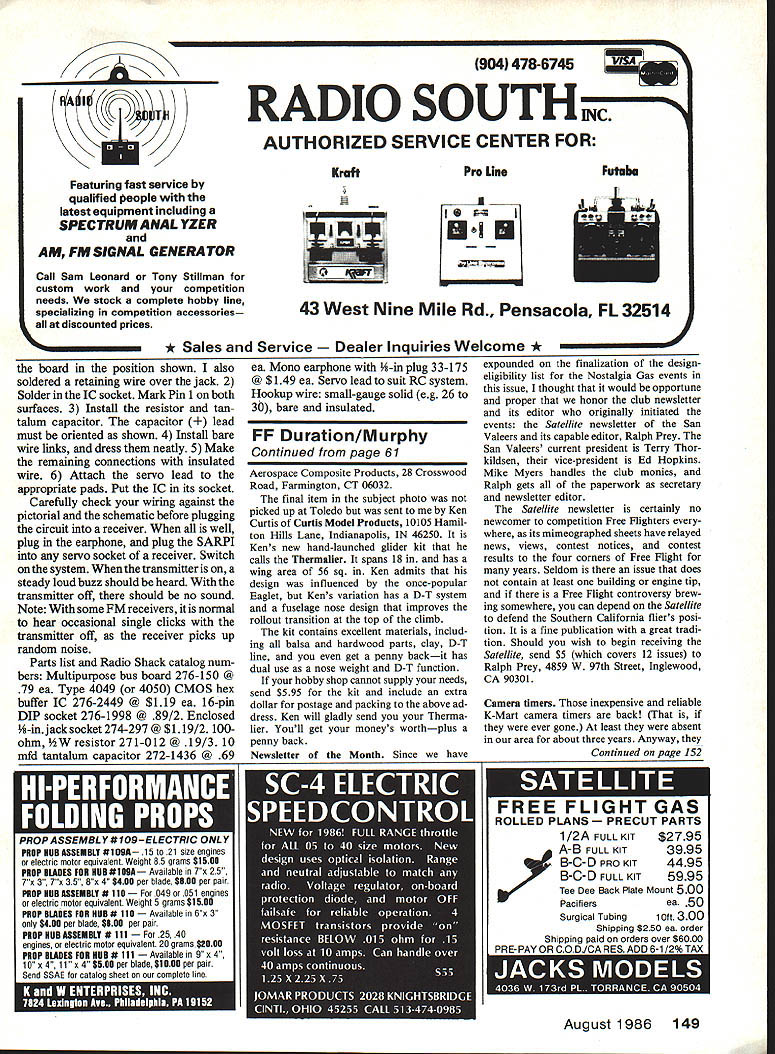
Those inexpensive and reliable K‑Mart camera timers are back! At the time of writing they are being listed at $6.95 but on sale at $5.91. The mechanism seems somewhat smaller than the version last seen on the shelves; however, the spring is very strong, and they can be rigged up to be used as a fuel shutoff very satisfactorily. I won't attempt to detail my particular conversion, since nearly every Gas flier has his own patented device, but if you have something different and surefire, we'd be interested in relaying your design to our readers.
Well, it's about time that I disappear for a while (two months) as well. So, see ya' downwind!
Harry Murphy 3824 Oakwood Blvd., Anderson, IN 46011.
Transcribed from original scans by AI. Minor OCR errors may remain.

