
Free Flight: Duration
Bill Hartill
FAI-CIAM Plenary meeting — Paris, April 23–25
- The procedure is for the Free Flight technical subcommittee to discuss agenda items and then pass recommendations for modifications of the FAI Sporting Code to the Plenary.
- Plans for World and Continental Championships were discussed.
Championships and events
- Indoor World Championships: August 22–26 at Cardington, England. Team housing will be hotel standard with separate bedrooms and baths within walking distance of the contest site. Package costs: $208 for contestants, $165 for supporters.
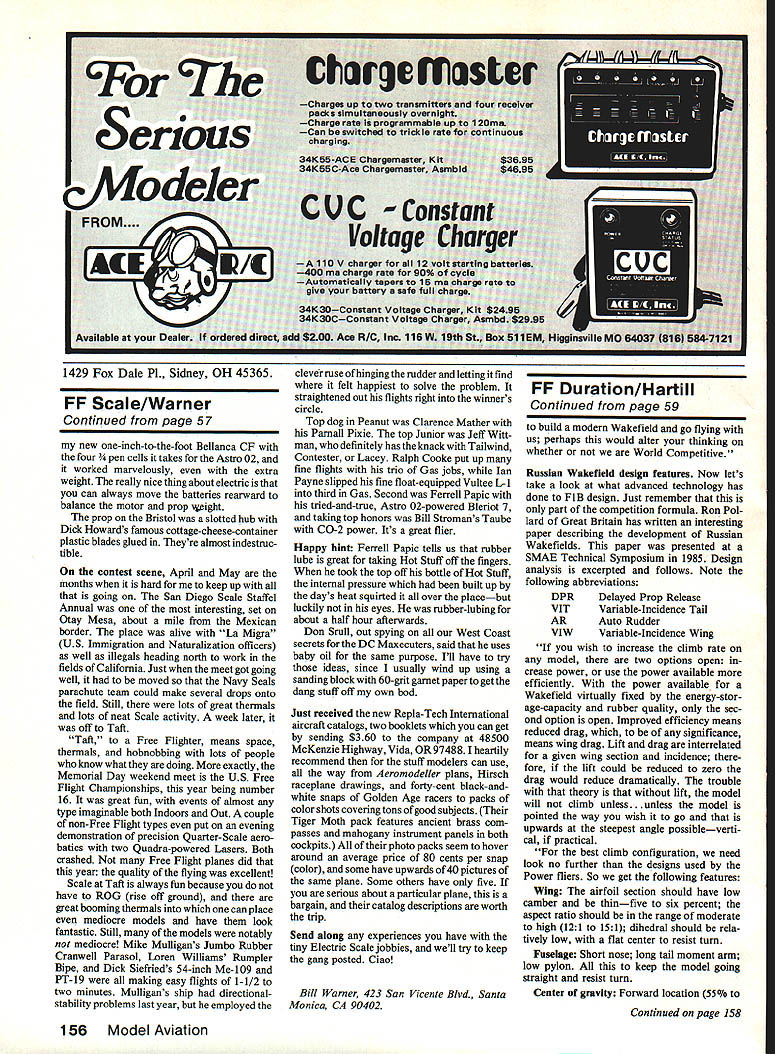
- European Championships (F1A, F1B, F1C): September 9–15 at Pitesti, Romania. Fees: $180 to cover accommodation, meals, transport and banquet; an additional $50 if you are a contestant. Non-Europeans have flown in the European Championships previously as unofficial guests (a Chinese F1C flier topped the field two years ago).
- 1987 Free Flight World Championships: France offered and FAI accepted. Site near Poitiers (Poitou region), about 100 miles southwest of Paris. Accommodations will include hotels, a university dormitory, and camping facilities.
- 1989 Free Flight World Championships: Argentina has submitted an offer; details and FAI acceptance pending.
Sporting Code and rules
- A proposal to drop the builder-of-the-model (BOM) rule was defeated in the Plenary meeting, despite a 5–4 passage in the technical meeting. Arguments for dropping BOM included enforcement difficulty and encouragement of ready-to-fly models for beginners. Traditional linkage of construction with competitive flying prevailed.
- A discussion was held concerning specific violations of the FAI Sporting Code in some 1985 competitions. It was agreed that all FAI contests should be run fairly and in accordance with the Sporting Code. FAI recognition was withdrawn from the 1986 Italcontieri (Italy) competition because organizers again proposed using an attempts-limit/waiting-time rule.
- For Championships, each national team will have the right to provide a qualified timekeeper. The matter of selection was raised.
- The Netherlands proposed a modified Championships flying schedule (combining F1A, F1B, F1C daily with longer morning maximums). The proposal generated much discussion but was referred back to the CIAM Free Flight subcommittee for redraft.
- France proposed that the two timekeepers should time independently to reduce the chance of both timing the same wrong model. This passed and will be effective in the next Sporting Code revision (January 1988 or later).
- A second French proposal, effective immediately, changed how two timekeepers' times will be handled: automatic averaging will be canceled in the event of an error or malfunction; such circumstances will be referred to the organizer and jury.
- Proposals to establish a new F1C specification were rejected by the technical committee and referred to the subcommittee for review.
Thanks to Ian Kaynes and George Xenakis for providing information on the FAI Paris meeting.
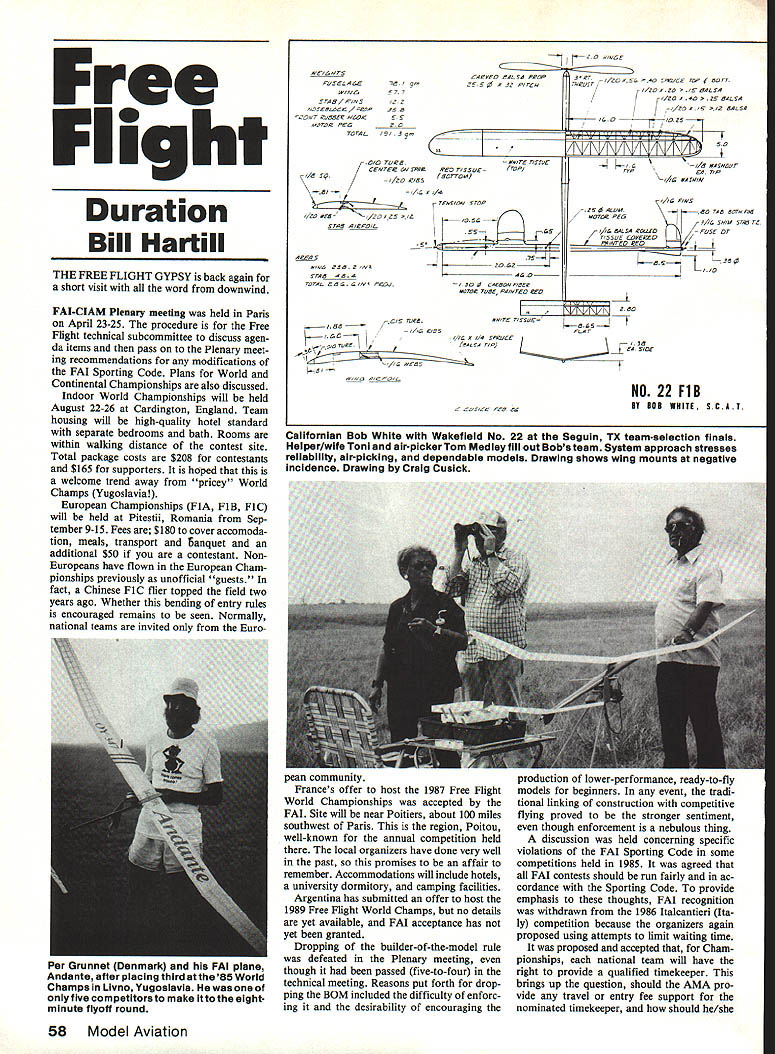
Bob White — Wakefield No. 22
- Developed for the 1984 Team Selection Finals at Seguin, TX, with wind expected. Design parameters modified to better cope with wind.
- Construction: very thin wing section; hard C-grain balsa for wing ribs; medium and hard balsa elsewhere.
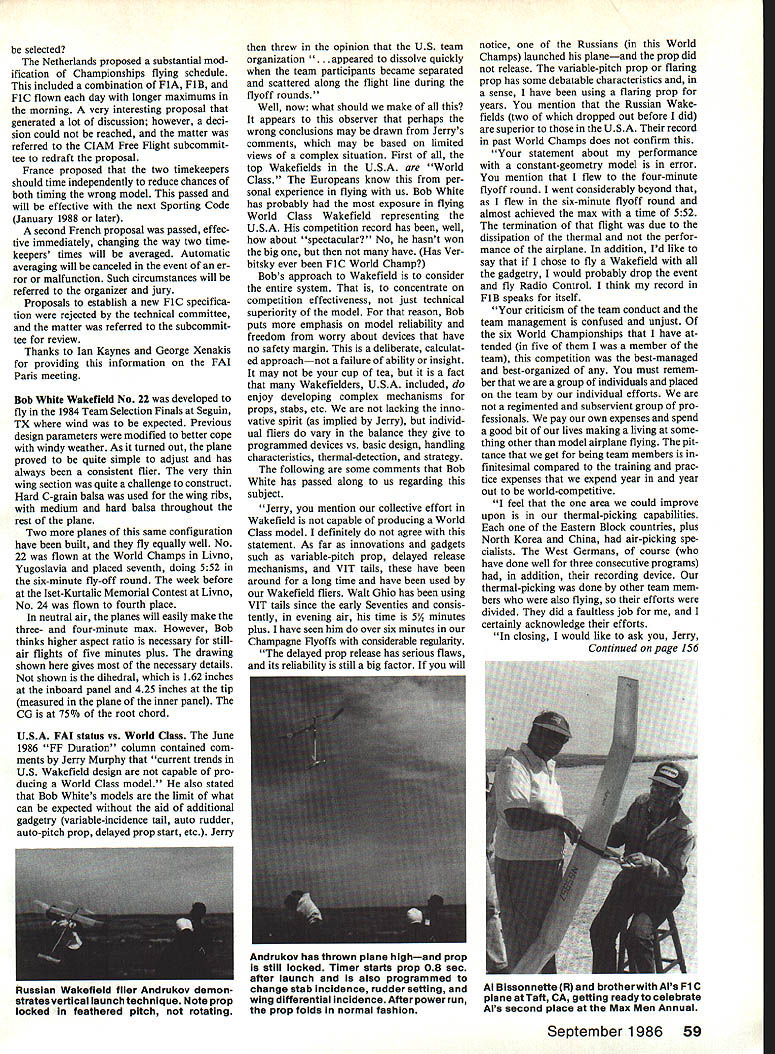
- Performance: simple to adjust and consistently good. Two more planes of the same configuration have been built and fly equally well. No. 22 placed 7th at the World Champs in Livno, Yugoslavia (5:52 in the six-minute fly-off). No. 24 placed 4th the week before at the Iset–Kuritalo Memorial Contest at Livno.
- Flight characteristics: in neutral air the planes easily make three- and four-minute maxes; higher aspect ratios likely needed for still-air flights of five minutes plus.
- Setup notes: dihedral — 1.62 in at the inboard panel and 4.25 in at the tip (measured in the plane of the inner panel). CG is at 75% of the root chord.
U.S.A. FAI status vs. World Class
- The June 1986 "FF Duration" column quoted Jerry Murphy as saying current U.S. Wakefield design trends are not capable of producing a World-Class model, and that Bob White's models represent the limit without additional gadgetry (variable-incidence tail, auto rudder, auto-pitch prop, delayed prop start, etc.). Jerry also criticized U.S. team organization during flyoffs.
Bob White's response (summary and excerpts)
- Bob disagrees that U.S. Wakefields are not World Class. He emphasizes a systems approach: competition effectiveness, reliability, and freedom from fragile gadgets.
- Gadgetry (VIT, DPR, VIT tails, etc.) has long been used by U.S. fliers. Walt Ghio has used VIT tails since the early 1970s and regularly achieves 5½–6+ minutes in evening air. Delayed prop release (DPR) suffers reliability problems (e.g., a Russian's prop failed to release at one World Champs).
- Bob notes his 5:52 flight went beyond the four-minute flyoff round and that this was determined by the thermal, not by model limitations.
- On team conduct: Bob called the team well-managed, not a regimented unit; team members are individuals who pay their own expenses and cannot always provide professional pit crews. He felt the main area for improvement is thermal-picking capabilities; Eastern Bloc teams displayed fast air-picking, and West Germany used recording devices. U.S. thermal-picking was done by team members who were also flying, splitting their focus.
Bob concludes: "Build a modern Wakefield and go flying with us; perhaps that would alter your thinking on whether or not we are World Competitive."
Russian Wakefield design features
Note: abbreviations used — DPR (Delayed Prop Release), VIT (Variable-Incidence Tail), AR (Auto Rudder), V/W (Variable-Incidence Wing), VLM (variable-lift mechanism — as used in the sequence descriptions).
General design approach
- To increase climb rate with fixed power (rubber energy), improve efficiency by reducing drag. This often means reducing lift during climb and pointing the model at a very steep climb angle.
- The best climb configuration borrows features from high-power models: fast, steep climb to altitude, then controlled transitions.
Typical features
- Wing:
- Thin, low-camber airfoil section.
- Aspect ratio moderate to high (about 12:1 to 15:1).
- Dihedral relatively low with a flat center section.
- Fuselage:
- Short nose, long tail moment arm, low pylon to resist turning.
- Center of gravity:
- Forward location (around 55%–60% of chord) for stability; long tail moment arm allows a small tailplane (about 18% of wing area). Tail volume coefficient ~1.55–1.60.
- Propeller:
- Diameter ~600 mm, pitch ~750 mm, with reduction at root and tip. Mechanisms can be complex; variable-pitch implementations have varied (continuous or stepped).
Construction notes
- DPR causes powerful power-on loads; wings must be very rigid to resist flexing or twisting. Russians used a 'D' box with Kevlar and carbon-fiber cap strips for stiffness.
- To neutralize lift during the powered climb, large VIT (on the order of 5 mm tailplane movement) is used, often augmented by washout on one wing-half (~2 mm). Thus three variables are used: VIT, AR, and VLM.
Example timing sequences (two variations)
- Alex Andrukhov:
- 0.3–0.8 sec — DPR
- 5 sec — VIT and AR
- 32 sec — VLM
- 38–40 sec — prop folds
- Viktor Roshnov variation:
- 0.3–0.8 sec — DPR
- 5 sec — VIT
- 15 sec — VLM
- 32 sec — AR
- 36 sec — prop folds
Notes
- These sequences allow tactical flying decisions (e.g., whether to launch depending on other models' positions). Techniques also include very fast wind-up and adding extra turns if not launching to keep torque high.
- Russian models tend to climb fast and glide fast but flat; combined performance yielded flights around 300 seconds in some events (confirmed by Alex Andrukhov at Livno 1984).
Closing thought
- There is no single best solution — the goal is to get high and stay high.
Wing spoilers revisited
- Background: Don Assel's FUBAR used a center-mounted wing spoiler DT. Harry Murphy wrote about it in the June 1986 column; Bill Bogart adds technical experience.
- Bogart's experience: a center-mounted plywood spoiler caused the model to dive straight into the ground on first DT. Reducing spoiler size reduced the dive but also reduced DT effectiveness — too small a spoiler allowed the ship to escape strong thermals.
- Explanation of the dive:
- A center-mounted spoiler reduces wing lift and increases downwash at the stab, increasing stabilizer angle of attack and lift — the nose drops. When vertical, the wing has no lift, the spoiler has no lift to spoil, downwash changes vanish, and the ship is trimmed nose-down to impact.
- Outboard spoilers avoid the trim-change problem. Sailplanes place spoilers well outboard to prevent trim-change-induced dives. For spot landing, two outboard spoilers are preferable to a single center one.
Nordic Glider notes
- Allard van Wallene (Netherlands) described construction of ribless wings for F1A in Volo Libero (November). He builds separate upper and lower shells in molds using Ronacell-resin hard polyurethane foam reinforced with carbon fiber. The article includes details and is available in English.
- In the U.S., several top fliers have been experimenting with foam wings; Jim Wilson has promised an article on his experiences.
- Per Grunnet (Denmark) emphasizes pilot skill over model: "The important thing is not which model is hanging on the end of the towline — the main factor is the person holding the other end of the line."
- Example (Livno): Per flew 10 maxes; in each flight the model was at towline height or higher when it dethermalized. He argues that under ideal conditions extra model performance matters only if you miss the thermal or in final flyoffs. Under marginal conditions (calm, rain, etc.), a higher-performance model can provide extra seconds and may win. Still, he advises spending time trimming and preparing yourself for competition rather than obsessing over squeezing a little extra from the model.
Electronic locating devices
- Summary by Matt Gewain of devices for locating lost models using buzzers and radio beacons.
- Lost models are an accepted cost of Free Flight, but retrieval systems can greatly improve odds of recovery.
- Buzzer systems:
- Simple, light, and effective in high vegetation. A buzzer is often sufficient to find a model lying in tall grass or behind trees.
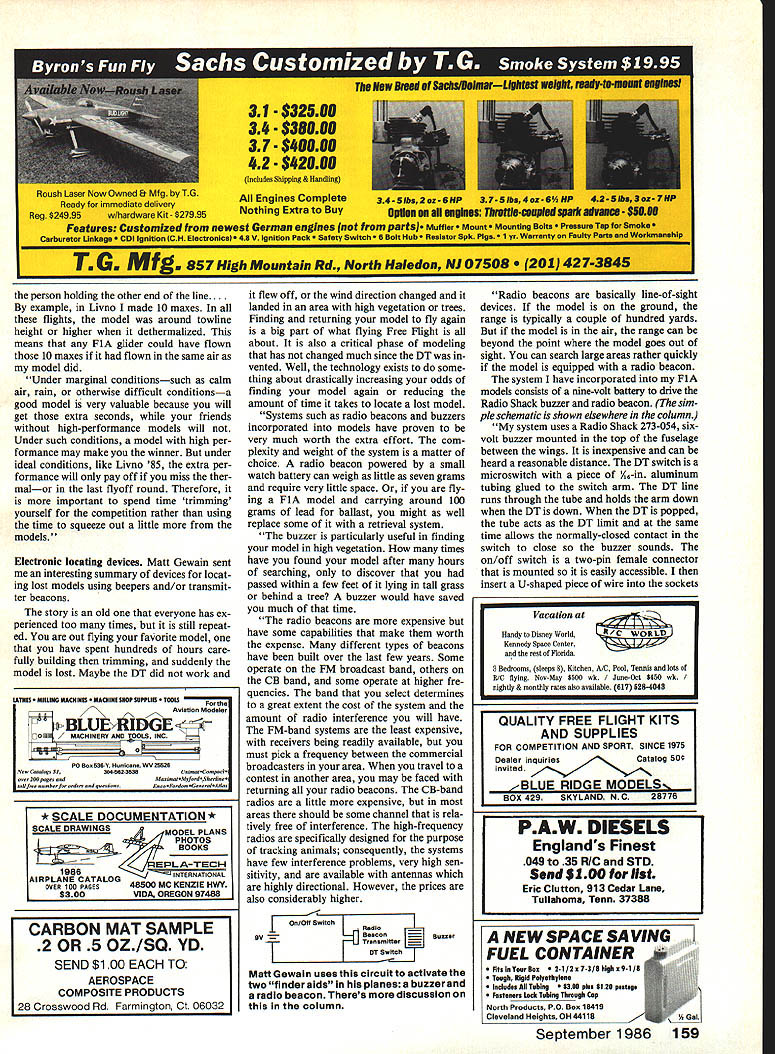
- Example system: Radio Shack 273-054 six-volt buzzer mounted in the top of the fuselage between the wings. DT switch is a microswitch with a short tube as a limit; when DT is down the buzzer is activated. Battery: nine-volt alkaline transistor-radio battery (long life).
- Radio beacons:
- More expensive but offer useful capabilities. Some operate on FM broadcast band, CB band, or higher frequencies.
- FM-band systems are inexpensive but require avoiding local broadcasters and retuning when traveling.
- CB-band radios are a bit more expensive but have usable channels in most areas.
- Higher-frequency trackers (used for animal tracking) offer high sensitivity, directional antennas, and less interference but are pricier.
- Range is line-of-sight: a few hundred yards on the ground, but much farther if the model is in the air.
- Practical notes:
- Many beacons are small and light; a radio beacon can weigh as little as seven grams. For F1A models that carry ballast, some ballast can be replaced by retrieval electronics.
- Bogging down searching time can be avoided with beepers or beacons.
- Sources and contacts (as advertised in NFFS Digest and Model Builder):
- Bradley Model Products, 1337 Pine Sap Ct., Orlando, FL 32817
- Gil Morris, 2810 Brackley Rd., Columbus, OH 43220
- Jim Watson Retrieval Systems, 725 Cooper Lake Rd. SE, Smyrna, GA 30080
Author contact
- Bill Hartill, 7513 Sausalito Ave., Canoga Park, CA 91307
Transcribed from original scans by AI. Minor OCR errors may remain.

