
Free Flight: Duration
Harry Murphy
ENGINES—again. Since I concluded the last session with an article about an antique engine, I suppose that we begin this month's doings with a review of a relatively newer power plant.
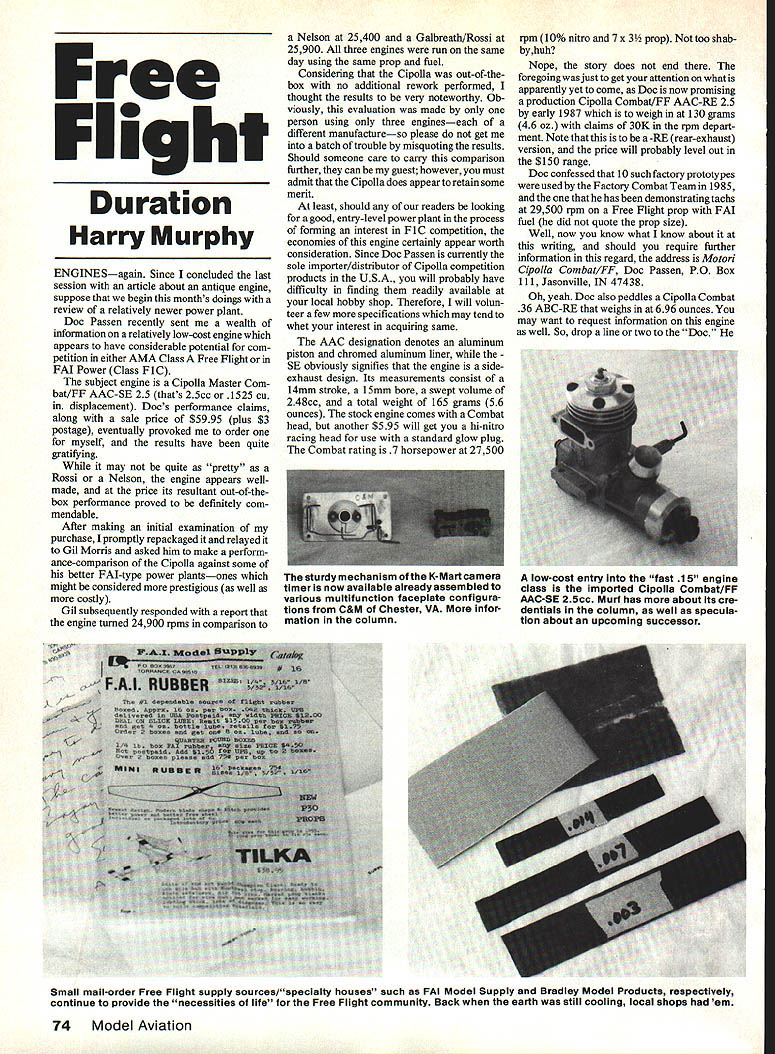
Doc Passen recently sent me a wealth of information on a relatively low-cost engine which appears to have considerable potential for competition in either AMA Class A Free Flight or FAI Power (Class F1C).
The subject engine is a Cipolla Master Combat/FF AAC-SE 2.5cc (that’s 2.5 cc or .1525 cu. in. displacement). Doc’s performance claims, along with a sale price of $59.95 (plus $3 postage), eventually provoked me to order one for myself, and the results have been quite gratifying.
While it may not be quite as “pretty” as a Rossi or a Nelson, the engine appears well-made, and at the price its resultant out-of-the-box performance proved to be definitely commendable.
After making an initial examination of my purchase, I promptly repackaged it and relayed it to Gil Morris and asked him to make a performance-comparison of the Cipolla against some of his better FAI-type power plants—ones which might be considered more prestigious (as well as more costly).
Gil subsequently responded with a report that the engine turned 24,900 rpm in comparison to a Nelson at 25,400 and a Galbreath/Rossi at 25,900. All three engines were run on the same day using the same prop and fuel.
Considering that the Cipolla was out-of-the-box with no additional rework performed, I thought the results to be very noteworthy. Obviously, this evaluation was made by only one person using only three engines—each of a different manufacture—so please do not get me into a batch of trouble by misquoting the results. Should someone care to carry this comparison further, they can be my guest; however, you must admit that the Cipolla does appear to retain some merit.
At least, should any of our readers be looking for a good, entry-level power plant in the process of forming an interest in F1C competition, the economics of this engine certainly appear worth consideration. Since Doc Passen is currently the sole importer/distributor of Cipolla competition products in the U.S.A., you will probably have difficulty finding them readily available at your local hobby shop. Therefore, I will volunteer a few more specifications which may tend to whet your interest in acquiring one.
The AAC designation denotes an aluminum piston and chromed aluminum liner, while the SE obviously signifies that the engine is a side-exhaust design. Its measurements consist of a 14 mm stroke, a 15 mm bore, a swept volume of 2.48 cc, and a total weight of 165 grams (5.6 ounces). The stock engine comes with a Combat head; another $5.95 will get a hi-nitro racing head. Use a standard glow plug. The Combat rating is 0.7 horsepower at 27,500 rpm (10% nitro and a 7 x 3.5 prop). Not too shabby, huh?
Nope, the story does not end there. The foregoing was just to get your attention on what is apparently yet to come, as Doc is now promising a production Cipolla Combat/FF AAC-RE 2.5 to be available early in 1987. It is to weigh 130 grams (4.6 oz.) with claims of 30,000 rpm in the rpm department. Note that this is to be a -RE (rear-exhaust) version, and the price will probably level out in the $150 range.
Doc confessed that 10 such factory prototypes were used by the Factory Combat Team in 1985, and the one that he has been demonstrating tached 29,500 rpm on a Free Flight prop with FAI fuel (he did not quote the prop size).
Well, now you know what I know about it at this writing, and should you require further information in this regard, the address is Motori Cipolla Combat/FF, Doc Passen, P.O. Box 111, Jasonville, IN 47438.
Oh yeah — Doc also peddles a Cipolla Combat .36 ABC-RE that weighs in at 6.96 ounces. You may want to request information on this engine as well. So, drop a line or two to the “Doc.”
C&M fuel cutoff timers
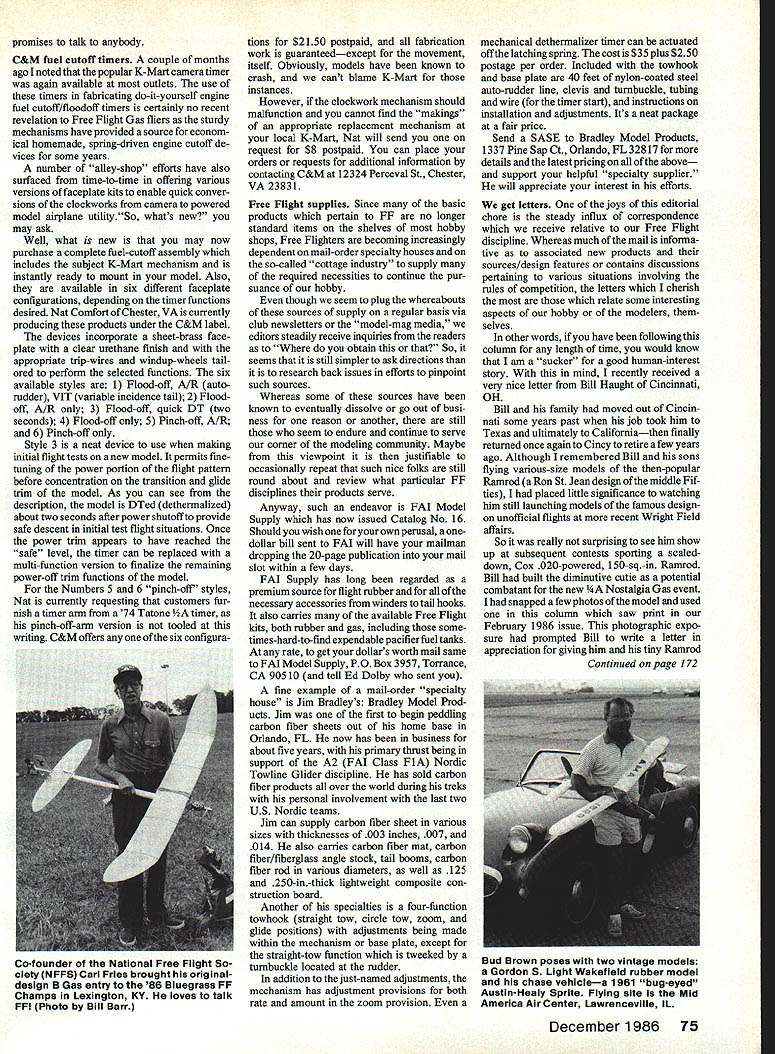
C&M fuel cutoff timers. A couple of months ago I noted that the popular K‑Mart camera timer was again available at most outlets. The use of these timers in fabricating do-it-yourself engine fuel cutoff/flood-off timers is certainly no recent revelation to Free Flight Gas fliers as the sturdy mechanisms have provided a source for economical homemade, spring-driven engine cutoff devices for some years.
A number of alley-shop efforts have also surfaced from time to time offering various versions of faceplate kits to enable quick conversions of the clockworks from camera to powered model airplane utility. "So, what's new?" you may ask.
Well, what is new is that you may now purchase a complete fuel-cutoff assembly which includes the subject K‑Mart mechanism and is instantly ready to mount in your model. Also, they are available in six different faceplate configurations, depending on the timer functions desired. Nat Comfort of Chester, VA is currently producing these products under the C&M label.
The devices incorporate a sheet-brass faceplate with a clear urethane finish and with the appropriate trip-wires and windup-wheel tailored to perform the selected functions. The six available styles are:
- Flood-off, A/R (auto-rudder), V/T (variable incidence tab)
- Flood-off, A/R only
- Flood-off, quick DT (two seconds)
- Flood-off only
- Pinch-off, A/R
- Pinch-off only
Style 3 is a neat device to use when making initial flight tests on a new model. It permits fine-tuning of the power portion of the flight pattern before concentration on the transition and glide portion of the model. As you can see from the description, the model is DTed (dethermalized) about two seconds after power shutoff to provide safe descent in initial test flight situations. Once the power trim appears to have reached the "safe" level, the timer can be replaced with a multi-function version to finalize the remaining power-off trim functions of the model.
For the Numbers 5 and 6 "pinch-off" styles, Nat is currently requesting that customers furnish a timer arm from a '74 Tatone X-14 timer, as his pinch-off arm version is not tooled at this writing. C&M offers any one of the six configurations for $21.50 postpaid, and all fabrication work is guaranteed—except for the movement itself. Obviously, models have been known to crash, and we can't blame K‑Mart for those instances.
However, if the clockwork mechanism should malfunction and you cannot find the "makings" of an appropriate replacement mechanism at your local K‑Mart, Nat will send you one on request for $8 postpaid. You can place your orders or requests for additional information by contacting C&M at 12324 Perceval St., Chester, VA 23831.
Free Flight supplies
Free Flight supplies. Since many of the basic products which pertain to FF are no longer standard items on the shelves of most hobby shops, Free Flighters are becoming increasingly dependent on mail-order specialty houses and on the so‑called "cottage industry" to supply many of the required necessities to continue the pursuit of our hobby.
Even though we seem to plug the whereabouts of these sources on a regular basis via club newsletters or the "model-mag" media, we as hobbyists clearly receive inquiries from the readers as to "Where do you obtain this or that?" So, it seems that it is still simpler to ask directions than it is to research back issues in efforts to pinpoint these sources.
Which some of these sources have been known to eventually dissolve or go out of business for one reason or another, there are still those who seem to endure and continue to serve our corner of the modeling community. Maybe from this viewpoint it is then justifiable to occasionally repeat that such nice folks are still around and review what particular FF disciplines their products serve.
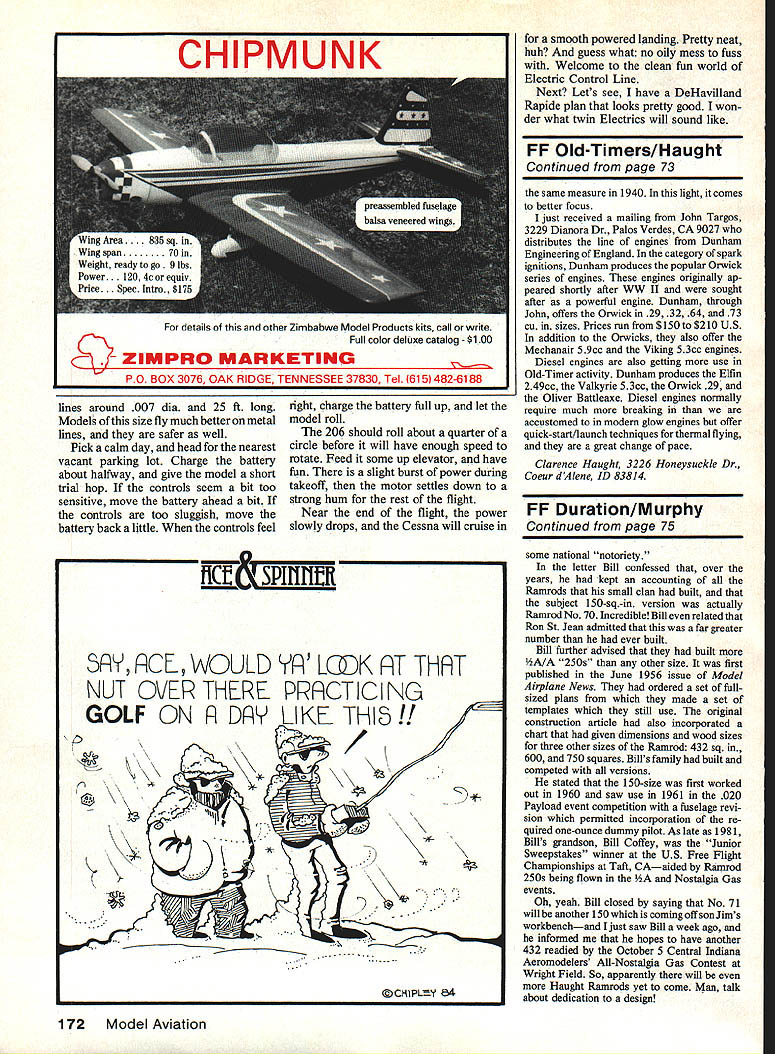
Anyway, such an endeavor is FAAI Model Supply which has now issued Catalog No. 16. Should you wish one for your own perusal, a one-dollar bill sent to FAAI will have your mailman dropping the 20-page publication into your mail slot within a few days.
FAAI Supply has long been regarded as a premium source for light rubber and for all of the necessary accessories from winders to tail hooks. It also carries many of the available Free Flight kits, bolts, both rubber and gas, including those sometimes hard-to-find expendable Pacific fuel tanks. At any rate, to get your dollar's worth mail same to FAAI Model Supply, P.O. Box 3957, Torrance, CA 90510 (and tell Ed Dolby who sent you).
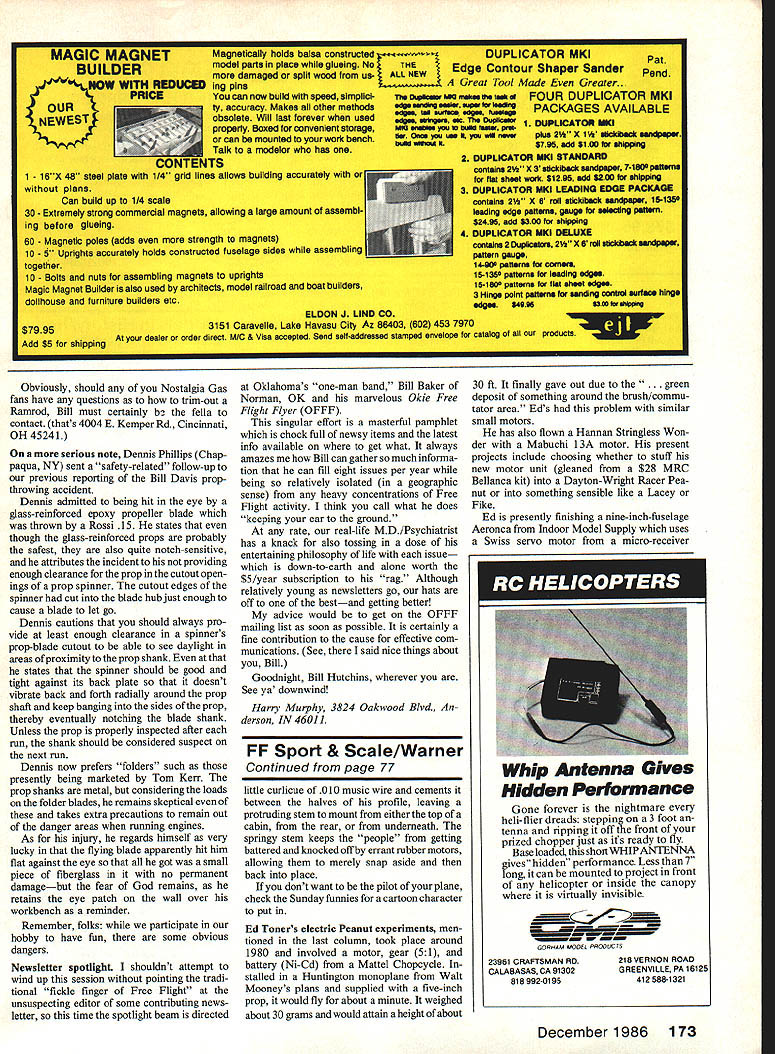
A fine example of a mail-order "specialty house" is Jim Bradley's Bradley Model Products. Jim was one of the first to begin producing carbon fiber sheetstock and other items out of his home base in Orlando, FL. He now has been in business for about five years, with his primary thrust being in support of the A2 (FAI Class F1A) Nordic Towline Glider discipline. He has sold carbon fiber products all over the world during his treks with U.S. Nordic teams and has been involved with the last two U.S. Nordic teams.
Jim can supply carbon fiber sheet in various sizes with thicknesses of:
- 0.003 inches
- 0.007 inches
- 0.014 inches
He also carries carbon fiber mat, carbon fiber/fiberglass angle stock, tail booms, carbon fiber rod in various diameters, as well as 0.125 and 0.250‑in. thick lightweight composite construction board.
Another of his specialties is a four-function towhook (straight tow, circle tow, zoom, and side positions) with adjustments being made within the mechanism or by pass plate, except for the straight-tow function which is tweaked by a turnbuckle located at the rudder.
In addition to the just-named adjustments, the mechanism has adjustment provisions for both rate and amount in the zoom provision. Even a mechanical dethermalizer timer can be actuated off the latching spring. The cost is $3.35 plus $2.50 postage per order. Included with the towhook and base plate are 40 feet of nylon-coated steel auto-rudder line, clevis and turnbuckle, tubing and wire (for the timer start), and instructions on installation and adjustment. It's a neat package at a fair price.
Send a SASE to Bradley Model Products, 1337 Pine Sap Ct., Orlando, FL 32817 for more details and the latest pricing on all of the above — and support your helpful "specialty supplier" who will appreciate your interest in his efforts.
We get letters
We get letters. One of the joys of this editorial chore is the steady influx of correspondence which we receive relative to our Free Flight discipline. Whereas much of the mail is informative as to associated new products and their sources/design features or contains discussions pertaining to various situations involving the rules of competition, the letters which I cherish the most are those which relate some interesting aspects of our hobby or of the modelers themselves.
In other words, if you have been following this column for any length of time, you would know that I am a "sucker" for a good human-interest story. With this in mind, I recently received a very nice letter from Bill Haught of Cincinnati, OH.
Bill and his family had moved out of Cincinnati some years past when his job took him to Texas and ultimately to California — then finally returned once again to Cincinnati to retire a few years ago. Although I remembered Bill and his sons flying various-size models of the then-popular Ramrod (a Ron St. Jean design of the middle F1B), I had placed little significance to watching him still launching models of the famous designs on unofficial flights at more recent Wright Field fly‑ins.
So it was really not surprising to see him show up at subsequent contests sporting a scaled-down, Cox .020-powered, 150‑sq.‑in. Ramrod. Bill had built the diminutive cutie as a potential contestant for the new N4A Nostalgia Gas event. I had snapped a few photos of the model and used one in this column which was shown in our February 1986 issue. This photographic exposure had prompted Bill to write a letter in appreciation for giving him and his tiny Ramrod some national "notoriety."
In the letter Bill confessed that, over the years, he had kept an accounting of all the Ramrods that his small clan had built, and that the subject 150‑sq.‑in. version was actually Ramrod No. 70. Incredible! Bill even related that Ron St. Jean admitted that this was a far greater number than he had ever built.
Bill further advised that they had built more 1/2A "250s" than any other size. It was first published in the June 1956 issue of Model Airplane News. They had ordered a set of full-sized plans from which they made a set of templates which they still use. The original construction article had also incorporated a chart that had given dimensions and wood sizes for three other sizes of the Ramrod: 432 sq. in., 600, and 750 sq. in. Bill's family had built and competed with all versions.
He stated that the 150‑size was first worked out in 1960 and saw use in 1961 in the .020 Payload event competition with a fuselage revision which permitted incorporation of the required one‑ounce dummy pilot. As late as 1981, Bill's grandson, Bill Coffey, was the "Junior Sweepstakes" winner at the U.S. Free Flight Championships at Taft, CA — aided by Ramrod 250s being flown in the N4A and Nostalgia Gas events.
Oh, yeah. Bill closed by saying that No. 71 will be another 150 which is coming off son Jim's workbench — and I just saw Bill a week ago, and he informed me that he hopes to have another 432 ready by the October 5 Central Indiana Aeromodellers' All‑Nostalgia Gas Contest at Wright Field. So, apparently there will be even more Haught Ramrods yet to come. Man, talk about dedication to a design!
Obviously, should any of you Nostalgia Gas fans have any questions as to how to trim-out a Ramrod, Bill will certainly be the fella to contact. (That's 4004 E. Kemper Rd., Cincinnati, OH 45241.)
On a more serious note, Dennis Phillips (Chapman, NY) sent a "safety-related" follow-up to our previous reporting of the Bill Davis prop-throwing accident.
Dennis admitted to being hit in the eye by a glass-reinforced epoxy propeller blade which was thrown by a Rossi .15. He states that even though the glass-reinforced props are probably the safest, they are also quite notch-sensitive, and he attributes the incident to his not providing enough clearance for the prop in the cutout opening of a prop spinner. The cutout edges of the spinner had cut into the blade hub just enough to cause a blade to let go.
Dennis cautions that you should always provide at least enough clearance in a spinner's prop-blade cutout to be able to see daylight in the areas of proximity to the prop shank. Even at that, he states that the spinner should be good and tight against its back plate so that it doesn't vibrate back and forth radially around the prop shaft and keep banging into the sides of the prop, thereby eventually notching the blade shank. Unless the prop is properly inspected after each run, the shank should be considered suspect on the next run.
Dennis now prefers "folders" such as those presently being marketed by Tom Kerr. The props/shanks are metal, but considering the loads on the folder blades, he remains skeptical even of these and takes extra precautions to remain out of the danger areas when running engines.
As for his injury, he regards himself as very lucky in that the flying blade apparently hit him flat against the eye so that all he got was a small piece of fiberglass in it with no permanent damage—but the fear of God remains, as he retains the eye patch on the wall over his workbench as a reminder.
Remember folks: while we participate in our hobby to have fun, there are some obvious dangers.
Newsletter spotlight. I shouldn't attempt to wind up this session without pointing the traditional "flicker finger of Free Flight" at the unsuspecting editor of some contributing newsletter, so this time the spotlight beam is directed at Oklahoma's "one-man band," Bill Baker of Norman, OK, and his marvelous Okie Free Flight Flyer (OFFF).
This singular effort is a masterful pamphlet which is chock full of newsy items and the latest on where to get what. It always amazes me how Bill can gather so much information that he can fill eight issues per year while being so relatively isolated (in a geographic sense) from any heavy concentrations of Free Flight activity. I think you can call what he does "keeping your ear to the ground."
At any rate, our real-life M.D./psychiatrist has a knack for also tossing in a dose of better-acting philosophy of life with each issue which is down-to-earth and alone worth the $5/year subscription to his "rag." Although relatively young as free flight columns go, our hats are off to one of the best—and getting better!
My advice would be to get on the OFFF mailing list as soon as possible. It is certainly a fine contribution to the cause for effective communications. (See, there I said nice things about you, Bill.)
Goodnight, Bill Hutchins, wherever you are. See ya' downwind!
Harry Murphy 3824 Oakwood Blvd., Anderson, IN 46011.
Transcribed from original scans by AI. Minor OCR errors may remain.

