
Free Flight: Duration
Bob Meuser
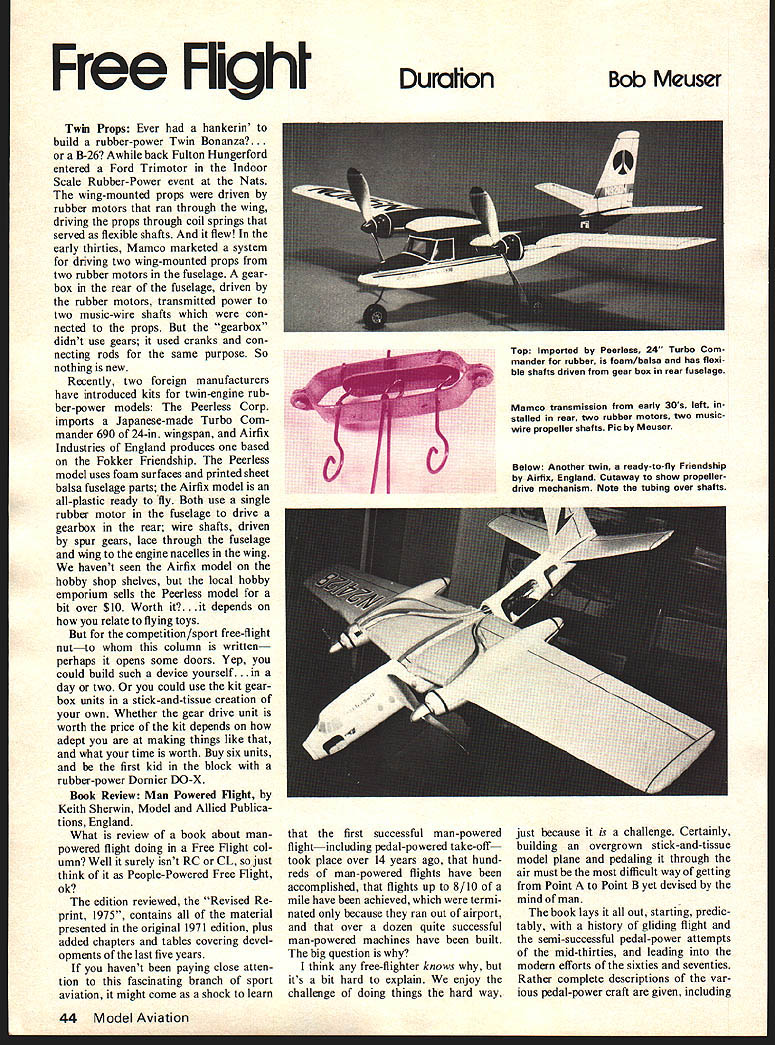
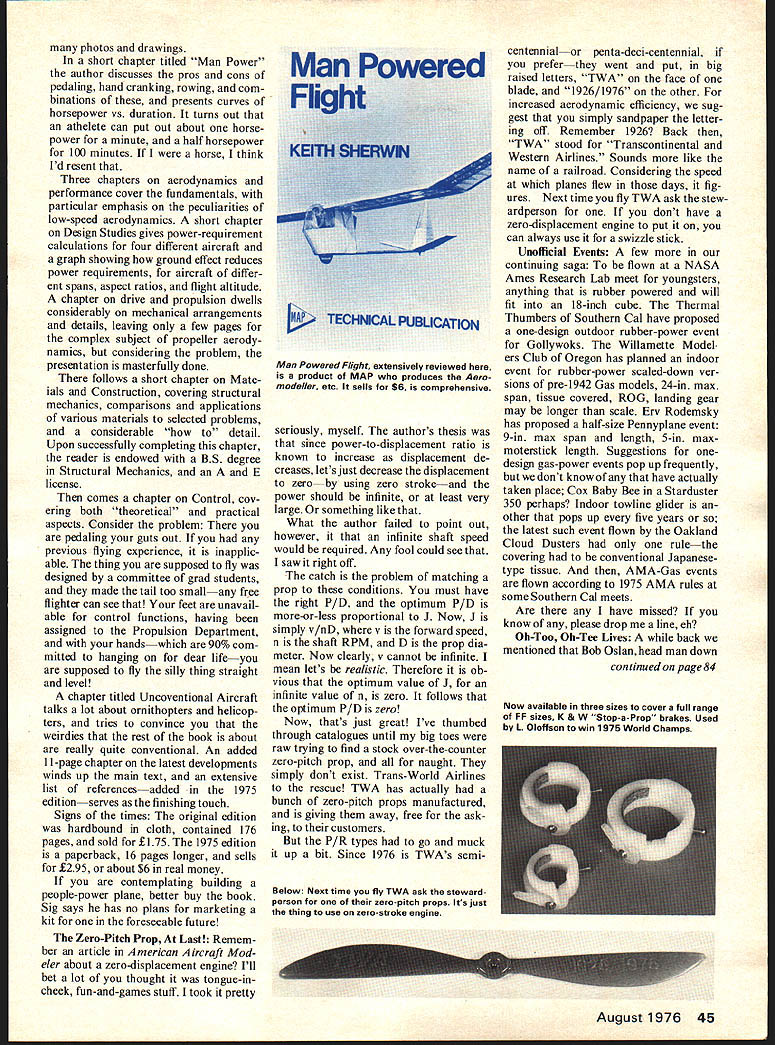
Twin Props: Ever had a hankerin' to build a rubber-power Twin Bonanza? … or a B-26? A while back Fulton Hungerford entered a Ford Trimotor in the Indoor Scale Rubber-Power event at the Nats. The wing-mounted props were driven by rubber motors that ran through the wing, driving the props through coil springs that served as flexible shafts. And it flew! In the early thirties, Mamco marketed a system for driving two wing-mounted props from two rubber motors in the fuselage. A gearbox in the rear of the fuselage, driven by the rubber motors, transmitted power to two music-wire shafts which were connected to the props. But the "gearbox" didn't use gears; it used cranks and connecting rods for the same purpose. So nothing is new.
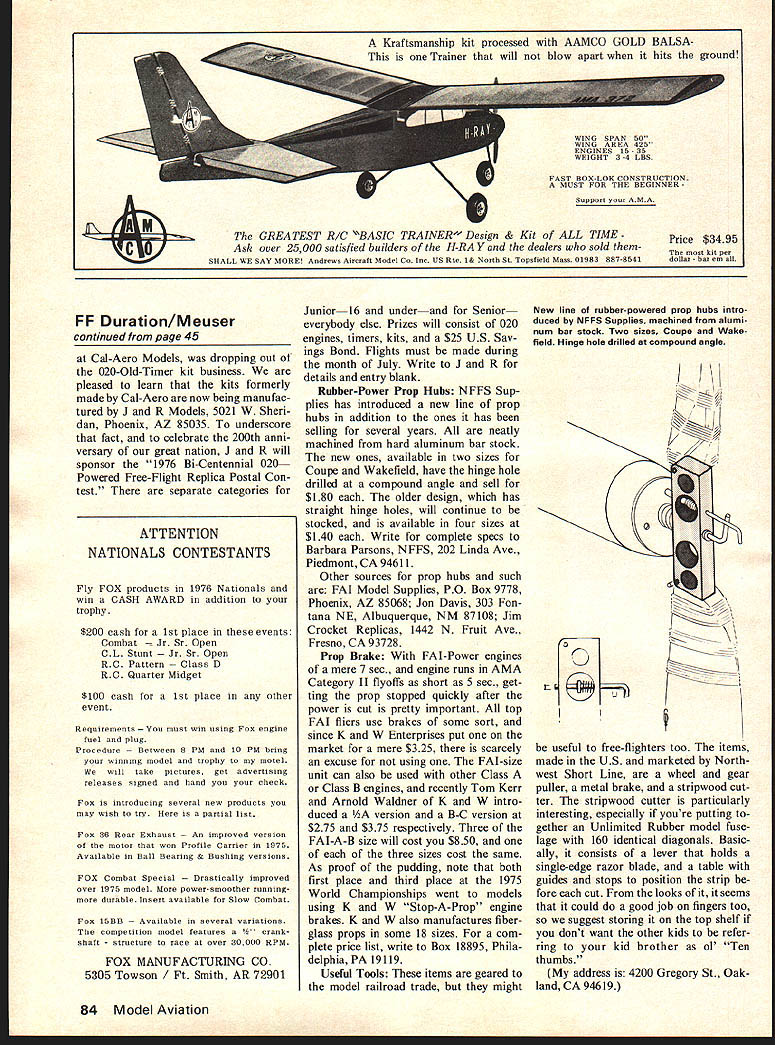
Recently, two foreign manufacturers have introduced kits for twin-engine rubber-power models: The Peerless Corp. imports a Japanese-made Turbo Commander 690 of 24-in. wingspan, and Airfix Industries of England produces one based on the Fokker Friendship. The Peerless model uses foam surfaces and printed sheet balsa fuselage parts; the Airfix model is an all-plastic ready-to-fly. Both use a single rubber motor in the fuselage to drive a gearbox in the rear; wire shafts, driven by spur gears, lace through the fuselage and wing to the engine nacelles in the wing. We haven't seen the Airfix model on the hobby shop shelves, but the local hobby emporium sells the Peerless model for a bit over $10. Worth it? It... depends on how you relate to flying toys.
But for the competition/sport free-flight nut—to whom this column is written—perhaps it opens some doors. Yep, you could build such a device yourself... in a day or two. Or you could use the kit gearbox units in a stick-and-tissue creation of your own. Whether the gear drive unit is worth the price of the kit depends on how adept you are at making things like that, and what your time is worth. Buy six units, and be the first kid in the block with a rubber-power Dornier DO-X.
Book Review: Man Powered Flight, by Keith Sherwin, Model and Allied Publications, England.
What is a review of a book about man-powered flight doing in a Free Flight column? Well, it surely isn't RC or CL, so just think of it as People-Powered Free Flight, ok?
The edition reviewed, the "Revised Reprint, 1975", contains all of the material presented in the original 1971 edition, plus added chapters and tables covering developments of the last five years.
If you haven't been paying close attention to this fascinating branch of sport aviation, it might come as a shock to learn that the first successful man-powered flight — including pedal-powered take-off — took place over 14 years ago, that hundreds of man-powered flights have been accomplished, that flights up to 8/10 of a mile have been achieved, which were terminated only because they ran out of airport, and that over a dozen quite successful man-powered machines have been built.
The big question is why? I think any free-flighter knows why, but it's a bit hard to explain. We enjoy the challenge of doing things the hard way, just because it is a challenge. Certainly, building an overgrown stick-and-tissue model plane and pedaling it through the air must be the most difficult way of getting from Point A to Point B yet devised by the mind of man.
The book lays it all out, starting, predictably, with a history of gliding flight and the semi-successful pedal-power attempts of the mid-thirties, and leading into the modern efforts of the sixties and seventies. Rather complete descriptions of the various pedal-power craft are given, including many photos and drawings.
In a short chapter titled "Man Power" the author discusses the pros and cons of pedaling, hand cranking, rowing, and combinations of these, and presents curves of horsepower vs. duration. It turns out that an athlete can put out about one horsepower for a minute, and a half horsepower for 100 minutes. If I were a horse, I think I'd resent that.
Three chapters on aerodynamics and performance cover the fundamentals, with particular emphasis on the peculiarities of low-speed aerodynamics. A short chapter on Design Studies gives power-requirement calculations for four different aircraft and a graph showing how ground effect reduces power requirements, for aircraft of different spans, aspect ratios, and flight altitude.
A chapter on drive and propulsion dwells considerably on mechanical arrangements and details, leaving only a few pages for the complex subject of propeller aerodynamics, but considering the problem, the presentation is masterfully done.
There follows a short chapter on Materials and Construction, covering structural mechanics, comparisons and applications of various materials to selected problems, and a considerable "how to" detail. Upon successfully completing this chapter, the reader is endowed with a B.S. degree in Structural Mechanics, and an A and E license.
Then comes a chapter on Control, covering both "theoretical" and practical aspects. Consider the problem: There you are pedaling your guts out. If you had any previous flying experience, it is inapplicable. The thing you are supposed to fly was designed by a committee of grad students, and they made the tail too small—any free flighter can see that! Your feet are unavailable for control functions, having been assigned to the Propulsion Department, and with your hands—which are 90% committed to hanging on for dear life—you are supposed to fly the silly thing straight and level!
A chapter titled Unconventional Aircraft talks a lot about ornithopters and helicopters, and tries to convince you that both are weirdies that the rest of the book is about are really quite conventional. An added 11-page chapter on the latest developments winds up the main text, and an extensive list of references—added in the 1975 edition—serves as the finishing touch.
Signs of the times: The original edition was hardbound in cloth, contained 176 pages, and sold for £1.75. The 1975 edition is a paperback, 16 pages longer, and sells for £2.95, or about $6 in real money.
If you are contemplating building a people-power plane, better buy the book. Sig says he has no plans for marketing a kit for one in the foreseeable future!
The Zero-Pitch Prop, At Last!: Remember an article in American Aircraft Modeler about a zero-displacement engine? I'll bet a lot of you thought it was tongue-in-cheek, fun-and-games stuff. I took it pretty seriously, myself. The author's thesis was that since power-to-displacement ratio is known to increase as displacement decreases, let's just decrease the displacement to zero—by using zero stroke—and the power should be infinite, or at least very large. Or something like that.
What the author failed to point out, however, is that an infinite shaft speed would be required. Any fool could see that. I saw it right off.
The catch is the problem of matching a prop to these conditions. You must have the right P/D, and the optimum P/D is more-or-less proportional to J. Now, J is simply v/nD, where v is the forward speed, n is shaft RPM, and D is the prop diameter. Now clearly, v cannot be infinite. I mean let's be realistic. Therefore it is obvious that the optimum value of J, for an infinite value of n, is zero. It follows that the optimum P/D is zero!
Now, that's just great! I've thumbed through catalogues until my big toes were raw trying to find a stock over-the-counter zero-pitch prop, and all for naught. They simply don't exist. Trans-World Airlines to the rescue! TWA has actually had a bunch of zero-pitch props manufactured, and is giving them away, free for the asking, to their customers.
But the P/R types had to go and muck it up a bit. Since 1976 is TWA's semi-centennial—or penta-deci-centennial, if you prefer—they went and put, in big raised letters, "TWA" on the face of one blade, and "1926/1976" on the other. For increased aerodynamic efficiency, we suggest that you simply sandpaper the lettering off. Remember 1926? Back then, "TWA" stood for "Transcontinental and Western Airlines." Sounds more like the name of a railroad. Considering the speed at which planes flew in those days, it figures. Next time you fly TWA ask the stewardess for one. If you don't have a zero-displacement engine to put it on, you can always use it for a swizzle stick.
Unofficial Events: A few more in our continuing saga: To be flown at a NASA Ames Research Lab meet for youngsters, anything that is rubber powered and will fit into an 18-inch cube. The Thermal Thumbers of Southern Cal. have proposed a one-design outdoor rubber-power event for Gollywoks. The Willamette Modelers Club of Oregon has planned an indoor event for rubber-power scaled-down versions of pre-1942 Gas models, 24-in. max. span, tissue covered, ROG, landing gear may be longer than scale. Roy Rodensky has proposed a half-size Pennsylvania event: 9-in. max. span and length, 5-in. max. motors/scratch length. Suggestions for one-design gas-power events pop up frequently; we don't know of any that have actually taken place. Are there any I have missed? If you know of any, please drop me a line, eh?
Free Flight: Duration
FF Duration/Meuser continued from page 45
at Cal-Aero Models, was dropping out of the 020-Old-Timer kit business. We are pleased to learn that the kits formerly made by Cal-Aero are now being manufactured by J and R Models, 5021 W. Sheridan, Phoenix, AZ 85035. To underscore that fact, and to celebrate the 200th anniversary of our great nation, J and R will sponsor the "1976 Bi-Centennial 020 Powered Free-Flight Replica Postal Contest." There are separate categories for Junior—16 and under—and for Senior—everybody else. Prizes will consist of 020 engines, timers, kits, and a $25 U.S. Savings Bond. Flights must be made during the month of July. Write to J and R for details and entry blank.
Rubber-Power Prop Hubs: NFFS Supplies has introduced a new line of prop hubs in addition to the ones it has been selling for several years. All are neatly machined from hard aluminum bar stock. The new ones, available in two sizes for Coupe and Wakefield, have the hinge hole drilled at a compound angle and sell for $1.80 each. The older design, which has straight hinge holes, will continue to be stocked, and is available in four sizes at $1.40 each. Write for complete specs to Barbara Parsons, NFFS, 202 Linda Ave., Piedmont, CA 94611.
Other sources for prop hubs and such are: FAI Model Supplies, P.O. Box 9778, Phoenix, AZ 85068; Jon Davis, 303 Fontana NE, Albuquerque, NM 87108; Jim Crocket Replicas, 1442 N. Fruit Ave., Fresno, CA 93728.
Prop Brake: With FAI-Power engines of a mere 7 sec. and engine runs in AMA Category II flyoffs as short as 5 sec., getting the prop stopped quickly after the power is cut is pretty important. All top FAI fliers use brakes of some sort, and since K and W Enterprises put one on the market for a mere $3.25, there is scarcely an excuse for not using one. The FAI-size unit can also be used with other Class A or Class B engines, and recently Tom Kerr and Arnold Walder of K and W introduced a V/A version and A/B/C version at $2.75 and $3.75 respectively. Three of the FAI-A-B size will cost you $8.50, and one of each of the three sizes cost the same. As proof of the pudding, note that both first place and third place at the 1975 World Championships went to models using K and W "Stop-A-Prop" propeller brakes. K and W also manufactures glass props in some 18 sizes. For a complete price list, write to Box 18895, Philadelphia, PA 19119.
Useful Tools: These items are geared to the model railroad trade, but they might be useful to free-flighters too. The items, made in the U.S. and marketed by Northwest Short Line, are a wheel and gear puller, a metal brake, and a stripwood cutter. The stripwood cutter is particularly interesting, especially if you're putting together an Unlimited Rubber model fuselage with 160 identical diagonals. Basically, it consists of a lever that holds a single-edge razor blade, and a table with guides and stops to position the strip before each cut. From the looks of it, it seems that it could do a good job on balsa strips, so we suggest storing it on the top shelf if you don't want the other kids to be referring to your kid brother as "ol' Ten-thumbs."
(My address is: 4200 Gregory St., Oakland, CA 94619.)
Ever hankerin' to build a rubber-powered twin Bonanza? A while back Fulton Hungerford entered the Ford Trimotor Indoor Scale Rubber-Power event at the Nats; the wing-mounted props were driven by rubber motors run through the wing, the driving props using coil springs to serve as flexible shafts. Flew. In the early thirties Mamco marketed a system driving two wing-mounted props — two rubber motors in the fuselage, a gearbox in the rear fuselage; the driven rubber motors transmitted power to two music-wire shafts connected to the props. The gearbox didn't use gears; it used cranks and connecting rods to the same purpose. So, nothing new.
Recently two foreign manufacturers have introduced kits for twin-engine rubber-power models. Peerless Corp. imports a Japanese-made Turbo Commander 690, 24-in. wingspan. Airfix Industries, England, produces a ready-to-fly based on the Fokker Friendship. The Peerless model uses foam surfaces, printed sheet-balsa fuselage parts. The Airfix model is all-plastic, ready to fly. Both use a single rubber motor, a fuselage drive gearbox, rear wire shafts driven by spur gears laced through the fuselage to the wing engine nacelles. I haven't seen the Airfix model on hobby-shop shelves; the local hobby emporium sells the Peerless model for a bit over $10. Worth it?
These notes relating to flying toys, competition/sport, the free-flight nutty column written perhaps opens some doors. Yep, you could build such a device yourself; two could use kit gearbox units in a stick-and-tissue creation of your own. Whether a gear-drive unit is worth the price in a kit depends on how adept you are at making things of that sort and what your time is worth. Buy six units first — kid-block rubber-power Domier DO-X.
Book Review: Man Powered Flight — Keith Sherwin, Model & Allied Publications, England. What is a review of a book about manpowered flight doing in the Free Flight column? Well, surely it isn't RC or CL — just think People-Powered Free Flight. Okay, the edition reviewed is a revised reprint, 1975, containing material presented in the original 1971 edition plus added chapters and tables covering developments of the last five years. If you haven't been paying close attention, this fascinating branch of sport aviation might come as a shock: learn Duralion C110 first successful man-powered flight — including pedal-powered take-off — took place over 14 years ago. Hundreds of man-powered flights have been accomplished; flights up to 8/10 mile have been achieved, terminated because they ran out of airport. Over a dozen quite successful man-powered machines have been built. Big question, I think free-fighter knows it's a bit hard to explain — enjoy the challenge of doing things the hard way.
The book lays out, starting predictably, the history of gliding flight, semi-successful pedal-power attempts in the mid-thirties, leading to modern efforts in the sixties and seventies. Rather complete descriptions of various pedal-power craft are given, including photos and drawings. A short chapter titled "Man Power" discusses pros and cons of pedaling, hand-cranking, rowing combinations, and presents curves of horsepower vs. duration. It turns out the athlete can put out about one-half horsepower for one minute, one-half horsepower for 100 minutes — I think I'd resent that.
Three chapters on aerodynamics and performance cover fundamentals with particular emphasis on the peculiarities of low-speed aerodynamics. A short chapter "Design Studies" gives power-requirement calculations for four different aircraft, with a graph showing ground effect reduces power requirements, aircraft differing in span, aspect ratio and flight altitude. The chapter on drive propulsion dwells considerably on mechanical arrangements and details, leaving few pages to the complex subject of propeller aerodynamics; considering the problem, the presentation is masterfully done. It follows a short chapter "Materials & Construction," covering structural mechanics, comparisons and applications of various materials selected, problems in considerable detail. Upon successfu
Transcribed from original scans by AI. Minor OCR errors may remain.

