
Free Flight
Duration
Larry Kruse
CO2 power continues to gain in popularity if my mail is a barometer of reader activity. In particular, CO2 conversions of one type or another are mentioned frequently by correspondents. Some readers tell of modifying rubber-powered kits to accept CO2 motors, while others mention converting glow engines (up to .049 size) to CO2 power using either the Davis Conversion accessories or parts of their own manufacture. C. P. Chapman of Chicago relates that he has had excellent success converting both the MRC balsa-and-tissue Super Cub and the MRC foam DeHavilland Puss Moth to CO2, needing to add only small incidence shims to the stabilizers to get good flights. C. P. also gives high marks to Sig's kits as conversion subjects.
Generally speaking, any small rubber-powered kit can be converted to CO2 power. However, as Chapman notes, biplanes with wingspans of 18 to 20 inches and monoplanes with spans up to 24 inches work best. Conversions of larger planes are possible using the popular Brown and Telco units, but weight becomes critical rather quickly.
Ordinarily, all that such a conversion requires is the installation of a 1/2-in. ply firewall and an appropriate air opening for the motor and tanks. Some modelers add air scoops to channel air over the tank, but I've never found that necessary unless the tank is installed in an essentially airtight cowl or cabin area. (In retrospect, that may be a comment on my building skills.)
One of the photos accompanying this column shows Mike Ivy's very workmanlike conversion of a Comet Piper Cub to Telco CO2 power. Note that Mike has substituted a Brown CO2 filler nozzle for the original Telco plastic unit. He also appears to be running a Williams Brothers prop on the front end.
The second type of conversion is illustrated by Lin Cochran's Nats-winning CO2 Endurance model. In reality, the ship is a double conversion. The motor is a Davis .020 changeover of a Cox glow engine attached to a cluster of tanks. The model (unbelievably enough) was originally a Twin Cyclone Old-Timer, to which the word "conversion" no longer applies. Radically reconstructed to its present Star Wars configuration, the plane rather handily won CO2 Duration at the Lake Charles Nats. Conforming to the current AMA rules limiting tank capacity to 130 times the motor displacement, the model's projected tank capacity is 2.6 cubic inches, a volume of gas capable of running the Davis conversion right up to the two-minute max mark (or over, on a good run).
Enlarging the topic at hand, that wizard of the machine shop, Stan Denton, has followed up on his terrific rubber-stripper with an offering that will gladden the hearts of FFers who like larger CO2-power models. Stan is now producing a .033-sized CO2 motor capable of powering a model having a wingspan up to 54 inches. Carrying a bore of .328 and a stroke of .400, the Denton CO2 can swing a prop as large as a modified 10-8. Dispensing with separate tank and filler units, the Denton CO2 uses the commercially available 12-gm CO2 cartridge as the tank, giving a motor run of slightly more than a minute with an optimal rpm setting.
The Denton CO2 comes complete with mounting bolts and two wrenches, one for tightening the prop and the other for locking the cylinder in place at the rpm setting you select. All-up weight with a cartridge in place is a shade under four ounces, making practical large models of up to 10 oz. Stan has plans available for a 50-in. Curtis Robin he has been using as a test bed for the motor if you don't have your own favorite design in mind.
As a personal note, I just received my Denton CO2 last week and ran through an entire package of cartridges demonstrating to friends how it swings that huge 10-8 prop. It's really a little jewel — amazing power.
Stan has produced a limited number of the motors and has them available now. The current price is $89.95 plus $2.75 postage to Denton Motors, Etc., 1107 S.W. 42, Oklahoma City, OK 73109. As a brief addendum, Stan is considering another run of rubber-strippers if interest is sufficient. Write to him and tell him you can't make it through another season without one.
Mirrors and blue smoke
After being involved in Free Flight since the early Sixties, I've seen trends in powered FF design come and go. From high-thrusters like the Starduster and the Witch Doctor through the pivotal, rear-finned Dixielander (which spawned a bevy of Pearls and other rear-rarified birds), we've messed with thrust lines, slab locations, fin positions, wing loadings, airfoils, engine preferences, and any other conceivable variable that might produce the winning edge. When we stand way back and look at what we've done, however, most of us would admit that we've only been playing in the frosting and scarcely touched the cake. There are those few, though, who would not have to hang their heads and admit to deluding themselves — those few who have clear and even printed visions of what may just be possible if accepted answers are laid aside in the quest for the real breakthrough, the truth beyond what's now true.
One of those who has been way out in front of the rest of us for over 20 years is Bill Gieseking of Denver, CO. Experimenting first with variable-camber airfoils in the late Sixties, Bill is now working with a folding-wing FAI ship that bears close scrutiny.
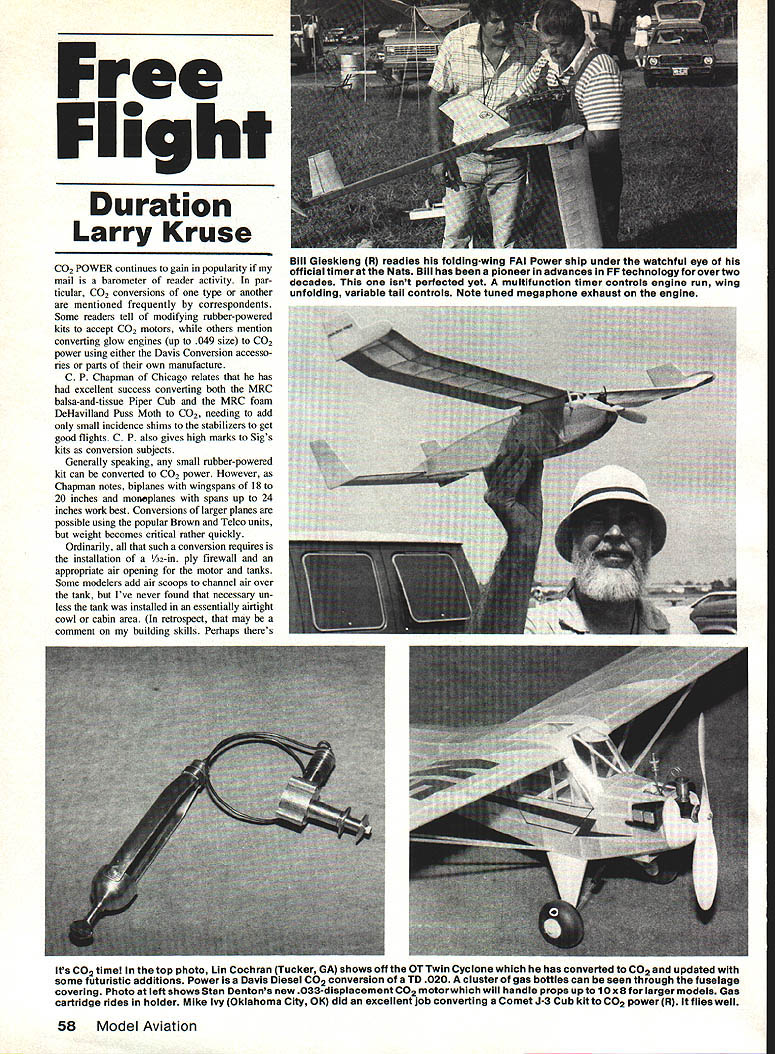
As the photo shows, the thrust line is far above the flying surfaces. The power setup features a tuned, trumpet-shaped exhaust and a single-bladed carbon-fiber prop. The outer panels of the wings fold up under the center panels (a la Jack McGillivray's famous folder) to give the wing a symmetrical airfoil under power; then two winglets fold up between each set of panels for additional lifting surface in the glide mode.
Moving toward the rear, the ship has both an auto-rudder and a variable-incidence stab for kicking itself out of its power run and into its glide pattern. All flying surfaces are either sheeted or partially sheeted to minimize flutter. The whole thing is actuated by a multi-function (and I mean multi) timer at various stages of its trajectory.
I'm sure Bill would be the first to admit that the plane has not been perfected yet. In fact, the photo shown was one of the last taken of it at the '86 Nats, as it unfortunately went off pattern and met its demise in a matter of milliseconds after a spectacular straight-up launch.
The unforgettable sight of that strange, clipped-wing screamer streaking skyward was enough, though. Anyone who saw it recognized that here was something different — something entirely out of the realm of anything else on the field that day: a brief glimpse of what might just be possible. Stay out there in front of us, Bill. Don't become discouraged by a lack of followers. We're back here. We're watching. It's just that we have so far yet to go.
More tech topics
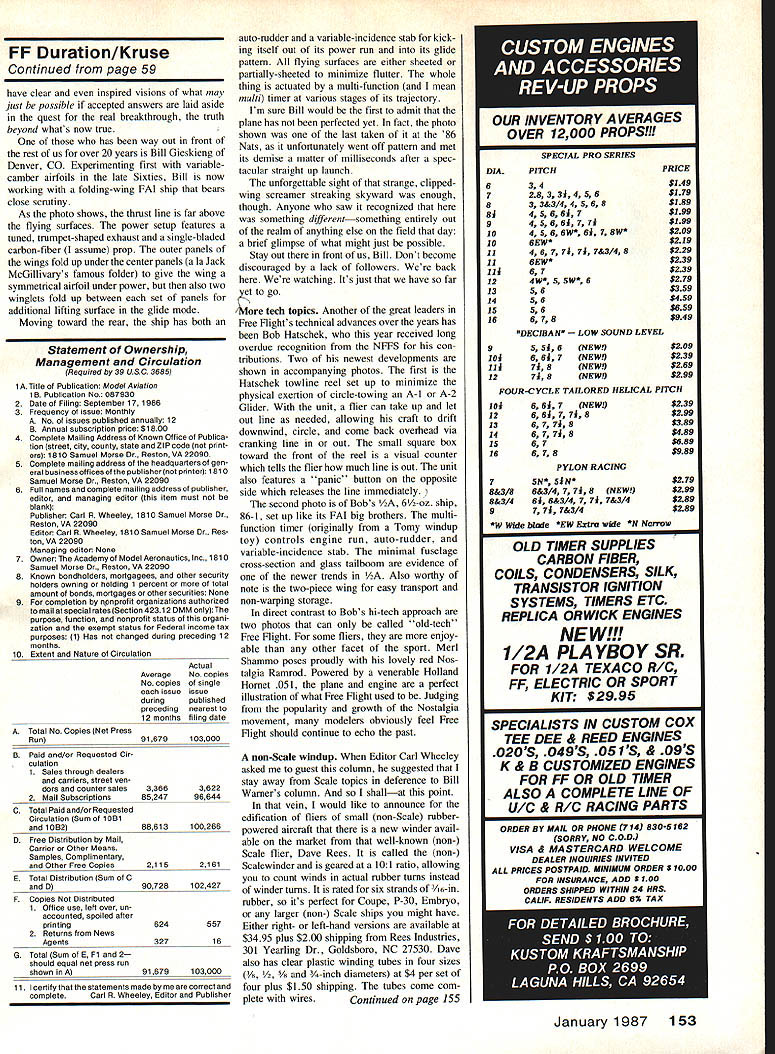
Another of the great leaders in Free Flight's technical advances over the years has been Bob Hatschke, who this year received long-overdue recognition from the NFFS for his contributions. Two of his newest developments are shown in accompanying photos. The first is the Hatschke towline reel set up to minimize the physical exertion of circle-towing an A-1 or A-2 glider. With this unit, a flier can take up and let out line as needed, allowing his craft to drift downwind, circle, and come back overhead with the crankline in or out. The small square box toward the front of the reel is a visual counter which tells the flier how much line is out. The unit also features a "panic" button on the opposite side which releases the line immediately.
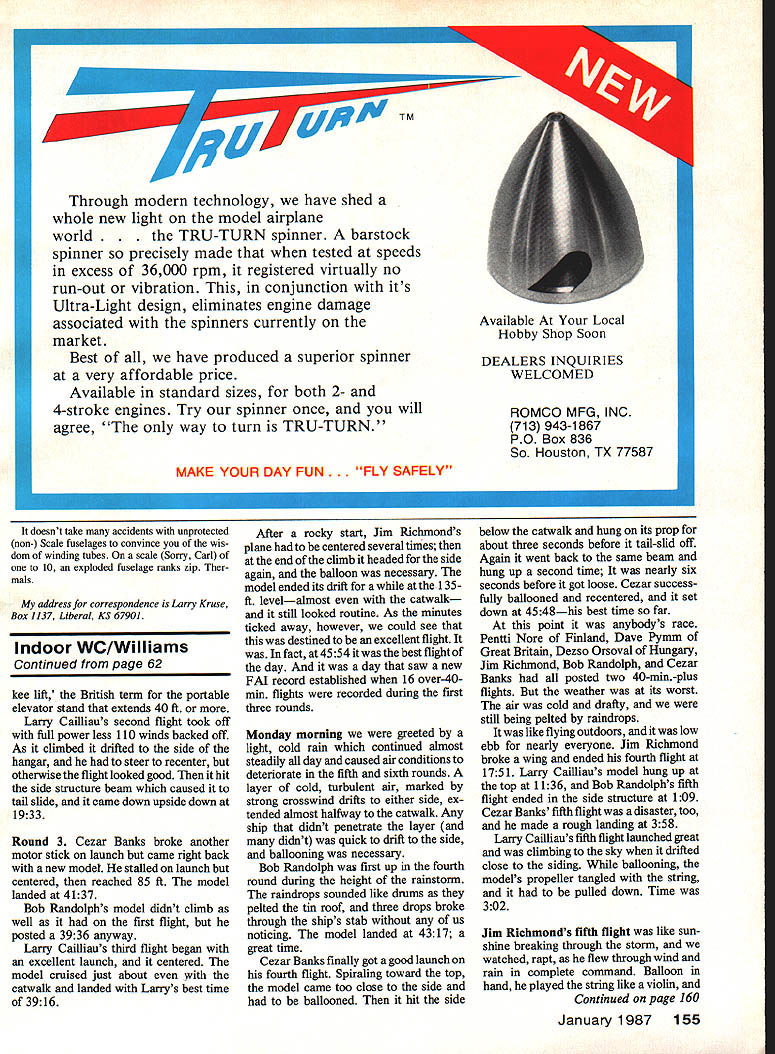
The second photo is of Bob's K/V, 6V, .02 ship, set up like its FAI big brothers. The multi-function timer (originally from a Tomy windup) controls engine run, auto-rudder, and variable-incidence stab. The minimal fuselage cross-section and glass tailboom are evidence of one of the newer trends in 1/2A. Also worthy of note is the two-piece wing for easy transport and non-warping storage.
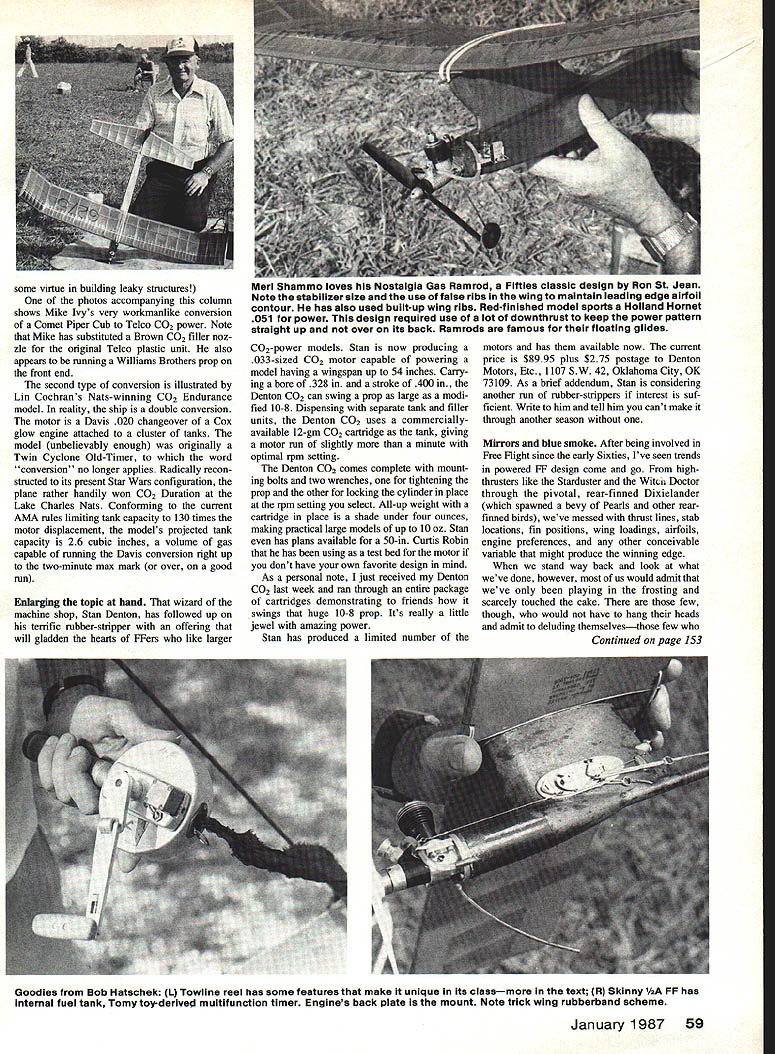
In direct contrast to Bob's hi-tech approach are the photos that can only be called "old-tech" Free Flight. For some fliers, they are more enjoyable than any other facet of the sport. Merl Shambo poses proudly with his lovely red Nostalgia Ramrod. Powered by a venerable Holland .051, the plane and engine are a perfect illustration of what Free Flight used to be. Judging from the popularity and growth of the Nostalgia movement, many modelers obviously feel Free Flight should continue to echo the past.
A non-Scale windup
When Editor Carl Wheeley asked me to guest this column, he suggested that I stay away from Scale topics in deference to Bill Warner's column. And so I shall — at this point. In that vein, I would like to announce for the edification of fliers of small (non-Scale) rubber-powered aircraft that there is a new winder available on the market from the well-known (non-Scale) flier Dave Rees. It is called the Rees Scalewinder and is geared at a 10:1 ratio, allowing you to count winds in actual rubber turns rather than in terms of winder turns. It is rated for six strands of 1/16-in. rubber, so it's perfect for Coupe, P-30, Embryo, and similar models.
Contact: Dave Rees, Yearling Dr., Goldsboro, NC 27530. Dave also has clear plastic winding tubes in four sizes (1/2, 3/8, 5/16 and 1/4-in. diameters) at $4 per set of four plus $1.50 shipping. The tubes come complete with wires.
It doesn't take many accidents with unprotected (non-)Scale fuselages to convince you of the wisdom of winding tubes. On a scale (Sorry, Carl) of one to 10, an exploded fuselage ranks zip.
Continued on page 155
My address for correspondence is: Larry Kruse, Box 1137, Liberal, KS 67901.
Transcribed from original scans by AI. Minor OCR errors may remain.

