
Free Flight: Duration
Harry Murphy
FAI FF Team
FAI FF TEAM. It is assumed that model-media coverage of the early-October U.S.A. Free Flight team selection finals at Taft, CA will eventually be provided in detail by various publications. Friend Gil (Gilbert) Morris sent a short synopsis of the meet's outcome as viewed by a participant rather than an observing reporter, and his comments follow.
The Taft Daily Midway Driller front-page headline read, "Airplane Competition Begins," with a large picture of about a dozen Honda 90s poised—race-ready, no airplanes. In fact, 37 came to fly Power, 40 Nordic, and 53 came to fly Wakefield.
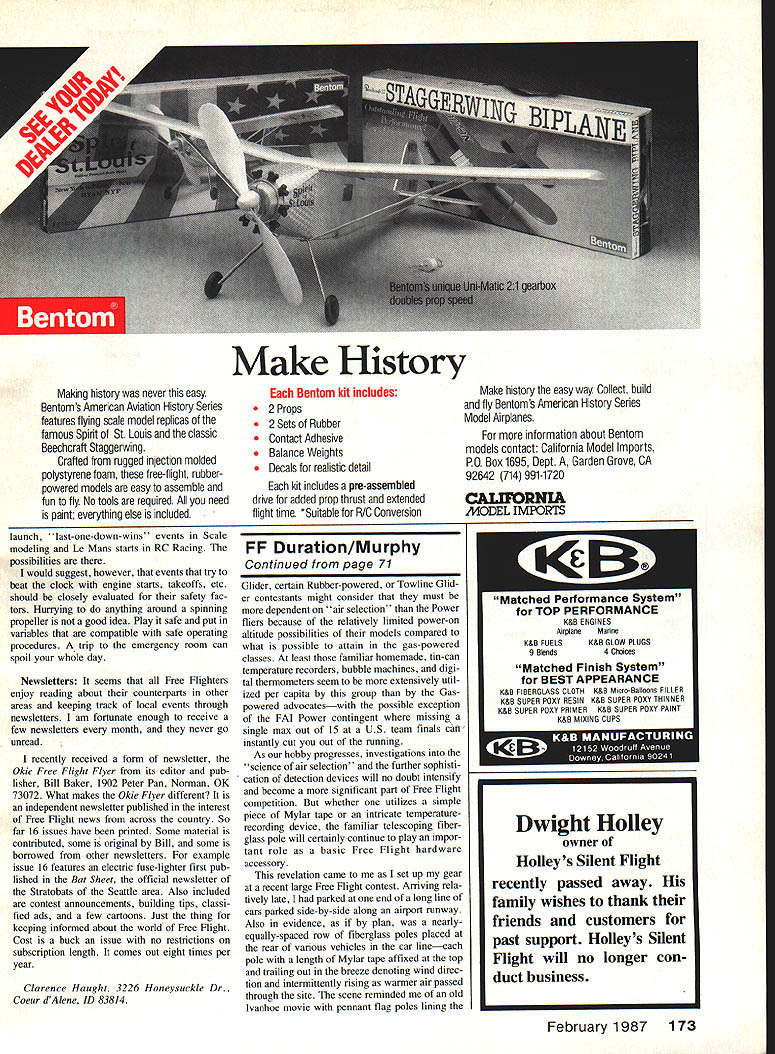
Wakefield was first off Friday, October 3. At 7:00 a.m. all 53 were to be in the air by 7:15 a.m. attempting four-minute maxes. What a magnificent sight. As far as I know, the whole three-day affair went smoothly. Mornings were cold—so cold that some engines would not start until Ken Oliver sprayed lighter fluid into the intake. Afternoons were warm and windy—about 90°F. Air picking was difficult and chancy during the afternoon rounds. There were about three dust devils each afternoon; one even did a surgical job on our tent without touching adjacent tents.
I thought Power would go to a fly-off. Five fliers had all clean maxes going into the final day. Then in the twelfth round Randy Archer's plane over-bunted and spiraled down to a low altitude for only a 60-second flight. Up to that point Archer's sleek, sheet-aluminum-covered model looked unbeatable. Norm Poti hit a Taft downer and dropped 26 seconds with only one round to go—his performance had been impeccable until then. Bob Sifleet, Bob Gutai, and Dale Mateer scrambled to perfect finishes. I don't think any of them ended up flying the exact same plane they started with, having done trim sessions between rounds.
I timed Jim Bradley's early-morning four-minute max attempt in Nordic. Nordic fliers have to be athletic: Jim circle-towed for 13 minutes of the 15-minute round, then zoomed the craft from its 164-ft towline. Rather than simply enjoying the view, he took off his sweatshirt and frantically ran in place, attempting to break the model away from the ground—it's like running the four-minute mile in place. He made 3:50. Only Randy Weiler's four-minute max topped this. It seems incredible that four minutes can be achieved from about 164 ft altitude in essentially dead air—unless all that waving tricks the drop rate to less than nine inches per second. Randy Weiler, Jim Bradley, and Dale Elder finished on top in Nordic.
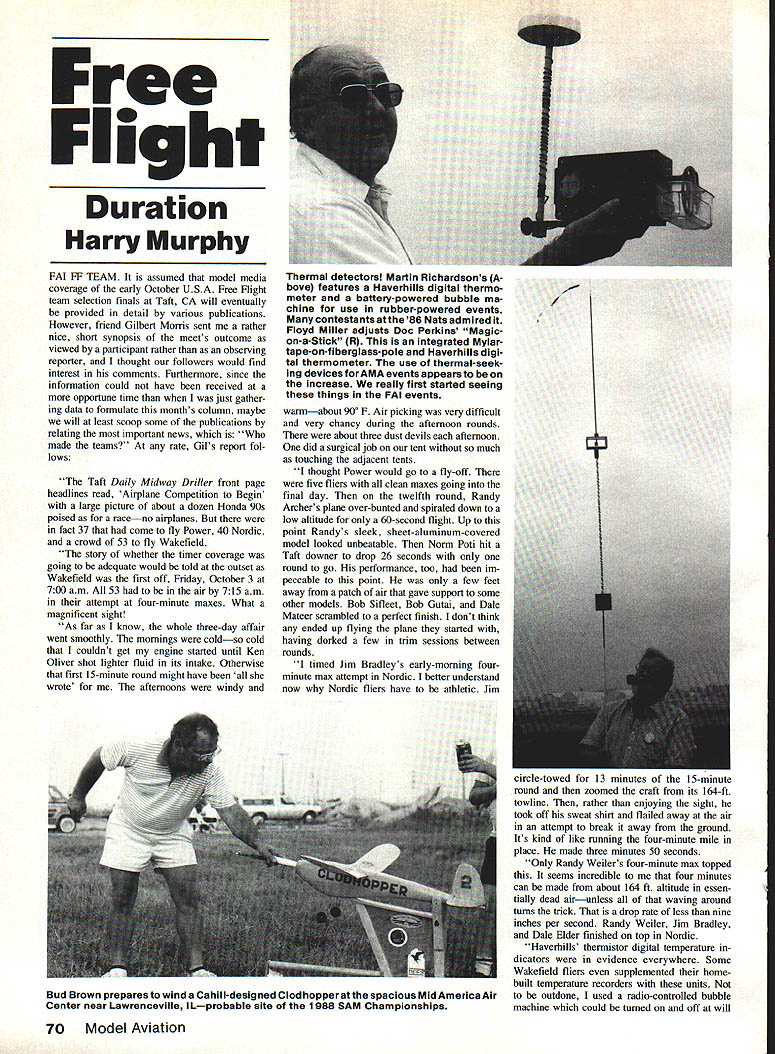
Haverhill thermistor digital temperature indicators were in evidence everywhere. Some Wakefield fliers even supplemented their home-built temperature recorders with these units. I used a radio-controlled bubble machine that could be turned on and off at will.
It looked like Wakefield would end up with the Jim Quinn, Bill Gibbons, and George Xenakis team—those three launched solid thermals in the final round. Bill Gibbons' model rose and remained attached to the thermal while the ground model followed the downside of the thermal and dropped what looked like a sure max. As a result, Bob White made the team once again at the expense of Bill's last-minute misfortune.
Contestant emotions at meets are tremendous. Doug Galbreath commented on the intensity—standing in line, fueling, timers. World Championship contestants said they were relaxed—hard to believe. So off to France go the nine to compete.
Gil missed membership on the Power team himself by a mere 13 seconds and, as a result, is first alternate should any of the final three have to capitulate for some unforeseen reason. Thanks for the contribution, Gil. We hope you make it next time.
Here’s the roster of the three teams and the times they posted in the finals:
- F1A Nordic Glider: Randy Weiler (2829 seconds), Jim Bradley (2811 seconds), Dale Elder (2768 seconds); first alternate Kevin Collins (2758 seconds).
- F1B Wakefield: Jim Quinn (2862 seconds), George Xenakis (2858 seconds), Bob White (2856 seconds); first alternate Bob Piserchio (2831 seconds).
- F1C Power: Bob Gutai (2880 seconds — maxed out), Bob Sifleet (2880 seconds — maxed out), Dale Mateer (2880 seconds — maxed out); first alternate Gil Morris (2867 seconds).
---
Oakland Cloud Dusters — Fiftieth Year
Bob Meuser (our recent alternate-month counterpart for this column) asked for help in tracking down lost or displaced former members of his parent model club, the Oakland Cloud Dusters. Plans for a fiftieth-anniversary celebration are being formulated for February 1987, and the club is attempting to notify all former members.
Bob requests that any former members notify him of their whereabouts as soon as possible. Even if a former member cannot attend, the current Dusters would like to hear from them and learn what mischief the "escapee" might have been involved in since last seen. If you can help, please contact:
Bob Meuser 4200 Gregory Street Oakland, CA 94619
We offer congratulations to the Oakland Cloud Dusters for enduring through the years and establishing a proud heritage.
---
Magic-on-a-stick
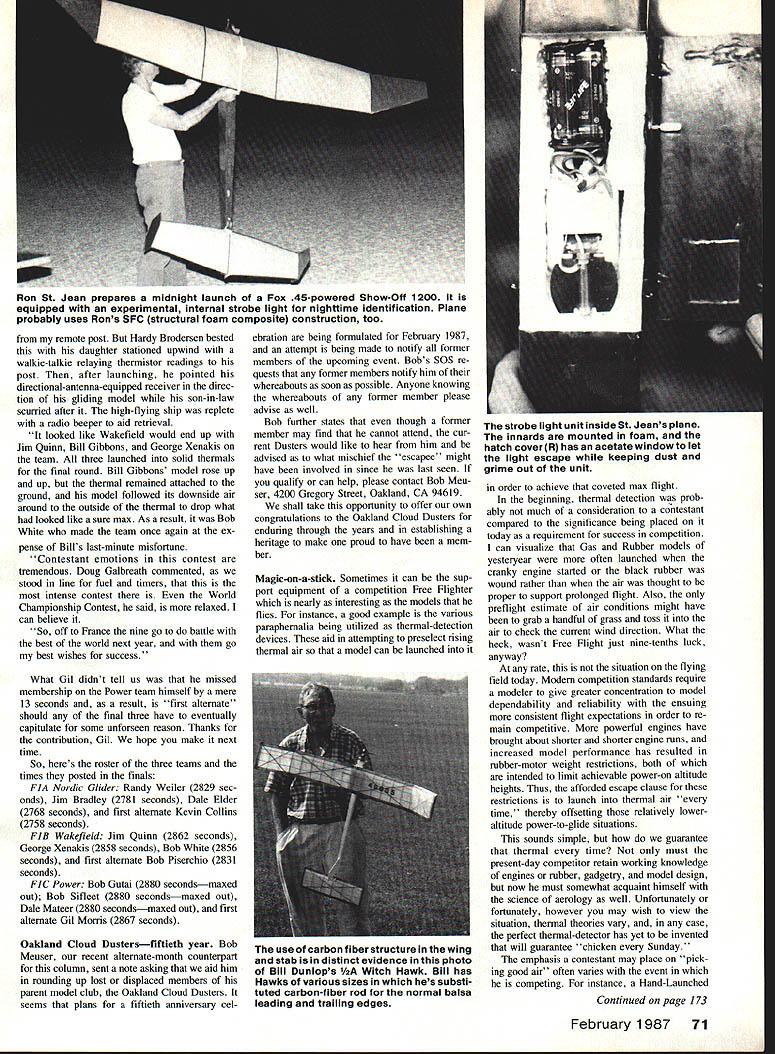
Sometimes the support equipment of a competition Free Flighter is nearly as interesting as the models themselves. Thermal-detection paraphernalia is now widely used to preselect rising air so models can be launched into thermals and achieve coveted max flights.
In the beginning, thermal detection was less important; models often went up when the engine started or the rubber was wound rather than when the air looked supportive. A bag of grass tossed into the air might have been the only pictorial estimate of conditions. Today, modern competition standards require greater concentration on model dependability and consistent performance. More powerful engines and increased model performance have led to restrictions (shorter engine runs, rubber-motor weight limits) that limit power-on altitudes. The escape clause is to launch into thermals "every time," which offsets lower power-to-glide situations.
How do you guarantee a thermal every time? Competitors now need some knowledge of aerology. Thermal theories vary, and no perfect thermal detector has been invented to guarantee a max. The emphasis placed on picking good air often varies by event: Hand-Launched Glider, certain Rubber-powered, or Towline Glider contestants tend to use thermal-recording devices, Mylar tape, bubble machines, and digital thermometers more extensively than Gas-powered fliers—though the FAI Power contingent also uses detectors heavily because a single missed max can eliminate you.
The familiar telescoping fiberglass pole with a piece of Mylar tape at the top will certainly continue to play an important role. I arrived late at a large contest and parked along a long line of cars. Adjacent to me was a nearly equal-sized row of fiberglass poles placed at the rear of vehicles—one pole with Mylar tape trailing in the breeze demonstrated wind direction and intermittently rose as warmer air passed. The scene looked like pennant flag poles lining the field.
Haverhill thermistors, digital thermometers, homemade temperature recorders, battery-powered bubble machines, and radio-controlled bubble units are now common. Contestants experiment with many approaches—some creative, some rudimentary—in their attempts to find rising air.
---
Night Retrieval — Strobe Test
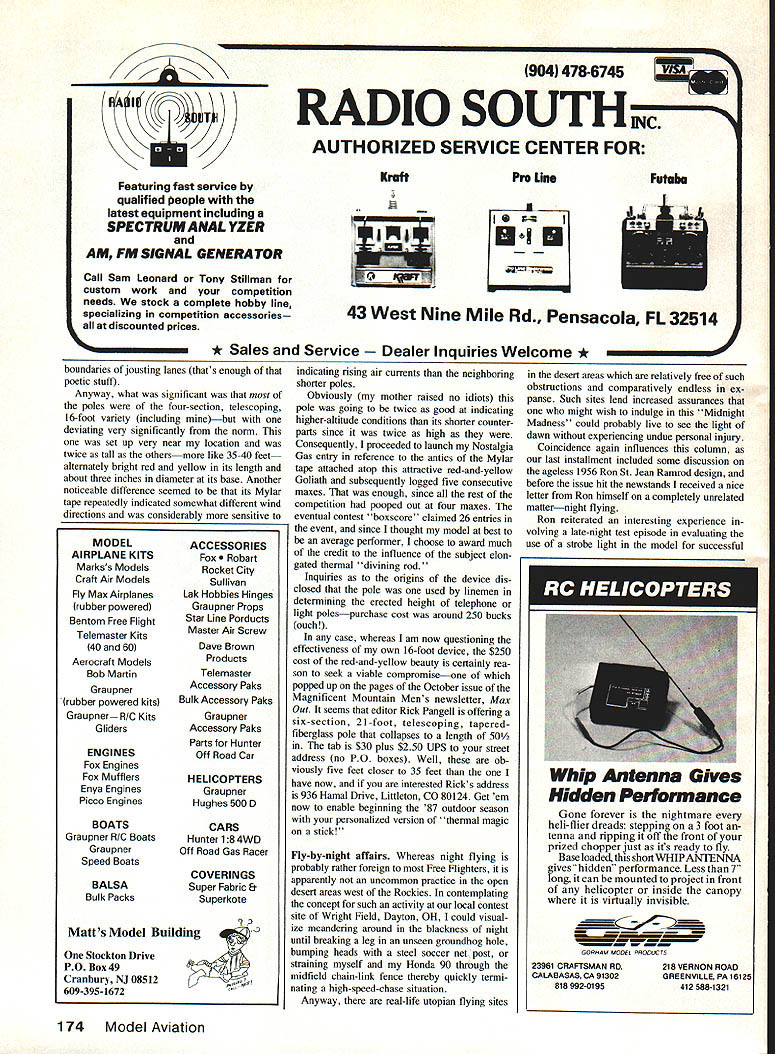
A useful test was reported using a strobe light for night retrieval. The strobe and its twin AA-size batteries were installed in the belly of a Fox .45-powered, 1,200-sq.-in. Show-Off model. The strobe blinked through a door-like transparent acetate sheet protecting it from fuel spray and desert residue.
Upon launch, the strobe was effective, although as a brisk breeze took the model downwind the light blacked out at certain positions in the glide circle—understandable since the source was inside the fuselage rather than externally mounted. Upon landing a mile or so downwind, the model rested on its far-side wingtip, exposing the flashing belly and making retrieval easier.
Distance on the desert at night is difficult to judge. The flashing strobe helped differentiate the wayward model from other lights (including a far-off train) and proved an advantage over steady-burn devices, which might otherwise force a morning scavenger hunt.
---
Newsletter Spotlight
This issue’s newsletter spotlight is on the Minneapolis Modeler, the official organ of the Minneapolis Model Aer Club. Representatives of this club travel long distances and turn up at many major Free Flight contests.
Club officers:
- President: Dave Braun
- Secretary: Gary Oakes
- Newsletter editor: Del Marchant
The newsletter covers the full span of Free Flight activities, including a full card of winter indoor contests. Six issues per year cost $3. To subscribe or request more information, contact:
Del Marchant 17110 24th Ave. North Plymouth, MN 55447
---
Plan Ahead?
More information should be available about the 1987 Lincoln (NE) Nats and the proposed new Free Flight site (a replacement for the previously used Mead site). The new site is about 10 miles from AMA Headquarters and appears to be a much better-suited facility. Official dates for 1987 move Free Flight and Indoor activities into the July 11–19 time slot instead of the usual first week of August.
The 1987 SAM Championships (the big Old-Timer event) are slated for Seguin, TX the week prior to the Nats, so you can plan to attend both.
Looking ahead to 1988, Indianapolis is the leading candidate to attract the AMA Nationals. The proposed site is about 25 miles from this writer and is a relatively new auxiliary airport facility for Indianapolis International. It may be too small to handle all Nats activities at once, so diversification of sites—similar to the 1987 Lincoln arrangements—may be necessary.
The 1988 SAM Champs site is less than two hours from Indianapolis and offers adequate, obstacle-free flying facilities in neighboring Vincennes, IN and Lawrenceville, IL. It pays to plan ahead. See ya downwind!
Harry Murphy 3824 Oakwood Blvd. Anderson, IN 46011
Transcribed from original scans by AI. Minor OCR errors may remain.

