

Free Flight: Duration
Barnaby Wainfan
Things weird and enjoyable
There is great satisfaction in getting any Free Flight model to fly well. It is an old saying that all models are beautiful when they are high overhead with the sun shining through the tissue. For me, if the model overhead is unconventional or just plain weird, it adds extra spice to the experience. The challenge of unusual models is part of the attraction — there is more feeling of achievement when you make a new and strange airplane fly.
A second attraction of the unconventional is the potential for improvements in performance. Remember, every breakthrough model that led to the "conventional" designs we fly now was a radical innovation when it first appeared. Small modifications to conventional practice yield small performance changes; radical experiments can lead to either dramatic improvements or equally dramatic failures. The successes make the failures worthwhile.
A final attraction of strange model design — what Detroit refers to as "driveway appeal" — is the conversation and pride such models spark. If you are flying a flying wing, a swept‑forward canard, or some other unusual airplane, it is very easy to pick your model out of the gaggle overhead.
Boston Cabin (14-gram Boston)
One event that has inspired many unusual models is Boston Cabin West (14‑gram Boston). Boston models are small and quick to build, so it is no great loss if an experiment fails. It is also an interesting event in which to compare configurations since the models are equal in the major areas that affect performance: span, aspect ratio, wing loading, frontal area, rubber length, and propeller diameter. If one model has an obvious performance advantage, then something unique to its configuration is giving it that edge.
Boston models have appeared with high wings, low wings, various tail surfaces including V and inverted V tails, canards, pusher props, and many other interesting features. Some of the "weirdies" are quite competitive with the more conventional high‑wing, tail‑aft designs.
Configuration innovation is one of the things that gives Boston its charm, and it is a major argument against the introduction of appearance points in the event. Appearance judging has its place in Scale competition, but the stated objective in Boston Cabin is duration within a set of rules governing configuration. If appearance points are awarded they will tend to stifle innovation. The builder of an unconventional model is taking a risk; appearance judging is highly subjective, and an innovative model could lose contests on looks even if it flies longer than the competition.
Appearance judging would also increase the time and effort required to build a competitive airplane, since time would be spent on detailing and finishing. That's fine for Scale, but AMA already has plenty of Scale events for those who want pretty, judged models. Adding appearance points to Boston Cabin would convert it from a fun, innovative Duration event into a kind of Free Flight "Standoff Scale" event and make it less attractive to try something new.
Hawthorne Flying Wing
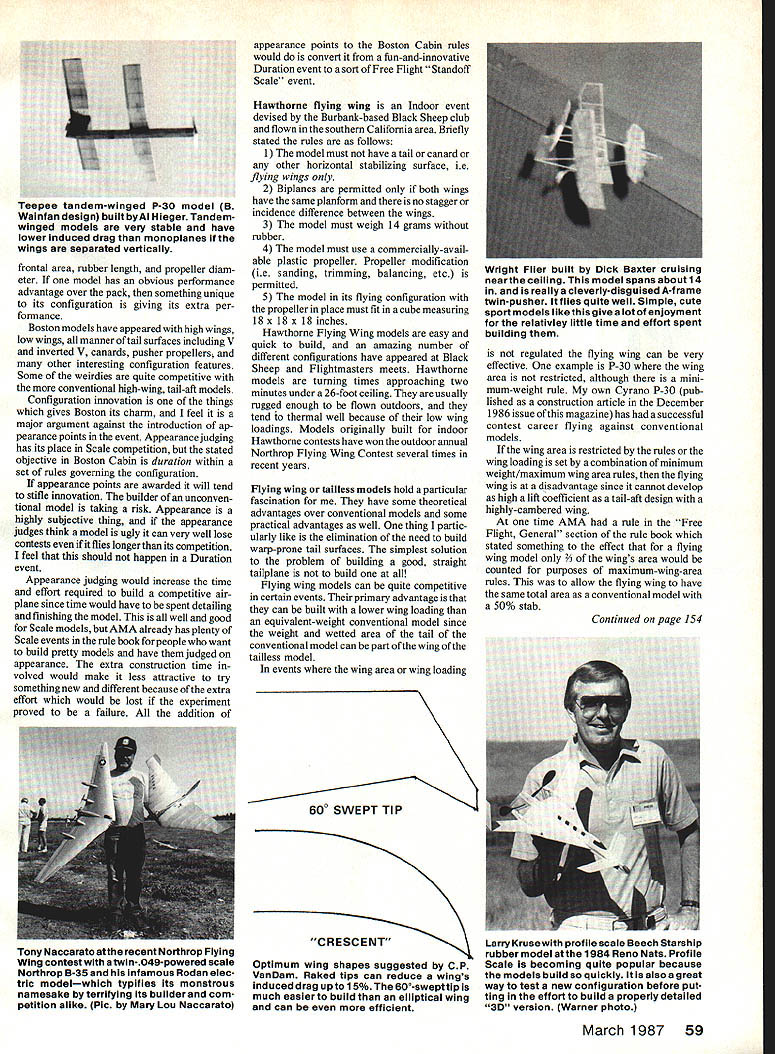
Hawthorne flying wing is an indoor event devised by the Burbank‑based Black Sheep club and flown in southern California. Hawthorne models are easy and quick to build, and an amazing number of configurations have appeared at Black Sheep and Flightmasters meets. They often thermal well because of their low wing loadings and can turn times approaching two minutes under a 26‑foot ceiling. Models originally built for indoor Hawthorne contests have won outdoor flying wing contests as well.
Briefly, the rules are as follows:
- The model must not have a tail or canard or any other horizontal stabilizing surface — flying wings only.
- Biplanes are permitted only if both wings have the same planform and there is no stagger or incidence difference between the wings.
- The model must weigh 14 grams without rubber.
- The model must use a commercially available plastic propeller. Propeller modification (sanding, trimming, balancing, etc.) is permitted.
- The model in its flying configuration with the propeller in place must fit in a cube measuring 18 x 18 x 18 inches.
Flying wing or tailless models have theoretical and practical advantages. One practical advantage is eliminating the need to build warp‑prone tail surfaces — the simplest solution to a warped tailplane is not to build one at all. Tailless models can be built with lower wing loading than an equivalent conventional model because the weight and wetted area of the tail on a conventional model can be part of the wing on a tailless design.
When wing area or wing loading is not regulated, the flying wing can be very effective. One example is P‑30, where wing area is not restricted (there is a minimum‑weight rule). My Cyrano P‑30 (published as a construction article in the December 1986 issue of this magazine) has had a successful contest career flying against conventional models.
If wing area is restricted by the rules, or wing loading is set by a combination of minimum weight and maximum wing area rules, the flying wing may be at a disadvantage since it cannot develop as high a lift coefficient as a tail‑aft design with a highly cambered wing.
At one time AMA had a rule in "Free Flight, General" that for a flying wing model only two‑thirds of the wing's area would be counted for purposes of maximum‑wing‑area rules. This two‑thirds‑area rule is no longer in the rule book, and I have not been able to find out the history of the rule. Current rules do not count any stab area which is below 50% of the wing area as wing area. If anyone can provide information on the history of the two‑thirds rule, when it was deleted, or whether it was inadvertently omitted, please contact me.
Joined wings
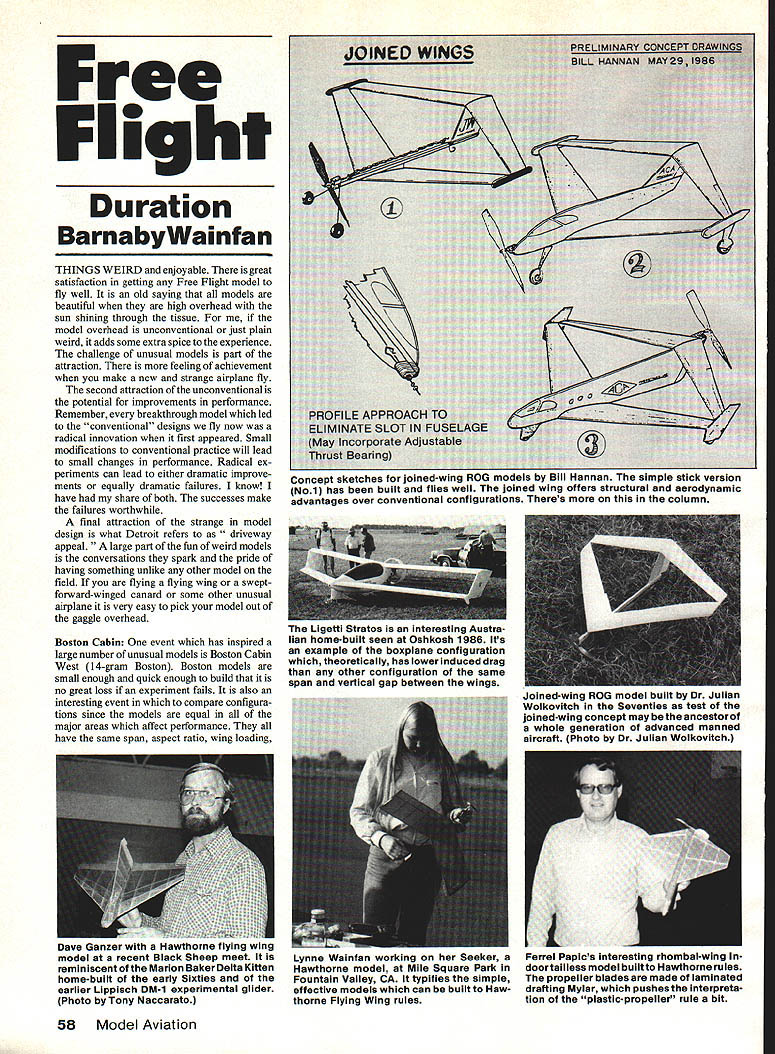
A recently interesting unconventional configuration is the joined wing. A joined‑wing airplane has two wings joined at the tips to form a diamond when viewed from above: the rear wing is swept forward and the front wing is swept back so the tips meet. The joined wing was invented by Dr. Julian Wolkovitch, who holds a patent on the concept.
The joined wing has two attractive advantages:
- Structural: the wings brace each other and form a truss, allowing a lighter structure.
- Aerodynamic: the vertical gap between the forward and aft lifting surfaces produces beneficial interference that reduces induced drag compared with two separate wings.
For modelers, the joined wing is especially attractive because it gives a tailless configuration with a built‑in truss structure for very light construction and low wing loading. Several ROG and towline ROG joined wings have been shown at meets and some have done quite well in duration events.
Examples and innovations
Notable hobby examples include:
- Bill Hannan's joined‑wing ROG models and other tailless designs.
- Ligeti's Stratos and other home‑builts demonstrating boxplane or rhombal concepts with favorable induced‑drag characteristics.
- Ferrel Papic's rhombal‑wing tailless model built to Hawthorne rules, pushing the interpretation of the plastic‑propeller rule with laminated Mylar blades.
- Teepee, a tandem‑winged P‑30 model (a B. Wainfan design built by Al Hieger), which shows tandem wings can be very stable and may have lower induced drag than a monoplane when the wings are vertically separated.
Frontal area, rubber length, and propeller diameter all affect performance; a model that is unique in its configuration can gain extra performance.
Simple sport models and "whirlythings"
Small, simple sport models give more fun for less cost and effort than almost anything in Free Flight. Many of these little jewels are unusual in configuration, and that is part of their attraction. When duration and contest‑winning performance cease to be the priority and pure fun is the goal, all kinds of strange models result. One classic example is Bill Hannan's Stringless Wonder — most Free Flight enthusiasts have built at least one, and for some it was their first successful model.
Another class of pure sport models are the "whirlythings" — Ceiling Walkers and Hannan's Unicopter, for example. These small rotating gadgets are easy and quick to build, can be flown in very little space, and rarely go OOS (out‑of‑sight) when flown outdoors. They make ideal first models for juniors and are great for involving curious spectators.
A radical suggestion: the ideal sport Free Flight model might be one with a low wing loading and a low lift‑to‑drag ratio — a machine that glides somewhere between a dropped feather and a tumbleweed. Built light, such a model can still have a good climb and, if a little overpowered, an exciting rapid climb. The combination of a steep—but slow—glide and a strong climb produces an airplane that is a lot of fun and does not require a large field or a thermalizer most of the time.
In the 1950s Roy Clough specialized in this type of model and produced designs so strange they boggled the mind, including a lifting‑body device that looked like a cross between a blimp and a Buck Rogers spaceship. More recently, the Charybdis .020‑powered wing by MacCutcheon is another enjoyable oddity.
Low‑L/D sport models are well worth trying — they are fun and you don't have to chase them too far.
Barnaby Wainfan 2503 Hardwick St., Lakewood, CA 90712
Transcribed from original scans by AI. Minor OCR errors may remain.

