

Free Flight: Duration
Harry Murphy
Readers Write
One advantage of performing this reporting task on an every‑other‑month basis is that it sometimes permits a timely response to readers' comments. If a reader takes up pen and paper promptly after receiving an issue, there is often a week or ten‑day interval before I reach my submittal deadline. That can provide a small window in which to publicly answer reader comments that may have general interest in the very next column. (I expect a short, sharp note from the boss, Associate Editor Ross McMullen, about my continual tardiness — tee‑hee.)
Anyhow, that plan worked this time, so I’ll begin where I left off discussing various types of thermal‑detecting aids. I thought this response from Bob File offered an interesting slant:
"I've just finished reading your column in the February '87 issue of Model Aviation magazine. I read Gil Morris' report of the FAI team finals at Taft, CA, and when I came to the part about the FAI Nordic contest I started laughing. The more I read about it, the more I had to laugh. How about those thermistor digital temperature indicators, radio‑controlled bubble machines, telescoping towers with Mylar ribbons, and circle‑towing for 15 minutes? Why am I laughing? Because 52 years ago in 1934, at the AMA Nationals in Akron, OH, I set a new record of 23 minutes 13 seconds with a towline glider towed up like a kite on a 100‑ft thread. This model now hangs in the AMA museum.
"I had to chuckle when reading the article because, at that time, we never heard of (nor dreamed of) all this exotic equipment now being used to find thermals. We got one crack at launching which was when our time came to fly.
"The point I am making is that with all this sophisticated equipment, it leaves the average guy out of the competition. If none of this were allowed everyone would have an equal chance. I can foresee even more hi‑tech equipment in the future, which means everyone will have to keep up or drop out.
"How about one contestant having a helium balloon go up a hundred or more feet with Mylar ribbons flailing out from the ground line every 10 feet or so? A couple of guy wires handled by a support crew could keep the balloon in place until the model is launched and then bring the balloon down again. They might even only let it up when the owner/contestant is ready to fly so the other contestants couldn't use it. How far will this go?"
Aha — nothing like a rip‑roaring debate.
If I read Mr. File correctly, he suggests we might be better off outlawing thermal‑detecting devices and returning to simpler flying. That raises broader questions about how we balance tradition, fairness, and technology in contest flying.
FAI vs. AMA Power
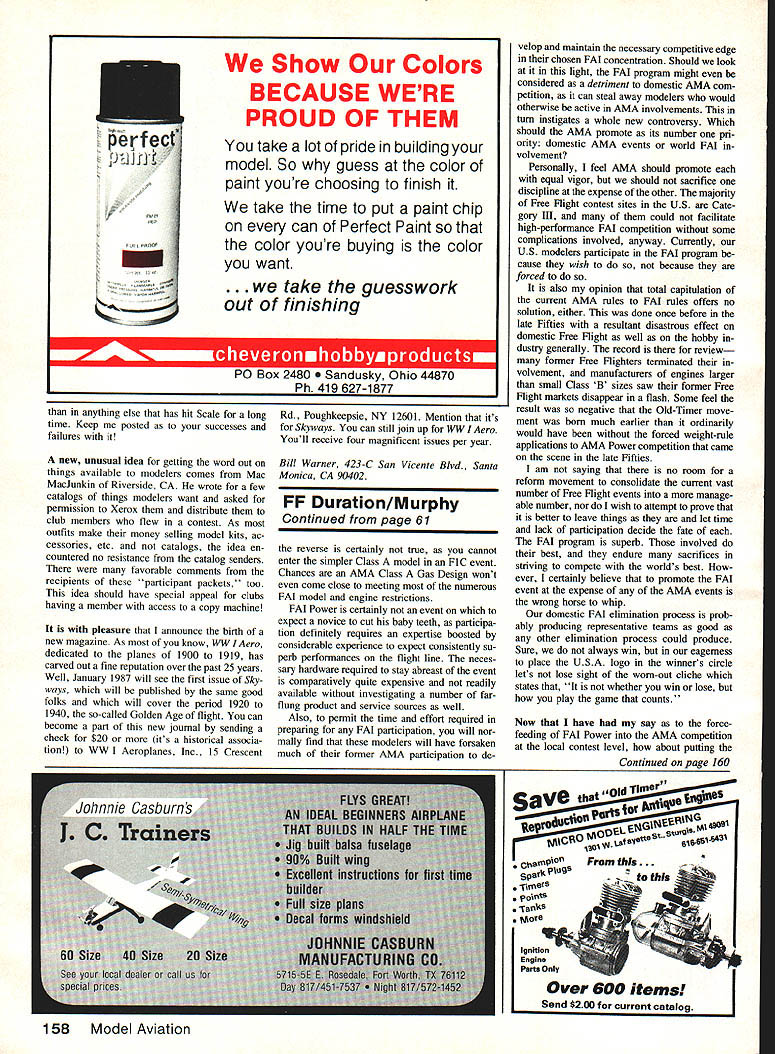
Former AMA president John Grigg has suggested replacing AMA Class A Gas with FAI Power (F1C) at local contests to push more U.S. involvement in F1C. That idea sent a chill down my spine.
At present, AMA Free Flight Gas competition covers the full range of engine displacements from .000 to .65, divided into five distinct classes (A, B, C, D, and E). The only regulation that separates those classes is engine displacement; model definitions, timing of flights, number of flights, and other procedures are common across categories I, II, and III.
Substituting FAI Power for AMA Class A would destroy much of that continuity. FAI Power carries a completely different set of extremely rigid rules and regulations, few of which are compatible with traditional AMA competition. Local contest directors and timers unfamiliar with FAI procedures would face a steep learning curve, and carding those events could complicate local contests rather than help them.
FAI Power is already well entrenched in the Free Flight community; those who wish to participate already do so. Complicating local contests to force FAI participation seems unlikely to grow the program meaningfully. In my experience, having Class A and FAI Gas simultaneously carded is the exception rather than the rule — and when they are carded together, it is because of their differences, not their similarities. An AMA Class A design generally will not meet the numerous FAI model and engine restrictions.
FAI Power is not a beginner's event. It requires expertise and considerable experience for consistently superb performances. The necessary hardware is comparatively expensive and not readily available without tracking down specialized suppliers. Modelers who prepare for FAI competition often focus their time and effort on that discipline, sometimes at the expense of domestic AMA participation. That raises a larger controversy: which should the AMA promote as its number one priority — domestic AMA events or world FAI involvement?
Personally, I believe the AMA should promote each with equal vigor and not sacrifice one discipline for the other. Most U.S. contest sites are Category III and could not facilitate high‑performance FAI competition without complications. Currently, U.S. modelers participate in FAI because they want to, not because they are forced to.
Total capitulation of AMA rules to FAI rules has been tried before (late 1950s) with disastrous effects on domestic Free Flight and the hobby industry. Many Free Flighters left the activity, and manufacturers of larger engines lost much of their market. That episode is part of the reason the Old‑Timer movement formed earlier than it might otherwise have.
I'm not saying there is no room to reform and consolidate the large number of Free Flight events into a more manageable set. The FAI program is superb and those who participate make sacrifices to compete with the world's best. But promoting FAI at the expense of AMA events is, in my view, wrong.
Our domestic FAI elimination process is producing representative teams as good as any other. In our eagerness to place the U.S.A. logo in the winner's circle, let's not lose sight of the old cliché: it is not whether you win or lose, but how you play the game that counts.
AMA Power at FAI Contests
On the flip side, what about running AMA power events at FAI contests? Charles Caton sent a timely letter describing a contest in Seguin, Texas, organized by the Tri‑City Free Flight Team and Reid Simpson. They scheduled three FAI events (two flown by rounds) with pole positions and full rules, but they also ran an AMA Open Gas event flown under the exact same FAI rules except for the fuel restriction, seven‑second engine runs, and three‑minute maxes.
Highlights from Caton's report:
- The AMA Open turnout was very good.
- Flights were along a short line with pole positions about eight feet apart; each pole held two fliers who switched places with their partner.
- At times there were 15 or so models in the air at once — an impressive sight.
- Rounds started at noon on Saturday, allowing test flying in the morning.
- The mixed line of Rubber, Gas, and Power fliers encouraged interaction — several FAI fliers actually talked with people holding AMA airplanes, and there was a friendly atmosphere.
The contest boxscore showed nine or ten entries across all events, with two contestants each in FAI Power and AMA Gas. This concept seems a more effective way to drum up new blood for FAI than forced rule changes. An FAI novice can get a feel for FAI competition without immediate expense on specialized engines and hardware, and the FAI contingent can extend a welcome to AMA fliers. Good job, Reid Simpson.
Tinted Windows and Vintage Kits
If you're into Scale or Old‑Timer authenticity, here's a simple technique for tinting plastic window material reported in a newsletter edited by Eric Strengell. Using Rit liquid clothing dye and K & S butyrate window material produces dark, attractive cockpit glazing. I tried it on my .70 Bombshell and got a dark navy‑blue tint that looks quite realistic.
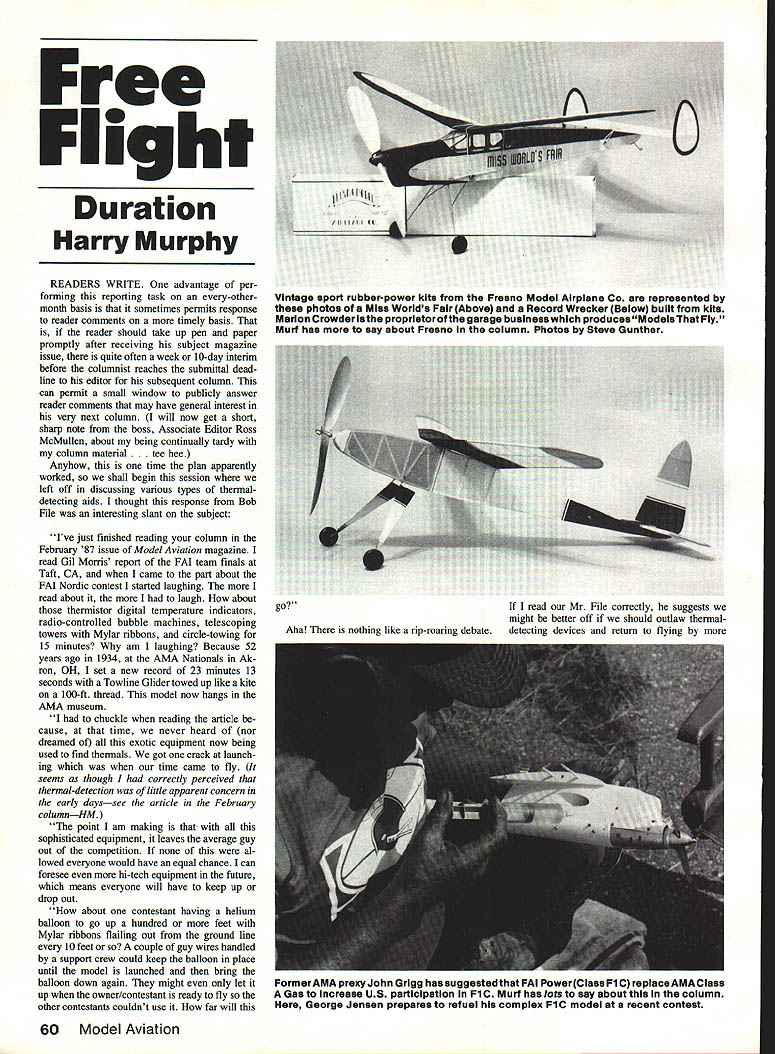
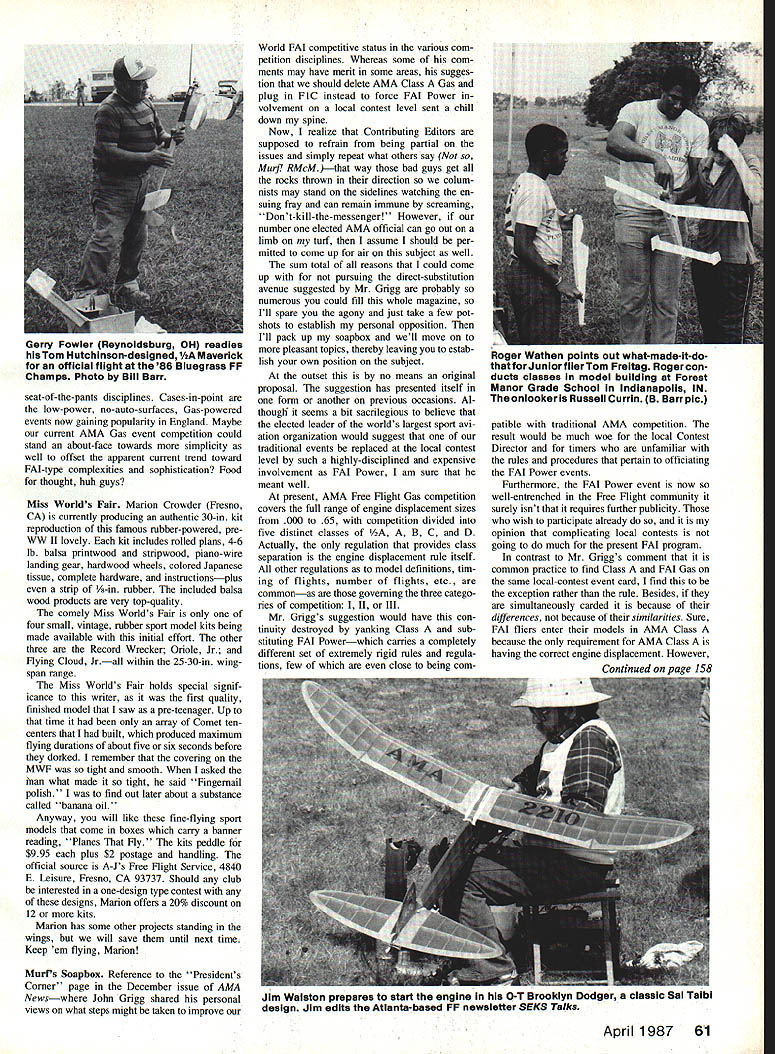
Also of interest: Marion Crowder of Fresno, CA, is producing an authentic 30‑in. kit reproduction of the famous Miss World's Fair rubber model. The kit includes rolled plans, 4–6 lb. balsa, printed wood, stripwood, piano‑wire landing gear, hardwood wheels, colored Japanese tissue, complete hardware, instructions, and 1/8‑in. rubber. Other initial kits in the series include Record Wrecker, Oriole Jr., and Flying Cloud Jr., all in the 25–30‑in. wingspan range. These fine sport models come in boxes proclaiming "Planes Fly." Price: $9.95 plus $2 postage and handling. Official source: A‑J's Free Flight Service, 4840 E. Leisure, Fresno, CA 93737.
See ya downwind!
Harry Murphy 3824 Oakwood Blvd. Anderson, IN 46011
Transcribed from original scans by AI. Minor OCR errors may remain.

