
Free Flight: Duration
Bill Hartill
A Few Notes (downwind from the Free Flight Gypsy)
The high-technology challenge. Free Flight aeromodeling is undergoing a metamorphosis. At one time Free Flight was the only aeromodeling flying sport. Then came the offshoots of RC and CL. Free Flight staggered along, with a few of us still gluing sticks together. The perpetuation and growth of Free Flight always seemed to be based on our ability to teach juniors how to glue those sticks together. As our ranks seemed to be dwindling there has been much agonizing about this "junior problem" and what to do about it.
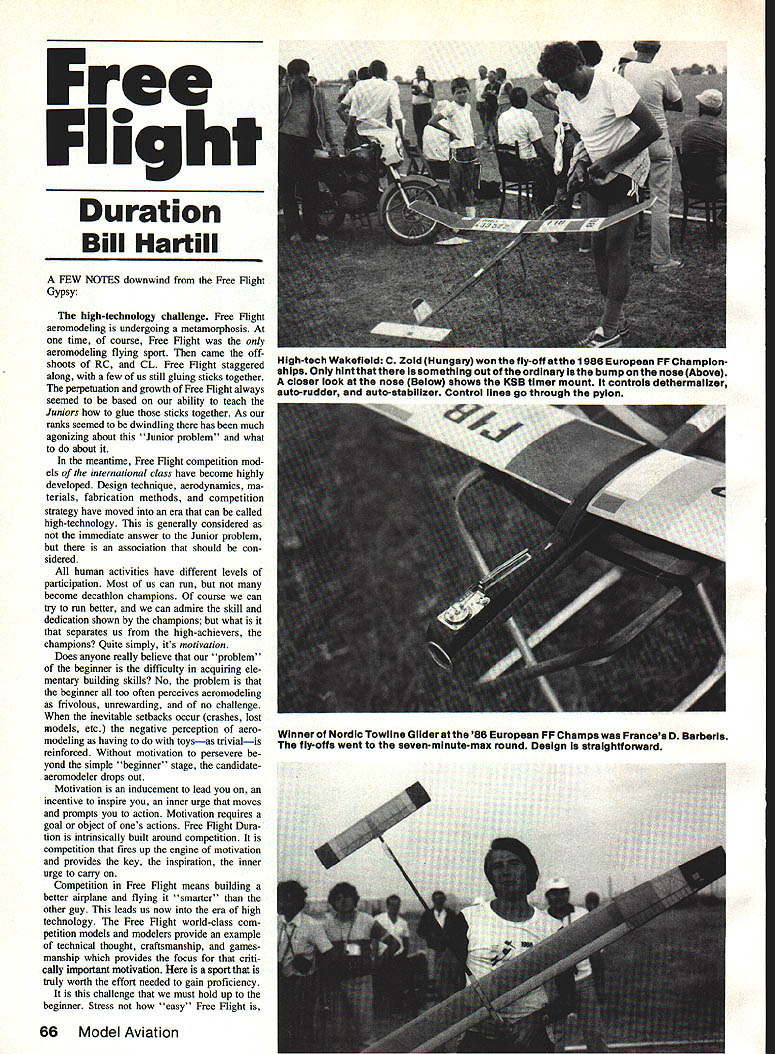
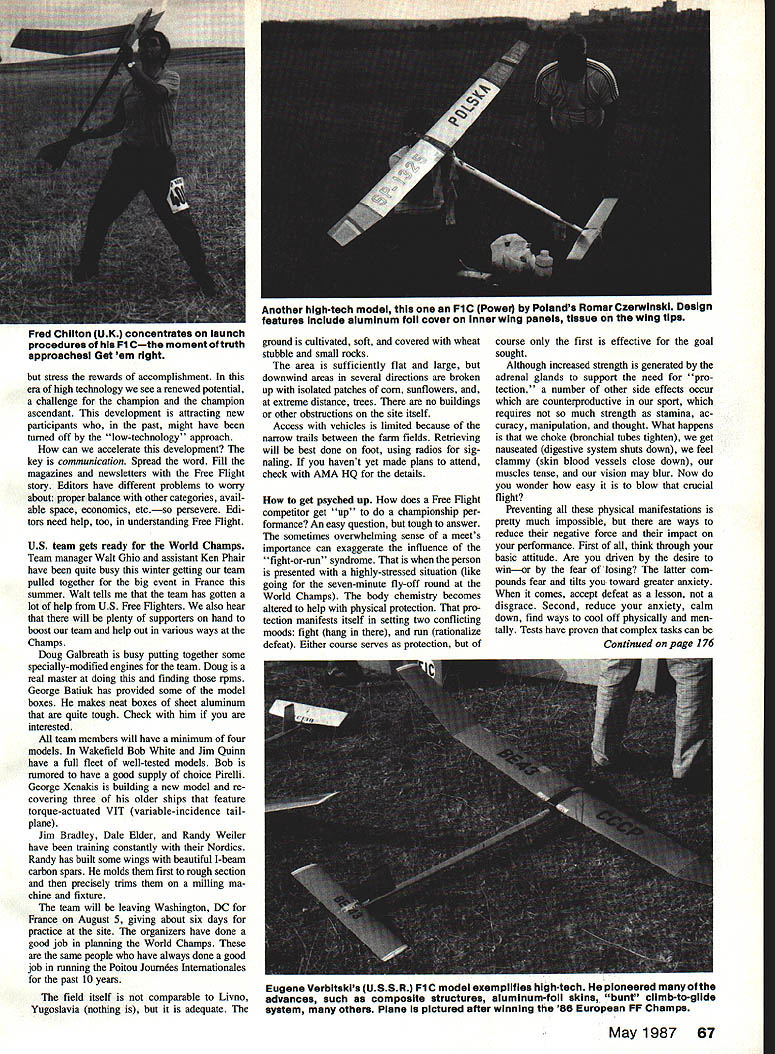
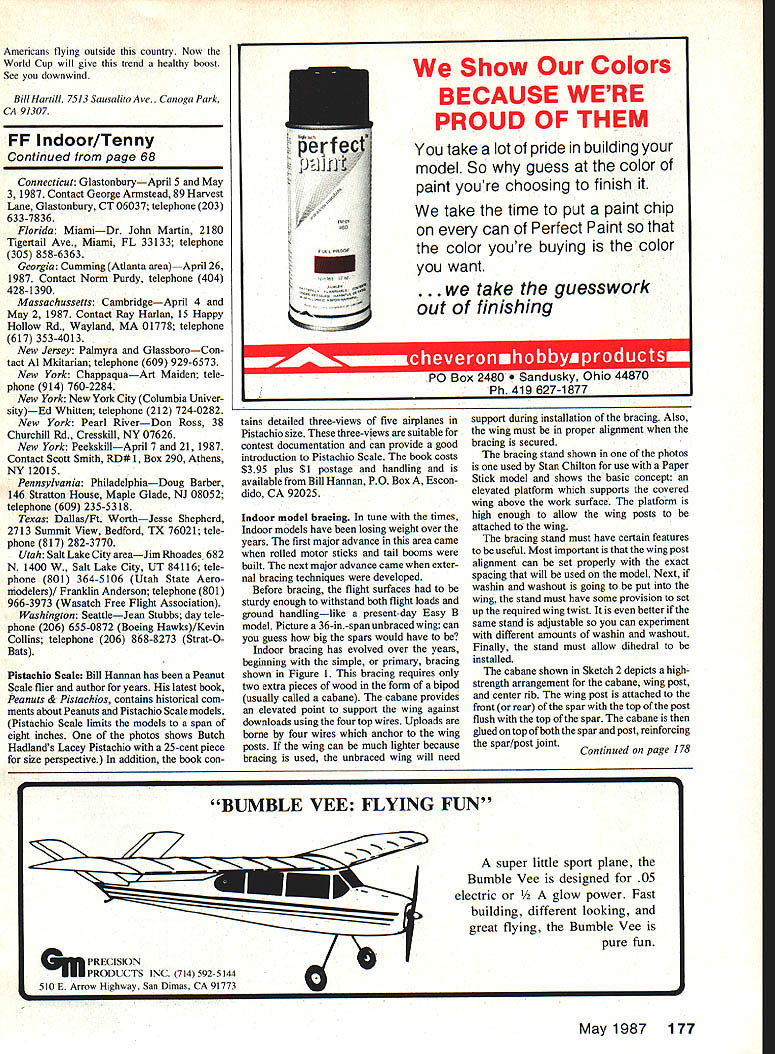
In the meantime, Free Flight competition models of the international class have become highly developed. Design technique, aerodynamics, materials, fabrication methods, and competition strategy have moved into an era that can be called high-technology. This is generally considered not the immediate answer to the junior problem, but there is an aspect that should be considered.
All human activities have different levels of participation. Most of us can run, but not many become decathlon champions. Of course we can try to run better, and we can admire the skill and dedication shown by the champions; but what separates us from the high-achievers? Quite simply: motivation.
Does anyone really believe that the beginner's problem is the difficulty in acquiring elementary building skills? No—the problem is that the beginner often perceives aeromodeling as frivolous, unrewarding, and unchallenging. When inevitable setbacks occur (crashes, lost models, etc.), this negative perception—tying aeromodeling to toys and triviality—is reinforced. Without motivation to persevere beyond the beginner stage, the candidate aeromodeler drops out.
Motivation is an inducement to lead you on, an incentive to inspire you, an inner urge that moves and prompts you to action. Motivation requires a goal. Free Flight Duration is intrinsically built around competition. Competition fires the engine of motivation and provides the inspiration and inner urge to carry on.
Competition in Free Flight means building a better airplane and flying it smarter than the other guy. This leads us into the era of high technology. World-class Free Flight models and modelers provide examples of technical thought, craftsmanship, and gamesmanship, which focus that crucial motivation. Here is a sport truly worth the effort needed to gain proficiency.
It is this challenge we must hold up to the beginner. Do not stress how "easy" Free Flight is—stress the rewards of accomplishment. In this era of high technology we see renewed potential, a challenge for champions and champions-to-be. This development is attracting new participants who might previously have been turned off by a "low-technology" approach.
How can we accelerate this development? The key is communication. Spread the word. Fill magazines and newsletters with the Free Flight story. Editors have different problems to worry about—proper balance with other categories, space, economics—so persevere. Editors need help, too, in understanding Free Flight.
U.S. Team Gets Ready for the World Champs
Team manager Walt Ghio and assistant Ken Phair have been quite busy this winter getting our team pulled together for the big event in France this summer. The team has received a lot of help from U.S. Free Flighters, and there will be plenty of supporters on hand to boost the team and help in various ways.
- Doug Galbreath is busy preparing some specially modified engines for the team. Doug is a master at finding the rpms.
- George Batiuk has provided some model boxes—neat, tough creations made from sheet aluminum. Check with him if interested.
- All team members will have a minimum of four models.
Team member notes:
- Wakefield: Bob White and Jim Quinn have full fleets of well-tested models. Bob is rumored to have a good supply of choice Pirelli engines.
- George Xenakis is building a new model and recovering three older ships that feature torque-actuated VIT (variable-incidence tailplane).
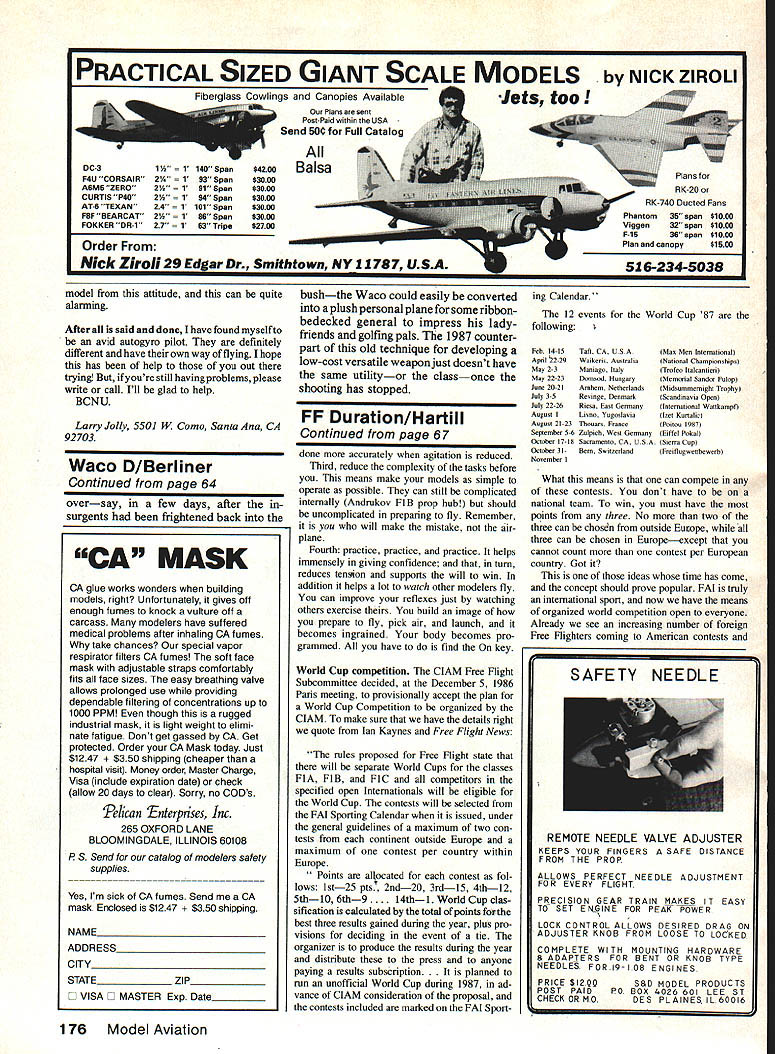
- Jim Bradley, Dale Elder, and Randy Weiler have been training constantly with their Nordics. Randy has built wings with beautiful I-beam carbon spars; he molds them first to a rough section and then precisely trims them on a milling machine and fixture.
Logistics:
- The team will leave Washington, D.C., for France on August 5, allowing about six days for practice at the site.
- The site organizers (the same group successful with the Poitou Journées Internationales for the past 10 years) have planned well.
- The field is adequate though not comparable to Livno, Yugoslavia. The ground is cultivated, soft, and covered with wheat stubble and small rocks.
- The area is sufficiently flat and large, but downwind areas in several directions are broken with isolated patches of corn, sunflowers, and, at extreme distance, trees. There are no buildings or other obstructions on the site itself.
- Vehicle access is limited because of narrow trails between farm fields. Retrieving will be best done on foot, using radios for signaling.
If you haven't made plans to attend, check with AMA Headquarters for details.
How to Get Psyched Up
How does a Free Flight competitor get "up" to do a championship performance? The question is easy, the answer tough. The overwhelming sense of a meet's importance can trigger the fight-or-flight instinct. Presented with a highly stressed situation (for example, going for the seven-minute fly-off at the World Champs), body chemistry changes to provide physical protection. That protection sets two conflicting moods: fight (hang in there) and run (rationalize defeat). Either serves as protection, but only the first is effective for the goal sought.
Although adrenal responses generate increased strength, several side effects are counterproductive in our sport, which requires stamina, accuracy, manipulation, and thought. Typical effects: bronchial tightening (choking), nausea (digestive shutdown), clammy skin (skin blood vessels close), muscle tension, and blurred vision. It is easy to see how you can blow a crucial flight.
Ways to reduce these negative effects:
- Think through your basic attitude. Are you driven by the desire to win—or by the fear of losing? The latter compounds fear and increases anxiety. When defeat comes, accept it as a lesson, not a disgrace.
- Reduce your anxiety. Calm down; find ways to cool off physically and mentally. Tests show complex tasks are done more accurately when agitation is reduced.
- Reduce task complexity. Make your models as simple to operate as possible. They can still be mentally complex (Andrulkov F1B prop hub!), but should be uncomplicated in preparing to fly. Remember: it is you who will make the mistake, not the airplane.
- Practice, practice, practice. Practice builds confidence, reduces tension, and supports the will to win. Watch other modelers fly—improve reflexes by observing theirs. You build an image of preparation, air picking, and launching; it becomes ingrained and your body becomes programmed. All you have to do is find the On key.
World Cup Competition
The CIAM Free Flight Subcommittee provisionally accepted a plan for a World Cup Competition at the December 5, 1986, Paris meeting. The rules proposed (quoted from Ian Kaynes and Free Flight News) state:
- There will be separate World Cups for classes F1A, F1B, and F1C.
- All competitors in the specified open internationals will be eligible for the World Cup.
- Events will be selected from the FAI Sporting Calendar, under these conditions:
- A maximum of two events from each continent outside Europe.
- At least one of the contests per country within Europe.
- Points are allocated for each contest as follows:
- 1st — 25 points
- 2nd — 20 points
- 3rd — 15 points
- 4th — 12 points
- 5th — 10 points
- 6th — 9 points
- 7th — 8 points
- The final points total for a competitor is the sum of points achieved in the best three contests during the year.
- The total points for a competitor will be published at the end of each year and must be attested by the competitor's national aeromodelling organization, which must be affiliated to the FAI.
- The World Cup will be held for the first time in 1987; the winner will be the competitor with the highest points total at the end of that year.
Clarifications:
- You can compete in any of these contests—you don't have to be on a national team.
- To win, you must have the most points from any three contests.
- No more than two of the three contests counted can be from outside Europe.
- All three can be chosen within Europe, but you cannot count more than one contest per European country.
This concept should prove popular. FAI is truly international, and now we have organized world competition open to everyone. Already more foreign Free Fliers are coming to American contests and vice versa, which will help the sport.
Americans Flying Outside This Country
The World Cup will give international competition a healthy boost. See you downwind.
Bill Hartill 7513 Sausalito Ave. Canoga Park, CA 91307
Transcribed from original scans by AI. Minor OCR errors may remain.

