
Free Flight: Duration
Harry Murphy
Where did everything go? Once upon a time there was Free Flight—and that was all there was. If you remember those days, you’re probably one who can now get senior-citizen discounts at local eateries and who has difficulty gluing two pieces of balsa together without your bifocals.
Decades have passed, yet Free Flight largely remains in the form it was when you may have left it. Antique and Old-Timer Free Flight activities are governed by the Society of Antique Modelers (SAM), the early glow-engine era has been revived under the National Free Flight Society (NFFS), and state-of-the-art domestic and international competition continues under the Academy of Model Aeronautics (AMA) and the Federation Aeronautique Internationale (FAI). There’s something for everyone, whether your hiatus was four years or forty.
A visit to a modern hobby shop after a long absence can be a shock. Proprietors today rely on R/C and larger-ticket items to keep doors open; you won’t find 10¢ Comet flying-scale kits or the original Goldberg Zipper on every shelf. Fortunately, many needs are met by a thriving “cottage industry”—one-man, part-time garage or basement operations supplying vintage plans, full-kit reproductions, repro parts for out-of-production engines, engine rebuilding, custom ignition and fuel-cutoff timers, propellers (reinforced plastic, carbon fiber, folding), and more.
- Vintage plans and full-kit reproductions
- Repro hardware and engine parts
- Engine rebuilding services
- Custom ignition and fuel-cutoff timers
- Propellers (reinforced plastic, carbon fiber, folding)
These basement boutiques often have limited production capacity and some come and go, but many are reputable, dedicated operators enjoying the hobby while helping fellow modelers. The downside is they’re not always well advertised, making it hard to find who’s still in business.
Good news: Kansas Free Flighter Jim O’Reilly has been tracking cottage-industry sources that support the Free Flight community. His current list includes about 50 sources and gives operation name, mailing address, phone (if available), proprietor’s name (if available), and a brief description of products or services. If you offer products or want a copy of the list, send your information to:
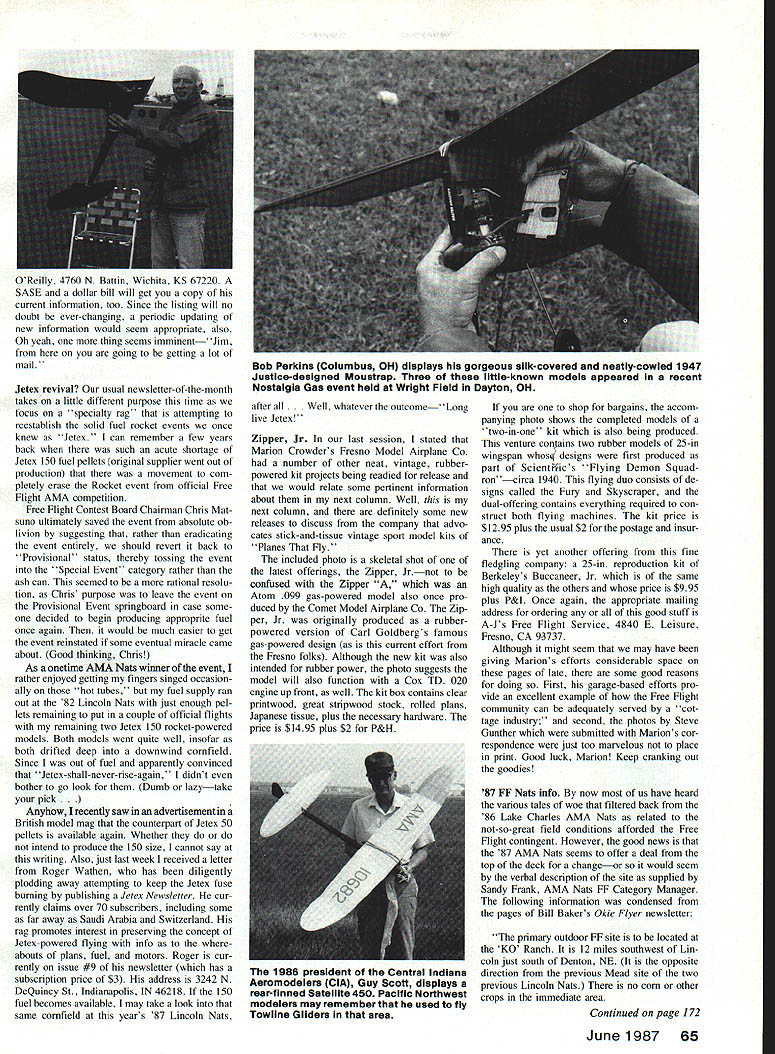
Jim O’Reilly 4760 N. Battin Wichita, KS 67220
A SASE and a dollar will get a copy of the current listing. Expect periodic updates—Jim’s going to be getting a lot of mail.
Jetex revival?
There was a time when shortage of Jetex 150 fuel pellets threatened to erase the Rocket event from AMA Free Flight competition. Contest Board Chairman Chris Matson wisely suggested reverting the event to Provisional (Special Event) status rather than deleting it, so the event could be reinstated if fuel production resumed.
Recently I saw an ad in a British model magazine suggesting Jetex 50 pellets are available again; whether 150 pellets will return is uncertain. Roger Wren has been publishing a Jetex Newsletter to rekindle interest in solid-fuel Jetex flying. He reports over 70 subscribers worldwide and provides information on plans, fuel, and motors. Roger is on issue #6; subscription is $3. Contact:
Roger Wren 3242 N. DeQuincy St. Indianapolis, IN 46218
If 150 fuel becomes available, I may be tempted to look for lost models at this year’s Lincoln Nats. Long live Jetex!
Zipper, Jr.
Marion Crowder’s Fresno Model Airplane Co. (A-J’s Free Flight Service) continues to produce high-quality stick-and-tissue vintage sport models. Recent releases include:
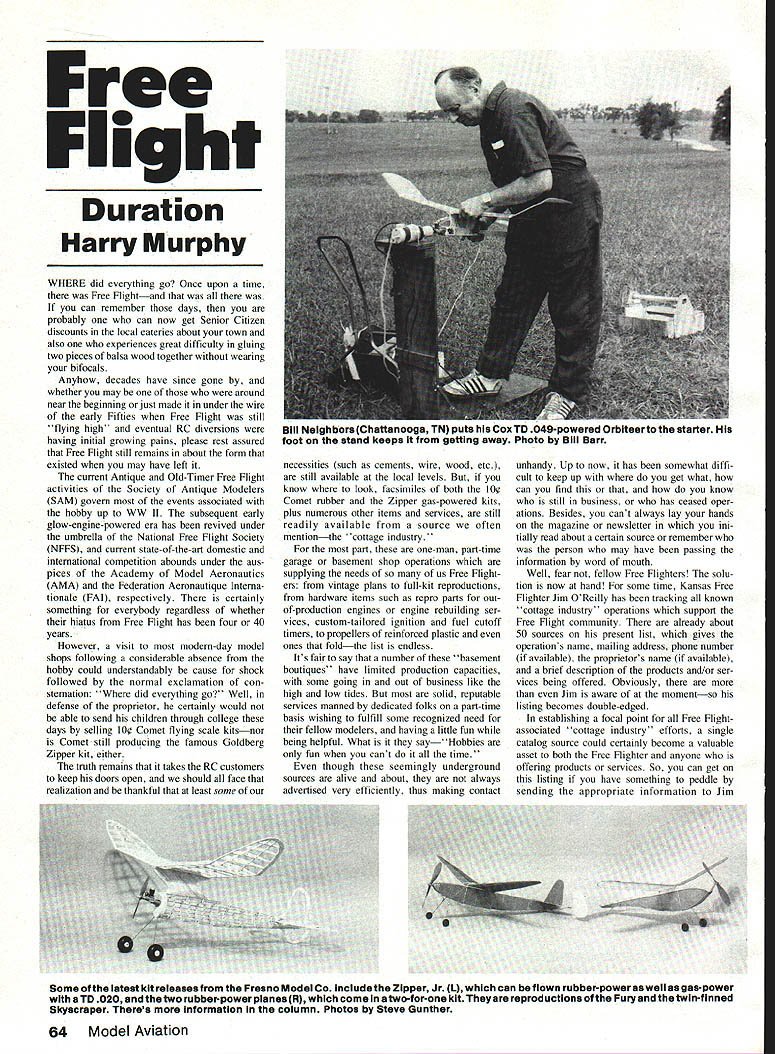
- Zipper, Jr.: a rubber-powered reproduction of Carl Goldberg’s famous Zipper (not to be confused with the Zipper "A" gas-powered Atom .099). The Zipper, Jr. is intended for rubber power but will also accept a Cox TD .020. The kit includes pre-doped printed wood, quality stripwood, rolled plans, Japanese tissue, and necessary hardware. Price: $14.95 + $2 P&H.
- Two-in-one Flying Demon Squadron duo: two 25-inch wingspan rubber models (the dual-finned Fury and Skyscraper), reproductions of designs first issued by Scientific circa 1940. The kit contains everything to build both models. Price: $12.95 + $2 postage & insurance.
- Berkeley’s Buccaneer, Jr.: a 25-inch reproduction kit of comparable quality. Price: $9.95 + $1.
Order from: A-J’s Free Flight Service 4840 E. Leisure Fresno, CA 93727
Marion’s garage-based efforts are a fine example of how the Free Flight specialty has been reclaimed by the do-it-yourself modeler. Keep cranking out the goodies, Marion!
'87 FFF Nats info.
After the poor field conditions at the ’86 Lake Charles AMA Nats, the ’87 AMA Nats site looks promising. The primary outdoor Free Flight site will be the “KO” Ranch, 12 miles southwest of Lincoln, south of Denton, Neb. The site is free of corn or nearby crops and offers a centrally located launch spot on a 660-acre facility with unobstructed visibility over about 300°. The terrain is gently undulating—up to the height of a two-story building—so chasing on foot can be difficult (bikes are permitted; hill-climbing variety recommended). Prevailing winds should provide a clear field at least one mile by two miles.
Indoor events will be flown at the Pershing Auditorium in downtown Lincoln (acoustic-tiled, 49-ft ceiling with recessed lights). Indoor events: Sunday and Monday, July 12–13, 8:00 a.m. to 12:00 p.m. daily. Indoor Category Director:
Richard Doing 6 Canary Hill Drive Pontiac, MI 48055
Outdoor events begin Tuesday, July 14, and run through the following Saturday. Official outdoor flights: 8:00 a.m. to 4:00 p.m. daily. Outdoor Category Director:
Linda Brown 2962 Lexington Trace Drive Smyrna, GA 30080
Let’s swallow the ’86 sour grapes and support the ’87 AMA Nats with optimism. See ya there!
Thermal air mail
A chain-letter discussion has developed around thermal-detection devices and their effect on Free Flight competition. My earlier column mentioned telescoping fiberglass poles with Mylar tape to help indicate thermals; that prompted letters debating whether such gadgets should be restricted.
While some advocate limiting high-tech aids, others counter that spotting a thermal is part of contest strategy. The sensible bottom line seems to be: permit each contestant to spot thermals by whatever means they wish, provided the method is not detrimental to fellow contestants.
See ya downwind!
Harry Murphy 3824 Oakwood Blvd. Anderson, IN 46011
Transcribed from original scans by AI. Minor OCR errors may remain.

