
Free Flight Duration
Ron St. Jean
This is the first of two guest columns by longtime free flighter Ron St. Jean. This month's column departs from the usual type of coverage provided by MA's "FF Duration" columnists, in that it presents a point of view on the subject of free flight rather than having news items. We found it quite thought-provoking, and timely when Ron submitted it as a possible feature article and decided to share it with our readers in this spot instead. The conclusion of the two-part column will be in the September 1987 issue.
Competition: a philosophy
Perhaps I'm just getting too old for it, but I am no longer interested in attending model contests. The 1984 Reno Nats was my last one, and I attended for the sole purpose of demonstrating that SFC-built ships were competitive. (SFC stands for "structureless foam composites," a method of constructing free flight models developed and pioneered by Ron. An article on this method appeared in the April 1982 issue, and a small sport FF model using this type of construction, Alpha One, was in the August 1983 issue. — RMcM.) I might still compete if it were enjoyable, but it is not—just too much hassle.
One philosophy of competition states that, "It doesn't matter what the rules are, because all are affected equally." On the surface this seems quite reasonable since, in most cases at least, all are affected equally.
What is not considered, however, is that the competition, under some rules, may not be enjoyable. Do we fly model airplanes in competition for an enjoyable way to practice our sport/hobby, or do we compete only to increase our self-esteem via increasing our inventory of trophies?
My analysis suggests that most of us compete for both of these reasons. But as we grow older, most of us display diminished ego-satisfaction needs, so the enjoyment of the endeavor becomes increasingly important. Eventually we may reach the point where, if no enjoyment remains, we just quit because the cost has gone too high. (By "cost" I mean not only dollar-cost, but cost in terms of energy, time, and mental anguish. Of course, if we replace this anguish with enjoyment, it becomes a plus or "negative cost.")
At the extreme, I know one flier—a fierce competitor—who has openly stated that he likes exceedingly difficult contest conditions the best; the reason being that many others become discouraged, drop out, and thereby increase his chances of winning. Do we wish to have our rules reflect this philosophy?
Though I was an avid trophy-hound in my youth, the law of diminishing returns set in about 20 years ago. Each new trophy did less for my ego than the one before it. Soon after this, sport flying largely replaced competition simply because it was more fun.
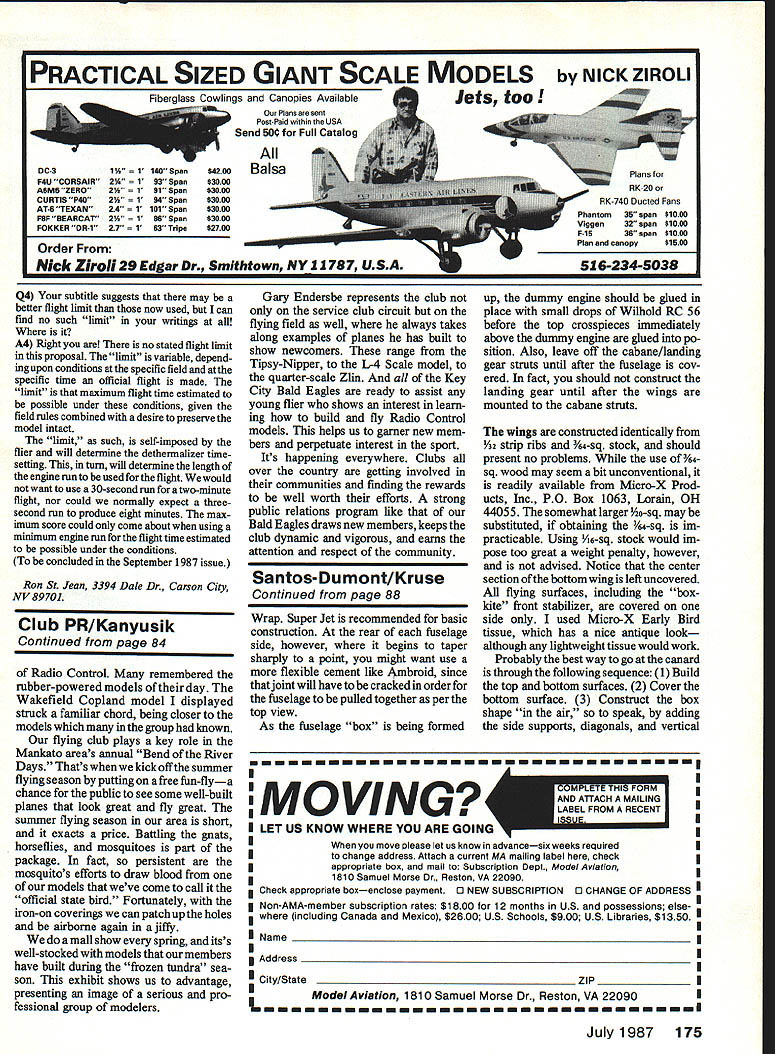
Deep in the heart of Texas' wide-open spaces: the best FF field in the Houston area is a half-hour drive southeast on an Exxon site. Although nearly a mile square, it's punctuated by oil-well rigs, tanks, trees, cattle, power lines, 4-ft. brush and wild bean stalks. The photo was taken at mid-field. Over the freeway is "gone!" Too small for Category III—ratio-scoring would work here.
Beginners' events
The AMA has, on several occasions, established special events for beginners. Even the Junior/Senior/Open age classifications had this in mind—but failed to recognize that some 13-year-olds were experts, while many 30-year-olds were beginners. In RC, the concept of having several skill categories went far toward popularizing the Pattern events. As one became more skilled in the less-skilled category, he advanced to the next higher category of skill.
In FF indoor events, however, the focus of attention has been upon simplifying the models flown so that they require less skill to build. As a result, the same experts who win the advanced events also win the beginners' events. This same result has come about in the outdoor FF rubber events, where the focus has also been upon model simplification. Current efforts to simplify special FF gas events are going in the same direction. Clearly, then, free flighters need to learn the lessons the RCers can teach.
Based upon AMA history, plus a little logic, I would recommend the following be considered when structuring special beginners' events:
- Reducing building and flying skill requirements will certainly permit more individuals to construct the special models. There never has been anything wrong with this concept except that, by itself, it is incomplete.
- Because many beginners are youngsters with only a small amount of cash, consideration should be given to cost-minimization so that more might join in the fun.
- Experts must be kept from flying in beginners' events, since the beginner still hasn't the ghost of a chance of winning against the experts. One way of doing this is to have parallel beginners' and experts' events and allow each contestant to enter one of them—but not both.
One reason the AMA Delta Dart program was so successful is that these three ideas were all incorporated. It is just a shame that there was no intermediate event these kids could advance to that had less competition than the regular AMA competition events.
A better "flight limit" for FF Gas?
During the first two decades of what we now call free flight gas, there were no such things as a flight limit. If one made a 43-minute, in-sight flight, he was given 43 minutes' credit for it. Eventually, however, it became obvious that something had to be done about this situation.
The key which made the first flight limit feasible was the invention of practical dethermalizers. With the introduction of the 10-minute limit of the late Forties, there were fewer lost models because fewer drifted off the field. But there were still too many, so the 10-minute limit was reduced; first to six, then to five minutes. But even this proved inadequate, so we now have separate categories for three- and two-minute limits.
With the shrinking—and outright disappearance—of suitable free flight fields as the population of the United States grew, the small-field problem never went away. It just became more intense with time. It is so bad now that many fliers could not safely make two-minute flights in the best field available within a 100-mile radius of their homes.
Should we formulate new rules to try once again to solve the shrinking-FF-field problem? Do we need Category IV for a one-minute limit and maybe a Category V for a 30-second limit in order to contain models in the smallest fields? Are categories of this type the only approach, or is there a better way to solve the problem? Do we wish to get new people into FF gas by making it more attractive to them? If so, could this be done?
There are currently three field categories in FF gas, times five size classes, times three age groups, times two launching mediums (HL, ROW), equals 90 records for AMA to keep track of. Isn't this overly complicated, especially in view of decreased interest in FF gas in recent decades? What would an appropriate engine run be for a 30-second limit? Perhaps two seconds? Use one second for flyoffs? Do we really want to add another 60 slots to the record book?
Consider, if you will, a totally different alternative to the current method of coping with the small-field problem: suppose we, instead, went to the concept that the best measure of a FF gas model's performance was the ratio of flight time divided by engine-run time. This would be numerically equivalent to the climb/glide ratio, plus one. But it would be easier to calculate, as no subtraction would be needed—just one division accomplished in a few seconds with the aid of the least-expensive pocket calculator.
Inexpensive watches are also now available to do the job. These can be shut down at the end of the engine run for accurate reading, with the engine-off time measuring the total time. The timer would record both engine-run and total time for the flight, then the total-time/engine-run ratio would be calculated by the official handling the flight cards. Finally, an average of the three (still clinging to the three-official-flights concept) flight ratios would be taken for each contestant's final score for the event.
On the surface, this would appear to be just a different way to compute FF gas flight scores; however, when one takes the time to analyze the implications of doing it this way, several important points emerge. Please consider the following:
- There would no longer be a need for three, four, or any number of separate flight-limit categories. One measure would do the job quite nicely. There would be no penalty for short flights to fit small fields, as long as the engine runs were correspondingly short. If my ship will do 180 seconds on a 10-second engine run, it should do about 90 seconds on a five-second run, and the scores would be the same (18.00 in each case). Conversely, if the field and wind should allow it, I could score the same with a 30-second run and a nine-minute flight (540 seconds).
- A contest director must now declare a contest to be Category I, II, or III before the start of competition. Once started, no changes in category may be made. Here in the Far West, most mornings are calm, while most afternoons are windy. Conceivably, one could use a small field for Category I until the wind came up, then switch to II or III—but this is not permitted. With the suggested scoring method, such adjustments to changing wind conditions would be automatic and would be made by the contestants—not by the CD.
- Current rules favor marathons—five, 10, or even 15 flights sometimes being required to remain competitive. With the suggested scoring method the need to have a sequence of flights to find the model's best performance would be obviated; one or two flights could be enough, with the best score of the flights being used.
I recognize that this suggested scoring method is vastly different from those used during the past half-century. It not only would require some getting used to, but several questions come up. Some of these questions will be addressed below.
Questions and answers
Q1) Why should I wish to have 50 years of tradition dumped for a different method of scoring?
A1) First of all, doing this would give greater relief to those flying in the smallest fields. No longer would the CD have to guess what the worst wind conditions would be during the day in picking one fixed competition category. Instead, this would be done by the contestants, who would lower engine runs (thereby lowering the flight times) as the wind picked up. They would want to do this in such a way as to keep their models in sight and within the available field. Second, many fields, under some conditions, are too small for even a two-minute flight. When these conditions come up, the fliers themselves could adjust by shortening engine runs and thereby reduce flight times to the degree needed to keep from losing their models.
Third, some modelers enjoy longer engine runs and flights. When conditions permitted it, they could have them without restructuring the competition. While they did this, those who preferred short engine runs and flights could exercise their preference, too—both under the same rules.
As a fourth consideration, making this change would reduce, for AMA Gas, Headquarters' record-homologation efforts to one-third of what they are at present.
A fifth point is that sophisticated, costly (and often troublesome) engine timers are now required for one to be competitive. If a nine-second engine run is allowed and I only get eight seconds, I'm handicapping myself by 11%. With the ratio scoring outlined here, there would be no such handicap. In fact, I may not need a timer at all, for natural timing alone being accurate enough.
Finally, flyoff marathons would cease, as there would no longer be several days with many fliers achieving the same maxes. Thus, contests could end sooner, or many others could complete in more events instead of being stuck in a marathon for the sake of winning a single event. This would increase both competition and entries, too.
Q2) How about "delayed" flights? Would 40 seconds or less still constitute an "attempt?"
A2) No. The 40-second rule would not be applicable. It would be too soon for short flights and too short for long flights. We would suggest that a score of 2.00 or lower constitute a delayed flight, as this would retain the same relationship as the traditional 40 seconds to a 20-second engine run.
Q3) It seems to me that, despite your ratio idea, many would continue losing their models just to win a contest. Let's say, for example, that field conditions are such that one must get quite high to get into lift. My strategy, then, would be to use a 20-second engine run to get to the lift, but this would require an eight-minute time to get a good score (24.00). I estimate that my ship could stay in this lift for six minutes, but it would be well off the field. I'm willing to take the risks involved, so I go for it.
A3) The point is well-taken. If we want rules to help prevent loss or damage to our models, some extra precautions are in order. I suggest that the rule book give the CD the authority to spell out any field rules needed to solve just this problem before a contest. One such possibility would be that out-of-sight (OOS) flights be scored as zero or at least be made "delayed" flights. (This one should probably be written into the rule book.)
A better example of a "field rule" would be something like: "All flights terminating in the lake (or forest, or over the river, in a residential district, on the mountain, in the swamp, etc.) shall be scored as zero." Would provisions like this be considered encouraging you to keep your model within the contest field? Except for the OOS flights, all such field rules should be at the option of the CD in order to best adjust the rules for local conditions and temperaments.
Q4) Your subtitle suggests that there may be a better flight limit than those now used, but I can find no such "limit" in your writings at all. Where is it?
A4) Right you are! There is no stated flight limit in this proposal. The "limit" is variable, depending upon conditions at the specific field and the specific time of the contest. It is, in fact, the "limit" that is the maximum flight time estimated to be possible under these conditions, given the field rules combined with a desire to preserve the model intact.
The "limit," as such, is self-imposed by the flier and will determine the dethermalizer time setting. This, in turn, will determine the length of the engine run to be used for the flight. We would not want to use a 30-second run for a two-minute flight, nor could we normally expect a three-second run to produce eight minutes. The maximum score could only come about when using a maximum engine run for the flight time estimated to be possible under the conditions.
(To be concluded in the September 1987 issue.)
Ron St. Jean 3394 Dale Dr., Carson City, NV 89701.
Transcribed from original scans by AI. Minor OCR errors may remain.

