
Free Flight: Duration
Harry Murphy
Stationary Auto-Stabs
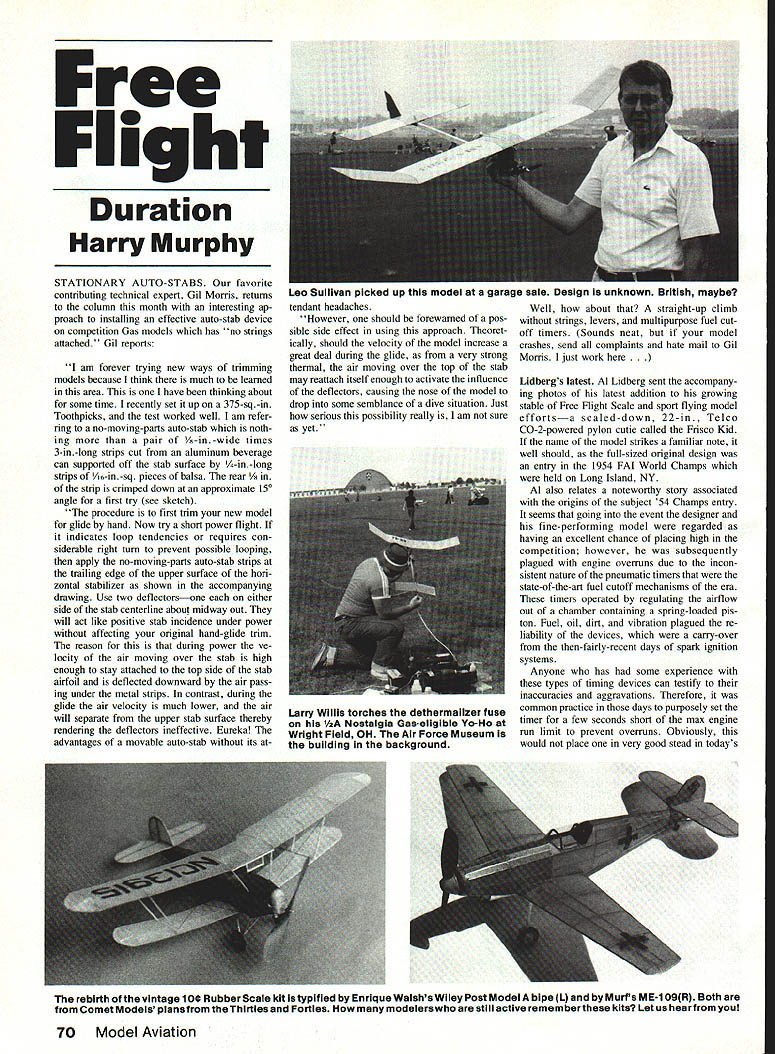
Our favorite contributing technical expert, Gil Morris, returns to the column this month with an interesting approach to installing an effective auto-stab device on competition gas models which has "no strings attached." Gil reports:
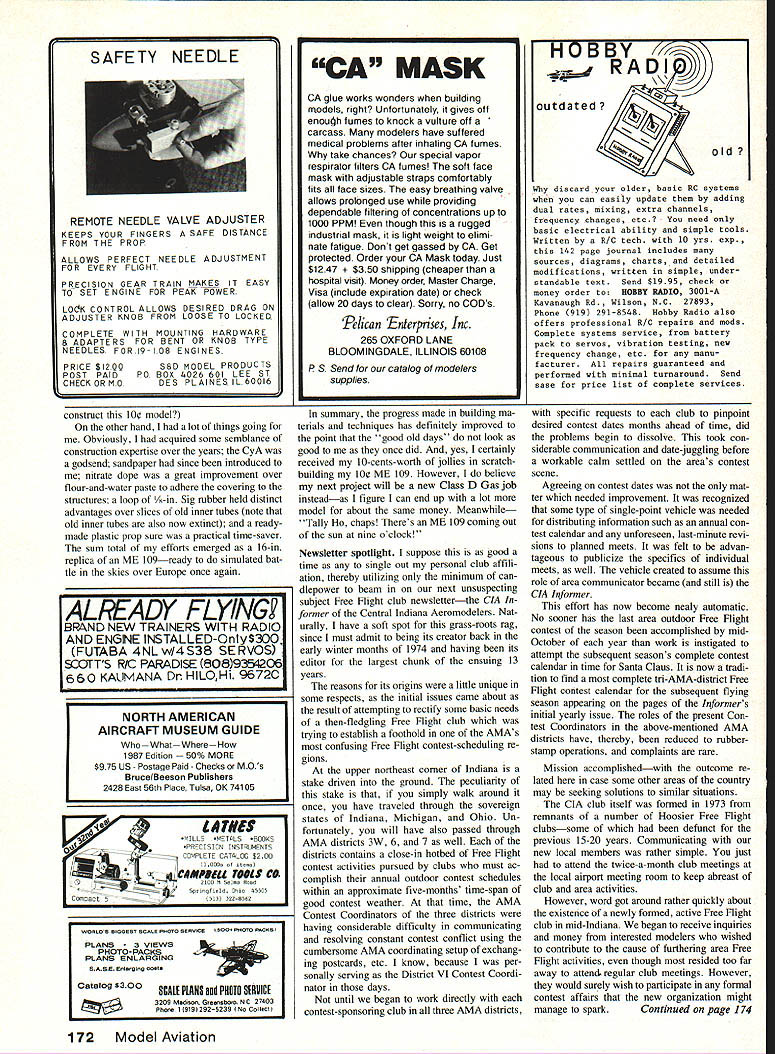
"I am forever trying new ways of trimming models because I think there is much to be learned in this area. This is one I have been thinking about for some time. I recently set it up on a 375-sq.-in. Toothpicks, and the test worked well. I am referring to a no-moving-parts auto-stab which is nothing more than a pair of 1/2-in.-wide by 3-in.-long strips cut from an aluminum beverage can supported off the stab surface by 1/16-in.-long strips of 1/16-in.-sq. pieces of balsa. The rear 1/2 in. of the strip is crimped down at an approximate 15° angle for a first try (see sketch).
"The procedure is to first trim your new model for glide by hand. Now try a short power flight. If it indicates loop tendencies or requires considerable right turn to prevent possible looping, then apply the no-moving-parts auto-stab strips at the trailing edge of the upper surface of the horizontal stabilizer as shown in the accompanying drawing. Use two deflectors—one each on either side of the stab centerline about midway out. They will act like positive stab incidence under power without affecting your original hand-glide trim.
"The reason for this is that during power the velocity of the air moving over the stab is high enough to stay attached to the top side of the stab airfoil and is deflected downward by the air passing under the metal strips. In contrast, during glide the air velocity is much lower, and the air will separate from the upper stab surface thereby rendering the deflectors ineffective. Eureka! The advantages of a movable auto-stab without its attendant headaches.
"However, one should be forewarned of a possible side effect in using this approach. Theoretically, should the velocity of the model increase a great deal during the glide, as from a very strong thermal, the air moving over the top of the stab may reattach itself enough to activate the influence of the deflectors, causing the nose of the model to drop into some semblance of a dive situation. Just how serious this possibility really is, I am not sure as yet."
Well, how about that? A straight-up climb without strings, levers, and multipurpose fuel cut-off timers. Sounds neat, but if your model crashes, send all complaints and hate mail to Gil Morris. I just work here . . .
Lidberg's Latest
Al Lidberg sent the accompanying photos of his latest addition to his growing stable of Free Flight scale and sport-flying model efforts—a scaled-down, 22-in., Telco CO2-powered pylon cutie called the Frisco Kid.
If the name of the model strikes a familiar note, it will; the full-sized original design was an entry in the 1954 FAI World Champs held on Long Island, N.Y.
Al also relates a noteworthy story associated with the origins of the subject '54 Champs entry. It seems that going into the event the designer and his fine-performing model were regarded as having an excellent chance of placing high in the competition; however, he was subsequently plagued with engine overruns due to the inconsistent nature of the pneumatic timers that were the state-of-the-art fuel cut-off mechanisms of the era. These timers operated by regulating the airflow out of a chamber containing a spring-loaded piston. Fuel, oil, dirt, and vibration plagued the reliability of the devices, which were a carry-over from the fairly-recent days of spark ignition systems.
Anyone who has had some experience with these types of timing devices can testify to their inaccuracies and aggravations. Therefore, it was common practice in those days to purposely set the timer a few seconds short of the maximum engine run limit to prevent overruns. Obviously, this would not place one in very good stead in today's competitions.
Anyway, Frisco Kid eventually chugged eleventh place. Its designer, although disappointed, went away with the purpose noted: European competitors were using reliable clockwork timers. He subsequently bought some mechanical clockwork camera timers and set about developing the now-fabled Tick-Off brand mechanical timers. Under the name John Tatone the initial venture became the beginning of the company we still know today as JTec. Isn't it interesting how a simple model airplane competition fizzle provided the turn to a successful lifelong occupation?
Al peddles plans and instructions for the latest version Frisco Kid for the puny sum of $3 postpaid. In addition he offers some 30-odd plans for small CO2, rubber scale, peanut scale, and No-Cal scale (profile fuselages) designs, which are too numerous to list here. When you order your Frisco Kid plans, add an additional dollar and receive his catalog which includes a picture, description, and price of each offering. Available plans range from $2 to $5, including a six-plan peanut scale packet for $5 prepaid. The address is A.A. Lidberg, 614 E. Fordham, Tempe, AZ 85283 — and tell him where you heard about his service (we love that recognition).
Turning 50
The Minneapolis Model Aero Club (MMAC) will chalk up its fiftieth year of existence this year. Founded in 1937, it has been continually active over the years in all aspects of Free Flight modeling: power, rubber, glider, scale, and indoor. It has also published a fine club newsletter since 1959.
Two special occasions are being planned to mark their golden anniversary year. First, there is a two-day Free Flight contest scheduled for the weekend of August 8–9, 1987 at their Blaine, MN contest site, with an on-the-field barbecue feast slated for Saturday evening. (Watch the "Contest Calendar" in Model Aviation for contest event details.)
Second, a fiftieth-anniversary banquet is being planned for the September/October time frame. Specifics on this event will be forthcoming from the MMAC as they are firmed up.
To insure a fine turnout to mark the occasion and to renew old friendships, the MMAC wishes to alert any former club members and friends about these two events. Additional info may be obtained by contacting club spokesman Dan Sephen, 3618 72nd Ave. N., Brooklyn Center, MN 55429. The phone number is (612) 561-6508.
Congratulations on your "first" 50, MMAC! We hope the next 50 years will be just as memorable.
Getting my 10¢ worth
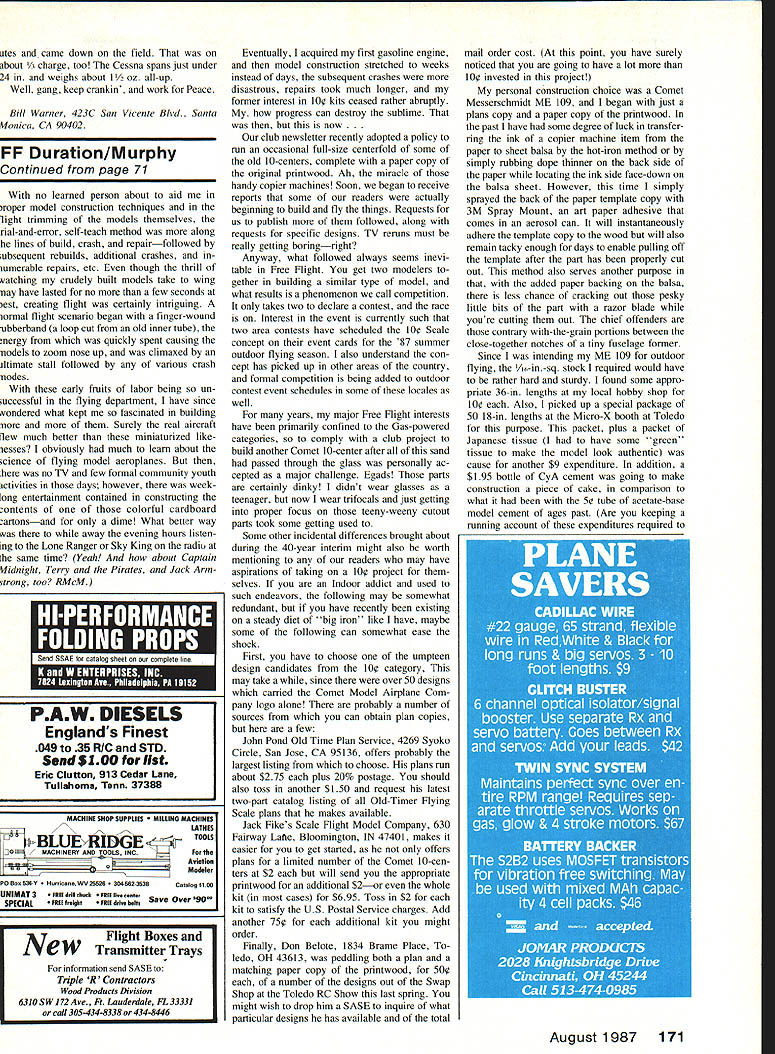
Just as with many a modeler of my age group, my initial infatuation with model aviation came through early teenage adventures with the 10¢ flying model kit which was then readily available at local five-and-dime stores of the period. Comet, Megow, Joe Ott, and Hi-Flyer were but a few of the brand names I remember as suppliers of these intriguing, diminutive, stand-off scale stick-and-tissue flying model construction kits of then-popular commercial and military full-scale aircraft.
With no learned person about to aid me in proper model construction techniques and in the finer trimming of the models themselves, the trial-and-error, self-teach method was more along the lines of build, crash, and repair—followed by subsequent rebuilds, additional crashes, and innumerable repairs. Even though the thrill of watching my crudely built models take to wing may have lasted for no more than a few seconds at best, creating flight was certainly intriguing. A normal flight scenario began with a finger-wound rubber band (a loop cut from an old inner tube), the energy from which was quickly spent causing the models to zoom nose-up, and climaxed by an ultimate stall followed by any of various crash modes.
With these early fruits of labor being so unsuccessful in the flying department, I have since wondered what kept me so fascinated in building more and more of them. Surely the real aircraft were lifelike? But then, these miniaturized likenesses? I obviously had much to learn about the science of flying model aeroplanes. But then, there was no TV and few formal community youth activities in those days; however, there was weekly model entertainment contained in constructing the contents of one of those colorful cardboard cartons—and for only a dime! What better way was there to while away the evening hours listening to the Lone Ranger or Sky King on the radio at the same time? (Yeah! And how about Captain Midnight, Terry and the Pirates, and Jack Armstrong, too?)
Eventually, I acquired my first gasoline engine, and then model construction stretched to weeks instead of days; the subsequent crashes were more disastrous, repairs took much longer, and my former interest in 10¢ kits ceased rather abruptly. My progress can destroy the sublime. The lessons were hard, but this is now . . .
Our club newsletter recently adopted a policy to run an occasional full-size centerfold of some of the old 10-centers, complete with a paper copy of the original printwood. Ah, the miracle of those hand-cut balsa paper machines! Soon, we began to receive reports that some of our readers were actually beginning to build and fly the things. Requests for us to publish more of them followed, along with requests for specific designs.
Interest in the 10¢ Scale concept has grown to the point that two area contests have scheduled the 10¢ Scale event on their ’87 summer outdoor flying season cards. I also understand the concept has picked up in other areas of the country, and formal competition is being added to outdoor contest event schedules elsewhere as well.
For many years, my major Free Flight interests have been primarily confined to the gas-powered scale events, so to comply with a club project to build another Comet 10-centers after all of this sand had passed through the glass was personally accepted as a major challenge. Egads! Those parts are certainly dinky! I didn’t wear glasses as a teenager, but now I wear trifocals and just getting into proper focus on those teeny-weeny cutout parts took some getting used to.
Some incidental differences brought about during the 40-year interim might also be worth commenting on to any of our readers who may have aspirations of taking on a 10¢ project for themselves. If you are an indoor addict and such endeavors would be somewhat redundant, fine; but if you have recently been existing on a steady diet of “big iron” like I have, maybe some of the following can somewhat ease the shock.
First, you have to choose one of the umpteen design candidates from the 10¢ category. This may take a while, since there were over 50 designs that carried the Comet Model Airplane Company logo alone! There are a number of sources from which you can obtain plan copies; here are a few:
- John Pond Old Time Plan Service, 4269 Suyako Circle, San Jose, CA 95136, offers probably the largest listing. His plans run about $2.75 each plus 20% postage. Enclose another $1.50 and request his latest two-part catalog listing of all Old-Timer Flying Scale plans.
- Jack Fife’s Scale Flight Model Company, 630 Fairway Lane, Bloomington, IN 47401, makes it easier to get started. He offers plans for a limited number of the Comet 10-centers at $2 each and will send you an appropriate printwood kit for an additional $2—or the whole kit for $6.95. Toss in $2 for postage. Add another 75¢ for each additional kit you order.
- Don Beebe, 1834 Brame Place, Toledo, OH 43613, was selling both a plan and a matching paper copy of the printwood for 50¢ each at flea markets and meets. He has since listed his stock through the Swap Shop at the Toledo RC Show. Drop him a SASE to inquire which designs he has available and the total mail order cost.
At this point, you have surely noticed that you are going to have a lot more than 10¢ invested in this project!
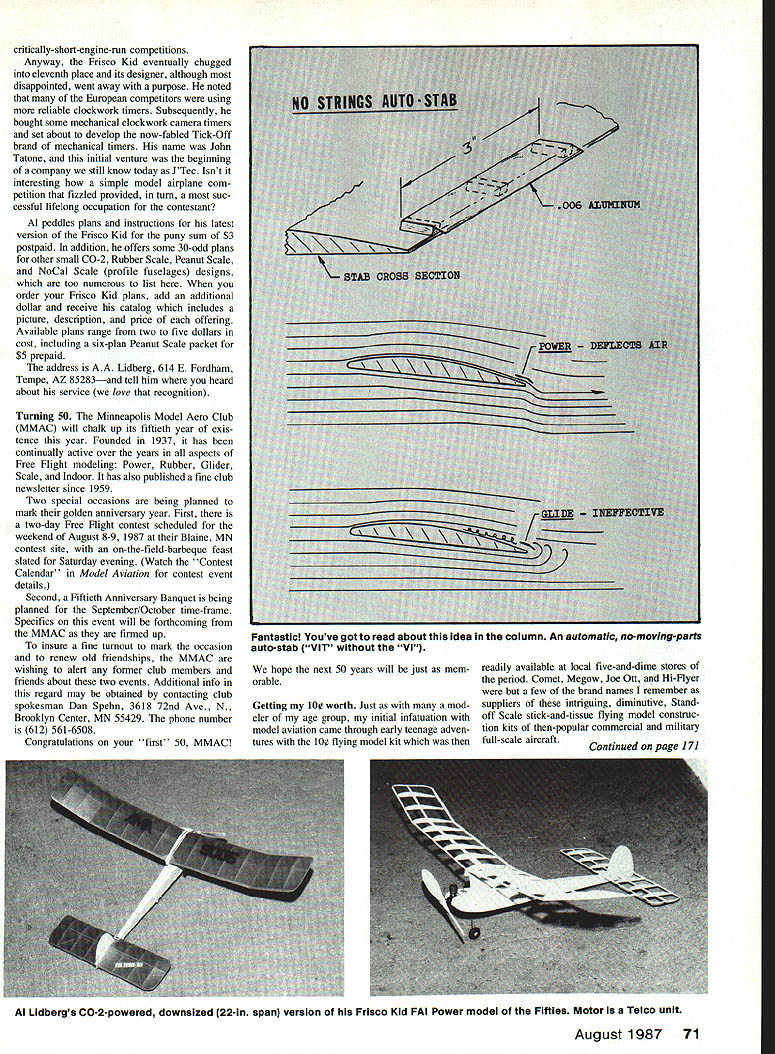
My personal construction choice was a Comet Messerschmitt Me 109, and I began with just a plans copy and a paper copy of the printwood. In the past I have had some degree of luck in transferring the ink of a copier item from the paper to sheet balsa by the hot-iron method or by simply rubbing the paper thinner on the back side of the paper while locating the ink side face-down on the balsa sheet. However, this time I simply sprayed the back of the paper template copy with 3M Spray Mount, an art paper adhesive that comes in an aerosol can. It will instantaneously adhere the template copy to the wood and remain tacky enough for days to enable pulling off the template after the part has been properly cut out. This method also helps reduce cracking of those pesky little bits of the part when cutting them out with a razor blade. The chief offenders are those curvatures with the narrow portions between the close-together notches of a tiny fuselage former.
Since I was intending my Me 109 for outdoor flying, the stock I required would have to be rather hard and sturdy. I found some appropriate 3/16-in. lengths at my local hobby shop for 10¢ each. Also, I picked up a special package of ten 1/8-in. lengths at the Micro-X booth at Toledo for this purpose. This packet, plus a packet of Japanese tissue (I had to have some "green" tissue to make the model look authentic), cost me another $9 or so. In addition, a $1.95 bottle of CA cement was going to make construction a piece of cake compared to the 5¢ tube of acetate-based model cement of ages past. (Are you keeping a running account of these expenditures required to build a 10¢ model?)
On the other hand, I had a lot going for me. I had acquired some semblance of construction expertise over the years; the CA was a godsend; sandpaper had since been introduced to me; nitrate dope was a great improvement over flour-and-water paste for adhering the covering; a loop of 1/4-in. Sig rubber held distinct advantages over slices of old inner tubes (note that old inner tubes are also now extinct); and a ready-made plastic prop was a practical time-saver. The sum total of my efforts emerged as a 16-in. replica of an Me 109—ready for aerial battle once again.
In summary, the progress made in building materials and techniques has definitely improved to the point that the "good old days" do not look as good to me as they once did. And, yes, I certainly received my 10-cents' worth of jollies in scratch-building my 10¢ Me 109. However, I do believe my next project will be a new Class D gas job instead—as I figure I can end up with a lot more model for about the same money. Meanwhile—'Tally ho, chaps!' There's an Me 109 coming out of the sun at nine o'clock!
Newsletter spotlight
I suppose this is as good a time as any to single out my personal club affiliation, thereby utilizing only the minimum of candor to beam in on our next unsuspecting subject—free flight club newsletter—the CIA Informer of the Central Indiana Aeromodellers. Naturally, I have a soft spot for this grass-roots rag, since I must admit to being its creator back in the early winter months of 1974 and having been its editor for the larger chunk of the ensuing 13 years.
The reasons for its origins were a little unique in some respects, as the initial issues came about as the result of attempting to rectify some basic needs of a then-fledgling Free Flight club which was trying to establish a foothold in one of the AMA's most confusing Free Flight contest-scheduling regions.
At the upper northeast corner of Indiana is a stake driven into the ground. The peculiarity of this stake is that, if you simply walk around it once, you have traveled through the sovereign states of Indiana, Michigan, and Ohio. Unfortunately, as you will have also noticed, AMA districts 3W, 6, and 7 as well. Each of the districts contains a close-knit set of Free Flight clubs and contest activities pursued by clubs who must accomplish their annual outdoor contest schedules within an approximate five-month time span of good contest weather. At that time, the AMA contest coordinators of the three districts were having considerable difficulty in coordinating and resolving contest-date conflicts using the cumbersome AMA coordinating setup of exchanging postcards, etc. I know, because I was personally serving as the District V Contest Coordinator in those days.
Not until we began to work directly with each contest-sponsoring club in all three AMA districts, with specific requests to each club to pinpoint desired contest dates months ahead of time, did the problems begin to dissolve. This took considerable communication and date-juggling before a workable calm settled on the area's contest scene.
Agreeing on contest dates was not the only matter which needed improvement. It was recognized that some type of single-point vehicle was needed for distributing information such as an annual contest calendar and any unforeseen weather and contest revisions or changes. We felt it advantageous to publicize the specifics of individual contests as well. The vehicle created to assume this role was the CIA Informer.
This effort has now become nearly automatic. No sooner has the last area outdoor Free Flight contest of the season been accomplished by mid-October than work is instigated to attempt the subsequent season's complete contest calendar in time for Santa Claus. It is now a tradition to put in that most complete tri-AMA-district Free Flight contest calendar for the subsequent flying season as an initial yearly issue. The roles of the present contest coordinators in the above-mentioned AMA districts have thereby been reduced to rubber-stamp operations, and complaints are rare.
The CIA club itself was formed in 1973 from remnants of a number of Hoosier Free Flight clubs—some of which had been defunct for the previous 15–20 years. Communicating with our new local members was simple: attend the twice-a-month club meetings and the local airport meet program to keep abreast of the club's activities.
However, word got around rather quickly about the existence of a newly formed, active Free Flight club in mid-Indiana. We began to receive inquiries and money from interested modelers who wished to contribute to the cause or further our Free Flight activities, even though they resided too far away to attend regular club meetings. They surely wished to participate in any formal contest affairs that the new organization might manage to spark.
Therefore, to enable giving these folks something in return for their obvious support, the Informer again served as a communication tool for club affairs, and subsequently grew in stature with the addition of a constant stream of design and construction articles plus a dash of Hoosier humor sprinkled about for flavoring. At any rate, everyone seemed to like our recipe for "what's the news" with respect to Free Flight in the eastern Midwest.
The current editor-in-chief of the Informer is Moe Whitmore, who is also doing double duty in 1987 in serving as club president. Roger Lane is the vice president, with Meredith Chamberlain retaining the keys to the club strongbox. Club interests run the gamut of Free Flight categories from indoor to FAI as is evident by such names on the membership roster as four-time World Indoor Champ Jim Richmond and current FAI power team member Dale Mateer. The six issues of the newsletter published each year go for $4.50 to domestic and Canadian subscribers, and full-fledged CIA Agent status (club member) amounts to $6 per year.
Well, would you believe it is time to head out to the airport for our next club meeting? So, "See ya downwind!"
Harry Murphy 3824 Oakwood Blvd. Anderson, IN 46011
Transcribed from original scans by AI. Minor OCR errors may remain.

