
Free Flight: Duration
Ron St. Jean
As I was saying when this piece began in the July issue, my suggestion was that the effect upon competitors' enjoyment should be strongly considered in deliberations regarding AMA competition rules changes. An analysis of beginners' events produced the added principle that beginners should not have to compete against experts.
A method of accomplishing this was suggested. It was also suggested that substitution of ratio scoring (flight time divided by engine run) for the present practice of coupling engine‑run times to flight maximums could serve to accomplish three ends:
- Help to solve the small‑field problem.
- Provide a flexibility for competition where it is not now available.
- Permit a logical lumping together of "categories" as we now know them.
Ratio scoring — Q&A
Q5. I'm not sure the flight‑time/engine‑run ratio would be the same for one ship under shorter or longer engine runs. How about javelin launches? A good thrower could use a .001‑second engine run and get a big score; in effect, he could compete with a large hand‑launched glider that just happened to have an engine on the nose which ran for a short time after the heave. Also, wouldn't ships with poor transitions suffer in small fields?
A5. To answer the first question: you are completely correct — javelin launches and very short engine runs would be favored, so a rule is needed to defeat this. The simplest way would be to return to the old ROG (rise‑off‑ground) requirement, but that might be too severe a handicap for many VIT‑equipped (variable‑incidence tail) models. A better approach is to permit hand‑launching but handicap it by adding a couple of seconds to the actual engine run before computing the ratio score for the flight. That practical allowance would prevent exploitation of tiny engine runs and make hand launches equitable.
Yes, ships with poor transitions would suffer in small fields — just as they do today in Categories II and III. The solution is the same as now: either don't compete a plane that has a poor transition except in the appropriate category (Category I), or correct the transition problem.
Putting more fun into Free Flight Gas
I previously suggested making rules that increase competitive enjoyment, thereby bringing more folks into the fold. Now let's apply that principle to FF Gas to see what might be done in addition to ratio scoring.
First, when a modeler must damage or lose his model to compete successfully because rules cannot be adapted to small fields, his enjoyment is lessened. Ratio scoring can, in effect, provide the advantages of an infinite number of site categories by having only one category. But ratio scoring alone does not solve everything: many available fields can accommodate maximum flight durations of only 20 seconds or less. Thus something more is needed to augment ratio scoring.
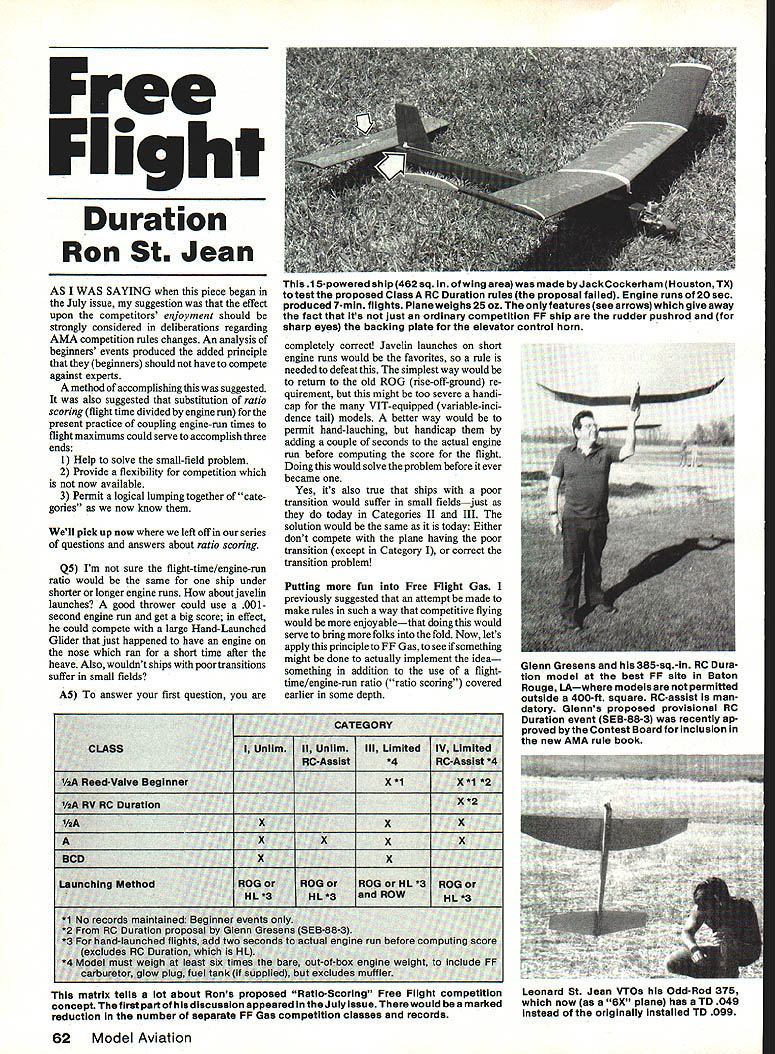
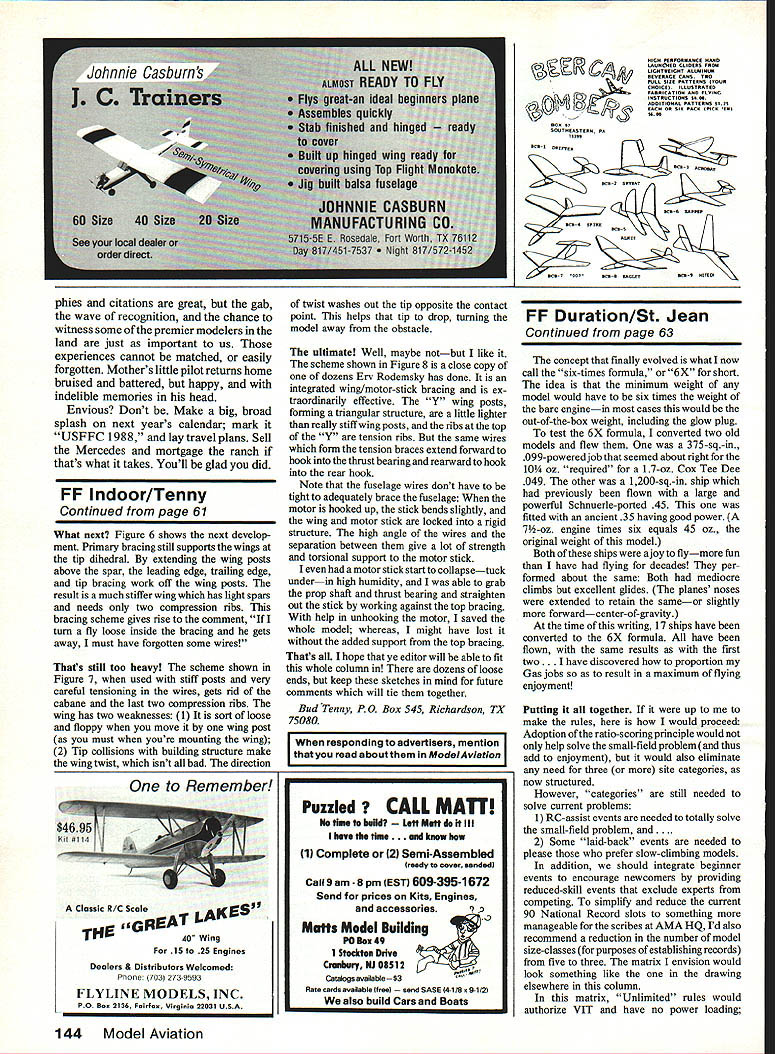
That "something else" is radio control — to keep models in small fields. The idea is simple, practical, and well‑proven. RC‑assist could be used to increase enjoyment by saving many broken and lost models. If RC‑assist were restricted to dedicated RC‑assist events (so models using RC only compete against each other, as in SAM events), then free flighters would not be forced to add RC to all their models to remain competitive.
Implementation of ratio scoring combined with separate RC‑assist events could largely solve the small‑field problem in FF Gas and provide more competitive enjoyment while reducing lost and broken models and encouraging greater participation.
Aerial hot rods, exclusively?
The main reason I dropped out of FF Gas competition was that I was unwilling to convert to modern, VIT‑equipped models — too much hassle — and I could not effectively compete against them without VIT. At a contest in Sacramento, I asked a successful local modeler about VIT. He said he didn't like it but had to use it to be competitive. How many more are like him?
I've noticed entries in AMA FF Gas have fallen while SAM has grown. Besides nostalgia, SAM offers features that may attract people away from AMA:
- Radio Control may be used in many events to solve the small‑field problem and avoid chasing.
- SAM rules preclude meteoric climb rates — most SAM FF ships are quite "laid‑back."
Could AMA offer FF Gas events with rules that preclude 100 ft/sec climb rates? I believe so. Two rule provisions could produce "laid‑back" events:
- No auto‑surfaces permitted.
- A power‑loading requirement that provides slow, "laid‑back" climb rates.
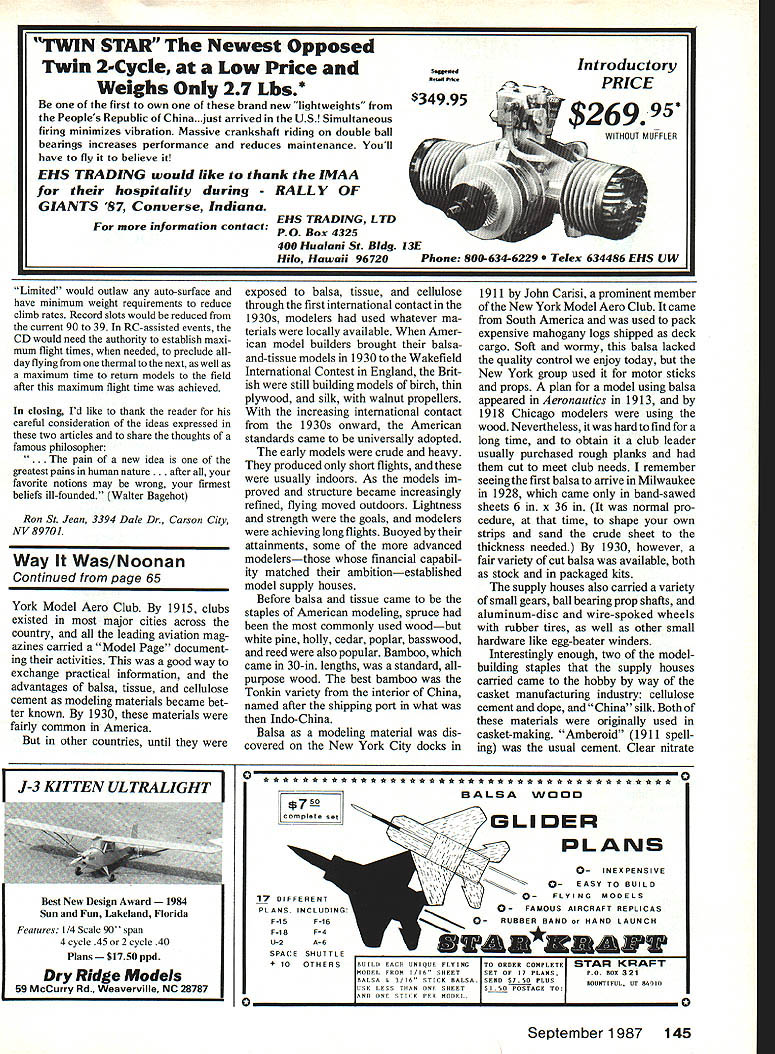
The concept I evolved is the "six‑times formula," or "6X" for short: the minimum weight of any model must be six times the weight of the bare engine — in most cases this is the out‑of‑the‑box engine weight, including the glow plug.
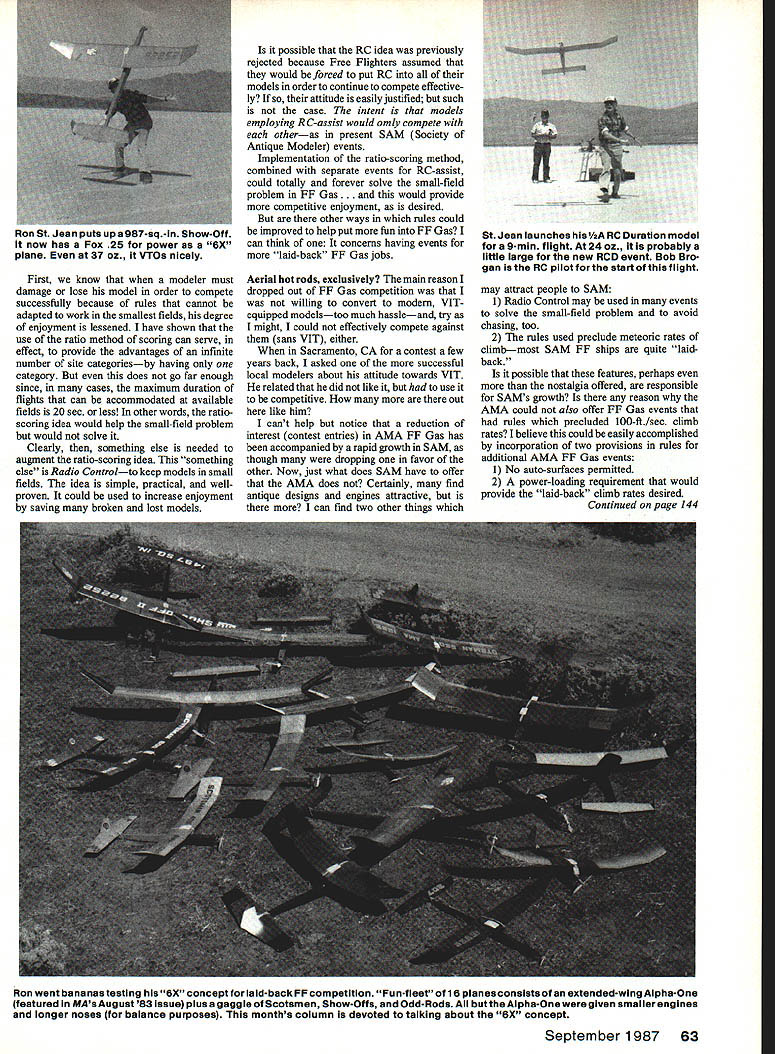
To test the 6X formula I converted two old models and flew them. One was a 375‑sq.‑in., .099‑powered job that seemed about right compared to the typical 1.7‑oz. Cox Tee Dee .049 example. The other was a 1,200‑sq.‑in. ship previously flown with a large .45; it was fitted with an older .35 that had good power. Both were a joy to fly — more fun than I had had flying for decades. They had mediocre climbs but excellent glides. (Noses were extended to retain the same or slightly more forward center of gravity.)
At the time of this writing, 17 ships have been converted to the 6X formula. All have been flown with similar, enjoyable results. I discovered how to proportion my gas jobs to yield maximum flying enjoyment.
Putting it all together
If it were up to me to make the rules, here is how I would proceed:
- Adopt the ratio‑scoring principle — this helps solve the small‑field problem and eliminates the need for multiple size categories as currently structured.
- Maintain separate events to address specific needs:
- RC‑assist events to totally solve the small‑field problem.
- "Laid‑back" events to provide models for those who prefer slow‑climbing models (no VIT and a minimum power‑loading such as the 6X rule).
- Beginner "laid‑back" events to encourage newcomers by providing reduced‑skill events that exclude experts.
- Reduce the number of model size classes for records from five to three to simplify and ease the contest director's workload. (I envision a matrix dividing Unlimited, Laid‑back, and RC‑assist events; Unlimited would authorize VIT and have no power‑loading requirement, Laid‑back would prohibit VIT and require minimum power‑loading, and RC‑assist would permit radio control and could use ratio scoring with appropriate engine‑run allowances so hand‑launch and javelin launches are equitable.)
Adoption of ratio scoring combined with separate RC‑assist and laid‑back events could, I believe, largely solve the small‑field problem. FF Gas would then provide the competitive enjoyment desired while reducing lost and broken models and encouraging greater participation.
Transcribed from original scans by AI. Minor OCR errors may remain.

