
Duration
Bob Meuser
Among the long list of free-flight hardware items, are two rubber-motor installers, one for small Peanut Scale models ($1.00) and the other for larger Peanuts and Walnut Scale size models ($1.50). The brass castings sold by Jim are epoxied into the end of a piece of aluminum tubing. Lastly, there is a D/T fuse holder or "snuffer tube," complete with a peg for the rubber band ($1.95). Simply poke a hole into the aft end of the fuselage, apply a drop of epoxy, and shove Jim's goodie in place. Check with Jim Crocket Replicas, 1442 N. Fruit Ave., Fresno, CA 93728.
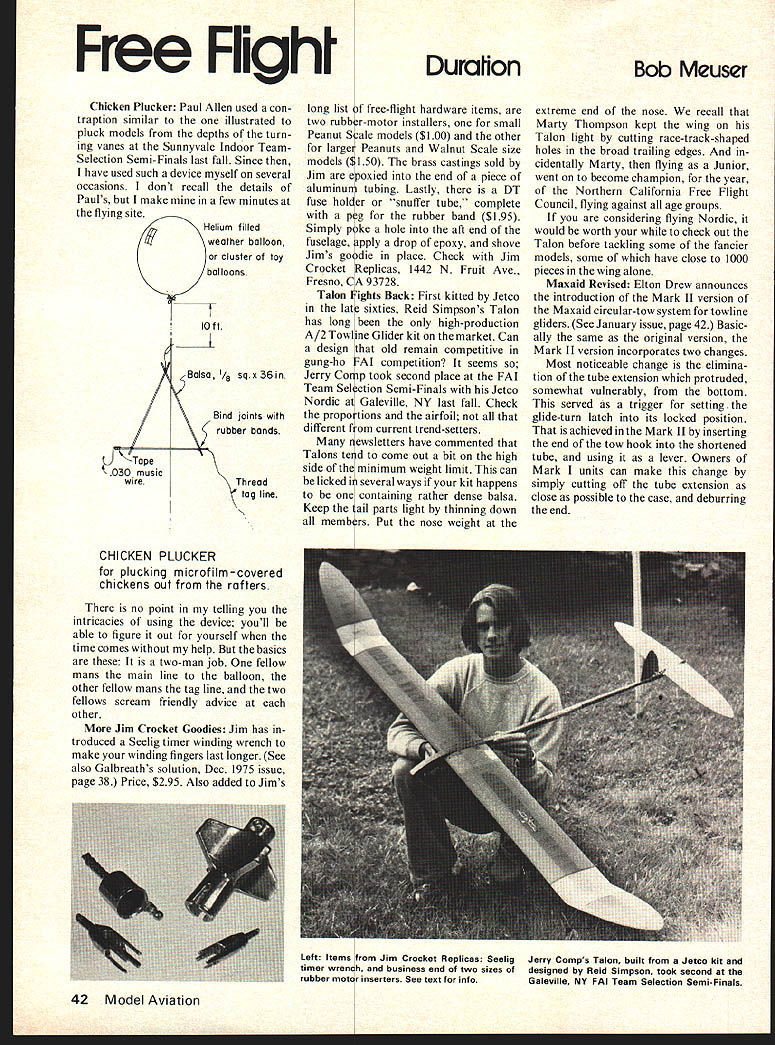
Talon Fights Back: First kitted by Jetco in the late sixties, Reid Simpson's Talon has long been the only high-production A/2 Towline Glider kit on the market. Can a design that old remain competitive in gung-ho FAI competition? It seems so; Jerry Comp took second place at the FAI Team Selection Semi-Finals with his Jetco Talon at Galeville, N.Y. last fall. Check the proportions and the airfoil, not all that different from current trend-setters.
Many newsletters have commented that Talons tend to come out a bit on the high side of the minimum weight limit. This can be licked in several ways if your kit happens to be one containing rather dense balsa. Keep the tail parts light by thinning down all members. Put the nose weight at the extreme end of the nose. We recall that Marty Thompson kept the wing on his Talon light by cutting race-track-shaped holes in the broad trailing edges. Incidentally Marty, then flying as a Junior, went on to become champion, for the year, of the Northern California Free Flight Council, flying against all age groups. If you are considering flying Nordic, it would be worth your while to check out the Talon before tackling some of the fancier models, some of which have close to 1,000 pieces in the wing alone.
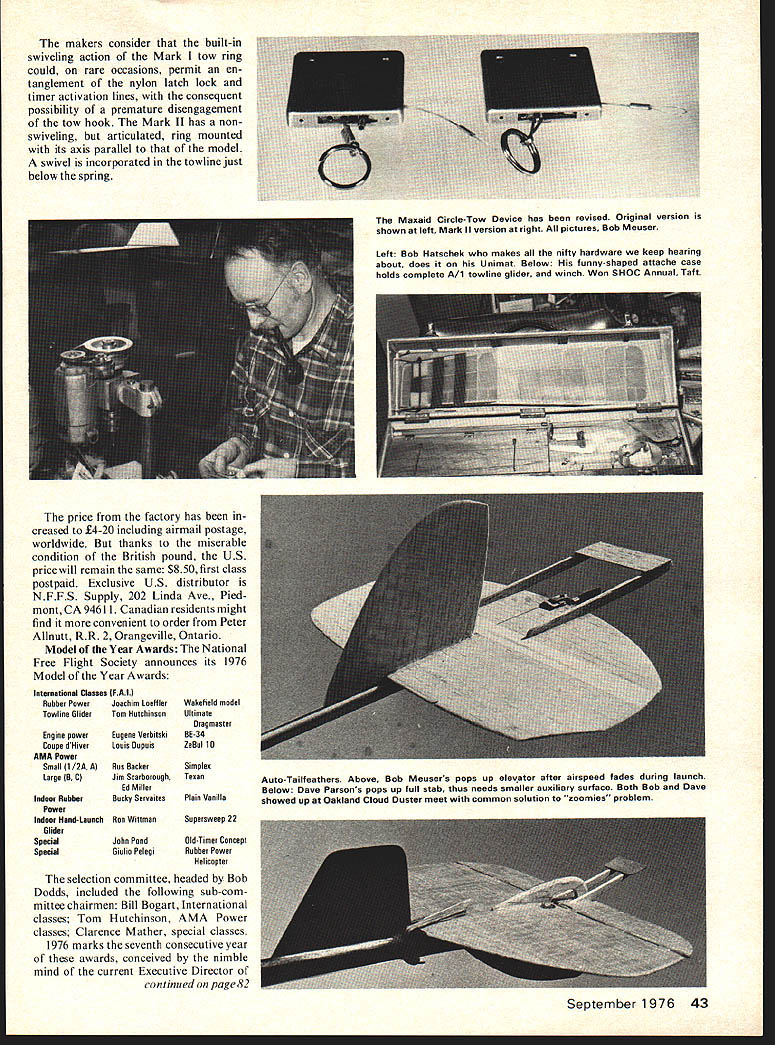
Maxaid Revised: Elton Drew announces the introduction of the Mark II version of the Maxaid circular-tow system for towline gliders. (See January issue, page 42.) Basically the same as the original version, the Mark II incorporates two changes. The most noticeable change is the elimination of the tube extension which protruded somewhat vulnerably from the bottom. This served as a trigger for setting the glide-turn latch into its locked position. That is achieved in the Mark II by inserting the end of the tow hook into the shortened tube and using it as a lever. Owners of Mark I units can make this change simply by cutting off the tube extension as close as possible to the case and deburring the end.
Factory price has been increased (including airmail postage worldwide). Thanks to the miserable condition of the British pound, the U.S. price will remain the same, first-class postpaid. Exclusive U.S. distributor: NFFS Supply, 202 Linda Ave., Piedmont, CA 94611. Canadian residents might find it convenient to order from Peter Allnutt, RR 2, Orangeville, Ontario.
Model of the Year Awards: The National Free Flight Society announces its 1976 Model of the Year Awards:
The selection committee, headed by Bob Dodds, included the following sub-committee chairmen: Bill Bogart, International classes; Tom Hutchinson, AMA Power classes; Clarence Mather, special classes. 1976 marks the seventh consecutive year of these awards, conceived by the nimble mind of the current Executive Director of the desired postal service.
Larry Jordan, of NFFS Plans and Pubs, says the 1975 reports have been selling exceptionally well despite their higher-than-ever price. Best get one before they run out; if they must be reprinted, as the earlier Sympos have, the price will probably be higher.
Plans Source: Gordon Codding, who supplied John Pond with many plans when John started in the O.T. plans business, is now in the business himself. His ten-page list includes many of the standard, and some rare, O.T. rubber and gas models, plus a large selection of rubber-power and gas-power flying scale models. There are Peanut and Walnut Scale lists too. In addition he has prototype and "solid scale" plans spanning aviation from Year One through about 1950.
Supplies Directory: Knowing where to buy some of the nitty goodies we need, which aren't usually available through the standard hobby supply channels, seems to be half the battle in free-flight modeling. I try, on a hit-and-miss basis, to keep up informed of new goodies that come to my attention. Those who fly Old-Timer models will find the supplies situation in a little better shape, for Clarence Andre is compiling a list of suppliers of the sorts of goodies used by O.T. modelers. Those interested in other forms of free flight will probably find the list useful too.
Pieces of the Directory appear, as they are generated, in S.A.M. Speaks, official publication of the Society of Antique Modelers. Jack Bolton is editor, and you can obtain more information about the Society and its publication by writing to him at 9521 Scenic Highway, Pensacola, FL 32504. Clarence Andre might send you copies of the part of the Directory that has now been compiled, if you send him a stamped self-addressed envelope and ask him nicely. 208 E. Rockenstein Ave., Butler, PA 16001.
Clarence's list can benefit from your help too. If you have information concerning suppliers of plans, kits, engines, reproduction parts, accessories, materials, whatever, tell him about it.
And — I hope you can stand this — also listed are copies of original factory drawings of seven World War I planes and a bunch of Golden Era homebuilts. Prices range from a mere $9.00 for the eight-drawing set for Storm's 1930 Flying Flivver, to $75.00 for the 150-drawing set for the Sopwith Pup. Golly. Maybe we could pool our resources and reenact World War I!
Engines Directory: S.A.M. Speaks also is running an alphabetical listing of every engine ever produced by American manufacturers. The March-April issue covered Ace through Apex, so it looks as though it will be a while before they get down through ZZZ Industries.
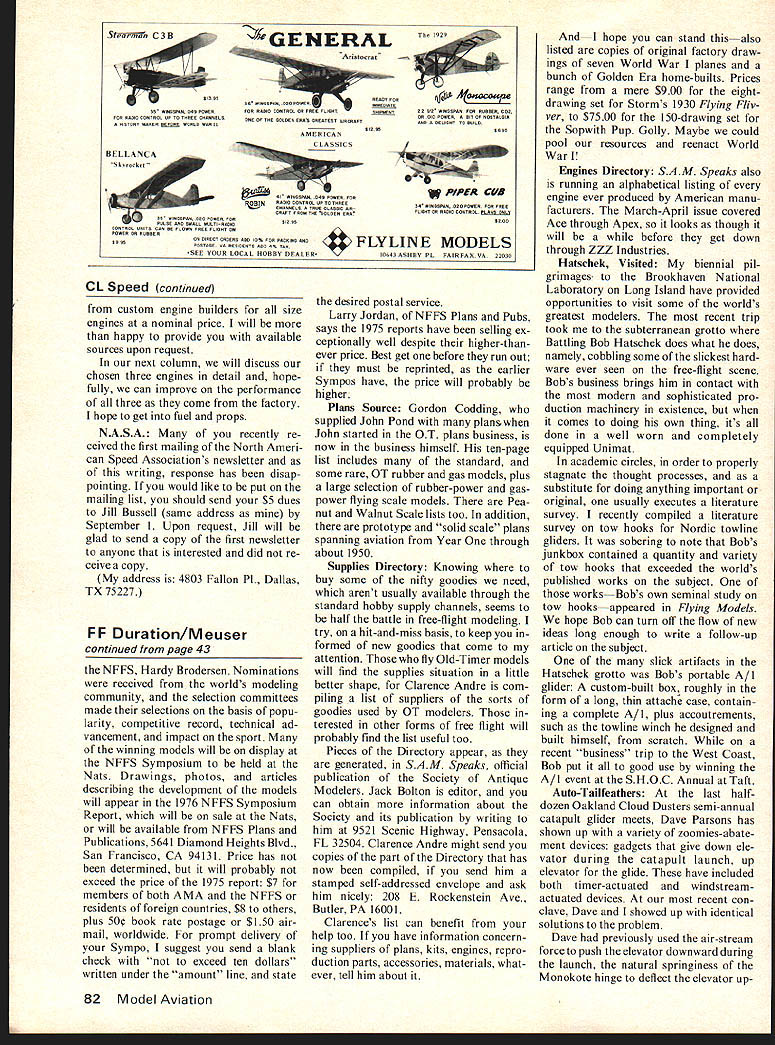
Hatschek, Visited: My biennial pilgrimage to the Brookhaven National Laboratory on Long Island has provided opportunities to visit some of the world's greatest modelers. The most recent trip took me to the subterranean grotto where Battling Bob Hatschek does what he does, namely, cobbling some of the slickest hardware ever seen on the free-flight scene. Bob's business brings him in contact with the most modern and sophisticated production machinery in existence, but when it comes to doing his own thing, it's all done in a well-worn and completely equipped home shop.
In academic circles, in order to properly stagnate the thought processes, and as a substitute for doing anything important or original, one usually executes a literature survey. I recently compiled a literature survey on tow hooks for Nordic towline gliders. It was sobering to note that Bob's junkbox contained a quantity and variety of tow hooks that exceeded the world's published works on the subject. One of those works—Bob's own seminal study on tow hooks—appeared in Flying Models.
We hope Bob can turn off the flow of new ideas long enough to write a follow-up article on the subject.
One of the many slick artifacts in the Hatschek grotto was Bob's portable A/1 glider: a custom-built box, roughly in the form of a long, thin attaché case, containing a complete A/1, plus accoutrements such as the towline which he designed and built himself from scratch. While on a recent "business" trip to the West Coast, Bob put it at his show-and-tell at the A/1 event at the S.H.O.C. annual at Taft.
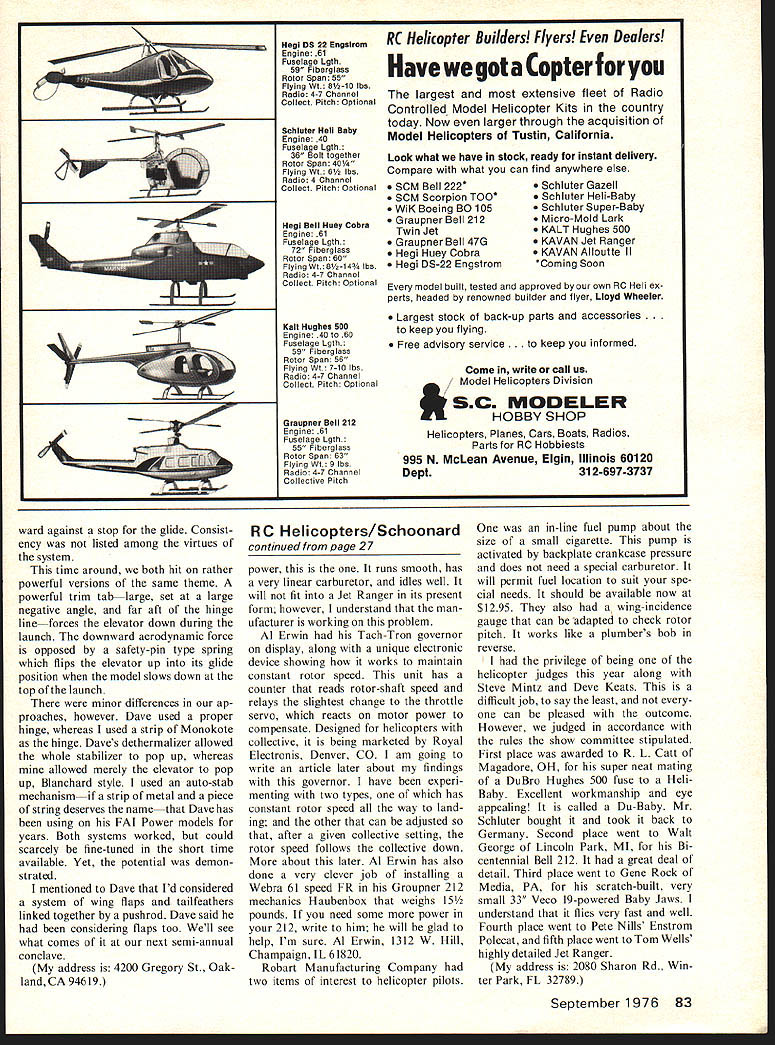
Auto-Tailfeathers: At the last half-dozen Oakland Cloud Dusters semi-annual catapult-glider meets, Dave Parsons has shown up with a variety of zoomie-abatement devices—gadgets that give down-elevator during the catapult launch, or a little temporary down for the plummet and then self-neutralize. He has shown gadgets that are timer-actuated and windstream-actuated. At our most recent conclave, Dave and I showed up with identical solutions to the problem.
Dave had previously used the airstream force to push the elevator downward during the launch; the natural springiness of the Monokote hinge then allowed the elevator to return to the neutral position after the launch. forward against a stop for the glide. Consistency was not listed among the virtues of the system.
This time around, we both hit on rather powerful versions of the same theme. A powerful trim tab — large, set at a large negative angle, and far aft of the hinge line — forces the elevator down during the launch. The downward aerodynamic force is opposed by a safety‑pin type spring which flips the elevator up into its glide position when the model slows down at the top of the launch.
There were minor differences in our approaches, however. Dave used a proper hinge, whereas I used a strip of Monokote as the hinge. Dave's dethermalizer allowed the whole stabilizer to pop up, whereas mine allowed merely the elevator to pop up. Blanchard style. I used an auto‑stab mechanism — if a strip of metal and a piece of string describes the name — that Dave has been using on his FAI Power models for years. Both systems worked, but could scarcely be fine‑tuned in the short time available. Yet, the potential was demonstrated.
I mentioned to Dave that I'd considered a system of wing flaps and tailfeathers linked together by a pushrod. Dave said he had been considering flaps too. We'll see what comes of it at our next semi‑annual conclave.
(My address is: 4200 Gregory St., Oakland, CA 94619.)
Transcribed from original scans by AI. Minor OCR errors may remain.

