
Free Flight: Duration
Harry Murphy
World Championships — Chaleilon Plage, France (August 13–15, 1987)
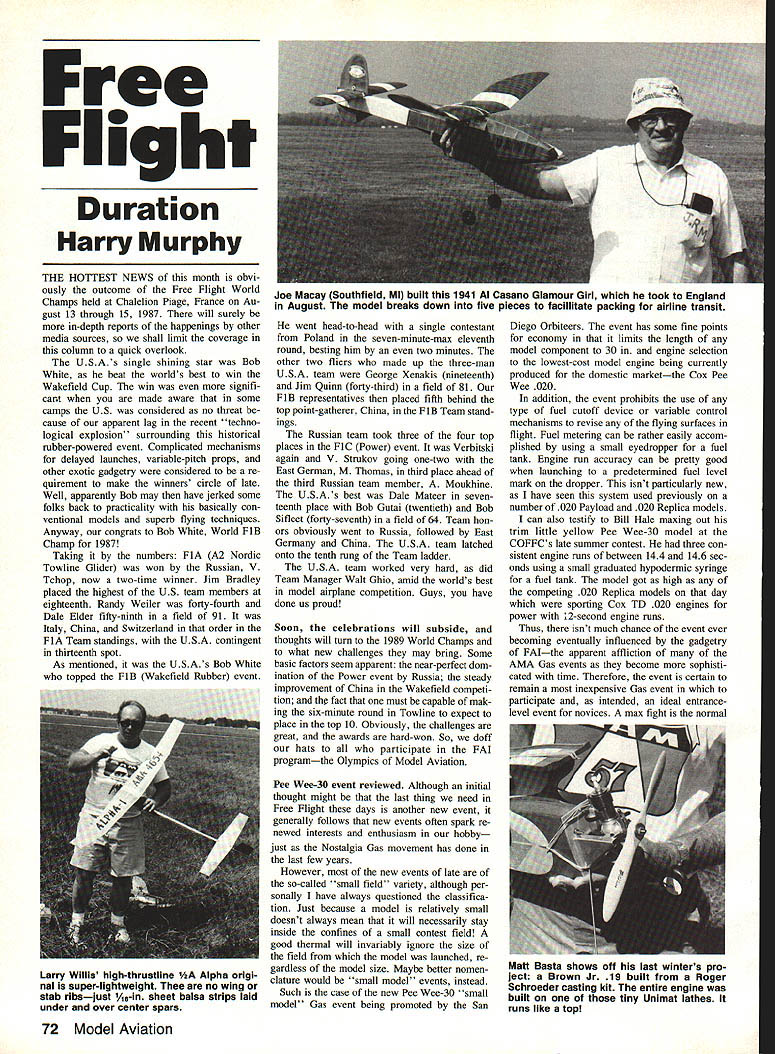
The hottest news this month is the outcome of the Free Flight World Champs held at Chaleilon Plage, France, August 13–15, 1987. There will surely be more in-depth reports elsewhere, so this column offers only a quick overview.
- F1A (A/2 Nordic Towline Glider)
- Winner: V. Tchop (Russia), now a two-time winner.
- U.S.A. placings: Jim Bradley — 18th; Randy Weiler — 44th; Dale Elder — 59th (field of 91).
- Team standings: 1. Italy, 2. China, 3. Switzerland; U.S.A. — 13th.
- F1B (Wakefield Rubber)
- Winner: Bob White (U.S.A.), who beat the Polish contestant in the seven-minute-max event by two minutes.
- U.S.A. team members: George Xenakis — 19th; Jim Quinn — 43rd (field of 81).
- Team standings: China topped the points; the U.S.A. placed 5th.
- F1C (Power)
- Top placings: Verbitski (Russia) and V. Strukov (Russia) went one-two; M. Thomas (East Germany) was third; A. Moukhine (Russia) followed.
- U.S.A. placings: Dale Mateer — 17th; Bob Gutai — 20th; Bob Sifleet — 47th (field of 64).
- Team honors: 1. Russia, 2. East Germany, 3. China; U.S.A. — 10th.
The U.S.A. team and Team Manager Walt Ghio worked very hard against the world's best—guys, you have done us proud. Soon the celebrations will subside and thoughts will turn to the 1989 World Champs. Some basic takeaways:
- Russia's near-perfect domination of the Power event.
- China's steady improvement in Wakefield.
- To place in the top 10 in Towline, you must be capable of making a six-minute round.
We doff our hats to all who participate in the FAI program—the Olympics of Model Aviation.
Pee Wee-30 event reviewed
At first glance another new Free Flight event might seem unnecessary, but new events often renew interest—much like the Nostalgia Gas movement has in recent years. Many recent events are labeled "small field" even though a small model does not guarantee it will stay inside a small contest field; thermals ignore model size. "Small model" would be a better term.
The San Diego Orbiteers are promoting the Pee Wee-30 "small model" Gas event. Highlights and rules (summary):
- Model/component length limit: 30 inches.
- Engine limited to the low-cost Cox Pee Wee .020 (the lowest-cost current domestic production engine).
- Prohibitions: no fuel cut-offs, no variable-control mechanisms, no in-flight revision of flying surfaces.
- Fuel metering: encouraged via a small eyedropper (dropper) fuel tank or similar; a small graduated syringe has been used successfully.
- AMA Category III requirement: two-minute flight time; at least one flight must be ROG (rise-off-ground).
- Scoring (Orbiteers' method): flight time divided by engine run, then multiplied by 100 to give the flight score.
Scoring examples and implications:
- A perfect max flight (120-sec. flight) with a 15-sec. or less engine run:
- 120 ÷ 15 × 100 = 800 points (the rules cap a single-flight maximum at 800 points).
- A 120-sec. flight with a 19-sec. engine run:
- 120 ÷ 19 × 100 ≈ 631 points (a 169-point penalty compared to a 15-sec. run).
Because of that scoring method, the incentive is to obtain engine runs of 15 seconds or less to maximize score—even though the originators say they permit any engine-run length. Given that contests typically allow six attempts to make three official flights, pilots may elect to reject an overrun flight as an attempt and try again to get a two-minute flight with a short engine run. For a three-flight total, three max flights would yield 2,400 points (3 × 800), so consistency of both flight time and short engine runs is crucial.
The Orbiters have worked hard on the rules—perhaps overly so; the finalized rules occupy much space explaining the unusual scoring. My view: Pee Wee-30 is a "lotsa fun" Gas event with very simple models, but the scoring system is overcomplicated.
A note on a personal Pee Wee-30: I built a blown-up 10-cent Comet Phantom Flash from plans sent by airline pilot/humorist Ed Toner. If you want a copy of the plans, contact Ed Toner at 52 Newbury Rd., Howell, NJ 07731—and tell him "The Phantom" sent you!
Newsletter spotlight
Each month this column briefly highlights a Free Flight newsletter. This month we shine the spotlight on the San Diego Orbiteers' El Torbellino (Spanish for "the turbine"). It is one of the better-edited and most colorful newsletters I’ve seen. Editor Don Oldenkamp and his contributing staff do a fine job of gathering and presenting material.
The club seems to have many officers—perhaps more officers than some clubs have members:
- Don Bartlett — Vice President and Program Chairman
- Fudo Takagi — Treasurer
- Speedy Diaz — Secretary
- Ed Booth — Trophy Manager
- Don O'Leary — President (to the best of my recollection)
This structure may give everyone something to do or may risk burning out the most active members. Much of the club's success appears due to an emphasis on Indoor non-Gas categories, "small model" events, and promotion of Junior and Novice involvement.
Photo phun, Mulvihill thoughts and a closing note
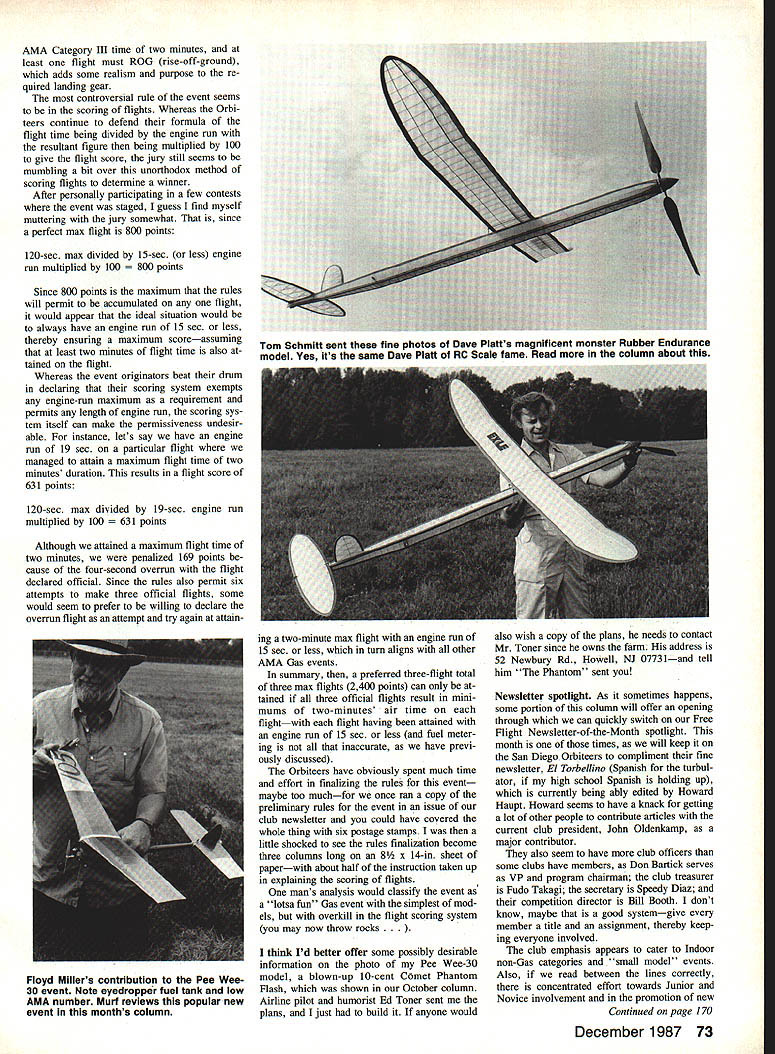
Dave Platt's majestic rubber model shown in this month's column is the work of a meticulous craftsman. Tom Schmidt, who took the photos, calls it an "Unlimited" Rubber model. Since the current Mulvihill Rubber event rules specify a maximum wing area of 300 sq. in., I wondered whether "Unlimited" means something different in this context. From a competition point of view, if a model exceeds 300 sq. in. and cannot fly in Mulvihill competition, it becomes a "fun model"—and that can be just fine.
John Winter, the AMA's Executive Director, recently wrote to the NFFS president outlining factors he believes are contributing to the decline of Free Flight participation, including that Free Flighters are too focused on competition and might benefit from "fun events" like the RC community. Perhaps there is truth in that; however, Free Flighters also relish the thrill of winning and the agony of defeat. Whether a model is "fun" or competitive, the pleasure of flying remains.
My apologies to Dave Platt—whether his model is under or over 300 sq. in. is immaterial. It's still beautiful.
Well, with winter coming on, next time's column will be packed with building tips—assuming I'm still here. If not, I'll see you downwind!
Harry Murphy 3824 Oakwood Blvd. Anderson, IN 46011
Transcribed from original scans by AI. Minor OCR errors may remain.

