
Free Flight: Duration
Barnaby Wainfan
GREETINGS from the world of the aerodynamically strange. MA’s publisher, Carl Wheatley, has once again asked me to write a guest column to keep the forces of conventionality (aft‑mounted tails) at bay for another month. I’ll start out by following up on two unconventional configurations I discussed last time I wrote a column. Since then, new wind‑tunnel results have become available that show some great possibilities.
Swept tips revisited
A wingtip design getting a lot of attention is a highly tapered tip with a leading‑edge sweep of about 60°. Theory predicts these tips can reduce induced drag and increase span efficiency without the parasite‑drag penalty associated with winglets; crescent‑shaped wings might even exceed the span efficiency of an elliptical wing.
NASA tested swept (or “sheared”) tips in the Langley wind tunnel. Reported by Paul Vigyan (working with K. C. Van Dam and Bruce Holmes) at Oshkosh, the tests showed that sheared tips used on a straight‑tapered wing improved efficiency by about 3.5 percent over an optimized Hoerner tip. The tested tips formed the outer 12% of the wingspan. A 3.5 percent drag reduction may sound small, but it translates to roughly 10 seconds on a five‑minute max flight, and about 31–32 seconds on a 15‑minute indoor flight — enough to affect competition results, especially in span‑limited events.
Now that the drag reduction from simple sheared tips has been demonstrated experimentally, NASA plans additional wind‑tunnel tests to see if the higher span efficiencies predicted for crescent wings can be realized in practice. Results of the sheared‑tip tests will be published in an upcoming AIAA paper.
Another look — boxplanes
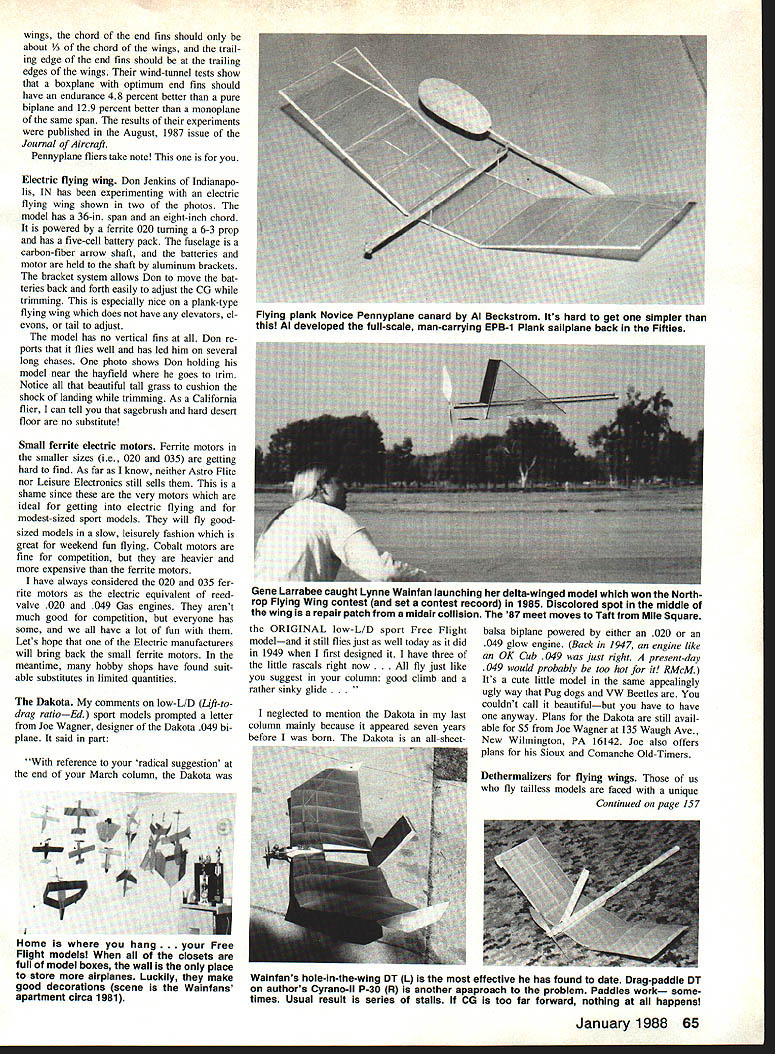
A biplane with the wingtips connected by end plates — the boxplane — promises very low induced drag. Historically, parasite drag from the end fins has reduced the net benefit. A recent study by Peter Gall and Hubert Smith examined how small the chord of the tip fins could be before they became ineffective.
Their wind‑tunnel tests indicate that for constant‑chord wings the chord of the end fins should be about 1/6 of the wing chord, with the trailing edge of the end fins aligned with the wing trailing edges. A boxplane fitted with these optimum end fins showed endurance about 4.8 percent better than a pure biplane and 12.9 percent better than a monoplane of the same span. The results appeared in the August 1987 issue of the Journal of Aircraft. Pennyplane fliers, take note.
Electric flying wing
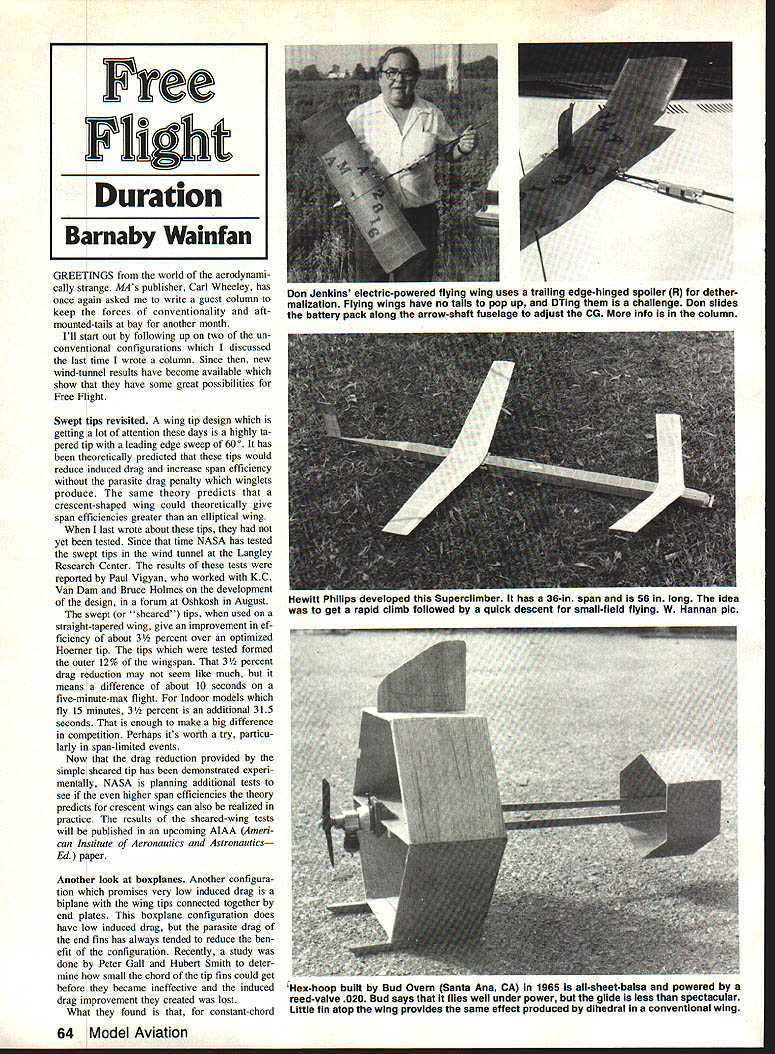
Don Jenkins of Indianapolis has been experimenting with a small electric flying wing. The model has a 36‑inch span and an 8‑inch chord, powered by a ferrite .020 motor turning a 6x3 prop and fed by a five‑cell battery pack. The fuselage is a carbon‑fiber arrow shaft; batteries and motor are mounted on the shaft with aluminum brackets that allow easy fore‑and‑aft movement to adjust the CG while trimming — a helpful feature on plank‑type flying wings that lack conventional tail surfaces. The model has no vertical fins. Don reports it flies well and has led him on several long chase retrieves; tall grass at his trim field cushions shock landings nicely.
Small ferrite electric motors
Small ferrite motors (.020 and .035) are becoming hard to find; as far as I know neither Astro Flight nor Leisure Electronics currently sells them. That’s a shame — these motors are ideal for getting into electric flying and for modest‑sized sport models. They drive good‑sized models slowly and pleasantly, great for weekend fun. Cobalt motors suit competition but are heavier and more expensive than ferrite types. Many hobby shops have found limited substitutes; let’s hope a manufacturer brings these small ferrite motors back into regular production.
The Dakota
My comments on low‑L/D sport models prompted a letter from Joe Wagner, designer of the Dakota .049 biplane. The Dakota is an all‑sheet balsa biplane that flies with either an .020 or .049 glow engine (an OK Cub .049 was ideal in the 1940s). It’s an appealingly ugly little model that flies well with a good climb and a short, snaky glide. Plans for the Dakota are still available for $5 from Joe Wagner, 135 Waugh Ave., New Wilmington, PA 16142. Joe also offers plans for his Sioux and Comanche Old‑Timers.
Dethermalizers for flying wings
Those of us who fly tailless models face a unique dethermalizer problem: you often need to match the dethermalizer material to the color of the surrounding area so it’s effective but not visually jarring. Dyes (Dr. Marin’s) or food coloring might work for tinting fillers. Adding a little white glue to filler makes it stickier but harder to sand. Many lightweight fillers use glass microballoons as a main ingredient — avoid inhaling sanding dust.
People, books, and modeling notes
- I’ve heard good news about more spouses getting involved in modeling: Shelly Dittman and Jane Schlosberg are both active, and that’s great to hear. Some women get so good at it they put the rest of us to shame (for example, Addie Necaaretto’s huge float biplane for the Lockheed Museum).
- Lympne fans: Richard Riding (editor of Aeroplane Monthly) has a new book, Ultralights: The Early British Classics. It compiles magazine material plus new content, with an excellent photo section on early engines (26 selected engines from the ABC 398cc to the Walter Micron). The book includes over 400 photographs, scale drawings, and data tables covering British lightplane history between the world wars. It’s available in hardback for 19.95 British pounds from Patrick Stephens, Ltd., Dedington Estate, Wellingborough, Northants, NN8 2QD, England. Highly recommended.
Understanding propellers
Propeller performance is often misunderstood. A spinning prop’s tips move through the air faster than the hub, so blade pitch must decrease from root to tip. The tip’s extra speed means it needs a lower angle of pitch; the root, moving more slowly, needs a much higher angle to contribute usefully. When you make props by cutting blades from a cylinder (a cottage‑cheese container) or molding laminates on a bottle, you must tilt the blade blank the correct way (commonly about 15° left of vertical on the cylinder) so the finished prop has higher pitch at the root and lower at the tip. If you tilt the wrong way, you’ll end up with high pitch where you need low and vice versa — the prop will look almost normal but will give poorer performance. Thanks to Paul McIlrath for this tip.
Keep your blades angled right and your peanuts out of the snowdrifts!
Barnaby Wainfan 2503 Hardwick St., Lakewood, CA 90712
Transcribed from original scans by AI. Minor OCR errors may remain.

