
Free Flight: Duration
Dave Linstrum 4057 San Luis Dr. Sarasota, FL 33580
AMA Museum exhibit
FREE FLIGHT on TV? Not really — although Free Flight and other AMA modeling have been shown on television in the past — but it seems that way when you view the Free Flight models suspended from what looks like a gigantic, inverted TV antenna in the atrium of the AMA Museum in Reston, VA.
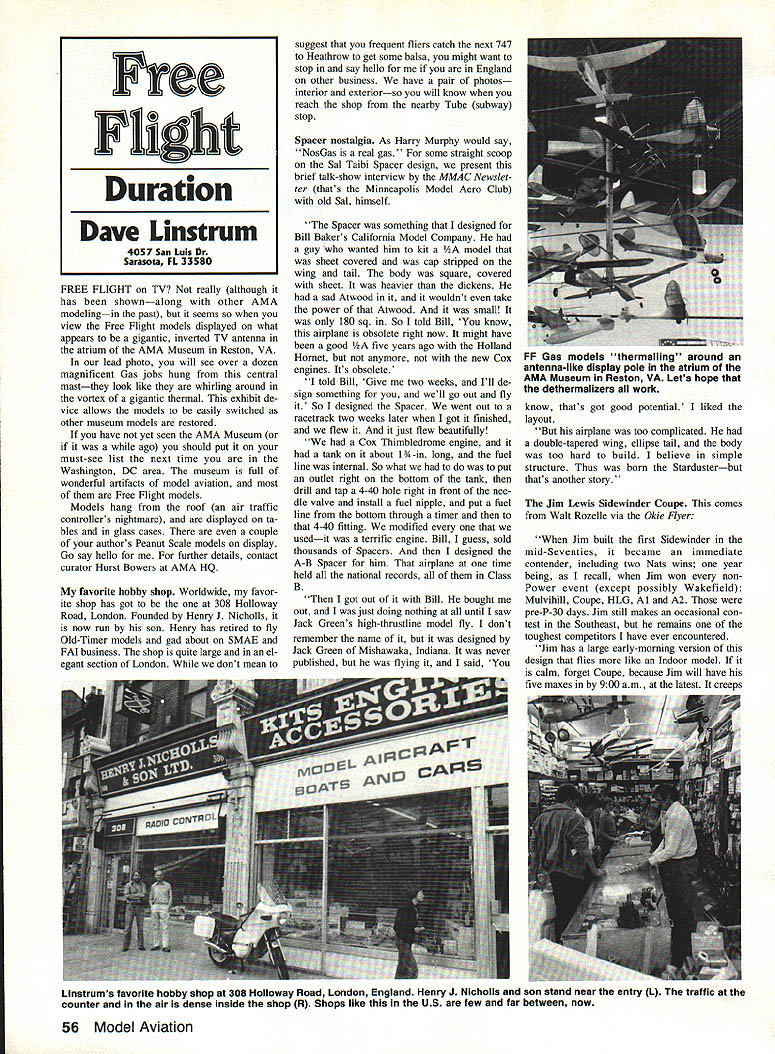
In the lead photo you can see over a dozen magnificent gas ships hung from the central mast; they look as if they are whirling in the vortex of a gigantic thermal. The exhibit device allows models to be easily switched as restorations are completed. If you haven't yet visited the AMA Museum (or it's been a while), put it on your must-see list when you're in the Washington, D.C., area. The museum is full of wonderful artifacts of model aviation, and many of them are Free Flight models.
Models are displayed hanging from the roof (an air-traffic controller's nightmare), on tables, and in glass cases. There are even a couple of the author's Peanut Scale models on display. For further details, contact curator Hurst Bowers at AMA Headquarters.
Favorite hobby shop
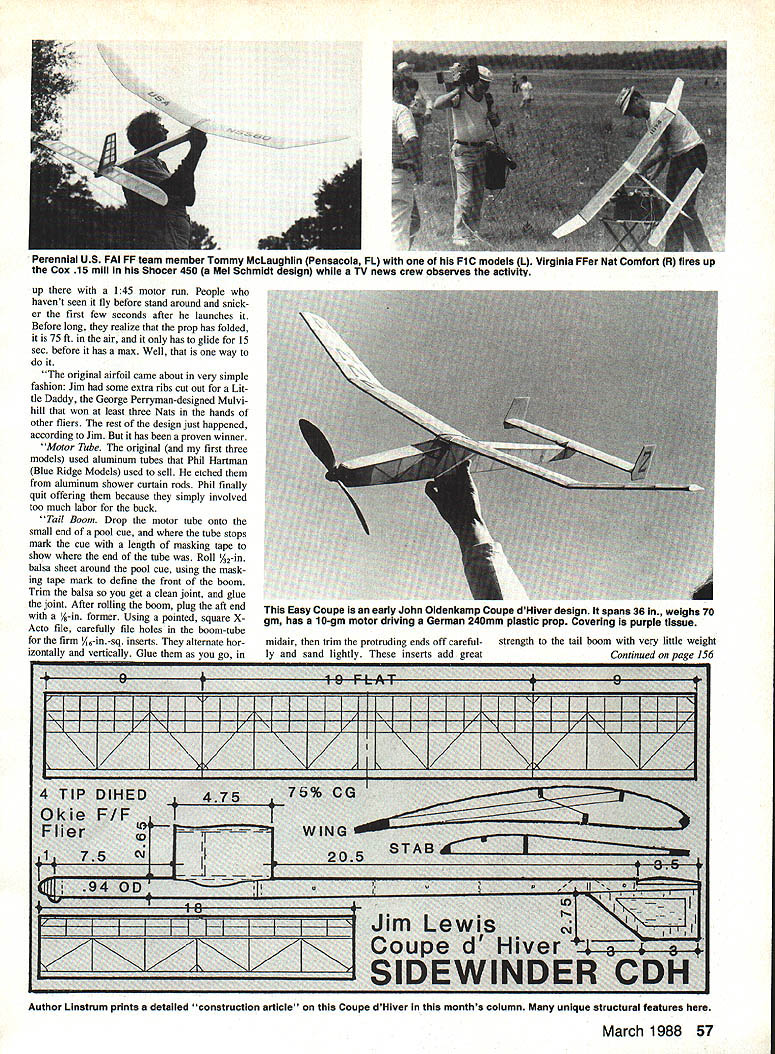
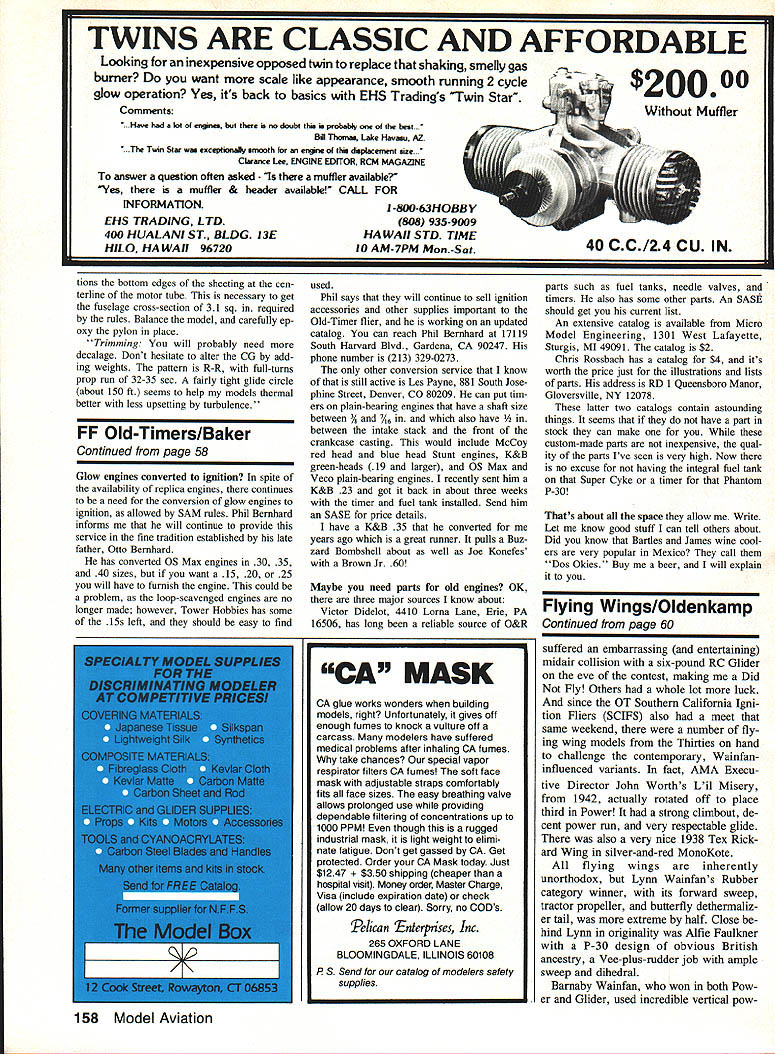
My favorite hobby shop worldwide is at 308 Holloway Road, London. Founded by Henry J. Nicholls and now run by his son (Henry has retired to Old-Timers and works on SMAE and FAI business), the shop is large and located in an elegant section of London. I don't mean to suggest frequent fliers book a 747 to Heathrow just to buy balsa, but if you're in England on other business, stop in and say hello. The shop provides photos of the interior and exterior so you'll know it from the nearby Tube (subway) stop. Shops like that in the U.S. are few and far between now.
Spacer — Sal Taibi (MMAC Newsletter excerpt)
Spacer nostalgia. As Harry Murphy would say, "No gas is a real gas." For some straight scoop on the Sal Taibi Spacer design, here is a brief talk-show-style account from the MMAC Newsletter with Sal Taibi:
"The Spacer was something I designed for Bill Baker's California Model Company. A fellow wanted Bill to kit a 1/2A model that was sheet-covered and had a cap-stripped wing and tail. The body was square and sheet covered. It was heavier than the dickens, had a sad Atwood in it, and it wouldn't even take the power of that Atwood. It was small — only about 180 sq. in. I told Bill, 'This airplane is obsolete right now; it might have been a good 1/2A five years ago with the Holland Hornet, but not anymore, not with the new Cox engines. It's obsolete.'
"I told Bill, 'Give me two weeks, and I'll design something for you, and we'll go out and fly it.' I designed the Spacer, and two weeks later we went to a racetrack and flew it. It just flew beautifully.
"We had a Cox Thimble-drome engine with a tank about 1-3/8 in. long and an internal fuel line. We put an outlet on the bottom of the tank, drilled and tapped a 4-40 hole right in front of the needle valve, installed a fuel nipple, and routed a fuel line to the bottom through that 4-40 fitting. We modified the engine — it was a terrific powerplant. Bill sold, I guess, thousands of Spacers. Then I designed the A-B Spacer for him. That airplane at one time held all the national records in Class B.
"Eventually I got out of it with Bill. He bought me out, and I was pretty much doing nothing until I saw Jack Green's high-thrust-line model fly. I don't remember the name — it was designed by Jack Green of Mishawaka, Indiana and never published — but when he flew it it won, and I said, 'That's got potential.' I liked the layout, but Jack's airplane was too complicated: double-tapered wing, elliptical tail, and a body that was hard to build. I believe in simple structure. Thus was born the Starduster — but that's another story."
Anecdotes and design notes
- Up there with a 1/45 motor run: people who haven't seen these models fly before often snicker for the first few seconds after launch. Before long they realize the prop has folded, the model is 75 ft. in the air, and it only has to glide for 15 seconds before it maxes — one way to do it.
- The original airfoil for one successful design came about simply: Jim had a few extra ribs cut for a Little Daddy (the George Perryman–designed Mulvihill that won several Nats). The rest of his design just happened, but it has been a proven winner.
- Jim Lewis's Sidewinder Coupe (from Walt Rozelle via the Okie Flyer): Jim built the first Sidewinder in the mid-'70s and it became an immediate contender, including two Nats wins in a year. Jim still flies occasionally in the Southeast and remains one of the toughest competitors around. His large early-morning version flies like an indoor model in calm air and can produce five maxes by 9:00 a.m.; the latest version creeps to 56 seconds.
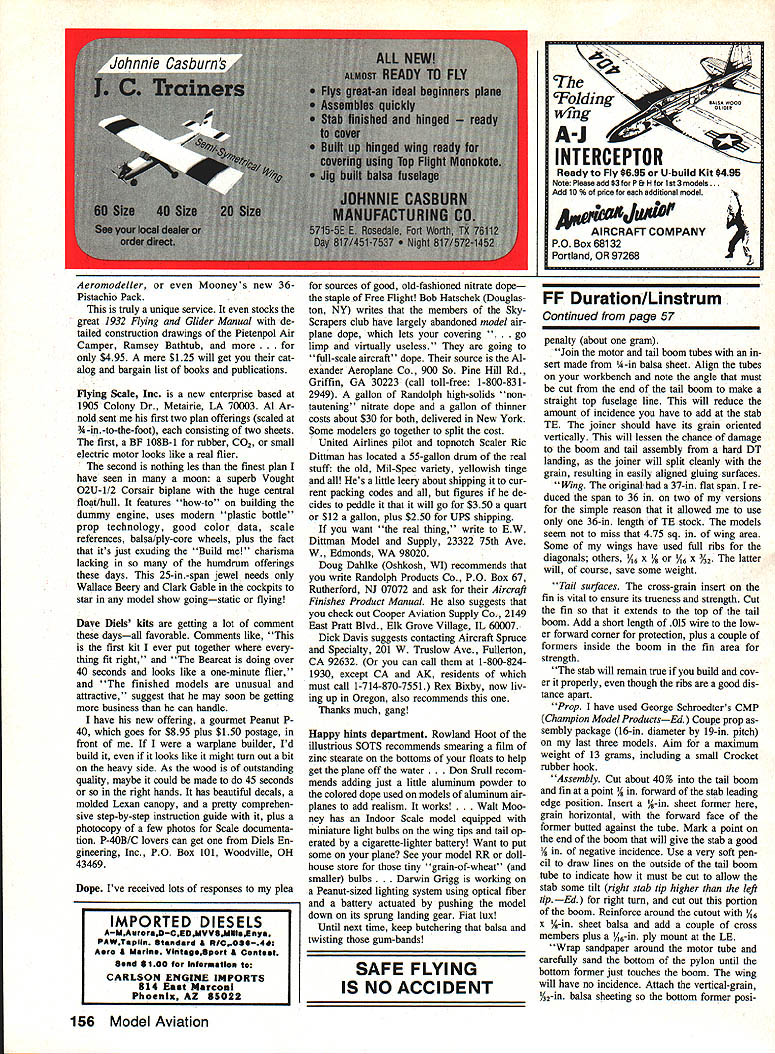
- Perennial U.S. FAI Free Flight team member Tommy McLaughlin (Pensacola, FL) with F1C models; L. Virginia FF'er Nat Comfort fires up a Cox .15 — observers often misjudge what they're seeing until the model's folded prop and climb/glide profile becomes apparent.
Construction tips
Motor tube
- The original (and my first three models) used aluminum tubes that Phil Hartman (Blue Ridge Models) used to sell. He etched them from aluminum shower curtain rods. Phil finally quit offering them because they involved too much labor for the price.
Tail boom
- Drop the motor tube onto the small end of a pool cue and mark where the tube stops with masking tape to indicate the front of the boom.
- Roll 1/32-in. balsa sheet around the pool cue, using the masking tape as a guide to form a clean front edge.
- Trim the balsa for a clean joint and glue it.
- Plug the aft end with a 3/8-in. former.
- Using a pointed, square X-Acto file, carefully file holes in the boom wall for 1/16-in. square inserts. Alternate the inserts horizontally and vertically for balanced reinforcement.
- Glue the inserts as you go; when dry, trim the protruding ends carefully and sand slightly.
These 1/16-in. square inserts add significant strength to the tail boom with very little weight penalty.
Visit and contact
If you visit the AMA Museum or the London shop, say hello for me. For museum inquiries, contact Hurst Bowers at AMA Headquarters.
Transcribed from original scans by AI. Minor OCR errors may remain.

