
Free Flight: Duration
Bill Hartill 7513 Sausalito Ave. Canoga Park, CA 91307
FREE FLIGHT: an endangered species revisited.
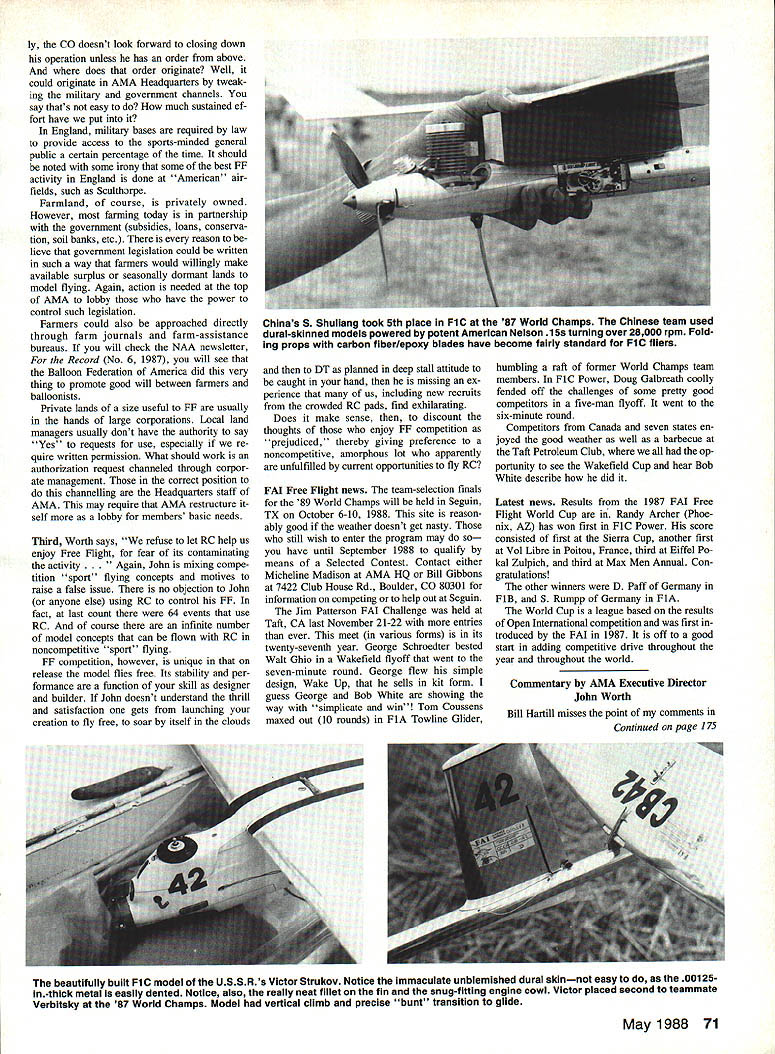
By now, you have all read of the great World Championship held this past year in France and the thrilling win of the Wakefield Cup by America's Bob White. January's issue of Model Aviation carried a splendid account of the action by reporter Martyn Cowley. U.S.A. modelers from all branches of the sport can feel proud to know that this most prestigious trophy is once again within our shores.
Go back and read that report again, and wonder about this popular worldwide surge of participation in FAI Free Flight, exemplified by the World Champs attracting contestants from over 30 countries; regional championships in Europe, South America, and Australia; by a new World Cup Series; and by a new World Champs cycle for young aeromodelers. And then wonder about the Free Flight bashing undertaken by AMA Executive Director John Worth in that same issue of Model Aviation. What's going on here?
AMA President Don Lowe has urged John Worth to express his views on what is wrong with Free Flight activity. Fine. Let's take a look at those views, and see what can be done.
Competition vs. Sport Free Flight
First, John Worth says, "There is essentially no sport Free Flight activity; it is practically all competition-oriented." Unfortunately, John goes on to find fault with competition flying without examining why there is little activity in "sport" FF. The trouble here lies in the blurring of distinction between the two types of flying. So-called "sport" categories such as:
- CO2
- HL
- Glider
- P-30
- AMA Cub
are flown in competition. With competition comes development—the challenge to do it better—whether it's F1C or Pennyplane.
Noncompetitive FF activity is available to all. If someone wants to fly something for fun, he is not held back by the nature and rules of FF competition. John seems to be saying something else—that the competition rules should be changed to make the category of "sport" flying more attractive to newcomers. (Editor’s note: Worth takes exception to this. His response is at the end of this column.) This ignores the obvious, that competition is competitive no matter what the rules are.
We welcome newcomers to FF, the grand old category of aeromodeling. Compete if you wish—and are excited by the challenge—and urge to excel—or fly for sport and fun in any way you wish to savor the thrill of flying free.
Flying sites — the vital issue
Second, Worth says, "The general lack of large sites from which to fly Free Flight on a regular basis puts a real damper on any desire to build Free Flight models." We agree wholeheartedly with this one. Finding and saving flying sites is the most important task we face. Without them we truly face extinction. There are many of us who feel that efforts by AMA in this direction are far from adequate.
AMA currently treats this not as a national but as a local problem. How many times have we heard, "If you have a flying site problem, contact Geoff Styles at Headquarters. He has the budget and the know-how to help you on a local basis." An example of how this is handled on a do-it-yourself basis is well-documented in the January MA in the article, "A Professional Approach to Finding and Keeping a Flying Field." What really is needed is a national program supported with a proper budget. Flying site acquisition should be an AMA activity that starts at the top and works down—not lecture to the locals in the boondocks. We have no leverage at the boondocks, especially in this era of "legal mania."
Sources for flying sites include:
- Public lands (government parks, flood-control basins, grasslands, conservation sanctuaries, mineral reserves, etc.)
- Military bases
- Farmland and seasonally dormant crop land
- Large private lands (often corporate-owned)
Public land is government controlled and therefore subject to the discretion of politicians. It should be the role of AMA to lobby the relevant politicians for access legislation.
Military bases are obvious candidates. Approaching a base commander with a request from a few locals never seems to be effective. Likely, the commander doesn't look forward to closing down operations unless he has an order from above. Where does that order originate? It could originate in AMA Headquarters by working the military and government channels. You say that's not easy to do? How much sustained effort have we put into it?
In England, military bases are required by law to provide access to the sports-minded general public a certain percentage of the time. It should be noted with some irony that some of the best FF activity in England is done at "American" airfields, such as Sculthorpe.
Farmland, of course, is privately owned. However, most farming today is in partnership with the government (subsidies, loans, conservation, soil banks, etc.). There is every reason to believe that government legislation could be written in such a way that farmers would willingly make available surplus or seasonally dormant lands to model flying. Again, action is needed at the top of AMA to lobby those who have the power to control such legislation.
Farmers could also be approached directly through farm journals and farm-assistance bureaus. If you check the NAA newsletter, For the Record (No. 6, 1987), you will see that the Balloon Federation of America did this very thing to promote goodwill between farmers and balloonists.
Private lands of a size useful to FF are usually in the hands of large corporations. Local land managers usually don't have the authority to say "Yes" to requests for use, especially if we require written permission. What should work is an authorization request channeled through corporate management. Those in the correct position to do this are the Headquarters staff of AMA. This may require that AMA restructure itself more as a lobby for members' basic needs.
RC and Free Flight
Third, Worth says, "We refuse to let RC help us enjoy Free Flight, for fear of its contaminating the activity..." Again, John is mixing competition "sport" flying concepts and motives to raise a false issue. There is no objection to John (or anyone else) using RC to control his FF. In fact, at last count there were 64 events that use RC. And of course there are an infinite number of model concepts that can be flown with RC in noncompetitive "sport" flying.
FF competition, however, is unique in that on release the model flies free. Its stability and performance are a function of your skill as designer and builder. If John doesn't understand the thrills and satisfaction one gets from launching your creation to fly free, to soar by itself in the clouds and then to DT as planned in deep stall attitude to be caught in your hand, then he is missing an experience that many of us, including new recruits from the crowded RC pads, find exhilarating.
Does it make sense, then, to discount the thoughts of those who enjoy FF competition as "prejudiced," thereby giving preference to a noncompetitive, amorphous lot who apparently are unfulfilled by current opportunities to fly RC?
FAI Free Flight news
The team-selection finals for the '88 World Champs will be held in Seguin, TX on October 6–10, 1988. This site is reasonably good if the weather doesn't get nasty. Those who still wish to enter the program may do so—you have until September 1988 to qualify by means of a Selected Contest. Contact Micheline Madison at AMA HQ or Bill Gibbons at 7422 Club House Rd., Boulder, CO 80301 for information on competing or to help out at Seguin.
The Jim Patterson FAI Challenge was held at Taft, CA last November 21–22 with more entries than ever. This meet (in various forms) is in its twenty-seventh year. George Schroeder bested Walt Ghio in a Wakefield flyoff that went to the seven-minute round. George flew his simple design, Wake Up, that he sells in kit form. All the winners — George and Bob White — are showing the way with "simplicity and win!" Tom Coussens maxed out (10 rounds) in F1A Towline Glider, humbling a raft of former World Champs team members. In F1C Power, Doug Galbreath coolly fended off the challenges of some pretty good competitors in a five-man flyoff. It went to the six-minute round.
Competitors from Canada and seven states enjoyed the good weather as well as a barbecue at the Taft Petroleum Club, where we all had the opportunity to see the Wakefield Cup and hear Bob White describe how he did it.
Latest news
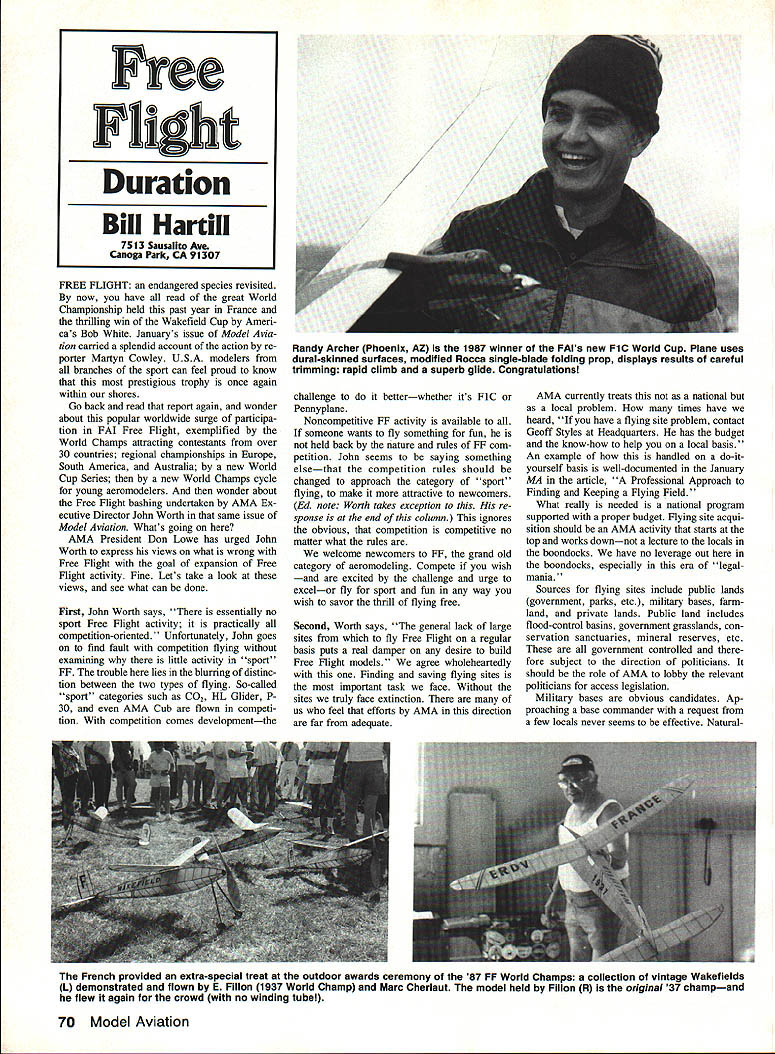
Results from the 1987 FAI Free Flight World Cup are in. Randy Archer (Phoenix, AZ) has won first in F1C Power. His score consisted of first at the Sierra Cup, another first at Vol Libre in Poitou, France, third at Eiffel Poplar Zulpich, and third at Max Men Annual. Congratulations!
The other winners were D. Paff of Germany in F1B, and S. Rump of Germany in F1A.
The World Cup is a league based on the results of Open International competition and was first introduced by the FAI in 1987. It is of value as a start in adding competitive drive throughout the year and throughout the world.
Editor’s note
Worth takes exception to some points in the preceding article. His response follows.
Response — John Worth, AMA Executive Director
I find no fault with the petition for Free Flight activity, except to note that the nature of it typically requires that it be held far away from where any potential newcomers are likely to see it. Likewise, I don't think that competition Free Flight rules should be changed, except to permit use of RC—after the officially timed portion of the flight is over—for return of the model to the launch point.
My basic premise is that RC can enable Free Flight to be flown from smaller fields, thus alleviating the problem of finding fields big enough to accommodate competition in Free Flight as it is now flown.
Regards, I love Free Flight as much as anyone, but I don't agree that watching a model in a dethermalized deep stall is "exhilarating." I think that RC is a better method of retrieving than is dethermalling. Also, I think that competition Free Flight is too much a retrieving contest; but as long as it is, the method of retrieval should be optional.
Another interesting point: Bill notes the great Free Flight World Championships story in the January issue of Model Aviation without mentioning that radio control was allowed to be used in that event for retrieval!
Otherwise, Bill's comments are well made, particularly the need for AMA to do more to help solve the flying-site problems. This subject is currently the object of an AMA Executive Committee study, which intends to put more funding into finding and keeping flying sites.
In summary, as modelers we often argue about what to do and how to do it, but we're essentially in agreement that something needs to be done, and that the status quo is not good enough.
Transcribed from original scans by AI. Minor OCR errors may remain.

