
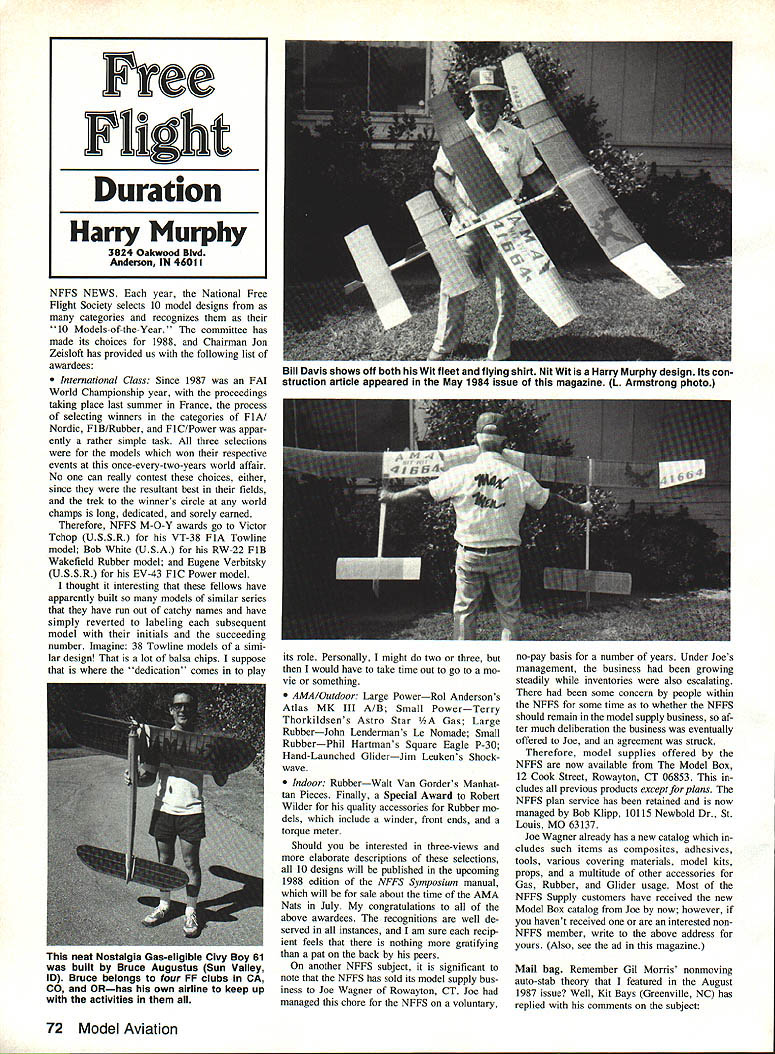
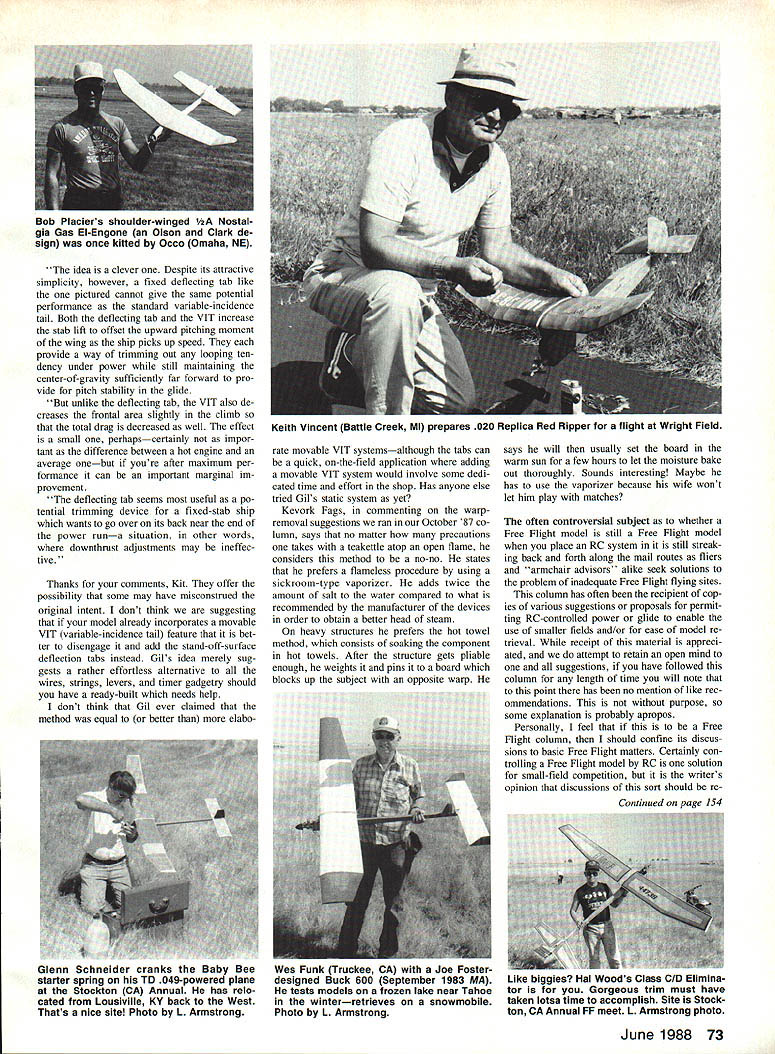
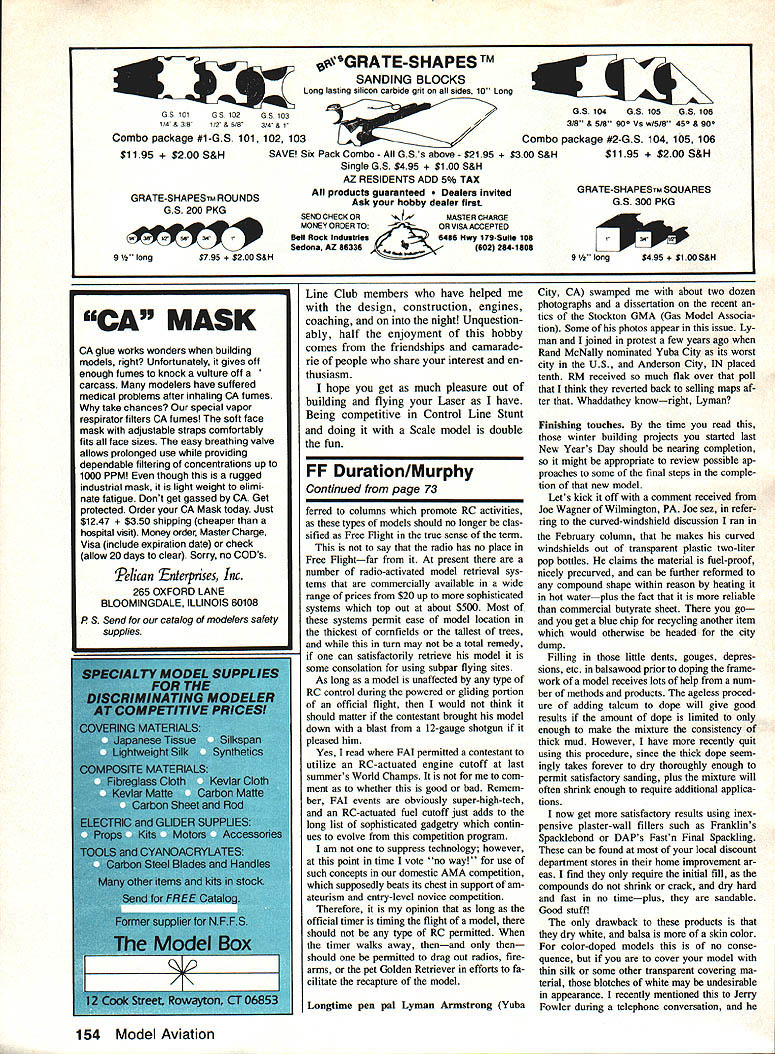
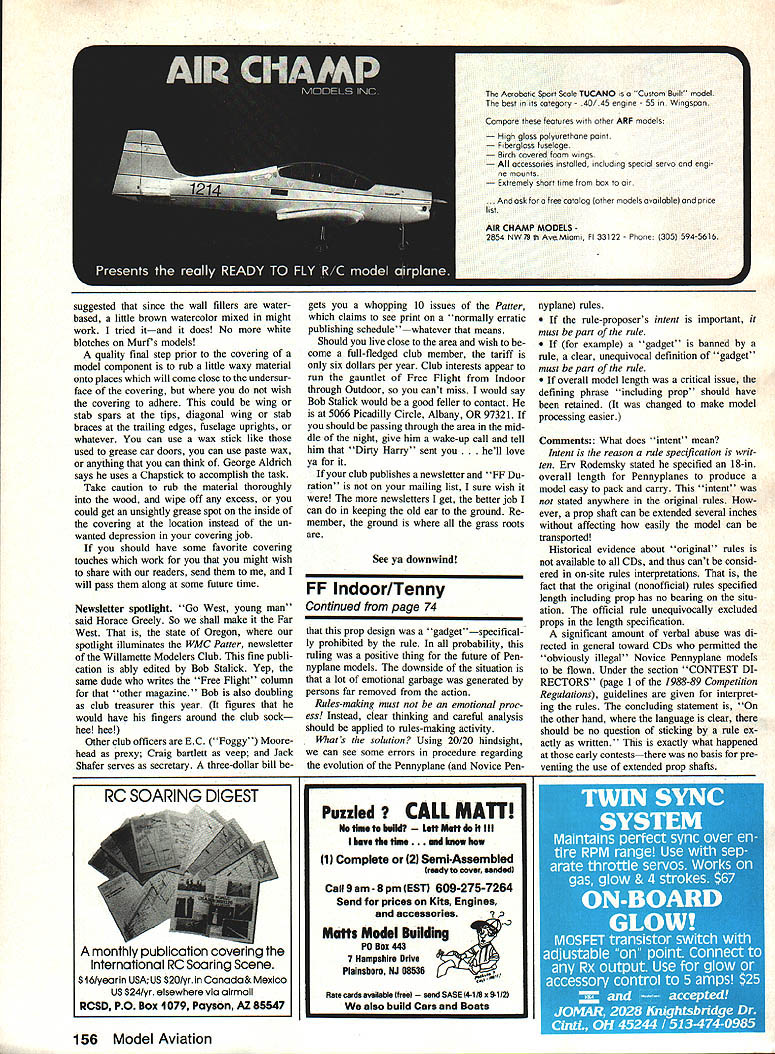
Free Flight: Duration
By Harry Murphy
3824 Oakwood Blvd. Anderson, IN 46011
NFFS News
Each year the National Free Flight Society selects 10 model designs from as many categories and recognizes them as their "10 Models-of-the-Year." The committee has made its choices for 1988, and Chairman Jon Zeisloft has provided the following list of awardees.
- International Class:
- Victor Tchop (U.S.S.R.) — VT-38 F1A Towline model
- Bob White (U.S.A.) — RW-22 F1B Wakefield Rubber model
- Eugene Verbitsky (U.S.S.R.) — EV-43 F1C Power model
Since 1987 was an FAI World Championship year, the selections in the FAI/Nordic, F1B/Rubber, and F1C/Power categories went to the models that won those events. These choices reflect the pinnacle of performance at a world championship.
I find it interesting that some designers have resorted to initials and sequential numbers for model names—imagine 38 Towline models of similar design! That is a lot of balsa chips. I suppose dedication is the operative word. Personally, I might build two or three and then take time out to go to a movie.
- AMA/Outdoor:
- Large Power — Rol Anderson's Atlas MK III A/B
- Small Power — Terry Thorkildsen's Astro Star 1/4 A Gas
- Large Rubber — John Lenderman's Le Nomade
- Small Rubber — Phil Hartman's Square Eagle P-30
- Hand-Launched Glider — Jim Leukens' Shockwave
- Indoor:
- Rubber — Walt Van Gorder's Manhattan Pieces
A Special Award goes to Robert Wilder for his quality accessories for rubber models, including a winder, front ends, and a torque meter.
If you are interested in three-views and more elaborate descriptions, all 10 designs will be published in the upcoming 1988 edition of the NFFS Symposium manual, which will be for sale around the time of the AMA Nats in July. My congratulations to all awardees—the recognitions are well deserved.
On another NFFS subject, the Society has sold its model supply business to Joe Wagner of Rowayton, CT. Joe had managed it voluntarily for a number of years and grew inventories steadily. After much deliberation, the business was offered to Joe and an agreement was struck. Model supplies formerly sold by the NFFS are now available from The Model Box, 12 Cook Street, Rowayton, CT 06853. This includes all previous products except plans. The NFFS plan service has been retained and is now managed by Bob Klipp, 10115 Newbold Dr., St. Louis, MO 63137.
Joe Wagner already has a new catalog with composites, adhesives, tools, covering materials, model kits, props, and many other accessories for gas, rubber, and glider usage. Most NFFS Supply customers have received the new Model Box catalog; if you haven't, or if you're not an NFFS member and want one, write to the above address.
Mail Bag
Remember Gil Morris' nonmoving auto-stab theory that I featured in the August 1987 issue? Kit Bays (Greenville, NC) replied with these comments:
The idea is a clever one. Despite its attractive simplicity, however, a fixed deflecting tab like the one pictured cannot give the same potential performance as the standard variable-incidence tail (VIT). Both the deflecting tab and the VIT increase stabilizer lift to offset the upward pitching moment of the wing as the ship picks up speed. They both provide a way of trimming out any looping tendency under power while maintaining the center of gravity sufficiently far forward for pitch stability in the glide.
But unlike the deflecting tab, the VIT also decreases frontal area slightly in the climb so total drag is reduced. The effect is small—certainly not as important as the difference between a hot engine and an average one—but for maximum performance it can be a valuable marginal improvement.
The deflecting tab seems most useful as a trimming device for a fixed-stab ship that wants to go over on its back near the end of the power run—a case where downthrust adjustments may be ineffective.
Thanks, Kit. Your comments clarify that some may have misconstrued the original intent. I am not suggesting that if your model already has a movable VIT you should disengage it and add stand-off-surface deflection tabs. Gil's idea merely offers an effortless alternative to the wires, strings, levers, and timer gadgetry if you have a ready-built ship that needs help. I don't think Gil ever claimed the method equals more elaborate movable VIT systems—though the tabs can be a quick, on-the-field application where adding a movable VIT would require shop time. Has anyone else tried Gil's static system yet?
Kevork Faggs, commenting on the warp-removal suggestions we ran in October '87, says he considers the teakettle-over-an-open-flame method a no-no. He prefers a flameless procedure using a sickroom-type vaporizer, adding twice the amount of salt to the water compared to the device manufacturer's recommendation to obtain a better head of steam.
For heavy structures he prefers the hot-towel method: soak the component in hot towels until pliable, weight and pin it to a board to oppose the warp, then set the board in the warm sun for a few hours to bake the moisture out. Sounds interesting—maybe he uses the vaporizer because his wife won't let him play with matches?
The often-controversial subject of whether a Free Flight model remains Free Flight when you place an RC system in it continues to generate debate. Fields and "armchair advisors" alike suggest RC-controlled power or glide to enable the use of smaller fields or to ease model recall. While such material is appreciated, if you've followed this column you will note I have not promoted those recommendations, and there's a reason.
If this is to be a Free Flight column, I should confine discussions to basic Free Flight matters. Controlling a Free Flight model by RC is one solution for small-field competition, but such discussions belong in columns that promote RC activities—these types of models should no longer be classified as Free Flight in the true sense.
This is not to say the radio has no place in Free Flight. There are commercially available radio-activated model retrieval systems ranging from about $20 to more sophisticated systems up to $500. Most help locate models in cornfields or trees, and while not a total remedy, satisfactory retrieval is a consolation for using subpar flying sites.
As long as a model is unaffected by any RC control during the powered or gliding portion of an official flight, I would not object if a contestant retrieved his model with a 12-gauge shotgun after the official flight—provided the official timer had finished timing. Yes, I read that FAI permitted an RC-actuated engine cutoff at last summer's World Champs. It is not for me to judge FAI's policies. Remember, FAI events are super-high-tech, and an RC-actuated fuel cutoff is just another gadget in that evolution.
I am not one to suppress technology; however, I vote "no way!" for use of such concepts in our domestic AMA competition, which supports amateurism and entry-level novice competition. Therefore, my opinion is that as long as the official timer is timing a model, there should be no RC permitted. When the timer walks away, then—and only then—should one be permitted to bring out radios, firearms, or the family pet in efforts to recapture the model.
Longtime pen pal Lyman Armstrong (Yuba City, CA) swamped me with about two dozen photographs and a dissertation on recent antics of the Stockton GMA (Gas Model Association). Some of his photos appear in this issue. Lyman and I protested a few years ago when Rand McNally nominated Yuba City as its worst city in the U.S., while Anderson, IN placed tenth. RM received so much flak that I think they went back to selling maps. Whaddathay know—right, Lyman?
Finishing Touches
By the time you read this, those winter building projects you started last New Year's Day should be nearing completion. Here are some final-step tips.
Joe Wagner of Wilmington, PA, commented on the curved-wingshield discussion I ran earlier and suggested improving curved windshields by post-sanding after a thin varnish.
Filling dents, gouges, and depressions in balsa prior to doping is aided by several methods. The old procedure of ramming balsa dust and dope into the depression works, but the thick dope mixture often flakes off, sands poorly, and shrinks requiring additional applications.
I now prefer inexpensive plaster-wall fillers such as Franklin's Spackle or DAP's Fast 'n Final Spackling, available at most discount department stores. They generally require only an initial fill, do not shrink or crack, dry hard and fast, and are sandable. The only drawback is they dry white while balsa is more skin-colored. For color-doped models this is not conspicuous, but for transparent coverings the white spots can show. Jerry Fowler suggested mixing a little brown watercolor into the water-based filler—tried it, and it works. No more white blotches on Murf's models!
A useful final step before covering is to rub a little waxy material onto places where you do not want the covering to adhere—wing or stab spars at the tips, diagonal braces at trailing edges, fuselage uprights, etc. You can use a grease stick like those for car doors, paste wax, or even ChapStick, as George Aldrich suggests. Rub the material thoroughly into the wood and wipe off excess to avoid unsightly grease spots on the inside of the covering.
If you have favorite covering tips that work for you, send them along and I'll pass them on.
Newsletter Spotlight
"Go west, young man"—this time to Oregon. Our spotlight illuminates the WMPC Patter, newsletter of the Willamette Modelers Club, ably edited by Bob Stalcik (the same fellow who writes a "Free Flight" column for another magazine). Bob also doubles as club treasurer this year.
Other club officers:
- E. C. ("Foggy") Moorehead — President
- Craig Bartlett — Vice President
- Jack Shafer — Secretary
A three-dollar subscription gets you 10 issues of the Patter, which claims to print on a "normally erratic publishing schedule." Full club membership is six dollars per year. Club interests cover the gamut of Free Flight from Indoor through Outdoor. Contact Bob Stalcik at 5066 Piccadilly Circle, Albany, OR 97321.
If your club publishes a newsletter and "FF Duration" is not on your mailing list, I wish it were! The more newsletters I get, the better I can keep an ear to the ground. Remember—the ground is where all the grassroots are.
See ya downwind!
Transcribed from original scans by AI. Minor OCR errors may remain.

