
Free Flight: Duration
John Oldenkamp 3331 Adams Ave., San Diego, CA 92116
Reflections: Taft — a Monster Meet Mecca
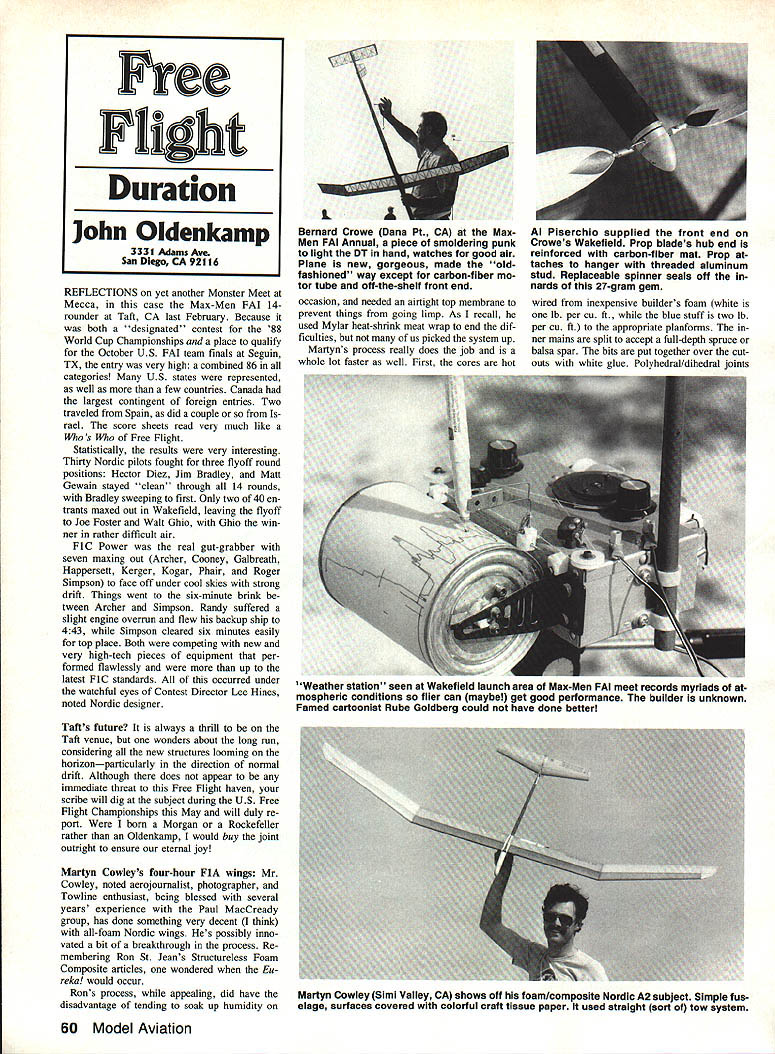
Reflections on yet another Monster Meet Mecca: the Max‑Men FAI 14‑rounder at Taft, CA, last February. Because it was both a designated contest for the '88 World Cup Championships and a place to qualify for the U.S. FAI team finals at Seguin, TX, entry was very high — a combined 86 in all categories. Many U.S. states were represented, along with several foreign entries; Canada supplied the largest contingent, two came from Spain, and a couple from Israel. The score sheets read very much like a Who's Who of Free Flight.
Statistically, the results were interesting:
- Thirty Nordic pilots fought for three flyoff positions; Hector Diez, Jim Bradley, and Matt Gewain stayed clean through all 14 rounds, with Bradley sweeping to first.
- Only two of 40 entrants maxed out in Wakefield, which produced a flyoff between Joe Foster and Walt Ghio; Ghio won in rather difficult air.
- F1C (power) was a real gut‑grabber: seven pilots maxed out — Archer, Cooney, Galbreath, Happersett, Kerger, Koger, Phair, and Roger Simpson — and faced off under cool skies with strong drift. The duel between Randy Archer and Roger Simpson went to the six‑minute brink. Randy suffered a slight engine overrun and flew a backup ship to 4:43; Simpson cleared six minutes easily for top place.
All of this occurred under the watchful eye of Contest Director Lee Hines, noted Nordic designer.
Taft's future? It is always a thrill to be on the Taft venue, but one wonders about the long run, considering new structures looming on the horizon — particularly in the direction of normal drift. There does not appear to be an immediate threat to this Free Flight haven, but I will dig into the subject during the U.S. Free Flight Championships in May and duly report. Were I born a Morgan or a Rockefeller rather than an Oldenkamp, I would buy the joint outright to ensure our eternal joy!
Martyn Cowley's four‑hour F1A wings
Martyn Cowley — aeromodeler, photographer, and towline enthusiast, with several years' experience with the Paul MacCready group — has produced very decent all‑foam Nordic wings and may have found a process breakthrough. Remember Ron St. Jean's "Structureless Foam Composite" articles? Ron's system worked but tended to absorb humidity on occasion and needed an airtight top membrane (he used Mylar heat‑shrink meat wrap). Martyn's process appears faster, strong, and moisture proof.
Martyn's method (outline):
- Hot‑wire the cores from inexpensive builder's foam: white (about 1 lb/ft³) or blue (about 2 lb/ft³) to the required planforms.
- Split the inner mains to accept full‑depth spruce or balsa spar bits; assemble over the cutouts with white glue.
- Make and secure polyhedral/dihedral joints.
- Epoxy carbon fiber mat (.007 in. thick) top and bottom as spar caps (strapping tape can be used in a pinch).
- Leading and trailing edge stock is optional.
- Cover the whole wing with ordinary craft tissue from a hobby store, using wallpaper glue made from the dry‑crystal variety for the adhesive.
Results: very quick, strong, inexpensive, and effectively moisture proof. Martyn had six or eight examples on hand, most appearing to use the CH407 airfoil. He has promised a more complete exposition soon.
Power is the wing (F1C construction trends)
One of the nastiest problems for modern F1C designers/builders/fliers is keeping the models intact over a long contest trail: wing flutter is a serious issue, especially with engine RPMs climbing to ~30,000.
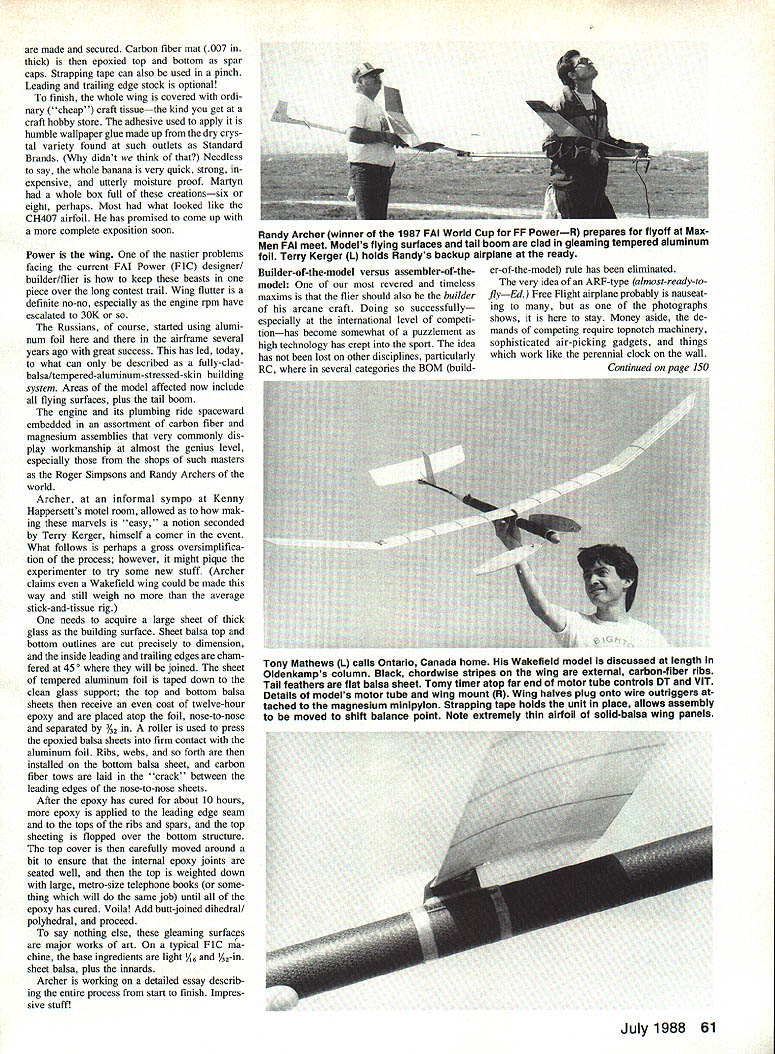
The Russians began incorporating aluminum foil into airframes years ago with great success. This has evolved into what can be described as a fully clad balsa/tempered‑aluminum stressed‑skin building system, now used on flying surfaces and tail booms. Engines and tail booms are embedded in carbon fiber and magnesium assemblies that commonly show workmanship approaching genius — particularly from shops like Roger Simpson's and Randy Archer's.
At an informal symposium in Kenny Happersett's motor room, Archer and Terry Kerger described a method that, while an oversimplification here, may pique experimenters. Archer claims even a Wakefield wing could be made this way and still weigh no more than the average stick‑and‑tissue rig.
Archer's stressed‑skin building method (summarized):
- Use a large sheet of thin glass as the building surface.
- Cut precise top and bottom balsa sheeting to dimension; chamfer the inside leading and trailing edges at 45° where they will join.
- Tape a sheet of tempered aluminum foil to the glass surface.
- Coat the top and bottom balsa sheets evenly with 12‑hour epoxy and place them atop the foil, nose‑to‑nose and separated by 3/8 in.
- Use a roller to press the epoxied balsa sheets into firm contact with the foil.
- Install ribs, webs, and other internal structure on the bottom sheet; lay carbon fiber tows in the seam between the nose‑to‑nose sheets.
- After roughly 10 hours' cure, apply more epoxy to the leading edge seam and to the tops of ribs and spars; fold the top sheeting over the bottom structure.
- Manipulate the top sheeting to ensure internal epoxy joints are well seated, then weight the structure down (large telephone books or similar) until fully cured.
- Add butt‑joined dihedral/polyhedral panels as required.
Typical base materials on a top‑level F1C machine: light 1/8 in. and 1/16 in. sheet balsa plus internal spars, ribs, carbon, and foil. The resulting gleaming surfaces are major works of art. Archer is preparing a detailed essay describing the whole process from start to finish.
Builder‑of‑the‑model versus assembler‑of‑the‑model
One of our most revered maxims has been that the flier should also be the builder. At the international level, however, this has become puzzling as high technology creeps into the sport. Other disciplines, notably RC, have already eliminated the BOM (builder‑of‑the‑model) rule in several categories.
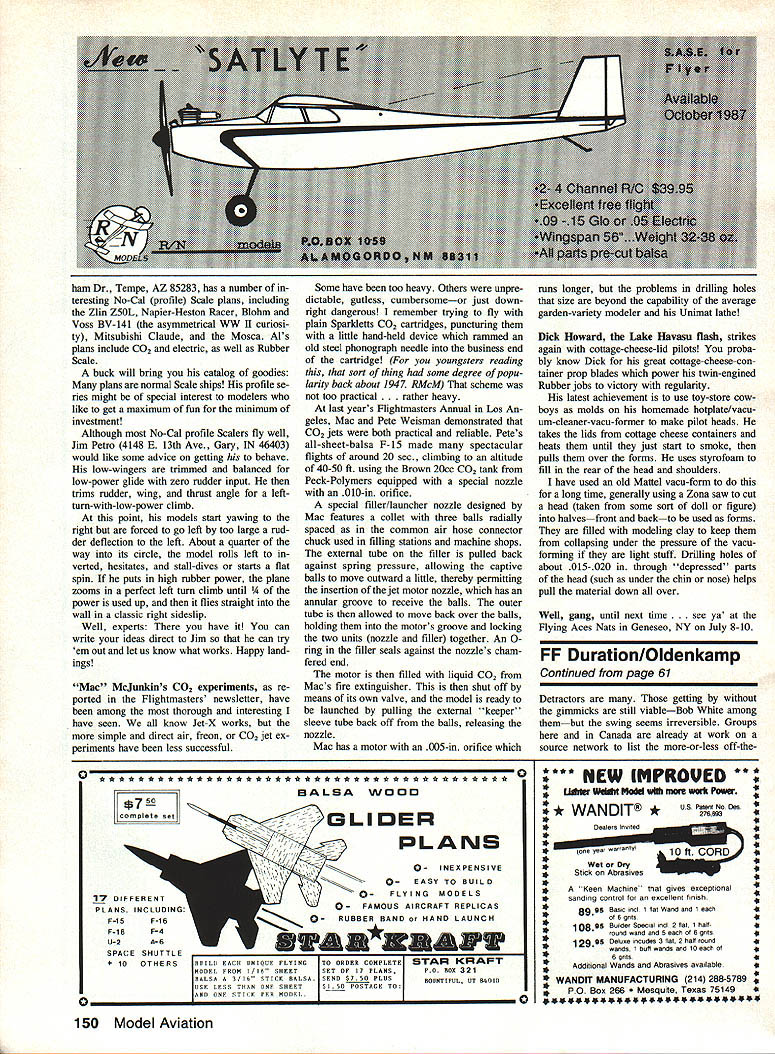
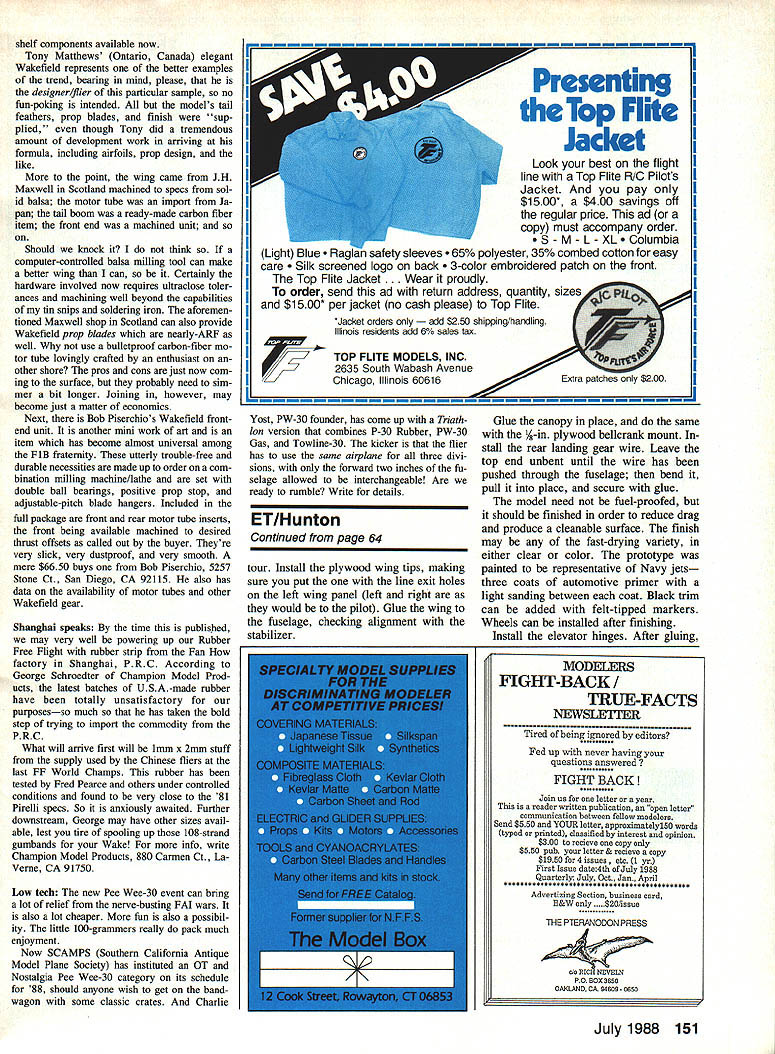
The idea of an ARF (almost‑ready‑to‑fly) Free Flight airplane may nauseate some, but as photographs show, it is here to stay. Competing demands require top‑notch machinery, sophisticated packing gadgets, and things that work like a perennial clock. Detractors are many, and those getting by without gimmicks (Bob White, for example) are still viable, but the swing toward specialized equipment seems irreversible. Groups in the U.S. and Canada are already at work on source networks listing off‑the‑shelf components and longer lead items.
Dick Howard and cottage‑cheese‑lid pilots
Dick Howard of Lake Havasu is famous for using cottage‑cheese container lids as molds for home‑made prop blades on twin‑engined rubber jobs. His latest trick is using store covers as molds in a home hot‑plate/vacuum former to make pilot heads. He heats the lids, draws them into the mold under vacuum, then backs them with foam.
I have used an old vacuum‑formed pilot on my own A2 for a long time. My usual method is to use an X‑Acto saw to cut a head (from some figure) into front and back halves to be glued as forms, then fill them with mineral clay so they won't collapse under the vacuum. Drilling holes about .015–.020 in. through depressed parts of the head (such as under the chin or nose) helps pull the material down all over.
Well, gang, until next time… see ya at the Flying Aces Nats in Geneseo, NY, on July 8–10.
Transcribed from original scans by AI. Minor OCR errors may remain.

