
Free Flight: Duration
Harry Murphy 3824 Oakwood Blvd. Anderson, IN 46011
Basic Yeller
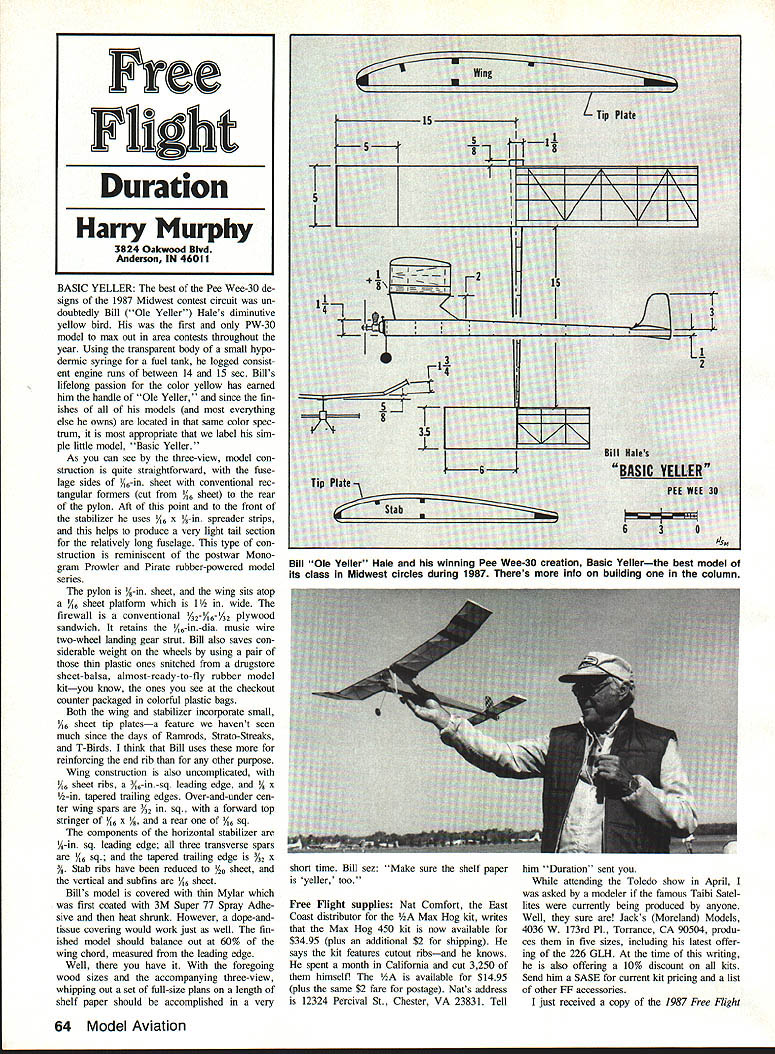
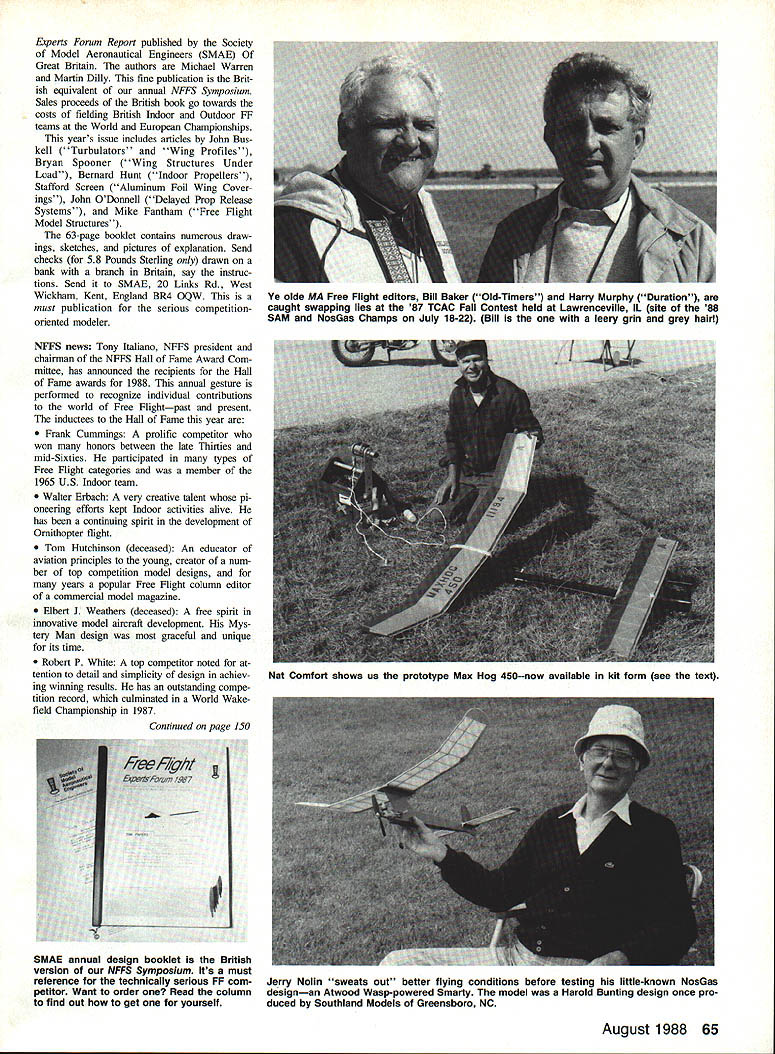
The best of the Pee Wee-30 designs of the 1987 Midwest contest circuit was undoubtedly Bill ("Ole Yeller") Hale's diminutive yellow bird. His was the first and only PW-30 model to max out in area contests throughout the year. Using the transparent body of a small hypodermic syringe for a fuel tank, he logged consistent engine runs of between 14 and 15 seconds. Bill's lifelong passion for the color yellow has earned him the handle "Ole Yeller," and since the finishes of all of his models (and most everything else he owns) are in that same color spectrum, it is most appropriate that we label his simple little model "Basic Yeller."
As you can see by the three-view, model construction is quite straightforward. The fuselage sides are 1/16-in. sheet with conventional rectangular formers (cut from 1/8-in. sheet) to the rear of the pylon. Aft of its point and to the front of the stabilizer he uses 1/16 x 1/8-in. spreader strips, which help produce a very light tail section for the relatively long fuselage. This type of construction is reminiscent of the postwar Monogram Prowler and Pirate rubber-powered model series.
The pylon is 1/8-in. sheet, and the wing sits atop a 1/4-in. sheet platform 1-1/2 in. wide. The firewall is a conventional 1/32–1/16–1/32 plywood sandwich. It retains the 1/16-in. dia. music-wire two-wheel landing gear strut. Bill also saves considerable weight on the wheels by using a pair of those thin plastic ones snitched from a drugstore sheet-balsa almost-ready-to-fly rubber model kit—the ones you see at the checkout counter packaged in colorful plastic bags.
Both the wing and stabilizer incorporate small 1/16-in. sheet tip plates—a feature we haven't seen much since the days of Ramrods, Strato-Streaks, and T‑Birds. These are likely used more for reinforcing the end rib than for any other purpose.
Wing and stabilizer details
- Wing construction: 1/16-in. sheet ribs, 1/16-in. sq. leading edge, 1/8 x 1/8-in. tapered trailing edges. Over-and-under center wing spars are 3/32-in. sq., with a forward top stringer of 1/16 x 1/8 and a rear one of 1/16 sq.
- Horizontal stabilizer components: 1/8-in. sq. leading edge; all three transverse spars are 1/16 sq.; tapered trailing edge is 1/8 x 3/32. Stab ribs have been reduced to 1/32-in. sheet. Vertical and subfins are 1/16-in. sheet.
Bill's model is covered with thin Mylar that was first coated with 3M Super 77 spray adhesive and then heat-shrunk. A dope-and-tissue covering would work just as well. The finished model should balance at 60% of the wing chord, measured from the leading edge.
With the foregoing wood sizes and the accompanying three-view, whipping out a set of full-size plans on shelf paper should be accomplished in a very short time. Bill sez: "Make sure the shelf paper is 'yeller,' too."
Free Flight supplies
Nat Comfort, the East Coast distributor for the 1/2A Max Hog kit, writes that the Max Hog 450 kit is now available for $34.95 plus $2 shipping. He says the kit features cutout ribs—and he knows; he spent a month in California and cut 3,250 of them himself! The 1/2A is available for $14.95 (plus the same $2 postage). Nat's address: 12324 Percival St., Chester, VA 23831. Tell him "Duration" sent you.
Taibi Satellites
At the Toledo show in April, I was asked if the famous Taibi Satellites were currently being produced. Yes—Jack's Moreland Models, 4036 W. 173rd Pl., Torrance, CA 90504, produces five sizes including the latest offering, the 226 GLH. At the time of writing he was offering a 10% discount on all kits. Send a SASE for current kit pricing and a list of other free-flight accessories.
Experts Forum Report (SMAE)
Published by the Society of Model Aeronautical Engineers (SMAE) of Great Britain. Authors: Michael Warren and Martin Dilly. This fine publication is the British equivalent of our annual NFFS Symposium. Sales proceeds go toward fielding British indoor and outdoor free-flight teams at the World and European Championships.
This year's 63-page issue includes articles by:
- John Buskell — "Turbulators" and "Wing Profiles"
- Bryan Spooner — "Wing Structures Under Load"
- Bernard Hunt — "Indoor Propellers"
- Stafford Screen — "Aluminum Foil Wing Coverings"
- John O'Donnell — "Delayed Prop Release Systems"
- Mike Fantham — "Free Flight Model Structures"
The booklet contains numerous drawings, sketches, and explanatory pictures. Send checks for 5.8 pounds sterling (drawn on a bank with a branch in Britain) to SMAE, 20 Links Rd., West Wickham, Kent, England BR4 OQW. This is a must for the serious competition-oriented modeler.
NFFS news — Hall of Fame inductees (1988)
Tony Italiano, NFFS president and chairman of the NFFS Hall of Fame Award Committee, has announced the 1988 Hall of Fame inductees. The awards recognize individual contributions to the world of free flight—past and present. The inductees are:
- Frank Cummings: A prolific competitor who won many honors between the 1930s and mid-1960s. He participated in many free-flight categories and was a member of the 1965 U.S. Indoor team.
- Walter Erbach: A very creative talent whose pioneering efforts kept indoor activities alive. He has been a continuing spirit in the development of ornithopter flight.
- Tom Hutchinson (deceased): An educator of aviation principles to the young, creator of several top competition model designs, and longtime free-flight column editor for a commercial model magazine.
- Elbert J. Weathers (deceased): A free spirit in innovative model-aircraft development. His Mystery Man design was most graceful and unique for its time.
- Robert P. White: A top competitor noted for attention to detail and simplicity of design. His outstanding competition record culminated in a World Wakefield Championship in 1987.
Covering, A-frame and props
When covering the wing, leave the tissue edges loose. Cut off the tissue sheet and lay it aside for more drying and shrinking before attaching it to the wing frames. Use medium-thick dope as paper cement, letting the paper lay naturally on the wing. When covered, the tissue will shrink a tiny bit more—only enough to remove the sag.
To keep the weight near the original model (2½ oz. without rubber), my A-frame was made of 3/16 x 3/8 x 40-in. pine sticks, cut to a channel section with 1/4-in. walls and cap strips. Pine plugs are inserted at the ends, and the whole assembly is cemented with Ambroid. Apply three coats of dope, sanding between coats.
To make the A-frame:
- Join sticks with a bevel at the nose, spacing them 11 in. apart.
- Use a 12-in.-long tapered, streamlined bamboo crosspiece projecting 1/2 in. at each end.
- The brace is about 3/8 x 1/2 in. at the center, tapering to 3/32 x 1/4 in. at the ends. Sand to an oval, streamlined section.
- Fit the crosspiece into notches cut in the sticks and carry the .040 I.D. eyelets or tubes for the prop bearings. Drill holes in the bamboo for thread binding (pure silk thread is best). Add four coats of Ambroid.
A set of matched props takes time but is worth it for performance and pride. I made mine before doing other parts of the model, spreading the work over many carving sessions (about 14 hours in all). Using a piece of basswood gave matched blanks of uniform wood. Blanks are "X"-type, 5/16 x 1-3/4 x 12 in., and drilled .040. Work from one prop to the other, removing even shavings following the pitch-drawn lines—you need a right-hand and a left-hand prop. Very little bottom camber is used; carve a thin airfoil until the blades are 1/16 in. thick at the hub and 3/16 in. at the tips and trailing edges. Block sand, then hand sand, balance, and weigh for uniformity. Use one coat of dope, sand, then apply two thin coats of clear lacquer.
Other details:
- A wire elevator incidence mount and wire "cans" or loops keep the rubber motors in place.
- Weigh out 7/8-in. rubber into two one-ounce pieces. Tie each into six strands and fasten in place using "S" hooks for winding.
- An eggbeater winder is needed to wind both motors simultaneously.
- Props must turn up and out: the right-hand prop is on your right when holding the model in launching position.
Launch by gently releasing the model straight and level. The gentle power of six strands lets it climb slowly but for a long time; I estimate about 2,000 turns, which would give roughly 2½ minutes of power.
A twin pusher usually has a natural circle caused by some small unbalanced force. Moving the wing tip slightly askew will trim for circling. Moving the wing backward toward the props will smooth out a stall tendency. This twin is forgiving and flew well from the start with only minor trim touches. It is satisfying to see a two-dollar non-balsa model circling high among expensive contemporary models—makes you feel plucky, clever, and content.
Magazines of the pre-balsa era
- Aeronautics
- Aerial Age
- Popular Science
- Aircraft
- Practical Aviation
- American Boy
- Popular Mechanics
- Aero Digest
- Flying
- Aero & Hydro
- Scientific American
Editorial: Free Flight — not dead
"Seems like just about everything I've picked up lately has iterated that FF is dead. Horsepucky!
FF does have problems—mostly flying sites and competition with video games—but what have we, the FF community, done to encourage outsiders into the activity? The San Diego Obituaries have contributed many of the new and encouraging events in recent years; what have we done?
When I came back into the fold six or eight years ago, I was told I would not enjoy it because the club was just an FAI activity. Well, lemme tell ya—it was. Fortunately, things have changed under good leadership and enthusiastic membership. The club has grown from a handful into a significant voice in the modeling community.
After pondering whether we should be allowed—or coerced—into putting radios into our well-thought ideas, it struck me that as individual fliers we are at our own discretion. We make the choice whether or not to fly RC-assisted models.
Whether or not we allow radios in Free Flight is not really the question. The real question is: Do we enjoy the activity as it is, and do we want to maintain Free Flight? If we want that, then there's no room for the radio—correct? If a Seelig can't get the desired results after being messed with by the fundamental genius of the flier, then radios are not the answer.
Free Flight will live. It will evolve—as it should.
Rick's comments were apropos. First, we sometimes forget that we are masters of our own destiny; if we ignore the "armchair prophets" and do our own thing, we will probably enjoy our hobby longer. Second, an enthusiastic club membership can do wonders. Enthusiasm is not bought, borrowed, or stolen; it must be developed from within and attributed to the industry and hard work of a membership with definite goals."
Newsletter spotlight: Michigan Antique Modelers (MAM)
We shall zero in on the Michigan Antique Modelers (MAM). These fellows are sparked by a real spark plug: fun-loving "Krazy Karl" Spielmaker (of Spielmaker Engines fame).
Although the group's name indicates an interest in Old-Timer activities—they host an annual two-day equivalent of a small SAM Champs—they are committed to all forms of Free Flight and Indoor flying. They deserve a gold feather for promoting and supporting youth events. This club loves kids.
Their newsletter is published four times a year and is chock full of interesting material with Krazy Karl's humor sprinkled throughout. To join, send $2.75 to editor Karl Spielmaker, 4690 Burlingame SW, Wyoming, MI 49509. Tell 'em a "Hoosier" sent you!
The Zeek Chronicles — Part 1
About five years ago, while serving as editor of our club newsletter, I published a couple of human-interest stories about Lew Mahieu's Nostalgia Gas design, the Zeek. What followed was an avalanche of mail from modelers about the basic design and its variations.
The design is unique: it began shortly after WWII at the famous California flying field at Rosecrans and Western in Los Angeles, and it passed through the ignition era into the early glow period while undergoing constant revision. It survived as one of the classics of the Nostalgia Gas movement.
Because it was difficult to piece together the "begats"—for example, the 227-sq.-in. Zeek begat the 435, the 435 begat the 575, etc.—from 2,000 miles away, I originally enlisted Don Lutz, who had a lifelong association with Lew and who produced a string of successful Zeek derivatives himself—the culmination being AMA Nats wins in the early 1950s. Even with Don's and Lew's aid—along with that of Carl Stokes—there are still gaps in the total Zeek story, as Lew's later notions and variations were the result of many doings.
There are probably vintage drawings of various sizes still dormant somewhere which may never surface, but the most sought-after at the moment is the glow-powered 575 or the B/C Zeek of the early 1950s. This was supposedly a preproduction version of Bill Cranford's, who produced a second A/B Zeek kit under the Premium Mfg. Co. It has been said Bill lent out only five sets of plans to be built for evaluation of the proposed 575 kit, but the kit did not become a commercial reality. Much of the information regarding later variations has been pieced together with the aid of Lyman Armstrong, Russ Hansen, and Bill Cranford himself. Yet a copy of the elusive 575 plans remains to be uncovered. Can anyone out there help us?
Don Lutz is also toying with the idea of organizing a reunion of all former modelers who once flew at Rosecrans and Western in those "wonder years." If it materializes, it should be a reunion! Anyone interested is urged to contact Don Lutz, 455 S. Stage Coach Lane, Fallbrook, CA 92028 and offer their support.
Don and I have often talked of putting together a Zeek article for publication, but with all the drawings involved it could fill a magazine by itself—not to mention the holes that still require plugging. We recently compromised on beginning a series of short segments in this column, which might pry loose additional Zeek information as we go along. We shall give it a shot. We think you will enjoy it.
Part II will be next time (in the October issue). Till then:
See ya downwind!
Transcribed from original scans by AI. Minor OCR errors may remain.

