
Free Flight: Duration
Louis Joyner 3657 Brookwood Rd. Birmingham, AL 35223
NEW materials, like any other change, bring new problems—and new possibilities. The technology of Free Flight wing construction is changing rapidly. It's hard to keep up with what's happening with composite construction, carbon fiber, Kevlar, and the other new materials and techniques. Of course, you can bury your head in the sand and keep building the way you have for the last 30 years. But before you do, take a look at some of the ways you can incorporate some of the new materials and techniques into the models you are building. You might be pleasantly surprised.
Many of the new structural techniques are actually easier and quicker than conventional balsa-and-tissue structures. And the result will be a wing that's stronger, stiffer, and more warp resistant.
With the advent of the zoom launch, the structural demands on a Nordic glider have increased greatly. Using conventional balsa, spruce, and tissue construction, the only way to increase strength and stiffness is to add more pieces. The last Nordic I built (Ekhtenkov's 1973 winner) had well over 300 pieces of wood in the wing. That's a lot of cutting, fitting, and gluing. No wonder the serious FAI fliers are trying to come up with better wings that are also easier and quicker to build.
Jim Bradley's Nordic wing technique
Three-time U.S. FF team member Jim Bradley of Orlando has been fine-tuning the structure of his 1987 model-of-the-year Nordic. The latest wings on his Nordic combine balsa, spruce, foam, and carbon fiber.
Here's how Jim does it:
- Build up a tapered spruce and carbon-fiber spar in a jig.
- Cut a piece of foam to planform shape, but a half-inch shorter than the desired panel length.
- Epoxy the foam blank to the front spar. Epoxy on the leading edge and two airfoil-shaped 1/4-in. balsa end ribs.
- Cap the ribs with .003 carbon-fiber sheet to act as guides when hot-wire cutting the foam to airfoil shape.
- Use a leading-edge piece of 1/8 x 3/16-in. balsa set vertically. To stiffen this small leading edge, add .007 carbon fiber at the back and bottom to form an L.
After the foam is cut to shape, Jim covers it with 1/2-oz. carbon-fiber matte (it looks like black silkspan). Since the matte is rather stiff, he cuts it to approximate size, creases it down the middle for the leading edge, coats it with spray adhesive, and attaches it to the foam, lapping it over the spar and then trimming flush with the rear face of the spar. To strengthen the matte, Jim brushes on two coats of Titebond glue diluted with an equal part of water. Applied with a Popsicle stick (or "craft stick") and smoothed out, it sands like a dream when dry and adds little extra weight. This has proved much lighter than epoxy and is plenty strong; the Titebond coating also helps keep dope from attacking the foam.
For the rest of the wing Jim uses a fairly conventional built-up balsa structure, with a few good twists:
- Before assembly, add a vertical piece of .007 carbon fiber to the front face of the trailing-edge strip to stiffen it.
- After assembly, add cap strips of .003 carbon fiber to the top and bottom of all the ribs.
I've tried the last two techniques on a couple of Wakefield wings; the added stiffness is amazing. Weight gain was only a few grams; adding the cap strips took a couple of hours—well worth it. Jim covers his wings with the usual tissue and dope. He cautions that you must be careful or these methods can end up heavier than conventional construction. His next wings will use three-ounce carbon-fiber cloth instead of the matte.
If you need carbon fiber sheet or matte, contact: Jim Bradley Bradley Model Products 1337 Pine Sap Ct. Orlando, FL 32825 Note: Jim's operation is a sideline—include a stamped, self-addressed envelope. He also makes an excellent circle-tow hook and electronic timer; write for his catalog if you want to get into Towline.
Structureless foam composite (SFC) and other foam-skin methods
Much of the new technology in wing construction involves using foam cores covered with a skin to stiffen everything up.
- Ron St. Jean's structureless foam composite (SFC) method uses foam covered with silkspan and painted with diluted wood glue; for extra strength he adds more layers of silkspan at the center. The method was detailed in the April 1982 issue of Model Aviation.
- California Nordic fliers Martyn Cowley and Jim Wilson adapted this technique, adding a sturdy spar and substituting gift-wrapping paper for the silkspan and wallpaper paste for white glue. Their wings are very stiff. For stabs and rudders, they use Japanese tissue over the foam.
A hybrid approach can work well: use a foam core with a hardwood (or carbon-fiber) spar, cover the front portion with carbon-fiber matte to create a D-box effect, and cover the rear two-thirds with silkspan, tissue, or 1/4-oz. Kevlar matte. For stabs or tip panels, a 1/8-sheet full-depth spar can be let into the foam, with carbon-fiber strips added top and bottom for extra stiffness. You can use either carbon-fiber sheet or carbon-fiber tows; if you use the tows, Titebond can be used instead of epoxy to attach them to the foam.
Caution: cyanoacrylate instant glues and many solvents (dope, thinner, epoxy paint, gasoline) melt foam. Always test first.
Kevlar and carbon-fiber mattes can fuzz up when coated with Titebond. Sanding knocks down most of the roughness, and then covering with tissue results in a smooth finish. Allow for the matte thickness when laying out wing section templates. Covering these structures with tissue and dope also waterproofs the wing since Titebond will dissolve in water. St. Jean covers his wings with plastic freezer wrap; Cowley and Wilson use shellac.
Hot-wire foam cutting and jigs
Getting set up to cut foam is surprisingly easy. A simple bow can be assembled from scrap 1x2s, with one arm pivoted. An old Coupe d'Hiver rubber motor, stretched between cup hooks, can keep the jig tensioned while you cut. For power, an old automotive battery charger works fine—no voltage regulator is necessary.
- For guiding the hot wire, 1/8" plywood will work, but plastic laminate is better.
- Cutting is quick: tapered wings are as easy as straight ones, and you can build in washout or washin.
- Cutting thin trailing edges can be tough—try cutting from the front to the back, and include runout at the leading and trailing edges of your airfoil guides.
- The hot-wire technique is also great for making airfoil-shaped jigs for building undercambered wings.
For more information on foam cutting, see Master Modeling (available from hobby shops or AMA). Another good reference is Composite Construction for Home-built Aircraft, which, while geared toward full-size aircraft, contains useful information on foam, carbon, Kevlar, and epoxy.
Foams: types and densities
There are two types of polystyrene foams commonly available:
- Expanded polystyrene (white bead foam): used in beer coolers and packaging. Light (about 1.3 lb/cu ft) but weak and crumbly.
- Extruded polystyrene: sold under brand names such as Styrofoam (blue) and Foamular (pink). Densities:
- Styrofoam (blue): around 1.7 lb/cu ft.
- Foamular F50: about 1.5 lb/cu ft.
- Foamular 250: about 1.8 lb/cu ft.
- Foamular LDA: a newer low-density foam, about 1.3 lb/cu ft.
- Styrofoam also makes a gray foam around 1.5 lb/cu ft.
Check local building-supply companies or the Yellow Pages under "insulation" to find suppliers.
European molded wings and other advanced methods
A number of European modelers combine foam with glass cloth and epoxy to make molded wings:
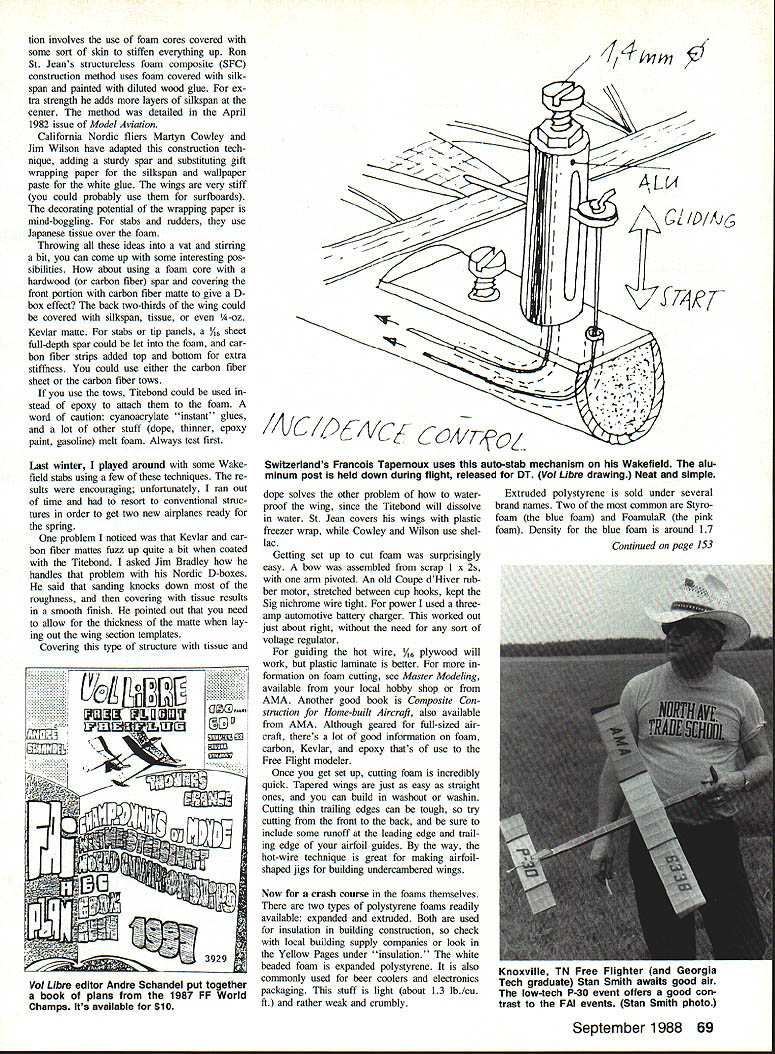
- Leo Reynders (Belgium) cuts a foam wing blank, uses paste pieces for the top and bottom mold, adds a plywood web and carbon-fiber rovings soaked in epoxy for the spar, lays light fiberglass cloth on polyester or PVC film, spreads epoxy, covers the core with film and cloth, adds the top form, and vacuum-bags the assembly to pull the mold tight. Squares of balsa glued to the front edge help alignment.
- Another European technique uses top and bottom skins made from thin (typically 1 mm) Rohacell polyurethane foam, covered with light glass cloth and epoxy, with a full-depth spar and no ribs. Rohacell is available from Aerospace Composite Products, P.O. Box 16621, Irvine, CA 92714 (sold in 1, 2, and 3 mm thicknesses; not always listed in catalogs).
Aluminum-skinned wings
An increasingly popular technique for F1C wings uses a very thin, hard aluminum skin over a sheeted balsa wing. Pioneered by Russian power flier and 1987 World Champion Eugene Verbitski, these wings are stiff and smooth. Basic construction:
- Cut aluminum to double-chord width.
- Epoxy on top and bottom balsa wing skins (typically light 1/16" balsa).
- Add ribs and spar.
- Bend the top sheet over the spar and rivet the assembly together.
Because the aluminum shows every detail, a clean workshop is essential. Proper cleaning and correct epoxy are critical for bonding.
Doug Joyce (New Orleans Power) uses a three-step cleaning process: wipe the aluminum with alcohol, then lacquer thinner, then trichloroethylene. Be very careful with vapors—work in a well-ventilated area and observe safety precautions. For adhesives, Doug uses 3M 2216 gray structural adhesive and coats both the aluminum and the balsa.
For a detailed British perspective, see the June 1986 issue of Aeromodeller (Stafford Screnn's article). The 1988 NFFS Symposium editor Herman Andersen scheduled a step-by-step photo story by Sal Frunciano on Randy Archer's aluminum wing-construction method, and several other composite-structure articles were planned. Check with: Fred Terzian NFFS Publications 4885 Moorpark Ave. San Jose, CA 95129 for ordering information.
Resources, contacts, and clubs
- Jim Bradley — Bradley Model Products, 1337 Pine Sap Ct., Orlando, FL 32825.
- Rohacell: Aerospace Composite Products, P.O. Box 16621, Irvine, CA 92714.
- NFFS Publications: Fred Terzian, 4885 Moorpark Ave., San Jose, CA 95129.
Hats off to the New Mexico Free Fliers! They have a good, old-fashioned approach to running a club, including a super newsletter and active junior programs. If you are interested in learning more about their activities, contact: Ann and Earl Erickson 810 Baird Circle Aztec, NM 87410
Notes and wrap-up
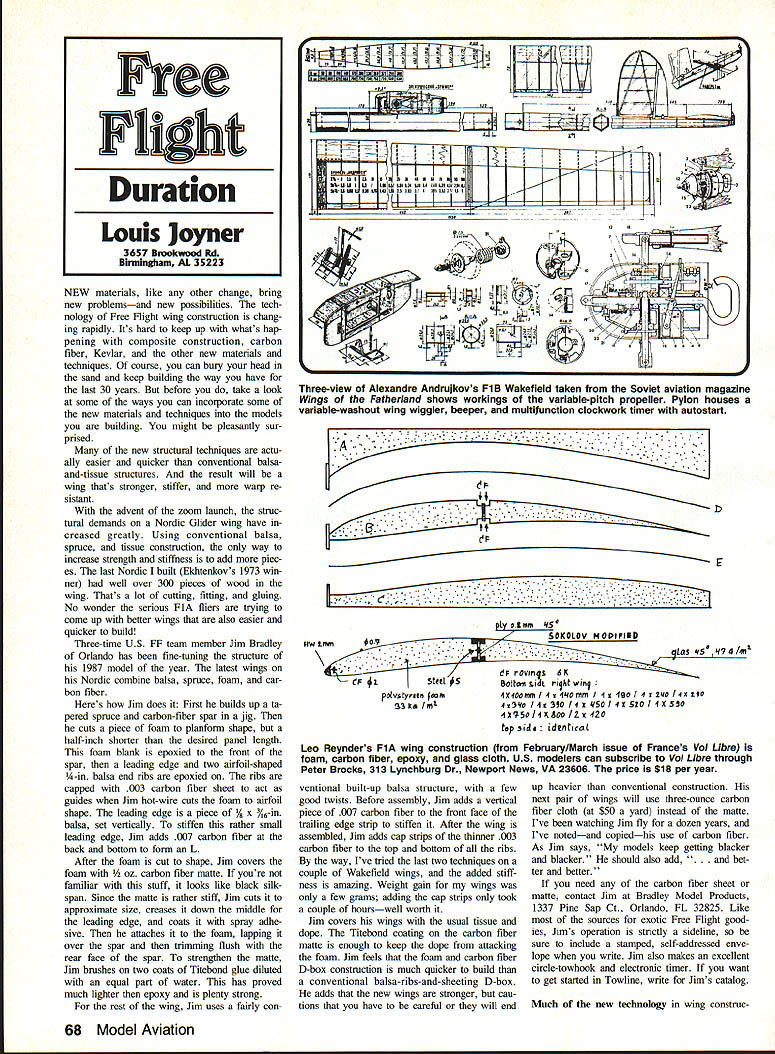
Keeping track of all the changes in Free Flight technology can be challenging. Part of the fun is the detective work of piecing bits of information together into something usable. For example, Alexandre Andrujkov's fast-climbing Wakefield was noteworthy for its all-sheet balsa fuselage at world championships, but many construction details were missing from newsletters. Eventually, detailed three-views and other information turned up in the Russian general aviation magazine Krylya Rodiny ("Wings of the Fatherland").
Experimenting with foam, carbon, Kevlar, and hybrid structures can yield lighter, stiffer, and quicker-to-build wings—but test carefully, mind solvents, and watch weight trade-offs. The new materials and methods are worth exploring; your models may end up "blacker—and better and better."
THE END.
Transcribed from original scans by AI. Minor OCR errors may remain.

