
Free Flight: Duration
Harry Murphy 3824 Oakwood Blvd. Anderson, IN 46011
FF Nats of '88
It has been no secret that the Free Flight community has been dealt a succession of subpar AMA Nats flying sites in recent years. It has also been many years since we've seen exclamations of "The best Nats ever!" in the aftermath of the once‑distinctive annual contest that produced so many former champions of lasting prestige.
The success or failure of any large Free Flight competition can often be measured solely by the facilities offered at the selected site. Competition Free Flighters are a hardy lot and will sacrifice personal comfort or travel many miles to compete on a field of adequate expanse that is relatively free of major obstructions. However, those hardships are difficult to accept when it is known beforehand that the selected site for national competition may be more of a challenge than the competition itself.
With modern land development and conversion to other uses, adequate locations have become fewer. In recent years this has been an acute problem for the AMA Nats Committee in obtaining suitable Free Flight facilities in or near the selected location for the Academy's annual "unified" Nats. The concept of holding RC, CL, FF, and Indoor disciplines in one location the same week now seems antiquated because the disciplines have varied and often incompatible requirements. There just does not seem to be any Utopian location that can satisfy all factions at one time.
Recent Nats sites offered to the Free Flight competitor have been less than adequate — examples include Lake Charles, Lincoln, and Virginia. The Virginia site selection for the 1988 AMA FF Nats appeared to be another step downward, and when that site dissolved shortly before the scheduled mid‑July date and no alternate site could be obtained on short notice, the Free Flight portion (with the exception of Scale) of the 1988 AMA Nats was cancelled altogether.
As I approached deadline for this column, phoenix‑like news appeared: the NFFS (National Free Flight Society) was scrambling to reschedule the previously cancelled Free Flight portion of the AMA Nats at the Mid America Air Center near Lawrenceville, IL for the weekend of October 14–16.
Regardless of any long‑range solutions that may or may not be forthcoming for future AMA Nats, you may rely on a NFFS‑sponsored Free Flight championship concept to become a reality in 1989. The present plan is for a three‑ to five‑day event in June at a Midwest site, with "site selection" to draw top priority. As I have oftimes stated, join the NFFS and support your "special interest gunfighters" if you want to preserve competition Free Flight as you would like it to be. We'll have more information on this subject next time.
1988 NosGas Champs
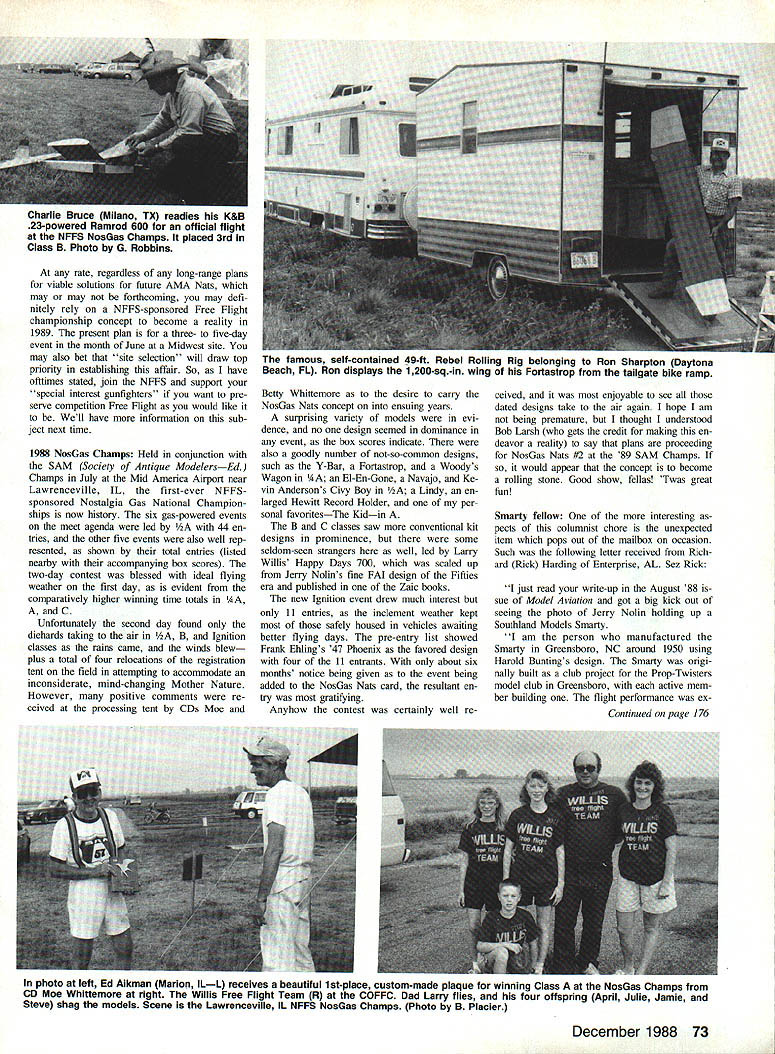
Held in conjunction with the SAM (Society of Antique Modelers) Champs in July at the Mid America Airport near Lawrenceville, IL, the first‑ever NFFS‑sponsored Nostalgia Gas National Championships is now history. Six gas‑powered events on the meet agenda were led by 44 entries; the other five events were also well represented.
The two‑day contest was blessed with ideal flying weather on the first day, as evident from the comparatively higher winning time totals in 1/4A, A, B, and C classes. Unfortunately, the second day found only the diehards flying in 1/4A, B, C and Ignition classes as rains and wind moved in. There were a total of four relocations of the registration tent on the field in attempts to accommodate an inconsiderate, mind‑changing Mother Nature. Nevertheless, many positive comments were received at the processing tent from contest directors Moe and Betty Whittemore about the desire to carry the NosGas Nats concept into ensuing years.
A surprising variety of models was in evidence, and no one design dominated any event. Notable examples included:
- 1/4A: Y‑Bar, Forastrap, Woody's Wagon
- 1/2A: El‑Fen‑Gone, Navajo, Kevin Anderson's City Boy
- A: Lindy, an enlarged Hewitt Record Holder, the Kidd
- B and C: Mostly conventional kit designs, with some rarities such as Larry Willis' Happy Days 700 (scaled up from Jerry Nolin's FAC design of the Fifties, as published in one of the Ziac books)
The new Ignition event drew much interest but only 11 entries due to the inclement weather. Frank Ehling's '47 Phoenix was the favored design, with four of the 11 entrants flying it. Given that the event was added to the NosGas Nats card with only about six months' notice, the resulting entry was most gratifying.
The contest was well received and it was enjoyable to see all those dated designs take to the air again. Bob Larsh gets credit for making this endeavor a reality, and I believe plans are proceeding for NosGas Nats #2 at the 1989 SAM Champs. If so, the concept is likely to become a rolling stone. Good show!
Smarty fellow
One of the more interesting items to come through this columnist's mailbox was a letter from Richard (Rick) Harding of Enterprise, AL. He wrote:
"I just read your write‑up in the August '88 issue of Model Aviation and got a big kick out of seeing the photo of Jerry Nolin holding up a Southland Models Smarty.
I am the person who manufactured the Smarty in Greensboro, NC around 1950 using Harold Bunting's design. The Smarty was originally built as a club project for the Prop‑Twisters model club in Greensboro, with each active member building one. The flight performance was excellent and was the main reason we decided to manufacture it. We learned a lot in this early attempt at the kit business and had hoped to expand the line with many additional kits. Our first run was 3,000 Smartys, which we sold rather fast.
We began production on a V‑2A sport control‑line model called the Snappy as a second kit, with a biplane version called the Snazzy to follow. Then I had to go into the service during the Korean conflict, which interrupted Snappy production. I was able to put it on the market after getting out of the service, and also produced about 2,000 more Smartys at that time. The Snazzy never made it to market. Although we had limited success, it wasn't the same market after the delay.
I don't have any Snappys left from this venture, but I do have a limited number of Smarty kits, which are still basically in good condition. I certainly enjoyed your article in the magazine. I promised myself I would get back into model building when I retired—would you believe I haven't started yet after retiring in '83? Hopefully, I'll start soon."
Rick also sent an original Smarty kit in that mailing. The kit was so perfectly preserved it was hard to believe it had actually been produced nearly 30 years earlier. The little pylon model has a wingspan of 30½ in., and the kit box claims it will fly with .035–.049 displacement engines. An Atwood Wasp .049 is pictured on the plans, though the kit was produced prior to the Cox Tee Dee .020 appearing on the scene; one of those would surely power the little fellow quite smartly as well.
Rick states that he will mail remaining kits anywhere within the United States for $15 each postpaid until his supply is exhausted. Order from:
Richard G. Harding Rt. 3, Box 292 Enterprise, AL 36330
The Zeek chronicles — Part II
Admittedly I'm heavy on NosGas subjects this session, but sometimes items of the same category seem to hit all at once. This is one of those times, so we continue with the promised Zeek sequel.
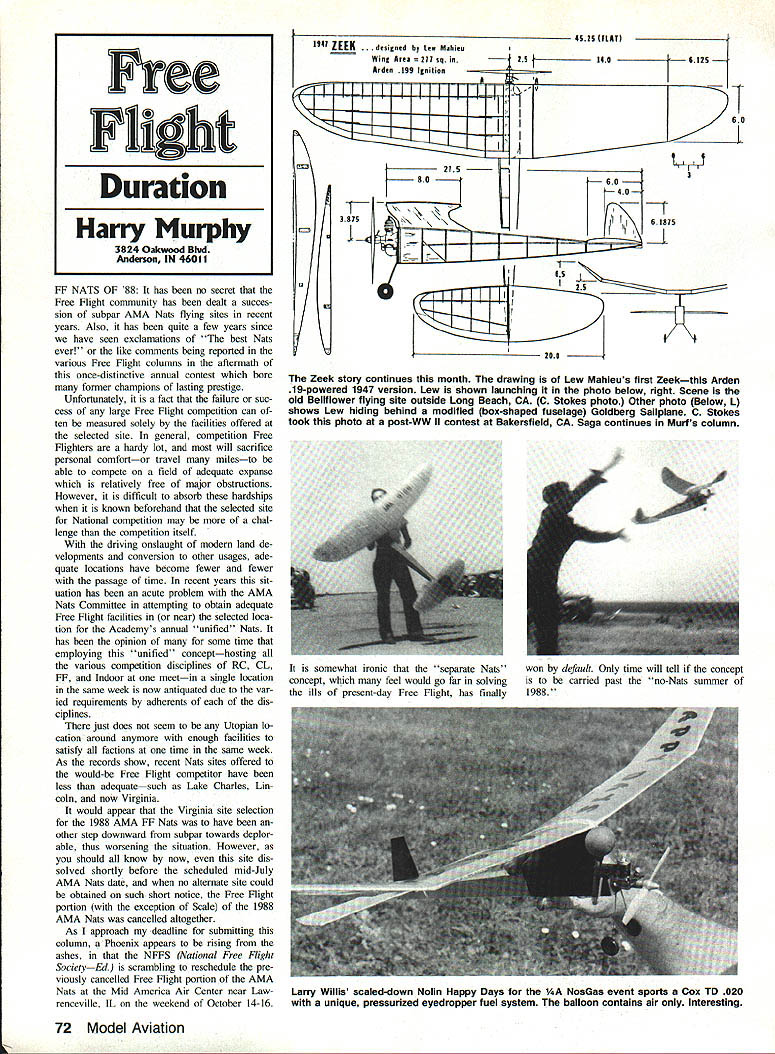
In my August 1988 column, Part I offered a teaser that I would follow with additional sections in serial form on the historical evolution of Lew Mahieu's Free Flight classic, the Zeek. With this episode we begin at the beginning — probably placing our time machine in the summer of 1946.
By that point Lew Mahieu had gained considerable experience building and flying many popular kit designs by Carl Goldberg, Merz, Clymer, Zipper, Scallop, and others. Being a prolific builder, Lew began to shortcut the tedious fuselage construction that utilized many small contoured parts typical of Goldberg‑type ribs. By building models faster he was more willing to try different ideas; small changes led to wide experimentation, and the Zeek was an outgrowth. The design is characterized by its small, boxy, slab‑sided fuselage.
The first Zeek was lost on its maiden flight at its first contest in Sacramento, CA, in September 1946. Lew had attended the contest with friends Ray Acord and Stillman Clampett. Ray Acord was to play an important role in making the Zeek a household word in Free Flight circles for years to come. Encouraged by his initial effort, Lew built a second Zeek, followed by additional models built by close friends such as Carl Stokes and Stu Sittig. A couple of years ago Lew sent this writer a copy of the plans of his original Zeek. The plans were drawn by Stu Sittig and are notarized with a 1946 date.
Transcribed from original scans by AI. Minor OCR errors may remain.

