
Free Flight
Duration
Dave Linstrum 4057 San Luis Dr. Sarasota, FL 33580
Cheap Thrills
I can remember when I was just a kid and got plenty of cheap thrills flying Jim Walker's innovative and great-flying catapult-launch gliders. Modeled after the Lockheed Shooting Star (an early Air Force jet), they came with a clever folding mechanism for the wing root and a catapult stick. You can now get them again by mail order — and the thrills are just as great.
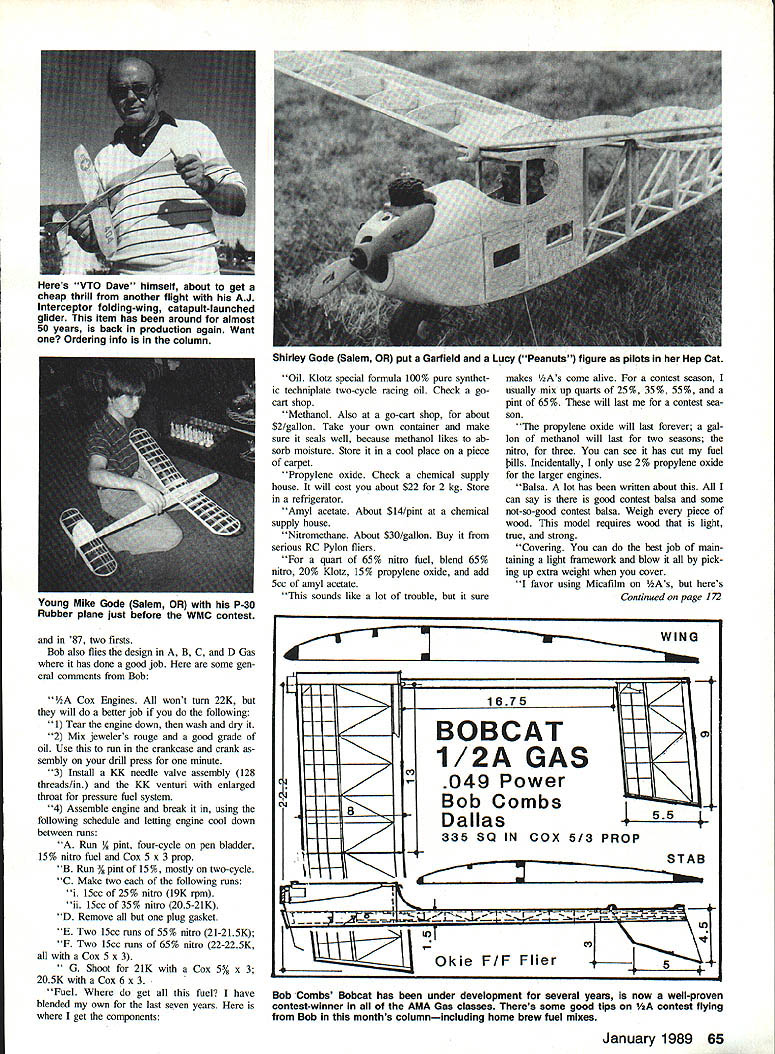
One of the photos shows your author with a big grin, getting ready to launch his A.J. Interceptor into a San Diego thermal. There is no thrill like seeing your model shoot into the blue, then see the wing flop open and the model begin circling like a hawk. The Interceptor is available ready to fly for only $6.95, or in a U-Build kit for $4.95. Add $3 postage/handling for first three models. To find your thrill, fly on Blueberry Hill after ordering from American Junior Aircraft Co., Box 68132, Portland, OR 97268.
Flying Aces Moth (Peck-Polymers kit)
Recently taken out of mothballs after being in storage since the late Thirties is the venerable Flying Aces Moth, now available as a Peck-Polymers kit. First published in the popular model magazine of the era, Flying Aces, it was designed by Herb Spatz. For over 50 years it has been a favorite of the stick-and-tissue fliers.
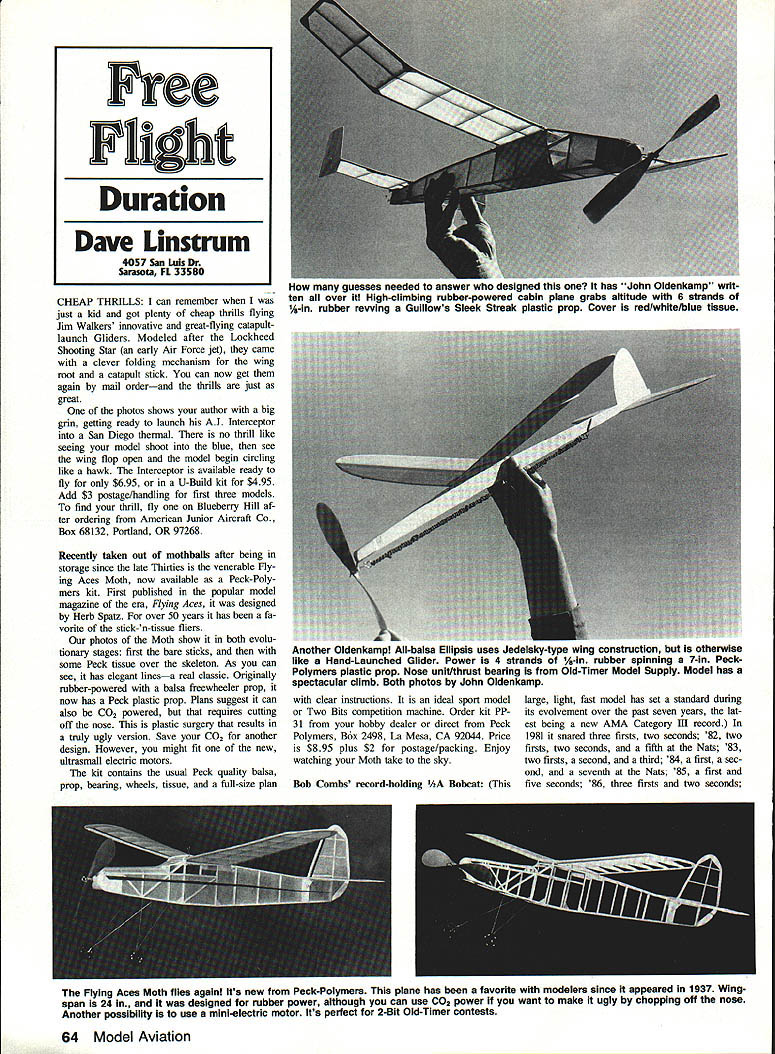
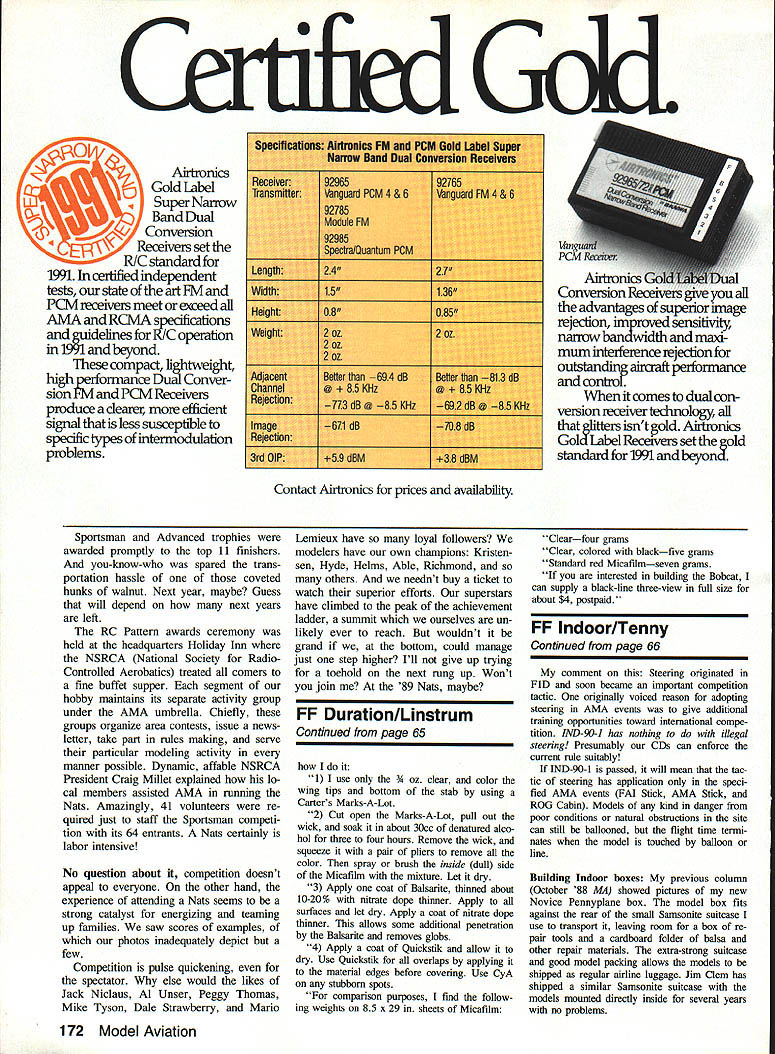
Our photos of the Moth show it in both evolutionary stages: first the bare sticks, and then with some Peck tissue over the skeleton. As you can see, it has elegant lines — a real classic. Originally rubber-powered with a balsa freewheeler prop, it now has a Peck plastic prop. Plans suggest it can also be CO2 powered, but that requires cutting off the nose. This is plastic surgery that results in a truly ugly version. Save your CO2 for another design. However, you might fit one of the new ultra-small electric motors.
The kit contains the usual Peck quality: balsa, prop, bearing, wheels, tissue, and a full-size plan with clear instructions. It is an ideal sport model or Two Bits competition machine. Order kit PP-31 from your hobby dealer or direct from Peck Polymers, Box 2498, La Mesa, CA 92044. Price is $8.95 plus $2 for postage/packing. Enjoy watching your Moth take to the sky.
Bob Combs' record-holding 1/4A Bobcat
This large, light, fast model has set a standard during its evolvement over the past seven years, the latest being a new AMA Category III record. In 1981 it snared three firsts, two seconds; 1982, two firsts, two seconds, and a fifth at the Nats; 1983, two firsts, a second, and a third; 1984, first, second, seventh at the Nats; 1985, first and five seconds; 1986, three firsts and two seconds; and in '87, two firsts.
Bob also flies the design in A, B, C, and D Gas where it has done a good job. Here are some general comments from Bob regarding 1/2A Cox engines and fuel.
1/2A Cox Engines (tuning and break-in)
All 1/2A Cox engines won't turn 22K, but they will do a better job if you do the following:
- Tear the engine down, then wash and dry it.
- Mix jeweler's rouge and a good grade of oil. Use this to run in the crankcase and crank assembly on your drill press for one minute.
- Install a KK needle valve assembly (128 threads/in.) and the KK venturi with enlarged throat for pressure fuel system.
- Assemble engine and break it in, using the following schedule and letting the engine cool down between runs:
- Run 1/4 pint, four-cycle on pen bladder: 15% nitro fuel and Cox 5 x 3 prop.
- Run 1/2 pint of 15%, mostly on two-cycle.
- Make two each of the following runs:
- 15 sec 25% nitro (19K rpm)
- 15 sec 35% nitro (20–21K rpm)
- Remove plug gasket.
- Two 15 sec runs 55% nitro (21–21.5K rpm).
- Two 15 sec runs 65% nitro (22–22.5K rpm), all with a Cox 5 x 3.
- Shoot for 21K with a Cox 5 x 3; 20.5K with a Cox 6 x 3.
Fuel
Where do you get all this fuel? I have blended my own for the last seven years. Here is where I get the components:
- Klotz special formula 100% pure synthetic techniplate two-cycle racing oil. Check a go-cart shop.
- Methanol. Also at a go-cart shop, for about $2/gallon. Take your own container and make sure it seals well, because methanol likes to absorb moisture. Store it in a cool place on a piece of carpet.
- Propylene oxide. Check a chemical supply house. It will cost about $22 for 2 kg. Store in a refrigerator.
- Amyl acetate. About $14/pint at a chemical supply house.
- Nitro methane. About $30/gallon. Buy it from serious RC pylon flyers.
For a quart of 65% nitro fuel, blend 65% nitro, 20% Klotz, 15% propylene oxide, and add 5 cc of amyl acetate.
This sounds like a lot of trouble, but it sure makes 1/2A's come alive. For a contest season, I usually mix up quarts of 25%, 35%, 55%, and a pint of 65%. These will last me for a contest season.
The propylene oxide will last forever; a gallon of methanol will last for two seasons; the nitro, for three. You can see it has cut my fuel bills. Incidentally, I only use 2% propylene oxide for the larger engines.
Balsa
A lot has been written about this. All I can say is there is good contest balsa and some not-so-good contest balsa. Weigh every piece of wood. This model requires wood that is light, true and strong.
Covering (Micafilm)
Covering: You can do the best job of maintaining a light framework and blow it all by picking up extra weight where you cover. I favor using Micafilm on 1/2A's, but here's how I do it:
- I use only the 3/4 oz. clear, and color the wing tips and bottom of the stab by using Carter's Marks-A-Lot.
- Cut open the Marks-A-Lot, pull out the wick, and soak it in about 30 cc of denatured alcohol for three to four hours. Remove the wick, and squeeze it with a pair of pliers to remove all the color. Then spray or brush the inside (dull) side of the Micafilm with the mixture. Let it dry.
- Apply one coat of Balsarite, thinned about 10–20% with naphtha. Apply to the full surface. This allows some additional penetration by the Balsarite and removes gloss.
- Apply a coat of Quickslik and allow it to dry. Use Quickslik for all overlaps by applying it to the material edges before covering. Use CYA on any stubborn spots.
For comparison purposes, I find the following weights on 8.5 x 29 in. sheets of Micafilm:
- Clear — 4 grams
- Clear, colored with black — 5 grams
- Standard red Micafilm — 7 grams
Building the Bobcat
If you are interested in building the Bobcat, I can supply a black-line three-view in full size for about $4, postage paid.
Transcribed from original scans by AI. Minor OCR errors may remain.

