
Free Flight: Duration
Larry Kruse Box 1137 Liberal, KS 67901
Meets and travel
Among the enjoyable aspects of the competition flying season is the opportunity to travel throughout the country to various meets within reasonable driving distance on weekends. Renewing old acquaintances and making new ones always ranks high on my list of favorite things to do, as does the chance to observe at first hand new developments in the art and science of Free Flight.
Denver's Magnificent Mountain Men Club harbors some of the nation's best and most innovative fliers, so it's always a pleasure to include at least one of its contests in travel plans. The club not only holds good monthly flying meets at its excellent site southeast of Denver, but it designates certain meets to emphasize specific events and encourage members to build outside their usual specializations.
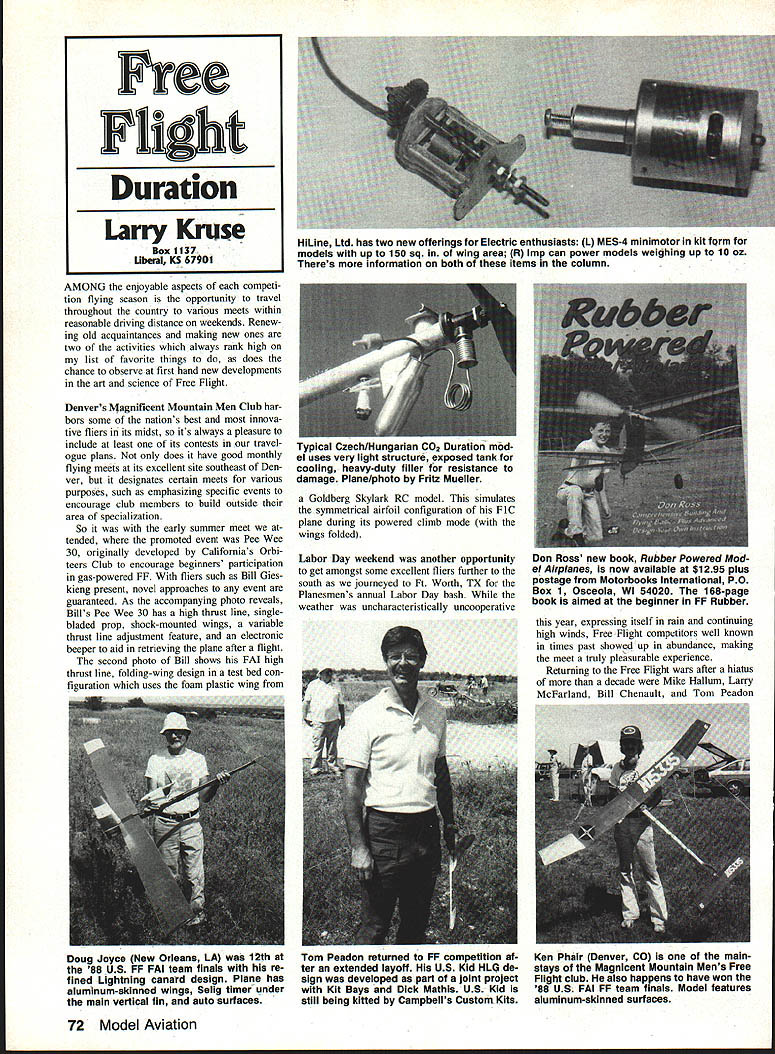
An early‑summer meet we attended promoted Pee Wee 30, originally developed by California's Orbiteers Club to encourage beginners' participation in gas‑powered free flight. With inventive fliers such as Bill Gieskieng present, novel approaches are guaranteed. Bill's Pee Wee 30 features a high thrust line, single‑bladed prop, shock‑mounted wings, a variable thrust‑line adjustment feature, and an electronic beeper to aid retrieval after flight. A second design shown by Bill was an FAI high‑thrust‑line folding‑wing test bed using the foam‑plastic wing from a Goldberg Skylark RC model to simulate the symmetrical airfoil configuration of his F1C plane during powered climb (with the wings folded).
Doug Joyce (New Orleans, LA), 12th at the '88 US FF/FAI team finals, has refined the Lightning canard design. The plane has aluminum‑skinned wings, a Selig timer under the main vertical fin, and automatic surfaces.
Labor Day weekend brought another opportunity to fly with excellent competitors at the Planesmen's annual Labor Day meet in Fort Worth, TX. Although the weather was uncharacteristically uncooperative, returning Free Flight competitors showed up in abundance, making the meet very enjoyable. After more than a decade away, the following fliers returned to competition:
- Mike Hallum
- Larry McFarland
- Bill Chenault
- Tom Peadon
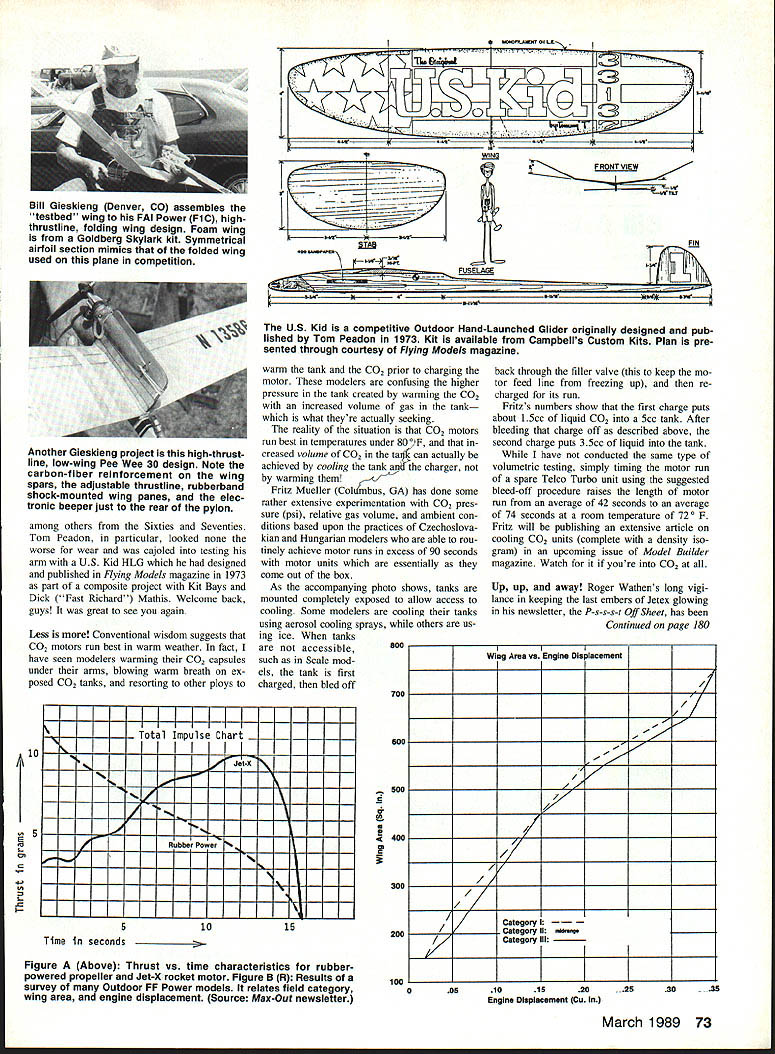
Tom Peadon, in particular, looked none the worse for wear and was cajoled into testing his arm with a U.S. Kid HLG he originally designed and published in Flying Models magazine in 1973 as part of a composite project with Kit Bays and Dick ("Fast Richard") Mathis. The U.S. Kid HLG is still available as a kit from Campbell's Custom Kits.
Don Ross's new book, Rubber‑Powered Model Airplanes, aimed at the beginning free flier, is now available for $12 plus postage from Motorbooks International, P.O. Box 1, Osceola, WI 54020.
CO2 motors — counterintuitive advice
Conventional wisdom suggests CO2 motors run best in warm weather, and I've seen modelers warming CO2 capsules under their arms, blowing warm breath on exposed CO2 tanks, and using other ploys to warm tanks prior to charging. These modelers confuse the higher pressure created by warming the CO2 with an increased volume of gas in the tank—which is what they actually seek.
The reality is that CO2 motors run best at temperatures under 80°F. Increased usable volume of CO2 in the tank can actually be achieved by cooling the tank and the charger, not by warming them.
Fritz Mueller (Columbus, GA) has conducted extensive experiments with CO2 pressures and volumes and studied practices used by Czechoslovakian and Hungarian modelers who report runs in excess of 90 seconds with essentially out‑of‑the‑box motor units. Observed practices include exposing tanks to direct sunlight prior to the first charge, cooling tanks with aerosol cooling sprays or cold water, and—when tanks are not accessible (as in Scale models)—charging the tank, bleeding it back through the filler valve to keep the motor feed line from freezing, and then recharging for the run.
Fritz's measured numbers indicate:
- First charge: about 1.5 cc of liquid CO2 into a 5 cc tank.
- After bleeding and recharging: about 3.5 cc of liquid into the tank.
- Motor run timing (TeCo Turbo spare unit): second‑ and third‑charge run times in the range of roughly 42 seconds to an average of about 74 seconds at room temperature (72°F).
Fritz will be publishing an extensive article on CO2 units (including a density isogram) in an upcoming issue of Model Builder magazine.
Jet power returns — the Jet‑X 50‑Z
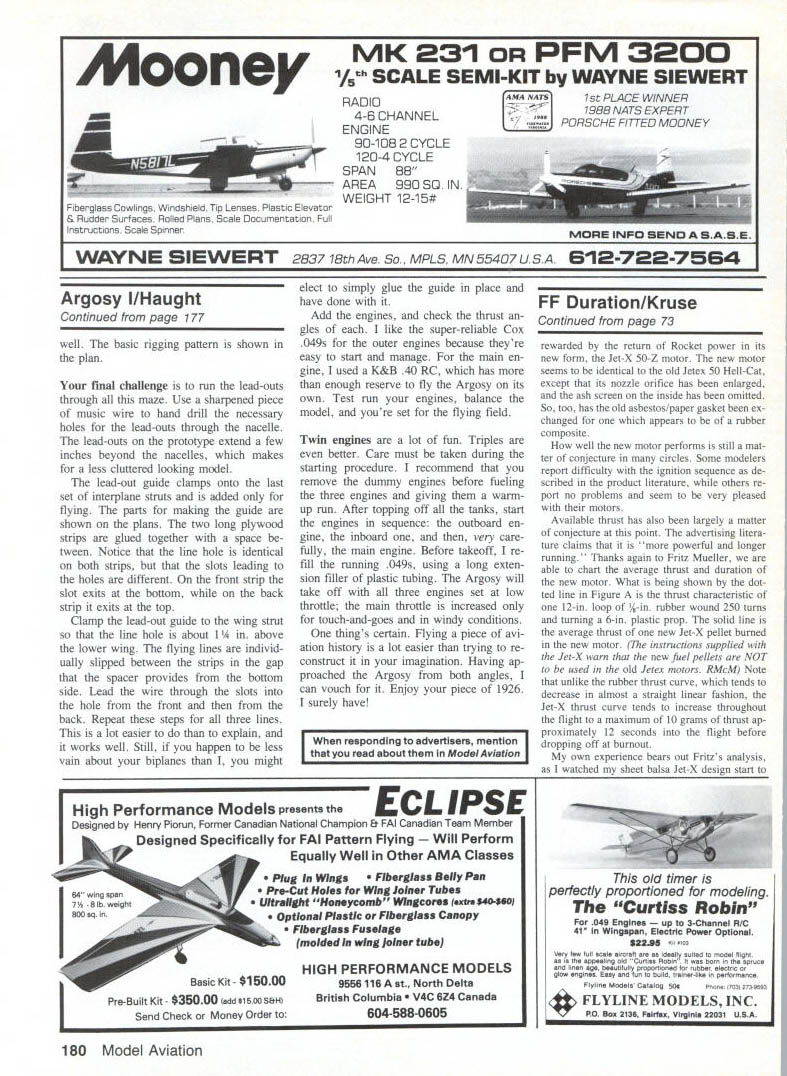
Roger Wathan's persistence in keeping Jetex interest alive in his P‑s‑s‑s‑t Off Sheet has been rewarded by the return of rocket power in the form of the Jet‑X 50‑Z motor. The new motor appears nearly identical to the old Jetex 50 Hell‑Cat, except:
- The nozzle orifice has been enlarged.
- The internal ash screen has been omitted.
- The old asbestos/paper gasket has been replaced by one that appears to be rubber.
User reports vary: some modelers report ignition sequence difficulties as described in the product literature, while others report no problems and are pleased with their motors. Available thrust and burn duration have been matters of conjecture, but Fritz Mueller provided thrust‑and‑duration measurements.
Fritz's thrust curve for the Jet‑X shows a thrust that tends to increase throughout the flight to a maximum of about 10 grams approximately 12 seconds into the burn before dropping off at burnout. This contrasts with a rubber motor thrust curve, which typically decreases in a nearly linear fashion. In flight tests I observed a sheet‑balsa Jet‑X design gain tremendous altitude about 10 seconds into its power pattern and accelerate out of sight on a two‑pellet charge.
Charts and club resources
The Magnificent Mountain Men Club (MMC) of Denver publishes a fine newsletter, the Max‑Out, edited by Rick Pangell. Rick and Bill Etherington plotted a helpful chart (recent Max‑Out issue) that grew out of club conversations about appropriate model sizes for various engines. The chart is a handy reference for selecting a kit to build for a given field size or engine classification, and it can serve as a guide for scratch builders or fledgling designers. One notable point on the chart is the intersection of Categories I and II at 450 sq. in. wing area and 1.5 cu. in. displacement—a standard size for FAI Power (F1C) ships.
Harran's Runway, Joan and Bill Harran's business, offers over 70 aviation publications ranging from classic Zlin volumes to collections of 50 years of British aeromodelling. Begun in 1985, Harran's Runway now publishes a 36‑page illustrated catalog listing magazines, books, plans, kits, hardware, rubber, and accessories.
New products and kits
Campbell's Custom Kits has two new George Perryman designs now in production:
- Super Maxer Speckled Bird (bent‑winged bird for Mulvihill) — $29.98 plus shipping.
- Fluffy Coop Speckled Bird (smaller, for Coupe d'Hiver) — $27.98.
Both kits include high‑quality balsa, tissue covering, full‑size plans, and other features expected from Campbell's. Available from Campbell's Custom Kits, Box 5996, Lake Worth, FL 33461‑0181.
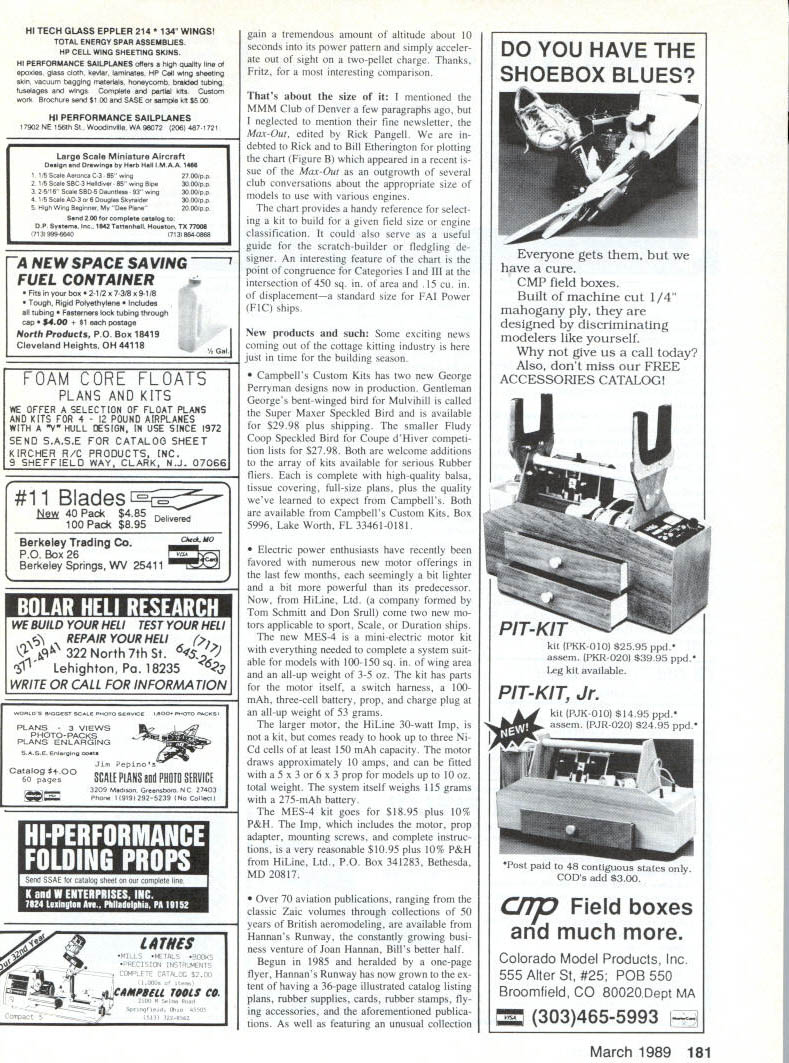
Electric power enthusiasts have seen many new motors recently. HiLine, Ltd. (a company formed by Tom Schmitt and Don Srull) offers two new motors suitable for sport, Scale, or Duration ships:
- MES‑4 (mini‑electric motor kit): Includes motor parts, switch, harness, a 100‑mAh three‑cell battery, prop, and charger. Suitable for models with 100–150 sq. in. wing area and an all‑up weight of 3–5 oz. Complete setup weighs 53 grams. Price: $18.95 plus 10% P&H.
- HiLine 30‑watt Imp: Ready to hook up to three NiCd cells (at least 150 mAh). Draws ~10 A and can be fitted with a 5 x 3 or 6 x 3 prop for models up to 10 oz. total weight. System weight with a 275‑mAh battery is 115 grams. Price: $10.95 plus 10% P&H.
HiLine, Ltd., P.O. Box 341283, Bethesda, MD 20817.
Final notes
Thanks to Fritz Mueller, Rick Pangell, Bill Etherington, and the many club members and vendors who shared data, observations, and new products. Watch for Fritz's forthcoming CO2 article in Model Builder if CO2 propulsion interests you. And welcome back to those returning to competition—it's great to see familiar faces in the pits again.
Transcribed from original scans by AI. Minor OCR errors may remain.

