
Free Flight: Duration
Harry Murphy 3824 Oakwood Blvd., Anderson, IN 46011
NFFS/USOC
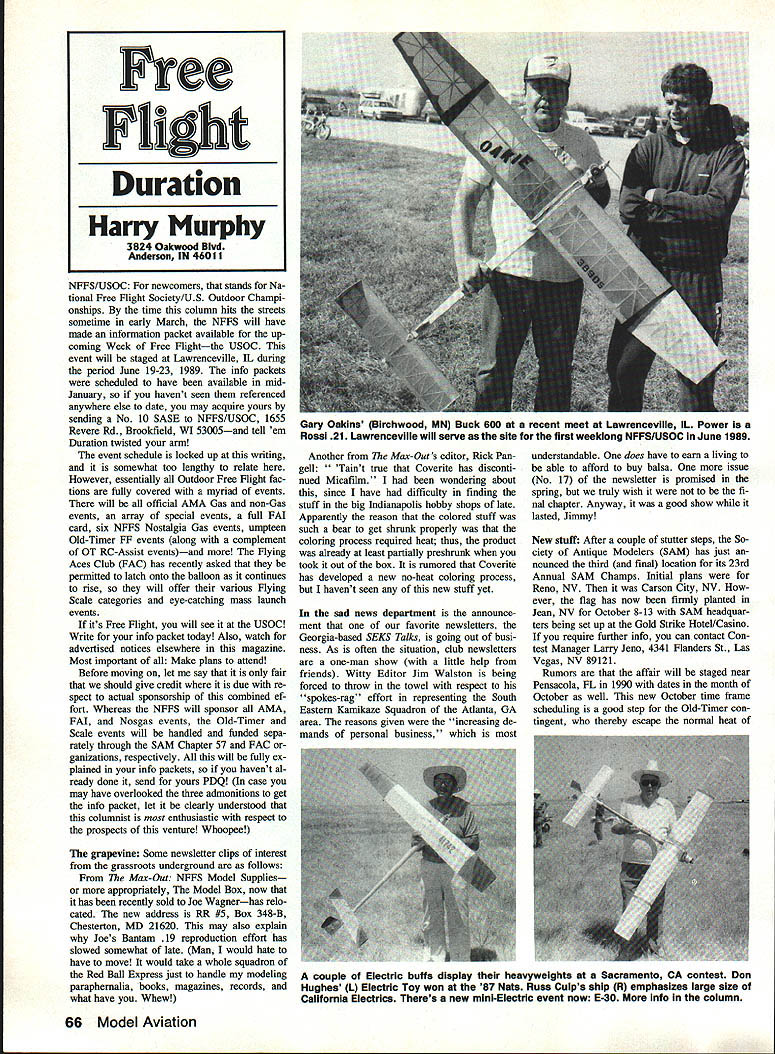
NFFS/USOC (National Free Flight Society/U.S. Outdoor Championships): By the time this column appears in early March, the NFFS will have an information packet available for the upcoming Week of Free Flight — the USOC. This event will be staged at Lawrenceville, IL during June 19–23, 1989. Info packets were scheduled to be available in mid-January; if you haven't seen them, send a No. 10 SASE to NFFS/USOC, 1655 Revere Rd., Brookfield, WI 53005 — and tell 'em Duration twisted your arm!
The event schedule is extensive and cannot be fully listed here, but essentially all Outdoor Free Flight factions are covered: all official AMA Gas and non-Gas events, an array of special events, a full FAI card, six NFFS Nostalgia Gas events, numerous Old-Timer FF events (with OT RC-Assist events), and more. The Flying Aces Club (FAC) will offer various Flying Scale categories and mass-launch events. Write for your info packet today and watch for advertised notices elsewhere in the magazine. Most important: make plans to attend.
Sponsorship
It is fair to credit actual sponsorship: the NFFS will sponsor all AMA, FAI, and Nostalgia events. The Old-Timer and Scale events will be handled and funded separately through SAM Chapter 57 and FAC, respectively. All details will be in the info packet, so if you haven't requested yours, send for one promptly.
The grapevine
Some newsletter clips of interest:
- From The Max-Out: NFFS Model Supplies — now sold to Joe Wagner and appropriately called The Model Box — has relocated to RR #5, Box 348-B, Chesterton, MD 21620. This may explain why Joe's Bantam .19 reproduction effort has slowed a bit lately.
- From The Max-Out's editor, Rick Pangell: "It ain't true that Coverite has discontinued Micafilm." Difficulty finding the colored stuff may have stemmed from a heat-based coloring process that partially preshrunk the material. Rumor has it Coverite developed a new no-heat coloring process; I haven't seen any of the new material yet.
- Sad news: the Georgia-based newsletter SEKS Talks is folding. Editor Jim Walston cites increasing demands of personal business. One more issue (No. 17) is promised in the spring; we wish it were not the final chapter.
New stuff
The Society of Antique Modelers (SAM) announced the third and final location for its 23rd Annual SAM Champs. Initial plans were Reno/Carson City, NV, but the flag is now planted in Jean, NV. Dates: October 8–13. SAM headquarters will be at the Gold Strike Hotel/Casino. For info, contact Contest Manager Larry Jeno, 4341 Flanders St., Las Vegas, NV 89121. Rumors are 1990's event may be near Pensacola, FL, also in October — a favorable move for Old-Timer flyers escaping summer heat.
---
Free Flight: Duration
Harry Murphy 3924 Oakwood Blvd., Anderson, IN 46011
E-30 — the new 30-inch electric event
The magic number 30 is back. After P-30 (30 in. rubber) and Pee Wee 30 (Cox .020), now comes E-30 for small electric motors. Tony Naccarato of the Blacksheep Exhibition Squadron authored the rules for this simplified event:
- Wingspan: 28–30 in.
- Minimum weight: 60 grams, including batteries.
- Commercially available plastic props only.
- Permitted motor systems:
- Ferretti Enterprises (two-cell system)
- VLH Y-70 motor system
- MRC motor system as removed from kit #1501 of their Cessna 150 foam model (only the motor system is permitted, not the model)
- No motor modifications permitted.
- Only the two 50 mAh batteries that come with each system are permitted.
Flight scoring: an official flight is 40 seconds or more; two-minute maxes; 30 seconds added for R/O flights; six attempts to make three official flights.
Tony lists small rubber kits easily convertible to E-30: Peck-Polymers One-Night 28, Micro-X Norbert, P-30, Phred's Models Potter P-30, RN Panda, Blue Ridge Square Eagle, and Jed's and Campbell's Souper 30. It sounds like fun — several clubs are experimenting with the event.
Don Ross book: Rubber Powered Model Airplanes
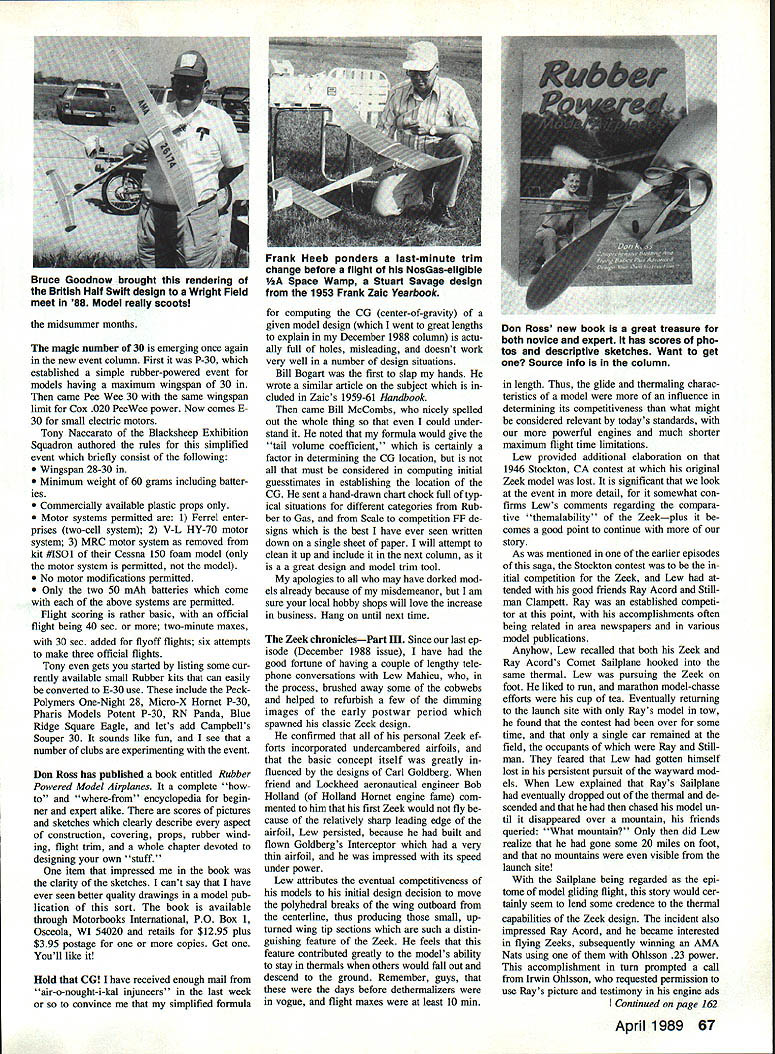
Don Ross has published Rubber Powered Model Airplanes, a complete "how-to" and "where-from" encyclopedia for beginners and experts. It contains scores of photos and clear sketches covering construction, covering materials, props, rubber winding, flight trim, and a chapter on designing your own models. The sketches are particularly clear. The book is available through Motorbooks International, P.O. Box 1, Osceola, WI 54020. Price: $12.95 plus $3.95 postage for one or more copies.
Center of gravity follow-up
My simplified CG formula from December 1988 has drawn enough mail to show it is incomplete and misleading in some design situations. Bill Bogart wrote a technical article on the subject included in Zaic's 1959–61 Handbook. Bill McCombs then provided a clear explanation and a hand-drawn chart covering typical situations for categories from Rubber to Gas and from Scale to competition free flight — a superb single-sheet design and trim tool. I will attempt to clean it up and include it in the next column. My apologies to anyone who trimmed models based on my earlier formula, but at least the local hobby shops will benefit.
The Zeek chronicles — Part III
Since the December 1988 issue, I had lengthy phone conversations with Lew Mathieu, who refreshed many images of the early postwar period that spawned his classic Zeek design.
- Airfoil and influences: All of Lew's Zeeks used undercambered airfoils. The basic concept was greatly influenced by Carl Goldberg's designs. When Lockheed aeronautical engineer Bob Holland (of Holland Hornet engine fame) commented that the first Zeek would not fly because of its relatively sharp leading edge, Lew persisted — he had flown Goldberg's Interceptor with a thin airfoil and liked its speed.
- Wing polyhedral: Lew attributes the Zeek's competitiveness to moving the polyhedral breaks outboard from the centerline, creating the small upturned wingtips that helped the model stay in thermals when others fell out. Remember, thermalling wasn't as vogue then, and flight maxes were often 10 minutes or more.
- Stockton 1946 contest: At the first competition for the Zeek in Stockton, CA, Lew attended with friends Ray Acord and Stillman Clampett. Both Lew's Zeek and Ray Acord's Comet Sailplane hooked the same thermal. Lew chased on foot and eventually returned to the launch site with only Ray's model. His friends feared he had been lost; only when Lew said he had chased his model until it disappeared over a mountain did they realize he had walked some 20 miles — and no mountains were visible from the launch site. The incident impressed Ray, who then became interested in flying Zeeks and went on to win an AMA Nats with Ohlsson .23 power. Irv Ohlsson later requested permission to use Ray's picture and the contest story in an engine ad.
- Commercial kits and engines: Ray Acord ultimately produced the first commercial kit of the Zeek under the Air-O label. Ray's shop also made the Air-O Mighty Midget (.45 cid) — a Ray Acord–redesigned continuance of earlier Bunch Tiger engines. Lew worked in Ray Acord's machine shop from 1945 through 1948 while moonlighting on other projects.
Correction to the original Zeek sketch
A minor correction to the sketch published in December 1988: the original Zeek used a single-wheel landing gear, not the two-wheel configuration I had shown. The two-wheel assumption arose because landing-gear details were omitted from Stu Sittig's original drawings. Early photos indicate the omission of sub-rudders; Lew said he met the ROG requirement by drilling holes in the trailing edges and inserting short hardwood dowels that extended forward to the bottom of the fuselage, allowing the model to remain upright with two prongs and a single wheel when on the ground.
Variants, records, and other notes
- Sizes: Other Zeeks followed the original 277 sq. in. in sizes of 435 and 575 sq. in. The 435 originally used a Torpedo .29, the 575 a Bunch Tiger .45. The 435 became the testbed for the transition from ignition to glow plug engines: ignition Torpedo .29 was removed, the pylon moved rearward, and the fuselage cross section reduced to accept an Arden .199 glow. Ignition Bunch .45s were later replaced by glow Torpedo .19s and .23s in the 575-size models.
- Records: Lew's Zeeks held the AMA ROG record at one time with a 22-minute, three-flight total. He held many Free Flight records and, uniquely, once held all four Control Line speed records (Classes A, B, C, and D) simultaneously.
- Derivatives and large versions: The Hurricane (a Goldberg look-alike produced by Advanced Engineering Company) influenced a Zeek variation from Stu Sittig; that variation was dropped after testing. The fabled 1,500-sq.-in. McCoy .60-powered Zeek existed but saw only a half-dozen contests because it was too large to transport easily.
- Fuel and business: Lew mixed his own glow fuel and sold it under the Super Sonic label; he eventually sold his fuel interests to John Brodbeck of K&B Manufacturing, which continued selling fuels under that label for decades. Lew began working full time for K&B in 1949 and is credited with bringing engine designer Bill Wisnewski to K&B.
- Other activities: Lew edited the "West Coast Report" for Model Airplane News for a couple of years and helped Bill Cranford produce the second edition of the A/B Zeek under Premium Manufacturing Co., which included a larger stab and subtle fuselage refinements while preserving the distinctive wing. At age 62 (at the time of these conversations), Lew remained energetic, having owned and run multiple businesses over the years, and owning several full-scale aircraft. He considered returning to Free Flight when his pilot medical situation allowed — in which case, be prepared for more record rewriting.
We thank Lew Mathieu for furnishing this information on his personal experiences and Zeek history.
---
Free Flight: Duration
Thus began my search in earnest for this pioneering group. It led me to discover a marvelously talented set of boys who, in the pre-balsa era, equaled the best modelers in the country.
Contacts and surviving members
A bit of work with names in the phone book led to:
- Lee Erling, son of ex-club member Ervin Erling. Lee became an invalid shortly thereafter but shared many sessions on music, model flying, and history. He loaned his father's box of propellers, silver trophies, and 1915 model catalogs.
- Alfred Hayden, whom I met once. He gave me clippings from the Milwaukee Journal and regretted that his box of propellers had been used to amuse his grandchildren. He died soon after; I appreciate his assistance.
- Ken Sedgwick, living in retirement in Florida, who vividly remembered the club's building techniques and contests. He said: "We were so utterly serious about our hobby. It was the all-compelling force in our lives and had a great deal to do with shaping our adult lives."
By the late 1960s these four men were the only surviving Milwaukee Model Aero Club members. Lynn Davies and Ervin Erling passed away in 1961. By 1975 the last of the Milwaukee Model Aero Club members was gone.
Models and contests
The Milwaukee Model Aero Club (MMAC) apparently began early in 1914. Lynn Davies had already built many models and taught others. Building a good-flying model took several weeks; hobby shops were still two decades away. The club eventually outgrew its initial flying site on what is now the University of Wisconsin–Milwaukee campus.
For their time the MMAC members were advanced builders. Models were carefully streamlined, sanded, and doped with banana oil. Props were designed and carved to true pitch (1/4 layout).
Transcribed from original scans by AI. Minor OCR errors may remain.

