
Free Flight: Duration
Louis Joyner 3657 Brookwood Rd. Birmingham, AL 35223
Beeper believer
The feeling is familiar to anyone who has ever flown Free Flight — a mixture of joy and panic when your model maxes out in a big thermal and doesn't come down. That's what I felt when I reached the fence about a mile downwind at the annual Pensacola contest last June. About the time I climbed over the fence, Jim Bradley pedaled up on his all-terrain bicycle, lifted his Nordic over the fence, and pedaled off after it. At the same time my Wakefield had picked up the same thermal.
Jim carried a small radio receiver that put out a static-clouded squawk. I looped the truck out the main gate and drove after him. Another mile downwind I spotted Jim's bicycle and saw him in a pasture, but neither model was in sight. Jim's beeper was picking up a signal from some woods farther downwind, so we headed in.
The woods were a briar patch — mixed pines and hardwoods with dense undergrowth of brambles and blackberries. Jim used his scanner as a direction finder, holding it against his chest and slowly turning; when the signal dropped off most, he'd about-face and head that way. I spread out and helped search for about a half hour, then returned to fly the next round. Jim stayed on. Less than an hour later he pedaled back to the flight line with his model. My Wakefield, without a beeper, stayed buried in the woods despite several hours of searching later that afternoon and the next morning.
Believe me, my next models will have some sort of beeper on board.
Beeper options
There are several commercial retrieval beeper units and kits available. If you want more information, write to:
- Bradley Model Products, 1337 Pine Sap Ct., Orlando, FL 32825
- Jim Walston Retrieval Systems, 725 Cooper Lake Rd. S.E., Smyrna, GA 30080
- Gil Morris, 2810 Brackley Rd., Columbus, OH 43220
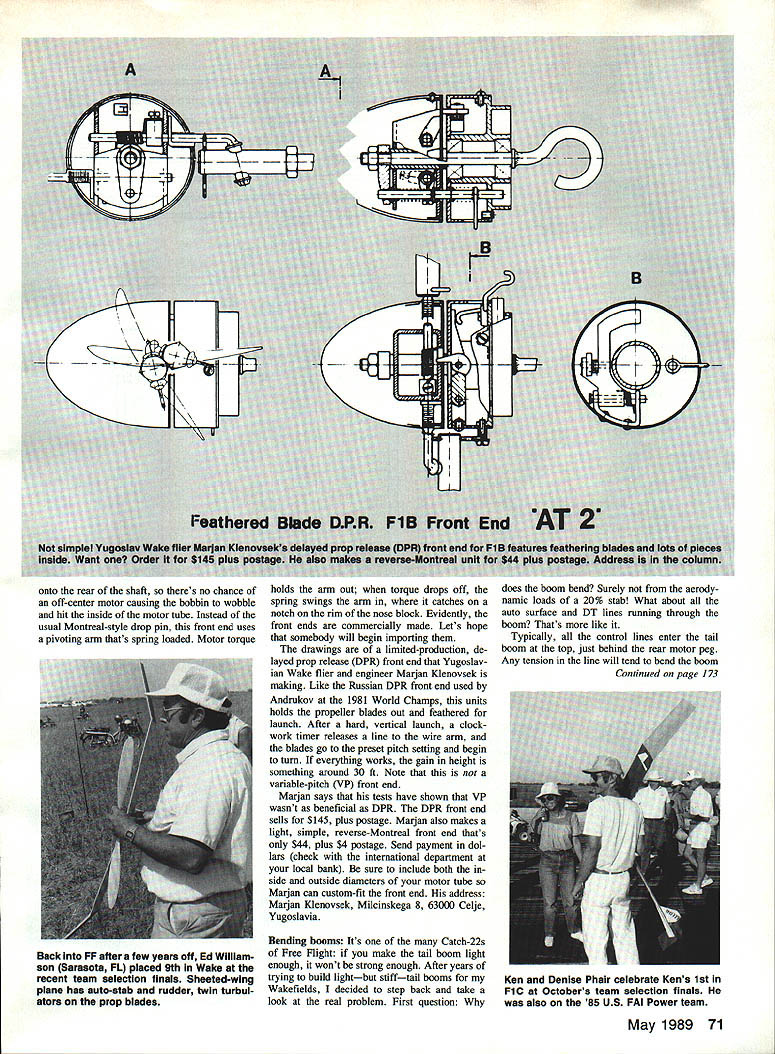
Jim Walston has developed a sophisticated, very lightweight transmitter/receiver system with a directional antenna. Gil Morris sells an inexpensive transmitter kit. Jim Bradley sells individual beepers and an electronic Nordic timer with beeper options.
Wakefield front ends
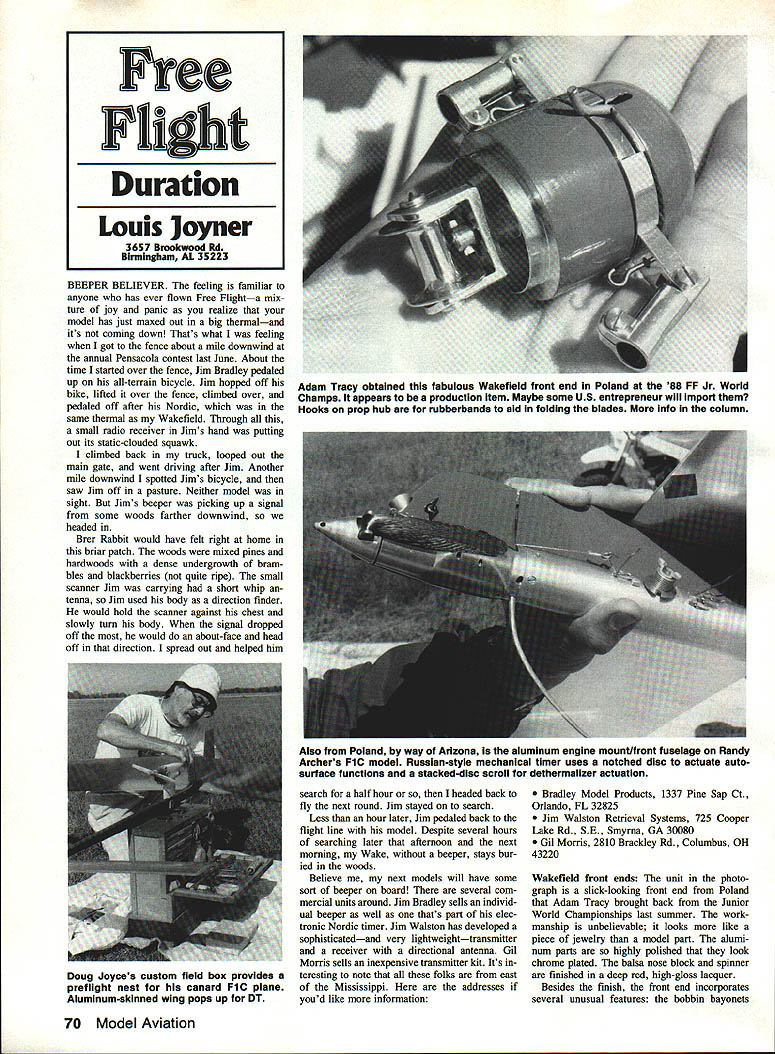
Adam Tracy brought back a handsome Wakefield front end from Poland after the Junior World Championships. The workmanship is exceptional — polished aluminum, a deep red high-gloss lacquer balsa nose block and spinner — and the unit includes features such as bobbin bayonets and hooks on the prop hub for rubber bands to aid in folding blades. It looks more like a piece of jewelry than a model part; perhaps some U.S. entrepreneur will import them.
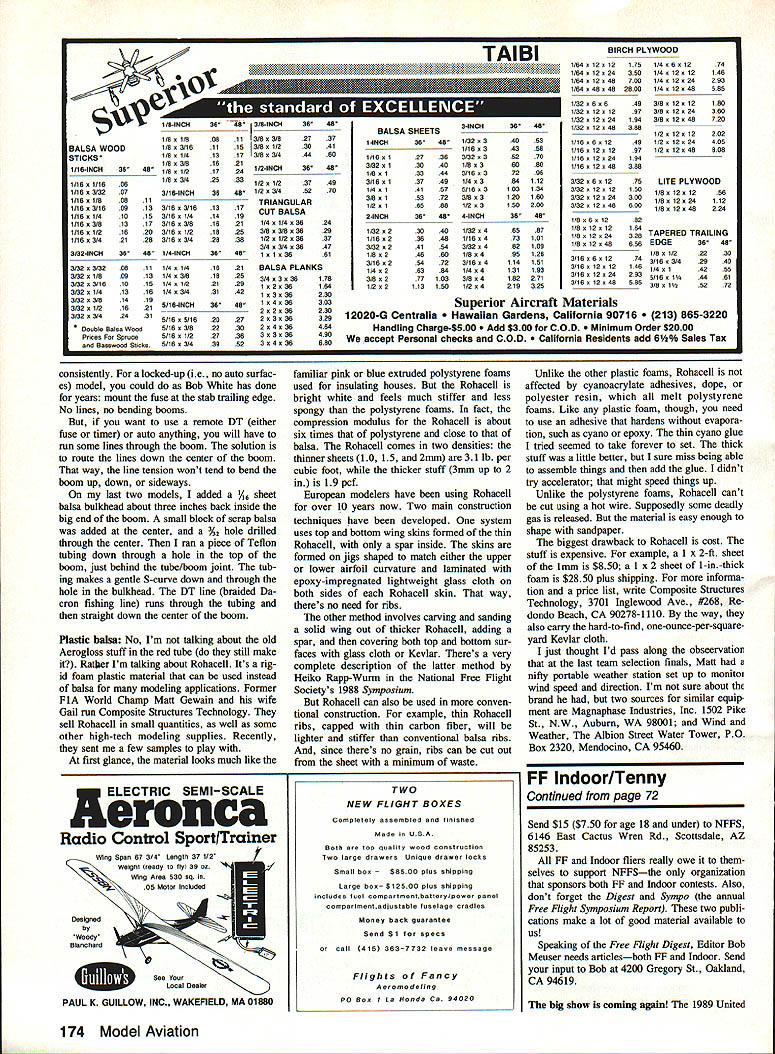
Also of interest are limited-production delayed-prop-release (DPR) front ends from Yugoslavian Wake flier and engineer Marjan Klenovsek. Similar in concept to the Russian DPR used at the 1981 World Champs, these units hold the propeller blades out and feathered for launch. After a hard vertical launch a clockwork timer releases a line to the wire arm; the blades then go to their preset pitch and begin to turn. If everything works, the gain in height can be on the order of 30 ft. Note: this is not a variable-pitch (VP) front end — Marjan's tests indicated VP wasn't as beneficial as DPR.
Pricing and ordering:
- DPR front end: $145 plus postage
- Light reverse-Montreal front end: $44 plus $4 postage
Send payment in dollars (check with your bank's international department). When ordering, include both the inside and outside diameters of your motor tube so Marjan can custom-fit the front end.
Address: Marjan Klenovsek Milcinskega 8 63000 Celje Yugoslavia
Bending booms
One of the Catch-22s of Free Flight: if you make the tail boom light enough, it may not be strong enough. After years of trying to build light but stiff tail booms for my Wakefields, I reconsidered the real cause of bending. It's rarely the aerodynamic load of a small stab; more often the culprit is the auto-surface and DT lines running through the boom. Typically those lines enter the boom at the top just behind the rear motor peg; any tension in a top-entry line will tend to bend the boom.
The solution is to route the lines down the center of the boom so line tension won't tend to bend the boom up, down, or sideways. On my last two models I added a 1/16" sheet balsa bulkhead about three inches back inside the big end of the boom. A small scrap balsa block centered the hole and I drilled a 3/16" hole through it. I then ran a piece of Teflon tubing down through a hole in the top of the boom just behind the tube/boom joint; the tubing makes a gentle S-curve down and through the bulkhead hole. The DT line (braided Dacron fishing line) runs through the tubing and then straight down the center of the boom. This keeps the lines centered and eliminates the bending moment that top-entry routing produces.
For locked-up models (no auto-surfaces), another simple approach is to mount the fuse at the stab trailing edge — no lines through the boom, no bending.
Plastic balsa: Rohacell
I'm not referring to the old Aerogloss product; I'm talking about Rohacell, a rigid foam plastic used in place of balsa for many modeling applications. Former F1A World Champ Matt Gewain and his wife Gail run Composite Structures Technology and sell Rohacell in small quantities along with other high-tech supplies; they sent me samples to try.
Rohacell looks similar to pink or blue extruded polystyrene insulation but is bright white, stiffer, and less spongy. Its compression modulus is about six times that of ordinary polystyrene and approaches that of balsa. Rohacell is available in two densities: thinner sheets (1.0, 1.5, and 2.0 mm) are roughly 3.1 lb/ft³, while thicker sheets (3 mm and up) are around 1.9 lb/ft³.
Two main European techniques have been developed for Rohacell wings:
- Use thin Rohacell skins (formed on jigs to match airfoil curvature) with a spar inside, then laminate with epoxy-impregnated lightweight glass cloth on both sides of each skin — eliminating ribs.
- Carve and sand a solid wing from thicker Rohacell, add a spar, then cover both top and bottom surfaces with glass cloth or Kevlar.
Rohacell also works well in conventional construction: thin Rohacell ribs capped with thin carbon fiber can be lighter and stiffer than balsa ribs, and because there's no grain, ribs can be cut from sheet stock with minimal waste.
For a detailed description of carving a solid Rohacell wing, see Heiko Rapp‑Wurm's article in the National Free Flight Society's 1989 Symposium.
Transcribed from original scans by AI. Minor OCR errors may remain.

