
Free Flight: Duration
Dave Linstrum 4057 San Luis Dr. Sarasota, FL 33580
When I agreed to do this filler column on request from MA's publisher, I was reminded of the main reason why I packed up all my Outdoor Free Flight models (except P-30 and Pee Wee 30, which are both small-field events) almost a decade ago. I have not given up Free Flight, of course—merely continued to enjoy it indoors, flying with the infamous MIAMA club (Miami Indoor Aircraft Model Association). I now fly the Rubber, Glider, and Power (CO2 and Electric) Free Flight models that I can stuff in my car—but I do it indoors.
I discussed this transition recently with another modeler whose writings appear frequently in MA: journalist Larry Kruse of Liberal, KS (he does the AMA Nats reports annually)—a truly dedicated Free Flighter. I mentioned that chasing models into pine forests, swamps, etc. was a pain, and asked him what made him give up Outdoor Scale events. His answer was succinct, and a comment on the site problems faced by FFers nationwide: "It was the chase, Ace!"
Flying Aces Nats video
Speaking of aces, many of you may have read of the exploits of the current Flying Aces Club, or perhaps read the Flying Aces magazine of the Thirties that spawned the national FF club. Every two years the FAC gathers at the local grass airport at Geneseo, NY, for their very own FAC Nats. This brings out probably the finest collection of Outdoor Flying Scale models in the country. They are truly world-class.
You may wonder why I mention this in a Duration column. It's simply because these guys fly in thermal country just like the rest of you, and many pick air and get long or OOS (out of sight) flights with their superb, often museum-quality models. They pack turns on braided rubber and do javelin launches just like Wakefield fliers. The only difference is that the models are replicas of full-size aircraft which are often of exotic design and, hence, exciting at the launch, climb, and thermal there—though stopwatches are used, as sometimes it is the last man down from a mass launch who wins.
Mass launches are a phenomenon unique to the flying style of the FAC. Models of a particular class, say raceplanes, or World War I craft, or Golden Age replicas, are grouped. The fliers wind their motors, line up, and launch simultaneously at the CD's command. This results in a mad swarm of Free Flights streaking skyward—as they used to say in the old Flying Aces articles.
Paul Mellrath (Cedar Rapids, IA) did some research on this mass flying and came to the conclusion that it was pioneered in 1933 by Italian Air Force Colonel Italo Balbo. He organized and led a goodwill flight of 25 flying boats on a route from Italy to the 1933 Chicago World's Fair. Incredibly, in that day of uncertain flying conditions, 23 of the 25 made the round trip. Ever since, the British have referred to any large gaggle of aircraft as a "Balbo."
Needless to say, the FAC Nats video is immensely entertaining. Produced by FAC Swamp Squadron Ace Dean McGinness (himself an entrant), it took time to record mass launches, winding preparations, model judgings, and award presentations. The admittedly amateur-made video will warm the heart of any Free Flighter, especially a flier who has some understanding of Flying Scale constraints. Performance models will blow you away.
To order the FAC Nats video:
- Price: $22.95 postpaid (VHS)
- Send check or money order to: Dean McGinness, FAC, 1503 Clairdale Ln., Lakeland, FL 33801
The video is a real keeper; it may inspire a few Balbo launches of your own. It's contagious.
Any Kinda Korda special event
Dick Korda, winner of the 1939 Wakefield Cup in the USA, decided something about celebrating the 50th anniversary of the event. In conjunction with the Florida Modelers Association, Dave will hold an "Any Kinda Korda" special event at the FMA field, Melbourne, FL, August 6, 1989. Check the calendar now; the event will allow size and type replicas.
Models and kits
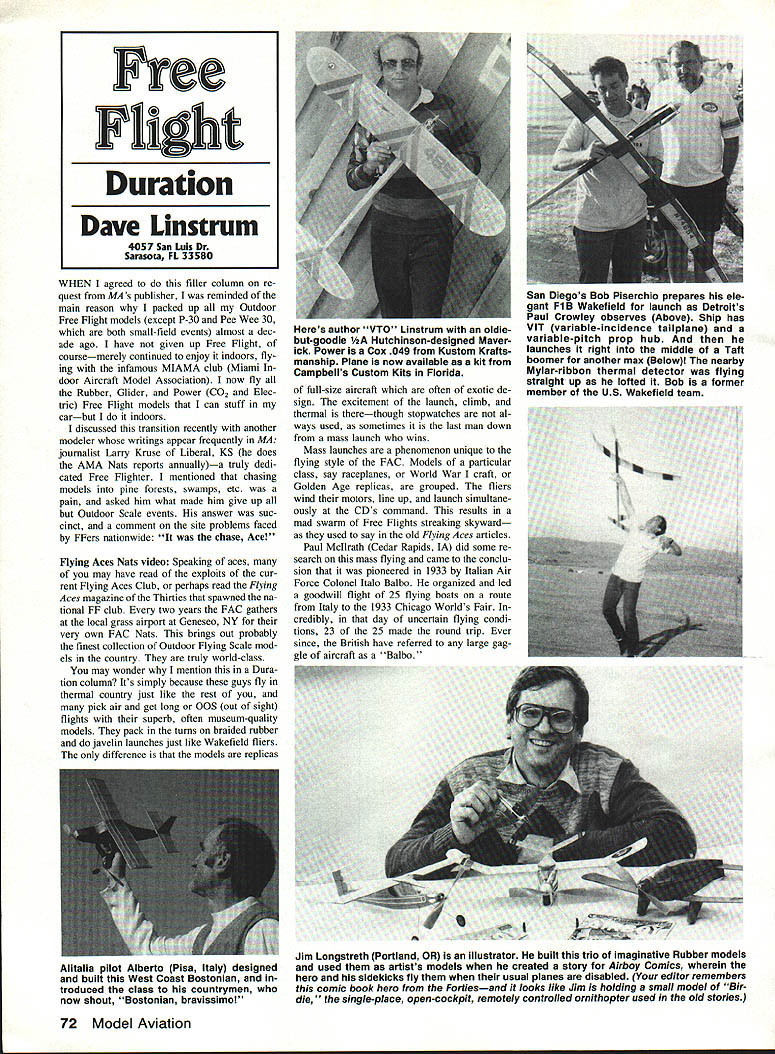
Here's an oldie-but-goodie from Linstrum: the Hutchinson-designed Maverick. Power: Cox .049. Kustom-Kraftsmanship plane now available as a kit from Campbell's Custom Kits, Florida.
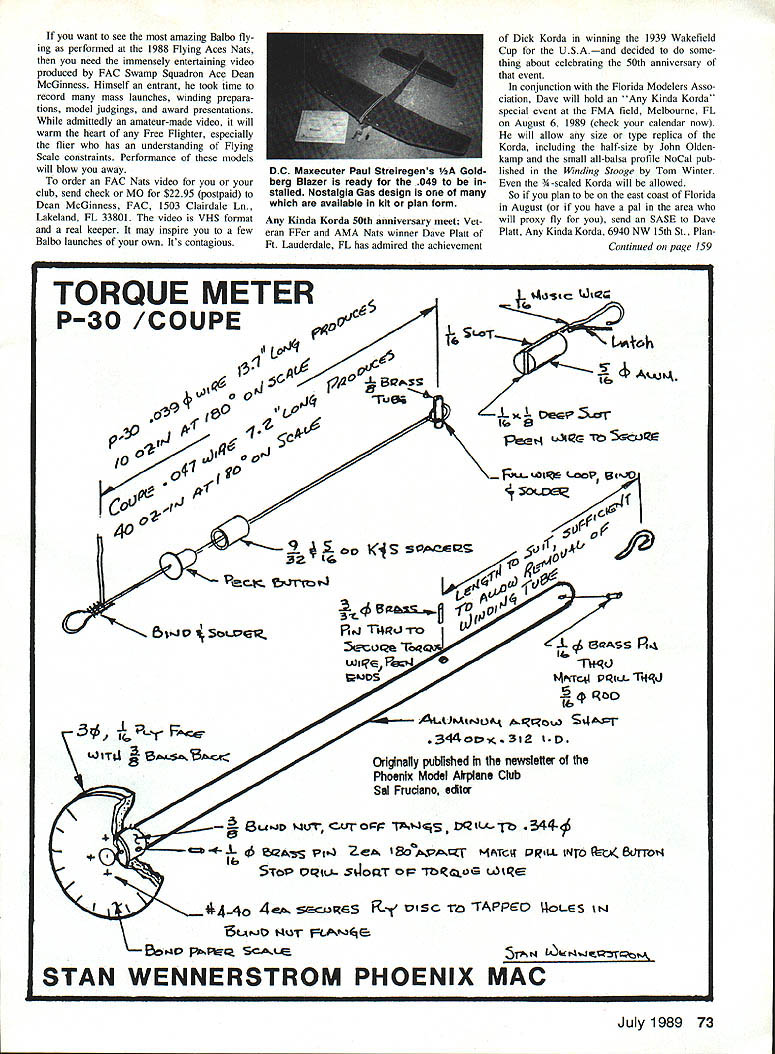
Alberto Pisa of Italy designed and built the West Coast "Bostonian," introduced to the class; countrymen now shout, "Bostonian — bravissimo!" Jim Longstreth, Portland, OR, illustrator, built a trio of imaginative rubber models used as artists' models created for a story in Airboy Comics, wherein the hero and sidekicks fly unusual planes. The editor remembers the comic-book heroes of the Forties and recalls Jim holding a small model "Birdie" — a single-place, open-cockpit, remotely controlled ornithopter used in old stories.
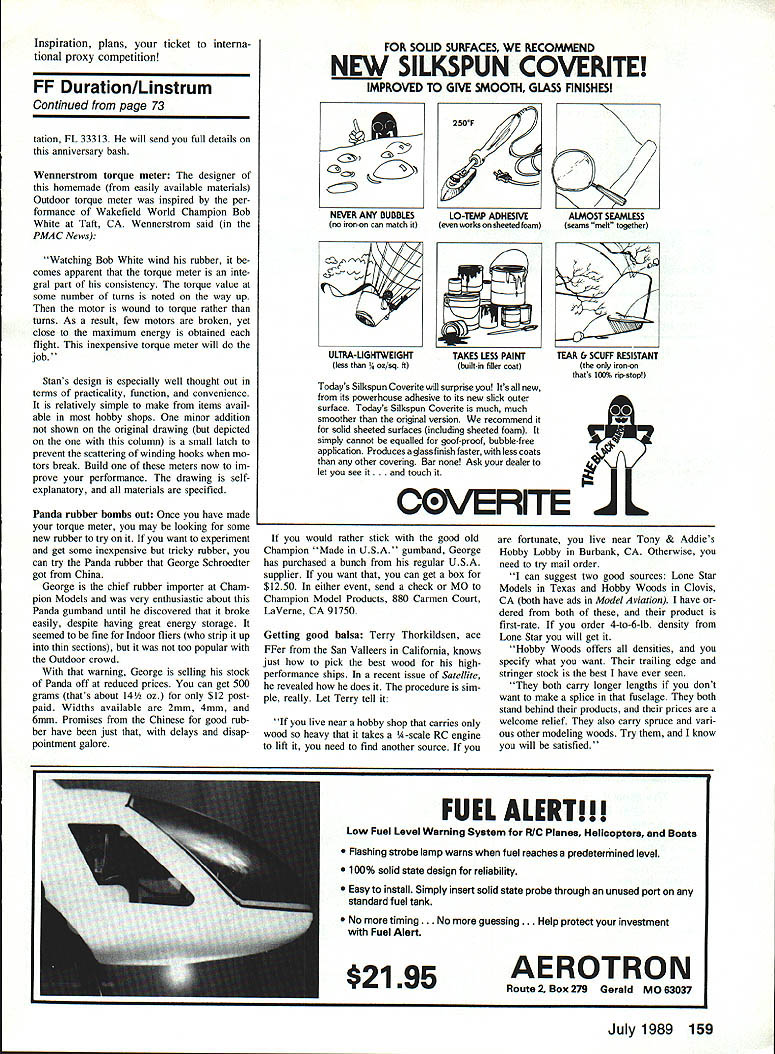
Wennerstrom torque meter
The designer of this homemade (from easily available materials) Outdoor torque meter was inspired by the performance of Wakefield World Champion Bob White at Taft, CA. Wennerstrom said (in the PMAC News):
"Watching Bob White wind his rubber, it becomes apparent that the torque meter is an integral part of his consistency. The torque value at some number of turns is noted on the way up. Then the motor is wound to torque rather than turns. As a result, few motors are broken, yet close to the maximum energy is obtained each flight. This inexpensive torque meter will do the job."
Stan's design is especially well thought out in terms of practicality, function, and convenience. It is relatively simple to make from items available in most hobby shops. One minor addition not shown on the original drawing (but depicted on the one with this column) is a small latch to prevent the scattering of winding hooks when motors break. Build one of these meters now to improve your performance. The drawing is self-explanatory, and all materials are specified.
Panda rubber bombs out
Once you have made your torque meter, you may be looking for some new rubber to try on it. If you want to experiment and get some inexpensive but tricky rubber, you can try the Panda rubber that George Schroedter got from China.
George is the chief rubber importer at Champion Models and was very enthusiastic about this Panda gumband until he discovered that it broke easily, despite having great energy storage. It seemed to be fine for Indoor fliers (who strip it up into thin sections), but it was not too popular with the Outdoor crowd.
With that warning, George is selling his stock of Panda off at reduced prices. You can get 500 grams (that's about 1.1 lb.) for only $12 postpaid. Widths available are 2 mm, 4 mm, and 6 mm. Promises from the Chinese for good rubber have been just that, with delays and disappointment galore.
If you would rather stick with the good old Champion "Made in U.S.A." gumband, George has purchased a bunch from his regular U.S.A. supplier. If you want that, you can get a box for $12.50. In either event, send a check or MO to: Champion Model Products, 880 Carmen Court, LaVerne, CA 91750.
Getting good balsa
Terry Thorkildsen, ace FFer from the San Valleiers in California, knows just how to pick the best wood for his high-performance ships. In a recent issue of Satellite, he revealed how he does it. The procedure is simple, really. Let Terry tell it:
"If you live near a hobby shop that carries only wood so heavy that it takes a 1/2-scale RC engine to lift it, you need to find another source. If you are fortunate, you live near Tony & Addie's Hobby Lobby in Burbank, CA. Otherwise, you need to try mail order.
"I can suggest two good sources: Lone Star Models in Texas and Hobby Woods in Clovis, CA (both have ads in Model Aviation). I have ordered from both of these, and their product is first-rate. If you order 4-to-6-lb. density from Lone Star you will get it.
"Hobby Woods offers all densities, and you may specify what you want. Their trailing edge and stringer stock is the best I have ever seen.
"They both carry longer lengths if you don't want to make a spar from spliced pieces. They both stand behind their products, and their prices are a welcome relief. They also carry spruce and various other modeling woods. Try them, and I know you will be satisfied."
Transcribed from original scans by AI. Minor OCR errors may remain.

