
Free Flight: Duration
Harry Murphy
NFFS Notes
The National Free Flight Society has announced its choices for the 10 models of the year for 1989. They are:
- AMA Large Power — Humming Bird by Charles Caton
- AMA Small Power — Booger II by Glenn Schneider
- AMA Large Rubber — Bandwagon by Roger Gregory
- F1A Nordic — S-11 Allround by Stefan Rumpp (W. Germany)
- F1B Wakefield — Fantasy by Stafford Quinn
- F1C Power — Silhouette by Stafford Screen (Gr. Britain)
- Indoor Scale — DO-X Flying Boat by Don Srull
- Indoor Intermediate Stick — Symphony by Earl Hoffman
- Special Publication — Building and Flying Indoor Model Airplanes by Ron Williams
- Special — Series of over 40 Peanut Scale drawings of French civil aircraft by Emanuel Fillon
Charles Dorsett chaired the selection committee for this year. Congratulations to all of the award winners!
NFFS Hall of Fame (1989)
In conjunction with the preceding selections, Chairman Anthony J. Italiano has announced four new inductees into the NFFS Hall of Fame for 1989. They are:
- Faun W. "Frank" Swaney (deceased)
- Edward Naudzius
- Johnny Clemens
- Bob and Sandy Peck
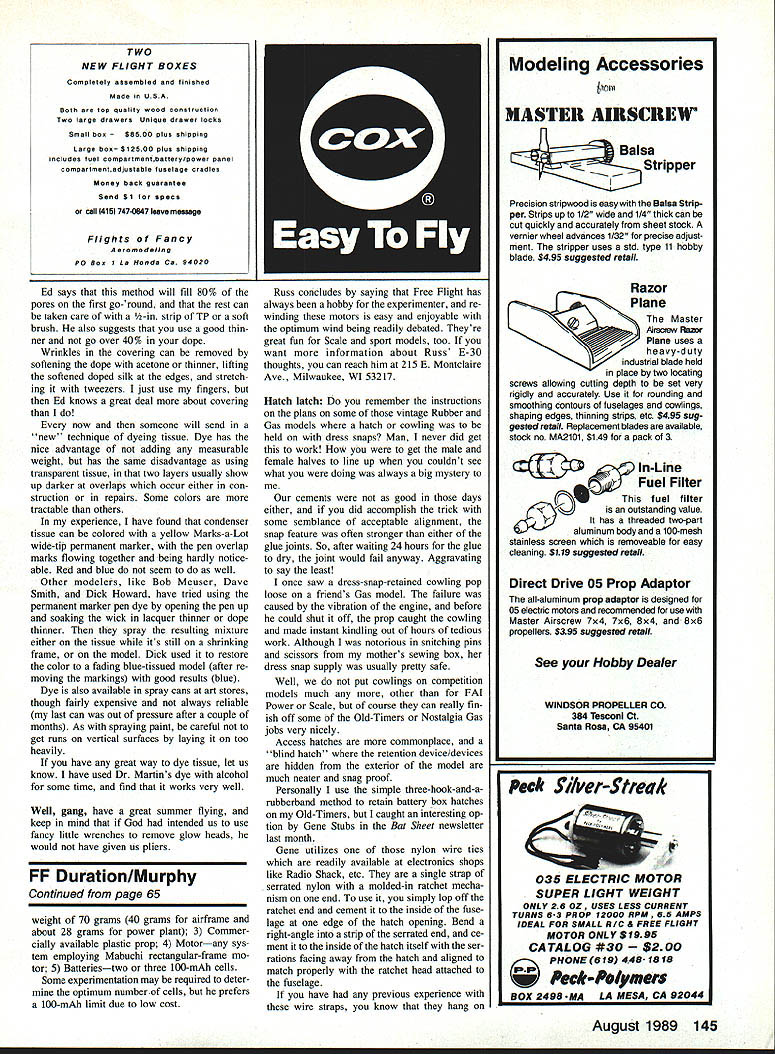
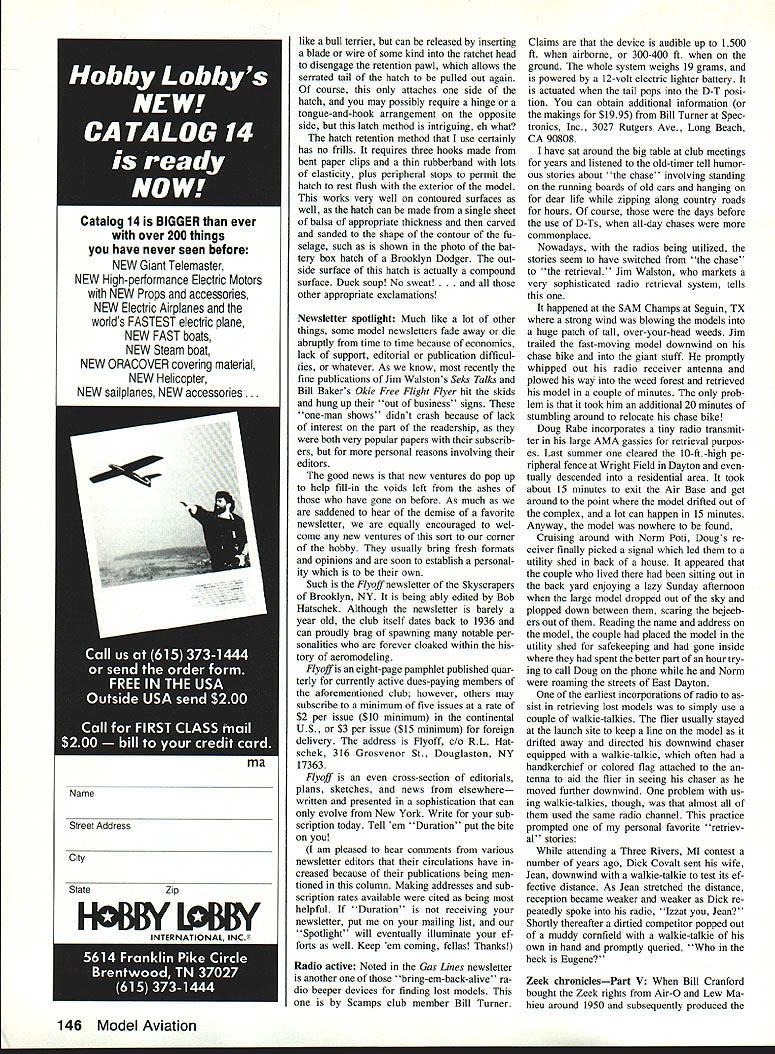
Frank Swaney was a longtime resident of California where he served many years as a hobby shop proprietor and hobby distributor in the Long Beach area. This provided him the opportunity to do what he liked best—helping youngsters and novices get acquainted with model airplanes. I have pleasant memories as a teenager of being picked up by Mr. Swaney in his Model A Ford and towed off to the club flying site in the earlier pre-California days when Faun was a Hoosier.
Ed Naudzius was instrumental in the establishment of the famed Detroit-based Plymouth Internationals model aero competition program, which took place in the postwar Forties and early Fifties.
Bob and Sandy Peck are the creators and producers of the fine line of Peck-Polymer rubber scale kits and supplies.
Johnny Clemens needs no introduction to many of us. He is an ex-AMA President and father of many AMA programs, including the AMA museum and the new Headquarters facility. I talked to Johnny at the Toledo RC Show recently, and he was as cheerful and friendly as ever. For many, he will always be Mr. AMA.
I believe this to be a grand gesture by the NFFS to honor these fine folks who have spent lifetimes promoting the hobby.
Pertinent potpourri
Lightning may not strike twice in the same place; apparently hurricanes do. E. Leisure, Fresno, CA 93727, is producing the famed Class C Hurricane design of Arl Armstrong as once produced by the Advanced Engineering Co. of Fresno. This somewhat smaller Comet Sailplane look-alike was a West Coast rage back in the Forties. It incorporated a 69-in. wingspan and 738 sq. in. of area, and its crutch-built and half-planked fuselage suggested a more durable construction than Carl Goldberg's famous classic.
You can get one of the new kits for $49 plus $2 for postage. Tell 'em you heard about it in "Duration," and they might include an empty tube of glue or something.
Nat also announced a price increase for the Max Hog kits that began in January of this year. The 1/2A is now $18.95, and the 450 A/B size is now $37.95, with both requiring an additional $2 for mailing fees. Nat's address is 12324 Percival, Chester, VA 23831.
- The new 1989 catalog from Campbell's Custom Kits shows a nearly across-the-board increase in retail kit prices as well. It appears that model kit costs are escalating along with everything else.
Flying site problems associated with the use of fuse dethermalizers seem to be on the upswing. In the past this problem has been more associated with arid Western locales, but more recently it has become a greater concern in the Midwest as well with the summer droughts being experienced. The old cliché of "What this country needs is a good five-cent cigar" needs to be revised to "What this country needs is a good five-dollar dethermalizer." Such a development would go far in alleviating a couple of problems other than fire hazard.
Many of the good flying sites that remain are gradually becoming smaller as land developers continually nip away at their edges, thus making flight termination at the end of a max more critical to prevent overflight into congested areas. As we know from experience, the old reliable fuse D-T just doesn't cut it in the accuracy department.
To build a nice sleek model and then drill a quarter-inch hole in the fuselage to stuff in a metal bushing and a three-inch length of cotton clothesline rope cannot be regarded as a thing of beauty.
The Tomy toy-based timer has offered some relief as an alternative. Different configurations based on how they're used pop up from time to time in various newsletters.
The multifunction Selig timers work fine in this application, but they will continue to enjoy limited use because of their weight, bulk, and having to mortise them into the fuselage.
At any rate, the problem exists, and the field of remedy is wide open for inexpensive and viable alternatives. Free Flight awaits your ideas!
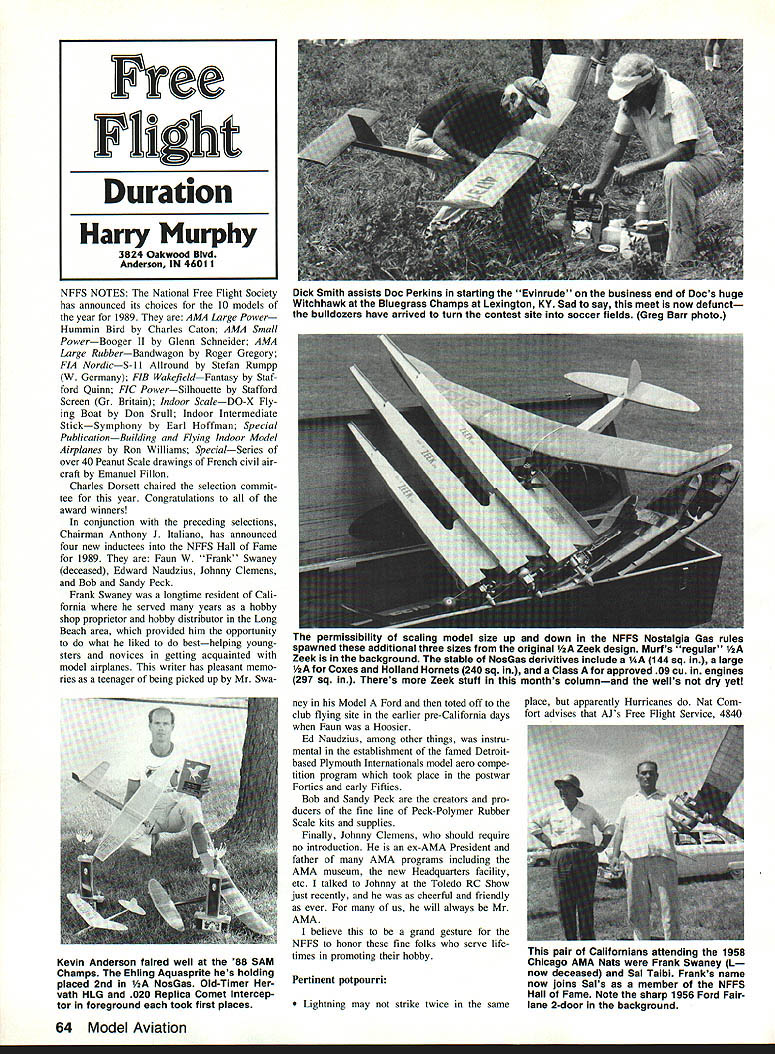
Another great annual Free Flight contest has gone down the drain because of "bulldozer blight." Bill Barr of Lexington, KY, advises that the famed Bluegrass FF Champs has forever lost its Masterson Station Park contest site, as heavy equipment has arrived to create a number of soccer fields. This was one of the Midwest's favorite meets, and the location brought a multitude of contestants down from the North and up from the South to do battle in Kentucky's beautiful horse country. Sad news in these parts.
Micro-electric power (Russ Whitford)
Russ Whitford writes that the Kodak camera motor has really opened opportunities for micro-electric power. He says these motors can be bought in his hometown of Milwaukee for 35¢. Suggested components and targets include:
- A three-cell (9 V) arrangement using 100 mAh Ni-Cd cells (or two or three 100-mAh cells, experimentation required to determine the optimum number)
- Target total weight of about 70 grams (roughly 40 grams for the airframe and about 28 grams for the power plant)
- A commercially available plastic prop
- A motor system employing a Mabuchi rectangular-frame motor
Russ prefers the 100-mAh cell limit due to low cost. He concludes by saying that Free Flight has always been a hobby for the experimenter—these motors are easy to fit and fun to use, with much debate over the optimum wind. They're great for Scale and sport models, too. If you want more information about Russ's E-30 thoughts, you can reach him at 215 E. Montclair Ave., Milwaukee, WI 53217.
Hatch latch
Do you remember the instructions on some vintage rubber and gas model plans where a hatch or cowling was to be held on with dress snaps? I never did get this to work consistently. Getting the male and female halves to line up when you couldn't see what you were doing was always a mystery.
Our cements were not as good in those days either, and if you did manage acceptable alignment, the snap feature was often stronger than the glue joints. After waiting 24 hours for the glue to dry, the joint would sometimes fail anyway. Aggravating, to say the least!
I once saw a dress-snap-retained cowling pop loose on a friend's gas model. Vibration caused the failure, and before he could shut the engine off the prop caught the cowling and destroyed hours of tedious work.
We do not put cowlings on competition models much any more, other than for FAI Power or Scale, but they can really finish off Old-Timers or Nostalgia Gas jobs nicely. Access hatches are more commonplace, and a "blind hatch"—where the retention devices are hidden from the exterior—is neater and snag-proof.
Personally, I use the simple three-hook-and-a-rubber-band method to retain battery box hatches on my Old-Timers. But I caught an interesting option from Gene Stubs in the Bat Sheet newsletter last month.
Gene uses one of those nylon wire ties commonly available at electronics shops like Radio Shack. They are a single serrated nylon strap with a molded-in ratchet mechanism. To use it, loop the ratchet end and cement it to the inside of the fuselage at one end; the free end is looped under a strip of the serrated end and cemented to the inside of the hatch itself with the serrated sections facing away from the hatch and aligned to match properly with the ratchet head attached to the fuselage.
If you've used these wire straps, you know they hang on like a bull terrier, but can be released by inserting a blade or wire into the ratchet head to disengage the retention pawl, allowing the serrated tail of the hatch to be pulled out again. Of course, this only attaches one side of the hatch, and you may require a hinge or a tongue-and-hook arrangement on the opposite side, but the latch method is intriguing.
The hatch retention method I use requires three hooks made from bent paper clips and a thin rubber band with lots of elasticity, plus peripheral stops to permit the hatch to rest flush with the exterior. This works well on contoured surfaces too; the hatch can be made from a single sheet of balsa of the appropriate thickness and then carved and sanded to the contour—duck soup! No sweat!
Newsletter spotlight
Like many things, some model newsletters fade away or die abruptly due to economics, lack of support, editorial or publication difficulties, or other reasons. Recently the fine publications Sel's Talks (Jim Walston) and Olde Free Flight Flyer (Bill Baker) folded. These one-man shows didn't crash from lack of interest—they were popular—but for personal reasons involving the editors.
The good news is that new ventures pop up to fill the void. New newsletters bring fresh formats and opinions and soon establish their own personalities.
Such is Flyoff, the newsletter of the Skyscrapers of Brooklyn, NY, ably edited by Bob Hatscheck. Although the newsletter is barely a year old, the club dates back to 1936 and can proudly claim many notable personalities in the history of aeromodeling.
Flyoff is an eight-page pamphlet published quarterly for currently active dues-paying members of the club; others may subscribe for a minimum of five issues at $2 per issue ($10 minimum) in the continental U.S., or $3 per issue ($15 minimum) for foreign delivery. Address: Flyoff, c/o R.L. Haskell, 316 Grosvenor St., Douglaston, NY 11363.
Flyoff is an even cross-section of editorials, plans, sketches, and news from elsewhere—written and presented in a sophistication that can only evolve from New York. Write for your subscription today. Tell 'em "Duration" put the bite on you!
I am pleased to hear from various newsletter editors that their circulations have increased because their publications were mentioned in this column. Making addresses and subscription rates available was cited as most helpful. If "Duration" is not receiving your newsletter, put me on your mailing list and our "Spotlight" will eventually illuminate your efforts. Keep 'em coming!
Radio active
Noted in the Gas Lines newsletter is another "bring-’em-back-alive" radio beeper device for finding lost models. This one is by Scamps club member Bill Turner. Claims are that the device is audible up to 1,500 ft. when airborne, or 300–400 ft. when on the ground. The whole system weighs 19 grams and is powered by a 12-volt electric lighter battery. It is actuated when the tail pops into the D-T position. You can obtain additional information (or the makings) for $19.95 from Bill Turner at Spectronics, Inc., 3027 Rutgers Ave., Long Beach, CA 90808.
I've sat around the big table at club meetings for years and listened to old-timers tell humorous stories about "the chase"—standing on the running boards of old cars and hanging on for dear life while zipping along country roads for hours. Those were the days before the use of D-Ts, when all-day chases were more commonplace.
Nowadays the stories seem to have switched from "the chase" to "the retrieval." Jim Walston, who markets a sophisticated radio retrieval system, tells this one.
At the SAM Champs in Seguin, TX, a number of models were blown into tall weeds and brush. One fellow's model was completely out of sight for about 15 minutes while it drifted down a ravine. By using his receiver and walking into the brush, he homed in on the model and retrieved it. The device worked so well it had to be seen to be believed.
Cruising with Norm Kolp, Doug's receiver finally picked a signal which led them to a utility shed behind a house. The couple living there had been enjoying a lazy Sunday when a large model dropped out of the sky and lodged in the eave. Reading the name and address on the model, the couple placed it in the shed for safekeeping and had gone inside, trying to call Doug while he and Norm roamed the streets of East Dayton.
One early use of radio to assist retrieval was a couple of small solid-state beepers. A beeper usually stays at the launch site to keep a line on the model as it drifts away and directs the downwind chaser. When the beeper loses signal, the handler then uses the radio to pinpoint the model. One fellow at the SAM Champs used a 5-channel radio and a handheld directional antenna, sweeping until the signal increased. Once the signal was strong, he simply followed it until the model was found. When the model was in a tree, he used a long pole with a hooked end to retrieve it. It isn't perfect, but such systems have saved models that otherwise would have been lost.
Zeek chronicles—Part V
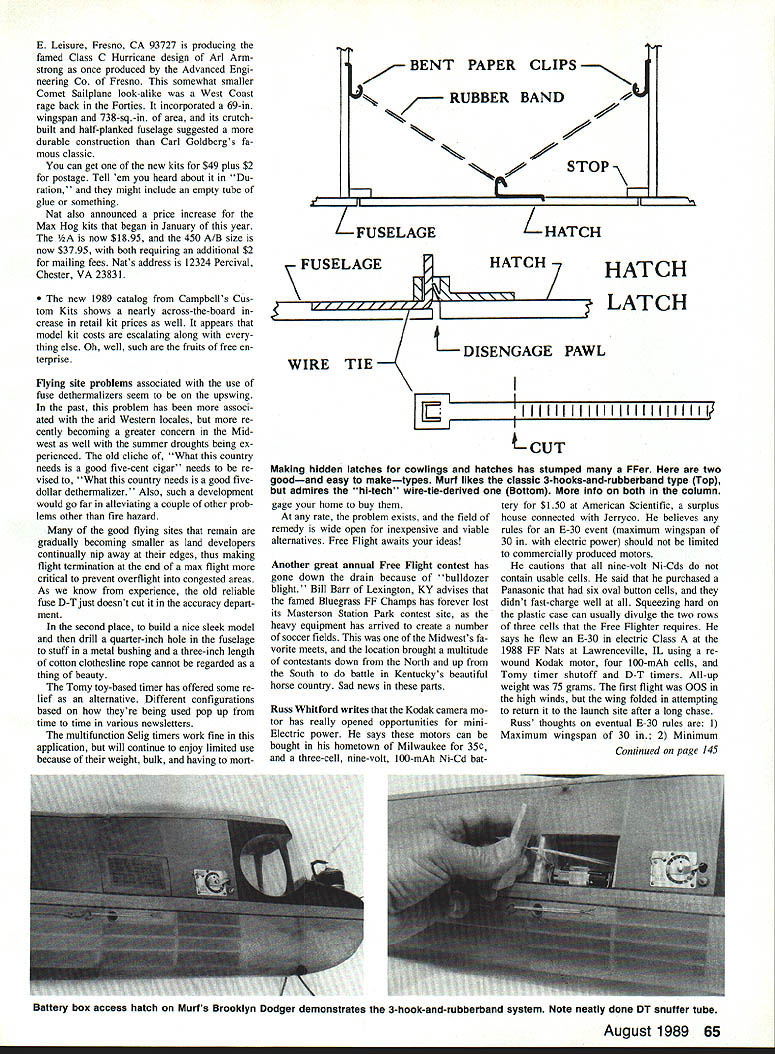
When Bill Cranford bought the Zeek rights from Air-O and Lew Mason around 1950 and produced the A/B and 1/4 kits under the Premium Manufacturing Company label, he owned Cranford Airport at Artesia, CA, which sported approved private and commercial flight schools. He also had a branch school at El Monte Airport.
He taught flying and operated some 28 airplanes, mostly Taylorcrafts and Cessna 140s, with a couple of Stinsons, a double-braced Cessna, and three PT-19s. Bill claimed he bought over 300 Stearmans as surplus and resold them, mostly to crop-dusters who stripped them of their lower wings, which were frequently damaged as a result of ground loops.
In addition to the Zeeks, Bill marketed a 1/4A Cabin version of the Zeek, calling it the Zeek-in. It was identical to the 1/2A Zeek but substituted a built-up cabin-type arrangement for the pylon wing mount.
Although the Zeek kits sold well, Bill claimed his main income producers for the Premium venture were a silhouette Buster G-liner and several plastic toys—one being a little outboard runabout with a scaled rubber-powered Mercury engine.
Bill stated that this was a time of constant change in competition rules, and new, more powerful engines were being introduced regularly. The 1/2A was designed to different philosophies than the earlier A/B, and the eventual "A" kit design was not a one-shot effort. Several sizes of 1/2As were evaluated—some with undercambered airfoils—before the design was finalized for kit production.
He hesitated to produce an .09 kit or a larger Class C version because he thought there was an insufficient market for the latter. Although engine performance was improving in most displacements, he was somewhat disappointed in engine development for the .09-cu.-in. size at the time. Bill confessed that some modelers around Marysville, CA got plans of his 575-sq.-in. B/C design—but we will follow that tangent another time.
Around 1952 Ray Downs entered the Zeek picture. After getting out of the Service in 1944, Ray and his wife opened Ray's Hobby Shop in 1945 in Tucson, AZ. During a buying trip to Los Angeles they heard that the Zeek business was for sale, looked up Bill Cranford, and purchased the rights and assets of the Zeek operation.
After moving the operation to Tucson, they resumed production of the 1/2A and A/B kits under Ray's Manufacturing Company. The two kits were produced for a couple of years until sales diminished and the factory shut down. Around 1955 Frank Garcheer of Midwest Models was in Tucson for a visit; at that time Ray sold his Zeek interests to Midwest, and as far as Ray knows the original Zeek tooling has not seen daylight since.
Next time we double back and pick up some of the flat-bottom-airfoil tangents. Till then,
See you downwind!
Transcribed from original scans by AI. Minor OCR errors may remain.

