
Free Flight: Duration
Bob Meuser
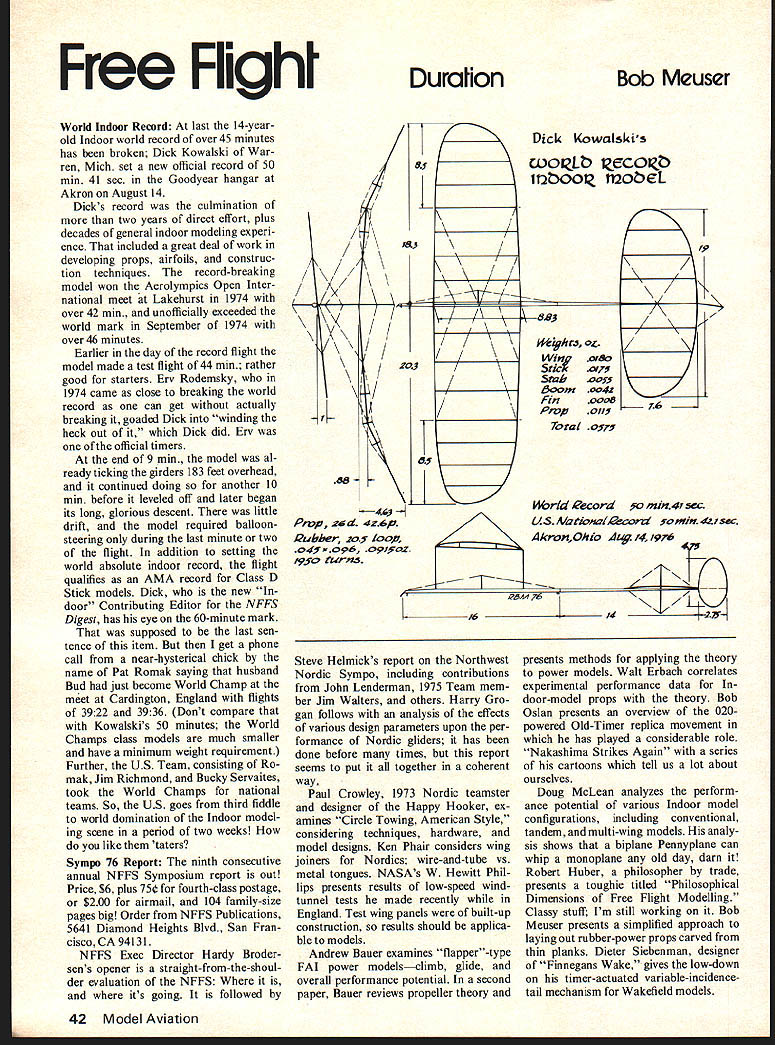
World Indoor Record: At last, the 14-year-old indoor world record of over 45 minutes has been broken; Dick Kowalski of Warren, Mich. set a new official record of 50 min. 41 sec. in the Goodyear hangar at Akron on August 14.
Dick's record was the culmination of more than two years of direct effort, plus decades of general indoor modeling experience. That included a great deal of work in developing props, airfoils, and construction techniques. The record-breaking model won the Aerolympics Open International meet at Lakehurst in 1974 with over 42 min., and unofficially exceeded the world mark in September of 1974 with over 46 minutes.
Earlier in the day of the record flight the model made a test flight of 44 min.; rather good for starters. Erv Rodemsky, who in 1974 came as close to breaking the world record as one can get without actually breaking it, goaded Dick into "winding the heck out of it," which Dick did. Erv was one of the official timers.
At the end of 9 min., the model was already ticking the girders 183 feet overhead, and it continued doing so for another 10 min. before it leveled off and later began its long, glorious descent. There was little drift, and the model required balloon-steering only during the last minute or two of the flight. In addition to setting the world absolute indoor record, the flight qualifies as an AMA record for Class D Stick models. Dick, who is the new "Indoor" Contributing Editor for the NFFS Digest, has his eye on the 60-minute mark.
That was supposed to be the last sentence of this item. But then I get a phone call from a near-hysterical chick by the name of Pat Romak saying that husband Bud had just become World Champ at the meet at Cardington, England with flights of 39:22 and 39:36. (Don't compare that with Kowalski's 50 minutes; the World Champs class models are much smaller and have a minimum weight requirement.) Further, the U.S. Team, consisting of Romak, Jim Richmond, and Bucky Servaites, took the World Champs for national teams. So, the U.S. goes from third fiddle to world domination of the indoor modeling scene in a period of two weeks! How do you like them taters?
Sympo '76 Report: The ninth consecutive annual NFFS Symposium report is out! Price, $6, plus 75¢ for fourth-class postage, or $2.00 for airmail, and 104 family-size pages big! Order from NFFS Publications, 5641 Diamond Heights Blvd., San Francisco, CA 94131.
NFFS Exec. Director Hardy Brodersen's opener is a straight-from-the-shoulder evaluation of the NFFS: Where it's been, and where it's going. It is followed by Steve Helmick's report on the Northwest Nordic Sympo, including contributions from John Lenderman, 1975 Team member Jim Walters, and others. Harry Grogan follows with an analysis of the effects of various design parameters upon the performance of Nordic gliders; it has been done before many times, but this report seems to put it all together in a coherent way.
Paul Crowley, 1973 Nordic teamster and designer of the Happy Hooker, examines "Circle Towing, American Style," considering techniques, hardware, and model designs. Ken Phair considers wing joiners for Nordics: wire-and-tube vs metal tongues. NASA's W. Hewitt Phillips presents results of low-speed wind-tunnel tests he made recently while in England. Test wing panels were of built-up construction; so results should be applicable to models.
Andrew Bauer examines "flapper"-type FAI power models—climb, glide, and overall performance potential. In a second paper, Bauer reviews propeller theory and presents methods for applying the theory to power models. Walt Erbach correlates experimental performance data for indoor-model props with the theory. Bob Oslan presents an overview of the 020-powered Old-Timer replica movement in which he has played a considerable role. "Nakashima Strikes Again" with a series of his cartoons which tell us a lot about ourselves.
Doug McLean analyzes the performance potential of various indoor model configurations, including conventional, tandem, and multi-wing models. His analysis shows that a biplane Pennyplane can whip a monoplane any old day, darn it! Robert Huber, a philosopher by trade, presents a toughie titled "Philosophical Dimensions of Free Flight Modeling." Classy stuff; I'm still working on it. Bob Meuser presents a simplified approach to laying out rubber-power props carved from thin planks. Dieter Siebenmann, designer of "Finnegan's Wake," gives the low-down on his timer-actuated variable-incidence-tail mechanism for Wakefield models.
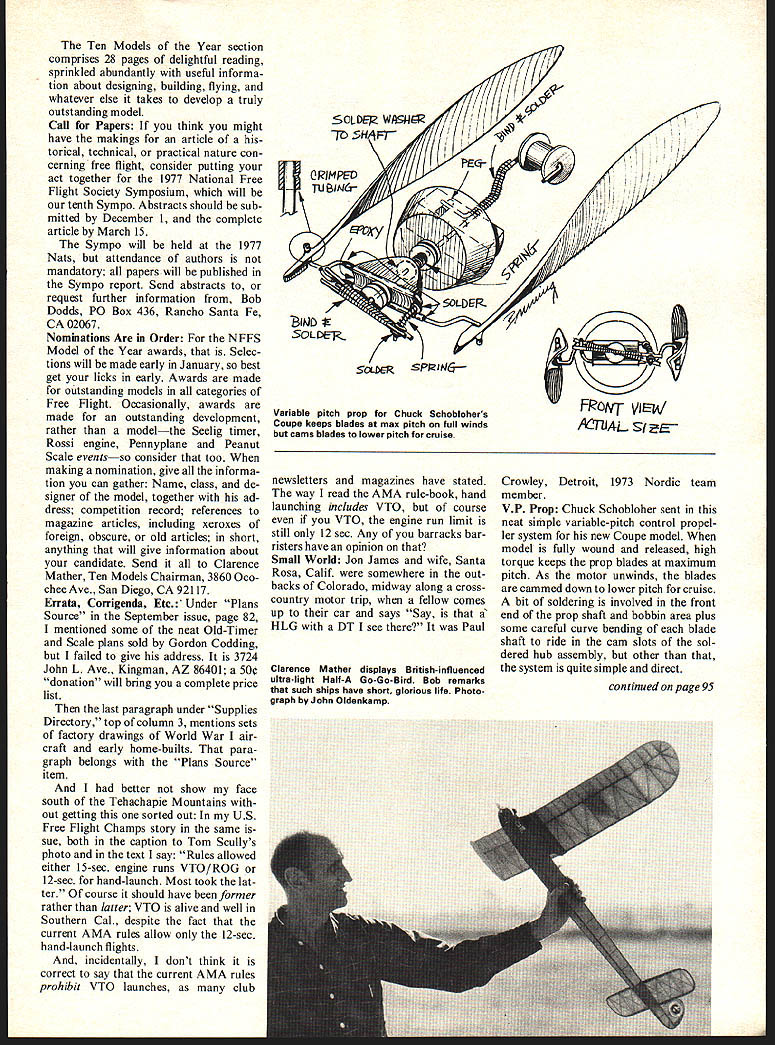
Model Aviation Ten Models of the Year section comprises 28 pages of delightful reading, sprinkled abundantly with useful information about designing, building, flying, and whatever else it takes to develop.
Free Flight: Duration
Bob Meuser
World Indoor Record: The last 14-year-old indoor world record (for over 45 minutes) has been broken. Dick Kowalski, Warren, Mich., set a new official record — 50 min. 41 sec. — Goodyear Hangar, Akron, August 14.
Dick's record is the culmination of two years' direct effort plus decades of general indoor modeling experience; it included a great deal of work developing props, airfoils, and construction techniques. The record‑breaking model won the Aerolympics Open International meet, Lakehurst, 1974 — over 42 min. — and unofficially exceeded the world mark in September, 1974 — over 46 minutes.
Earlier in the day the record‑flight model made a test flight of 44 minutes. A rather good starter, Erv Rodemsky (1974) came close to breaking the world record. He kept goading Dick, winding the heck out of the model, and did get it going. Erv's official timers ended at 9 min.; the model, already ticking, cleared girders 183 feet overhead and continued for another 10 min. before leveling off. Later it began its long, glorious descent; with a little drift the model required balloon‑steering during the last minute. The two‑flight addition set the world absolute indoor record. The flight qualifies as an AMA record for Class D stick models.
Dick, now a Contributing Editor of the NFFS Digest, has his eye on the 60‑minute mark. Supposedly, upon reading the last sentence of the item, I got a phone call from a near‑hysterical Pat Romak saying husband Bud had just become World Champ at the meet in Cardington, England (flights 39:22, 39:36).
Don't compare Kowalski's 50 minutes with World Champs class models; those are much smaller and have a minimum weight requirement. Further, the U.S. team consisting of Romak, Jim Richmond, and Bucky Servaites took the World Champs national team honors. So the U.S. goes third fiddle in world domination of the indoor modeling scene for a period of two weeks — like taters.
About Hardware:
From time to time I present some rather fancy hardware—winders, torquemeters, prop hubs, and such—and this issue will be no exception. Perhaps this gives the impression that success in free-flight competition requires the use of such sophisticated stuff. Not true! You don't need a machine shop to build a successful Nordic glider or AMA Gas model. And a reworked hand-me-down hand drill makes a perfectly usable Wakefield motor winder. The fanciness of the hardware has little relationship to winning or losing.
Some free fliers see the development of sophisticated hardware as an end in itself, and devote time to it that would be better spent in practice flying, if trophy collecting is their goal. But, you can't practice fly all of the time. And while fancy hardware may not ensure winning, it makes losing more fun!
I haven't presented much in the way of simple hardware as I figured everybody already knew about it. Maybe that needs correcting. But I'll continue to present the fancy stuff for two reasons: many readers seem to enjoy seeing it, and in many cases it represents an advance in the state of the art. If simpler hardware comes along that does the job as well, we'll throw that into the hopper too.
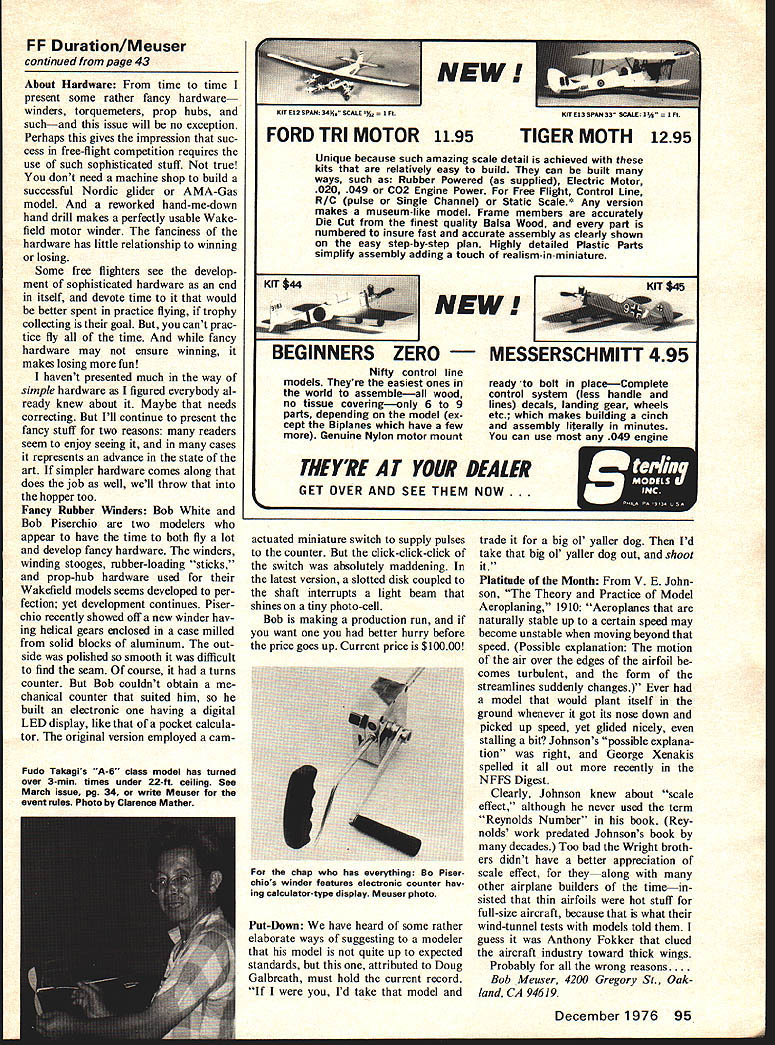
Fancy Rubber Winders: Bob White and Bob Piserchio are two modelers who appear to have the time to both fly a lot and develop fancy hardware. The winders, winding stooges, rubber-loading "sticks," and prop-hub hardware used for their Wakefield models seem developed to perfection; yet development continues. Piserchio recently showed off a new winder having helical gears enclosed in a case milled from solid blocks of aluminum. The outside was polished so smooth it was difficult to find the seam. Of course, it had a turns counter. But Bob couldn't obtain a mechanical counter that suited him, so he built an electronic one having a digital LED display, like that of a pocket calculator. The original version employed a cam-actuated miniature switch to supply pulses to the counter. But the click-click-click of the switch was absolutely maddening. In the latest version, a slotted disk coupled to the shaft interrupts a light beam that acts on a tiny photo-cell.
Bob is making a production run, and if you want one you had better hurry before the price goes up. Current price is $100.00!
Put-Down:
We have heard of some rather elaborate ways of suggesting to a modeler that his model is not quite up to expected standards, but this one, attributed to Doug Galbraith, must hold the current record. "If I were you, I'd take that model and trade it for a big ol' yaller dog. Then I'd take that big ol' yaller dog out, and shoot it."
Platitude of the Month:
From V. E. Johnson, "The Theory and Practice of Model Aeroplaning," 1910: "Aeroplanes that are naturally stable up to a certain speed may become unstable when moving beyond that speed. (Possible explanation: The motion of the air over the edges of the airfoil becomes turbulent, and the form of the streamlines suddenly changes.)" Ever had a model that would plant itself in the ground whenever it got its nose down and picked up speed, yet glided nicely, even stalling a bit? Johnson's "possible explanation" was right, and George Xenakis spelled it all out more recently in the NFFS Digest.
Clearly, Johnson knew about "scale effect," although he never used the term "Reynolds Number" in his book. (Reynolds' work predates Johnson's book by many decades.) Too bad the Wright brothers didn't have a better appreciation of scale effect, for they—along with many other airplane builders of the time—insisted that thin airfoils were hot stuff for full-size aircraft, because that is what their wind-tunnel tests with models told them. I guess it was Anthony Fokker that clued the aircraft industry toward thick wings.
Probably for all the wrong reasons...
Bob Meuser 4200 Gregory St., Oakland, CA 94619.
Transcribed from original scans by AI. Minor OCR errors may remain.

