
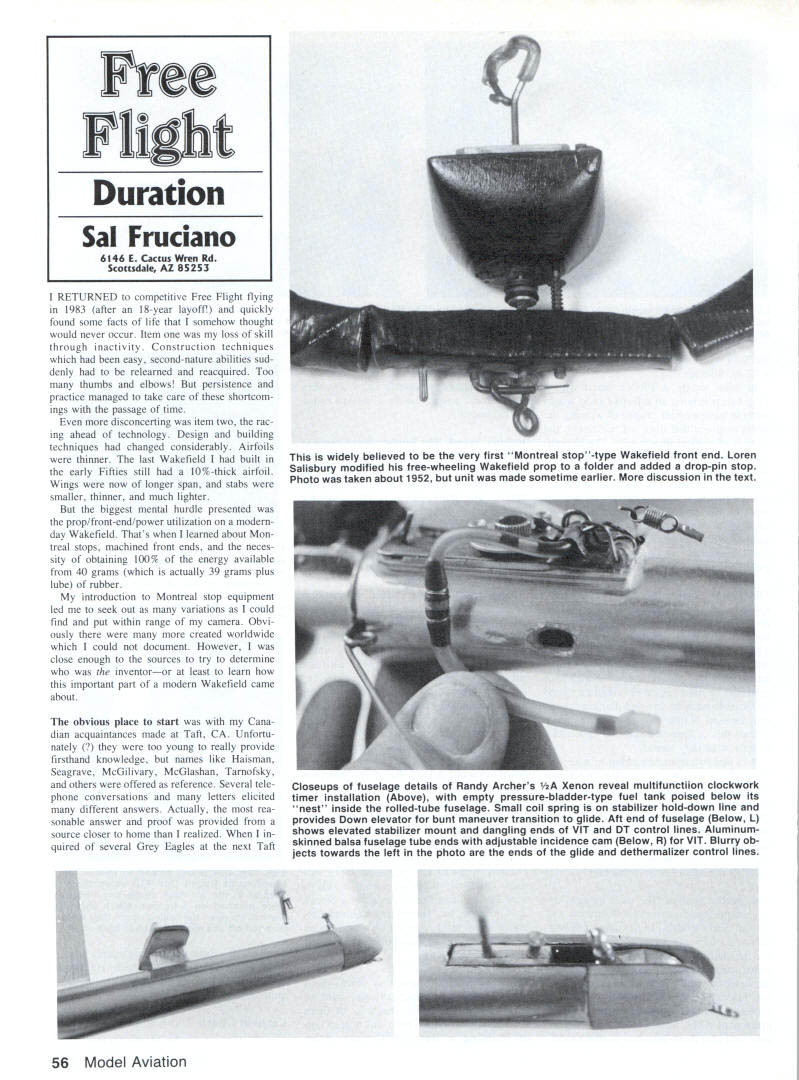
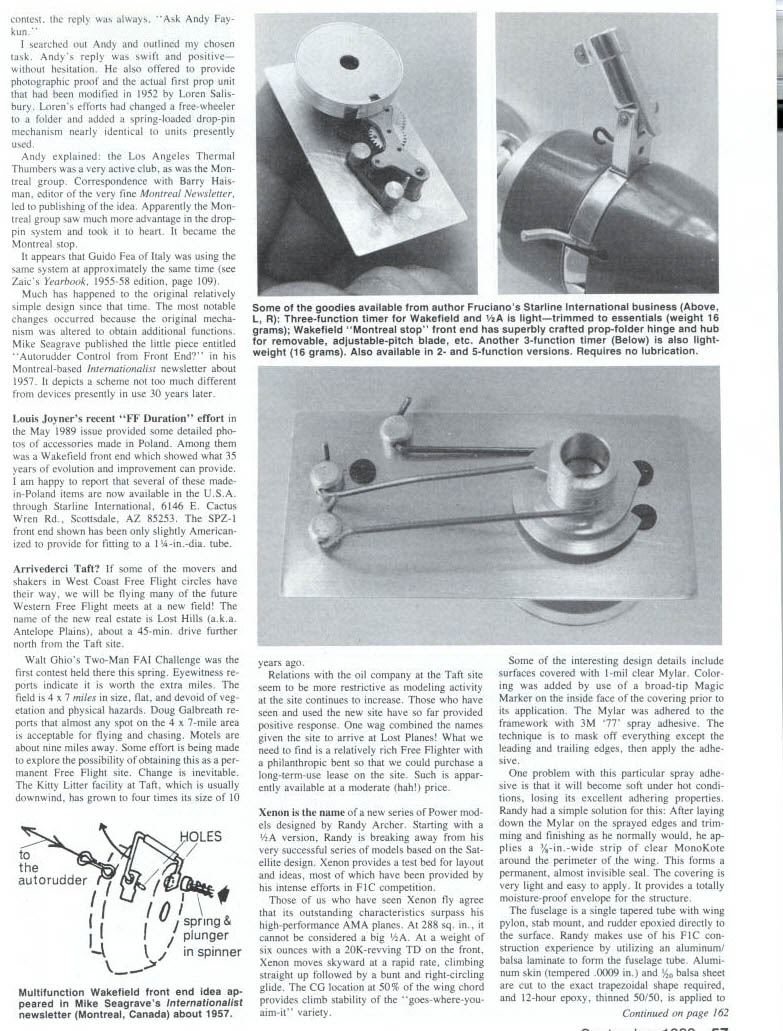
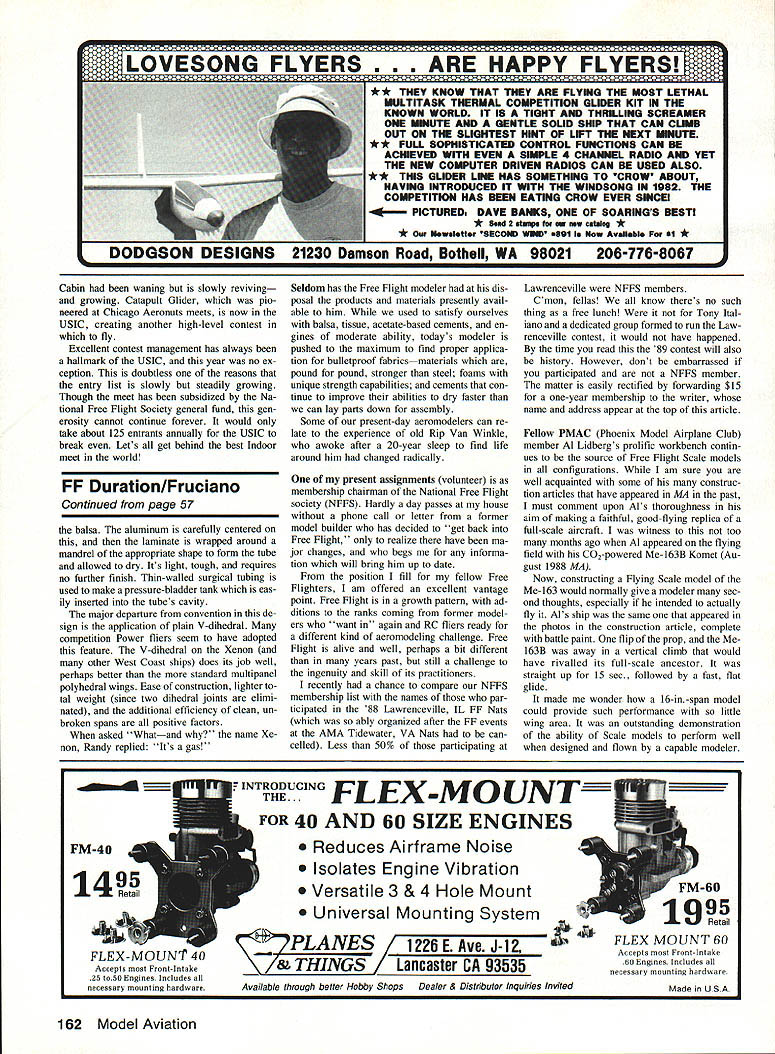

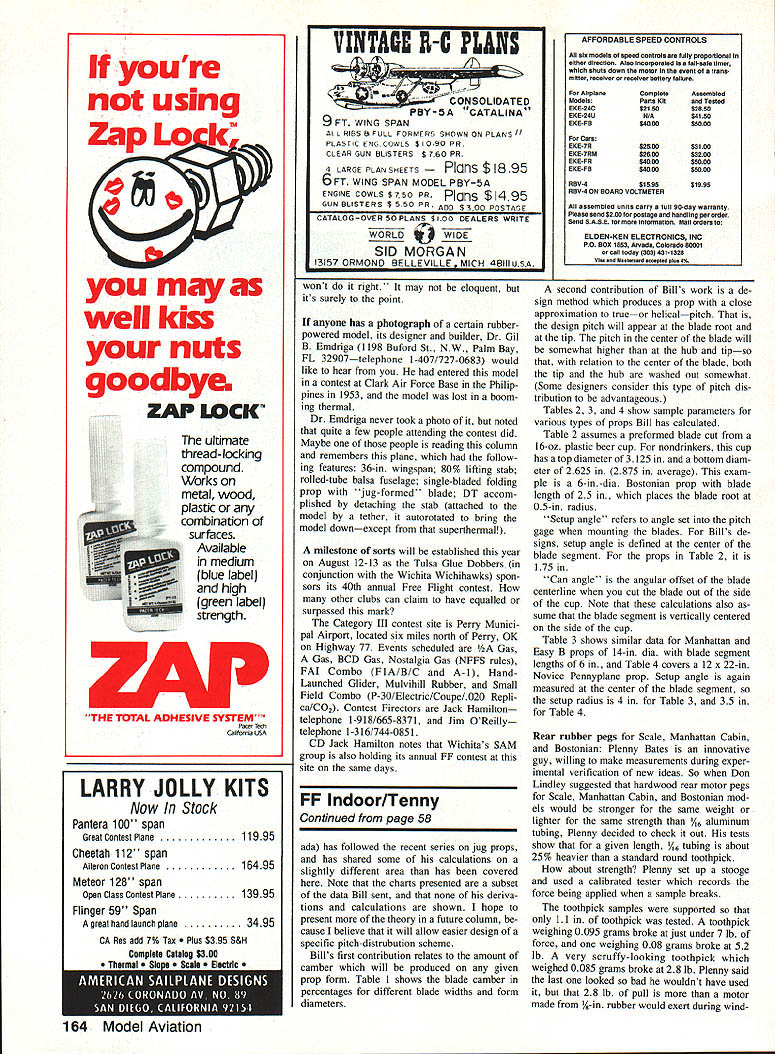
Free Flight: Duration
Sal Fruciano 6146 E. Cactus Wren Rd. Scottsdale, AZ 85253
Introduction — returning to Free Flight
I returned to competitive Free Flight flying in 1983 after an 18‑year layoff and quickly encountered facts I had not expected.
- Item 1: Loss of skill through inactivity. Construction techniques that had been second nature had to be relearned. With persistence and practice I recovered, but it was humbling.
- Item 2: Racing‑ahead technology. Design and building techniques had changed considerably: airfoils are thinner (my last Wakefield in the early 1950s used a 10%‑thick airfoil), wings have longer spans, and stabs are smaller, thinner, and much lighter.
The biggest mental hurdle was prop/front‑end/power utilization on the modern Wakefield. That led me to learn about Montreal stops, machined front ends, and the necessity of obtaining 100% of the energy available from 40 grams (actually 39 grams plus lubricant) of rubber.
Montreal stop — origin and evolution
My investigation into Montreal‑stop equipment began by seeking out as many variations as I could document. To trace the origin I turned to acquaintances made at Taft, CA. Names offered included Haisman, Seagrave, McGilivary, McGlashan, Tarnofsky and others, but answers varied.
A credible source closer to home was Andy Fay (Los Angeles). Andy provided prompt help, photographic proof, and the actual first prop unit modified in 1952 by Loren Salisbury. Salisbury had converted a free‑wheeling folder into a folder with a spring‑loaded drop‑pin mechanism very similar to those in modern use.
Andy explained that the Los Angeles Thermal Thumbers were very active and that correspondence with Barry Haisman and the Montreal group led to publication of the idea in the Montreal Newsletter. The Montreal group adopted the drop‑pin system enthusiastically and it became known as the Montreal stop.
Other contemporaneous developments:
- Guido Fea (Italy) was using a similar system at about the same time (see Zaic’s Yearbook, 1955–58).
- Mike Seagrave published “Autorudder Control Front End” in the Montreal‑based Internationalist newsletter (~1957), depicting a scheme not unlike later devices.
- Over the ensuing decades the original simple mechanism was altered to gain additional functions and refinements.
Louis Joyner’s May 1989 “FF Duration” featured photos of Polish accessories, including Wakefield front ends that show 35 years of evolution. Several of these Polish items are now available in the U.S. through Starline International (same address as above). The SPZ‑1 front end shown has been slightly Americanized to fit a 1‑1/4‑in.‑dia. tube.
Lost Hills (Antelope Plains) — a new Western site
Some West Coast Free Flight organizers are moving many future Western meets to a new field: Lost Hills (aka Antelope Plains), about a 45‑minute drive north of the Taft site.
- Walt Ghio’s Two‑Man FAI Challenge was the first contest held there this spring, with positive eyewitness reports.
- The field is roughly 4 × 7 miles, flat, and essentially free of vegetation and hazards. Doug Galbreath reports nearly any spot on the area is acceptable for flying and retrieval.
- Motels are about nine miles away. Efforts are under way to explore obtaining the site for more permanent Free Flight use.
Taft’s “kitty litter” facility has grown substantially and relations with the oil company leasing the land have become more restrictive as modeling activity increases. Many who have seen Lost Hills respond positively — one wit called it “Lost Plains.” What’s needed is a benefactor to secure a long‑term lease for Free Flight use.
Xenon — Randy Archer’s new power series
Randy Archer’s new Xenon series of power models (starting with 1/2A) departs from his Satellite‑based designs and serves as a test bed for layout and ideas derived from his F1C experience.
Key features:
- Wing area: 288 sq. in.; weight about 6 oz. — a big 1/2A.
- Power: 20K‑revving TD on the nose; climbs rapidly and straight up, followed by a blunt, right‑circling glide.
- CG at 50% chord gives very stable, pointable climbs.
- Surfaces covered with 1‑mil clear Mylar. Coloring was done with a broad‑tip Magic Marker on the inner face before application; Mylar was adhered with 3M #77 spray adhesive applied only to leading and trailing edges.
- To prevent softening of the adhesive in heat, Randy seals the Mylar perimeter with a 1/4‑in.‑wide strip of clear MonoKote — forming a nearly invisible, permanent seal that makes the covering moisture‑proof and very light.
- Fuselage: a single tapered tube built from an aluminum/balsa laminate — tempered .0009‑in. aluminum skin bonded to 1/32‑in. balsa and wrapped on a mandrel. The result is light, tough, and needs no further finish. A thin‑walled surgical tubing pressure‑bladder fuel tank fits inside the tube.
- Wing uses plain V‑dihedral (single bend). Benefits: easier construction, lighter weight (fewer dihedral joints), and cleaner, continuous span efficiency compared with multiplane polyhedral wings.
When asked about the name Xenon, Randy said simply: “It’s a gas!”
Materials, the returning modeler, and Free Flight today
Modern modelers have an unprecedented range of products: bulletproof fabrics (pound‑for‑pound stronger than steel), advanced foams, and ever‑improving adhesives and cements. For those returning after years away, the changes can seem dramatic — like Rip Van Winkle waking after 20 years.
As NFFS membership chairman, I frequently get calls and letters from former modelers trying to get back into Free Flight and seeking current information. Free Flight is in a growth pattern, attracting former competitors and radio‑control fliers wanting a different challenge. It remains a living, inventive discipline.
A comparison of the NFFS membership list with entrants at the 1988 Lawrenceville, IL FF Nats showed less than 50% of participants were NFFS members. If you flew at Lawrenceville and are not a member, it’s easy to join: forward $15 for a one‑year membership to the writer at the address above.
Al Lidberg’s CO2 Me‑163B Komet (Scale)
PMAC member Al Lidberg continues to produce impressive Free Flight scale models. His CO2‑powered Me‑163B Komet (featured in August 1988 MA) demonstrated remarkable performance: a vertical climb straight up for 15 seconds, followed by a fast, flat glide. The model matched the photos from his construction article, complete with bubble canopy.
It’s a testament that well‑designed and well‑flown Scale models can perform outstandingly, even with small span and limited wing area.
Closing
Free Flight is alive and well — different in many respects from years past, but still a rich field for ingenuity and skill. For those returning or new to the discipline, the community and resources are ready to help.
Transcribed from original scans by AI. Minor OCR errors may remain.

