
Free Flight: Duration
Harry Murphy 3824 Oakwood Blvd. Anderson, IN 46011
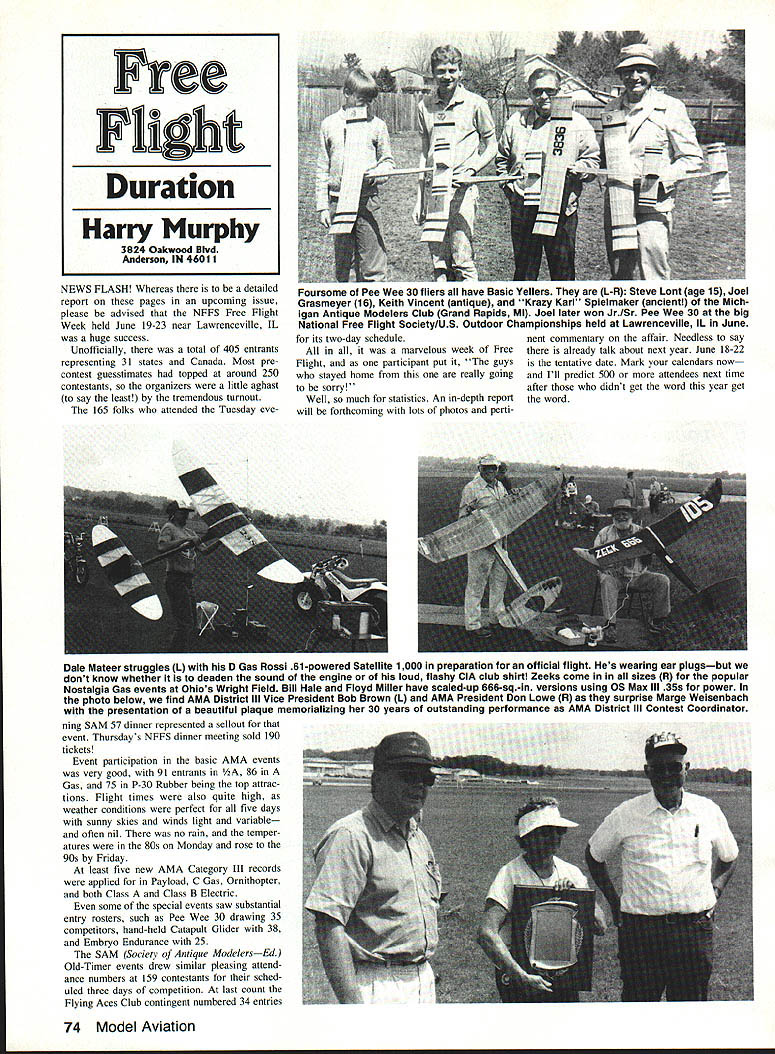
NEWS FLASH! Whereas there is to be a detailed report on the pages in an upcoming issue, please be advised that the NFFS Free Flight Week held June 19–23 near Lawrenceville, IL was a huge success.
Unofficially, there was a total of 405 entrants representing 31 states and Canada. Most pre-contest guesstimates had topped out at around 250 contestants, so the organizers were a little aghast (to say the least) at the tremendous turnout.
The 165 folks who attended the Tuesday evening SAM 57 dinner represented a sellout for that event. Thursday's NFFS dinner meeting sold 190 tickets!
All in all, it was a marvelous week of Free Flight, and as one participant put it, "The guys who stayed home from this one are really going to be sorry!"
An in-depth report will be forthcoming with lots of photos and pertinent commentary on the affair. Needless to say there is already talk about next year. June 18–22 is the tentative date. Mark your calendars now — I'll predict 500 or more attendees next time after those who didn't get the word this year get the word.
Event participation in the basic AMA events was very good, with the top attractions being:
- V/A: 91 entrants
- A Gas: 86 entrants
- P-30 Rubber: 75 entrants
Flight times were also quite high, as weather conditions were perfect for all five days with sunny skies and winds light and variable — often nil. There was no rain, and temperatures were in the 80s on Monday and rose to the 90s by Friday.
At least five new AMA Category III records were applied for in Payload, C Gas, Ornithopter, and both Class A and Class B Electric.
Some of the special events also saw substantial entries:
- Pee Wee 30: 35 competitors
- Hand-launched Catapult Glider: 38 competitors
- Embryo Endurance: 25 competitors
The SAM (Society of Antique Modelers) Old-Timer events drew similar pleasing attendance numbers, with 159 contestants for their scheduled three days of competition. At last count the Flying Aces Club contingent numbered 34 entries.
Silly Putty D-T
In my last column I mentioned that for a number of reasons Free Flight was in dire need of smokeless dethermalizers (D-Ts) to replace the simple and inexpensive lighted-fuse system—especially for the small, non-gas models. Much to my surprise, the next issue of Rick Pangell's Max-Out newsletter included just such an item.
At first glance I thought the suggested D-T system was someone's idea of a spoof. But a closer scan and the accompanying testimonials by creator Bill Gibbons indicated the system may have definite merit for non-gas-powered model use—so here it is.
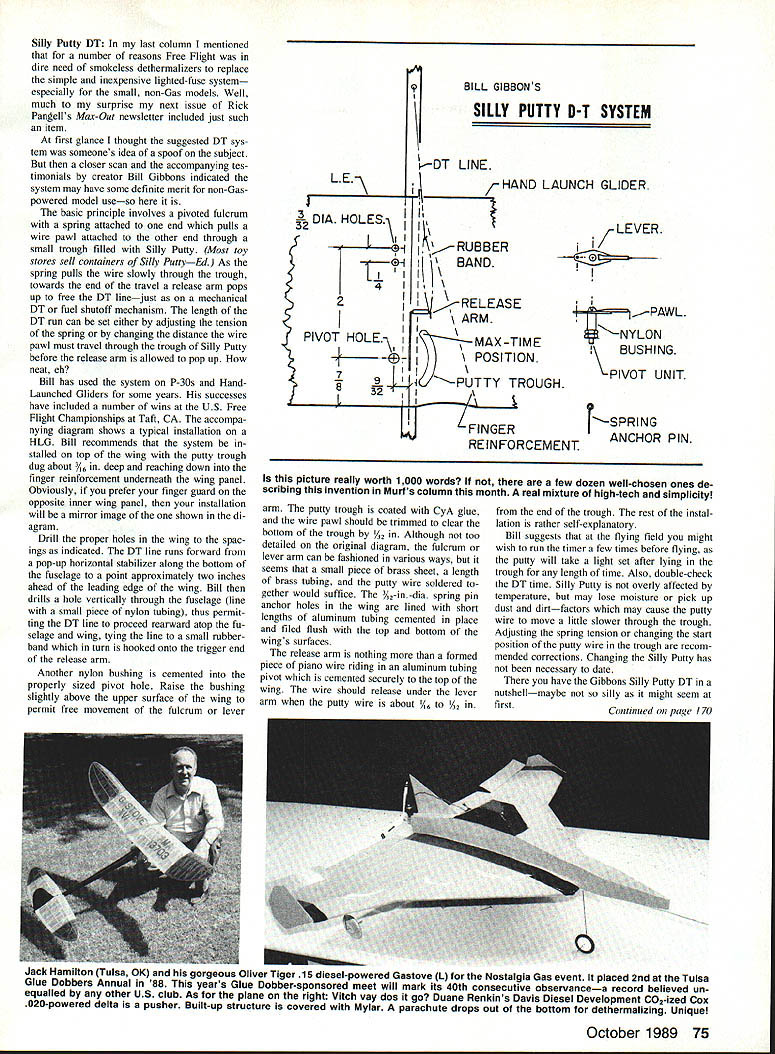
The basic principle involves a pivoted fulcrum with a spring attached to one end which pulls a wire pawl attached to the other end through a small trough filled with Silly Putty. As the spring pulls the wire slowly through the trough, toward the end of the travel a release arm pops up to free the D-T line—just as on a mechanical D-T or fuel shutoff mechanism. The length of the D-T run can be set either by adjusting the tension of the spring or by changing the distance the wire pawl must travel through the trough of Silly Putty before the release arm is allowed to pop up.
Bill has used the system on P-30s and hand-launched gliders for some years. His successes have included a number of wins at the U.S. Free Flight Championships at Taft, CA. The typical installation on a hand-launched glider mounts the system on top of the wing with the putty trough dug about 3/16 in. deep and reaching down into the finger reinforcement underneath the wing panel. If you prefer your finger guard on the opposite inner wing panel, then your installation will be a mirror image.
Drill the proper holes in the wing to the spacings indicated on the diagram. The D-T line runs forward from a pop-up horizontal stabilizer along the bottom of the fuselage to a point approximately two inches ahead of the leading edge of the wing. Then drill a vertical hole through the fuselage (line with a small piece of nylon tubing), permitting the D-T line to proceed rearward atop the fuselage and wing, tying the line to a small rubber band which in turn is hooked onto the trigger end of the release arm.
Cement another nylon bushing into the properly sized pivot hole. Raise the bushing slightly above the upper surface of the wing to permit free movement of the fulcrum or lever arm.
Coat the putty trough with CYA glue, and trim the wire pawl to clear the bottom of the trough by 1/32 in. The fulcrum or lever arm can be fashioned in various ways, but a small piece of brass sheet, a length of brass tubing, and the putty wire soldered to the sheet should suffice. The 1/32-in. dia. spring pin at the anchor holes in the wing are lined with short lengths of aluminum tubing cemented in place and filed flush with the top and bottom of the wing's surfaces.
The release arm is a formed piece of piano wire riding in an aluminum tubing pivot which is cemented securely to the top of the wing. The wire should release under the lever arm when the putty wire is about 7/64 to 1/8 in. from the end of the trough. The rest of the installation is rather self-explanatory.
At the flying field you might wish to run the timer a few times before flying, as the putty will take a light set after lying in the trough for any length of time. Also, double-check the D-T time. Silly Putty is not overly affected by temperature but may lose moisture or pick up dust and dirt—factors which can cause the putty wire to move a little slower through the trough. Adjusting the spring tension or changing the start position of the putty wire in the trough are recommended corrections. Changing the Silly Putty has not been necessary to date.
There you have the Gibbons Silly Putty D-T in a nutshell—maybe not so silly as it might seem at first.
More cover-up stuff
As was forewarned, the final issue (#35) of Bill Baker's fine Okie Free Flight Flyer newsletter has now come and gone in a flash—but not without some good information included. We have often passed on tips about model covering and re-covering, and an article by Walter Rozelle in the OFF's waning issue deserved relaying to our larger MA audience as well.
The article discusses using white glues as an adhesive for either silk or films as an alternative to more conventional methods. Walt suggests that if anyone is still using the age-old ritual of pre-doping frameworks followed by soaking through the paper or silk with thinner to gain the required adhesive bond, they are not up to date with the latest model-covering techniques.
Applying tissue, silkspan, or silk with thinned white glue in lieu of nitrate/butyrate dopes is not particularly new, and personally I have had only so-so success with using white glues for this task. Although the finished covering bonded like crazy, the appearance suffered somewhat compared to traditional doped-on methods. Also, removing the old covering was a real bear if it had been applied with white glue. Whether from lack of experience or whatever, I gave up quickly and returned to the known security of aircraft dopes for covering adhesives.
However, Walter makes some interesting claims with respect to the use of white glue and the covering iron in applying clear Micafilm. He says that one apparent disadvantage of Micafilm is the small range between the temperature needed to adhere the film when using Balsarite adhesive and the temperature required to shrink the film. Another problem is that the film will often creep from the periphery when you shrink the open areas, as the Balsarite bond does not seem steadfast. A common solution has been to apply 3M 77 spray cement to the periphery of the model part and only apply Balsarite on the open-area framework.
Now comes the white glue method: Walt says he first read that a former free-flighter, Woody Blanchard, used white glue to attach Micafilm on an RC electric model, and so he subsequently decided to try it himself. He brushed on two coats of Franklin Home, Shop, and Craft Glue (thinned 50–50 with water) around the outline of the stab of a new model; set his covering iron at about 11 o'clock; and started ironing away. He learned quickly to use the nose of the iron to press the covering to the periphery with the rest of the iron off the part of the framework, as doing otherwise would shrink the film before it was attached to the edges. Walt says he was most pleased with the results.
He discovered that white glue also works well on overlap joints, such as polyhedral joints. A couple of brushed-on thinned coats of glue will allow the Micafilm to overlap itself beautifully. He testifies that it wasn't necessary to wait until the glue was completely dry if the temperature of the iron was increased a bit.
Walt was so overjoyed with his first white glue job that he phoned Jim Walton, who distributes Franklin products. Jim listened patiently, then asked Walt if he had tried brushing white glue on undercambered wing surfaces and applying silk with a covering iron as well. One-upmanship strikes again!
Walt makes these white glue methods sound so good that I shall have to have another go at it—especially with Micafilm, as I am personally still searching for the world's greatest covering "stickum" for films. I have used so many different adhesives in covering models in the last few years that I have to keep a logbook on what has been used on which model. Now, I suppose I shall have to start a new column under "White Glue."
Dope sheet
If you have been around modeling as long as I have, then you are familiar with the better brands of aircraft dopes that have been made available to modelers over the years. One such brand that has weathered well is the Randolph brand of aircraft finishes.
As an early teen, I would peddle my bike down to the road to a small airport towing a quart jar which a befriended airplane mechanic would fill to the brim with clear nitrate dope from a 55-gallon drum of Randolph for a small amount of loose change. Since Randolph has always catered to the full-scale aircraft market, a one-gallon container is about the smallest quantity that has been available to modelers in recent years. This is fine for thinners and clear dope—thinners can be used up rather quickly—but a gallon of color dope is nearly impossible to use up for model airplane purposes—and is quite expensive as well.
Jim Correll (under his ABC Hobby Shop logo) of Clarksville, IN, has remedied this problem and is making Randolph dopes available in smaller quantities of 1/2-pints, pints, and quarts. Pricing is most reasonable. He offers clear nitrate and butyrate dope, thinner, rectifier, and sanding sealers, as well as 23 colors in turpentine. Send him a SASE for a free color chart and complete price listing. That's ABC Hobby Supplies, P.O. Box 2391, Clarksville, IN 47131—or phone 812/944-5357. Jim is a modeler himself and fully understands your finishing problems. Tell him Duration set you onto him!
NosGas is here to stay
As far as this columnist is concerned, Old-Timers and Nostalgia Gas are just as much a part of the active Free Flight scene as the AMA or FAI activities. If you launch it without a radio or control lines and you put a stopwatch on it, then it's duration in my book.
The six NosGas events drew 197 total entrants at the June NFFS/USOC, with the 1/2-A event tallying 62 contestants. Bob Watson logged over 17 min 02 sec, beating the other 61 entrants; his total also bested the AMA 1/2-A Gas-winning score. Other NosGas entry totals were:
- 1/4-A: 25
- A: 42
- B: 31
- C: 25
- Unofficial NosGas Ignition event: 12
This is a sure indication that more fliers are seeking low-tech competition; old-timer alternatives to the FAI and AMA Schneider-powered-missile and multi-gadgetry events. This is not to say that technology is not popular, but the simple machine also has its place in Free Flight.
Apparently NosGas isn't about to sit back complacently with the five official events and one special event it now endorses. I caught a discussion in a recent NWC Patter newsletter suggesting there may be interest in the early-FAI Power event. John Lenderman and Bob Stallick extended the bait with the idea of resurrecting all those FAI Power models that are still in storage. The photo of Jack Hamilton's Gastone and the local-area popularity of Jerry Nollen's Happy Days indicate that vintage FAI gas jobs hold interest for some.
John and Bob's idea is to permit models to compete that were used prior to the day when cold fuel became the rule (January 1970) and before models became heavily technicalized—gadgetry monsters. This would put those G15 supporters, K&B FAI .15s, and black-cylinder Cox .15s back into use. Any takers?
Terry Rimert suggested lumping vintage 1/2-A, A, and B class Pan Am payload designs into a single event with each carrying its appropriate number, size, and weight of dummy pilots. Require the ROG rule, and the Pan Am stuff might be a bunch more fun again. The 1/2-A Payload event was attempted as a special event at the AMA Nats some five or six years ago, but it failed to revive. Maybe Terry's proposal has more merit. Mull it over at your next club meeting.
The gumboaders turned thumbs down for any NosGas-type Rubber events at the onset of the NosGas movement, stating that Rubber models of the era were not unlike those previous or immediately following. Whether they feel differently about that now is not known to this writer. Maybe it is time to ask some questions again? Meanwhile, it is NosGas on the move!
The Zeek chronicles—Part VI
We still have enough material to make up about two more episodes of this saga, but I would like to pause at this point and present a letter written to me by a lifelong friend. This gentleman has been an associate and very close friend for over 30 years. While our longtime relationship has been somewhat tentative with modeling, he had shown an interest and kept insisting that he was going to get involved in the hobby again. We have all heard those conversations, and most are taken with a grain of salt.
While this story involves an A/B Zeek, it also answers some questions as to where our next novices might come from and what a person gets out of building and flying model airplanes. If the message here gets through, those folks who say that Free Flight needs some fun events should go hang their heads in shame.
Although we sometimes see clubs get small, seldom do we see a better class of club than the one we have at the local level. At one of our Free Flight club meetings last May, Les surprised me by showing up with a finished A/B Zeek and a very nice job. He had made a rather nice job of it, considering it was his first Free Flight gas job. His only previous modeling experience was in an electric-powered RC sailplane, and he had built an RC boat. Then he showed up at Wright Field on June 4—the second day of the Central Ohio Free Flight Club's spring contest. The rest is Les' story:
"I had been dreading this day for weeks. I had my Zeek built, and I had lost a lot of sleep over it. I had my prop glued in, and the darned thing would not run. I had tested the engine in my backyard and cracked the fence. But I had since repaired it and it was ready again to test under power. I felt that I had to go to the Wright Field contest to get some experience, as I had already pre-entered the NFFS/U.S. Outdoor Champs to be held in a couple of weeks at Lawrenceville, IL.
My son-in-law and I arrived at the contest site about 11:00 a.m., and by now I had decided that I was only going to watch, but I ran into my old friend, Harry Murphy, and he made me go get my plane. I said I would, but that I probably would not fly it. He introduced me to some of his flying friends, and they looked over my plane. They commented about several of my strange innovations, but said the plane appeared legal and flightworthy.
Although extremely nervous, I then did something irrational: I decided to fly my plane. The boys suggested that I put the prop on backwards for some technical reasons, and I did. Harry helped me get the D-T fuse on correctly and align the tail section. After having some trouble, the engine finally started. Now I was really nervous! I unhooked the battery and got ready to launch the Zeek. My mind was a blank, and I tossed the plane into the air. It took off low in a half-circle right at the other contestants. It finally climbed a little, and to my surprise it gained altitude fast.
As I proudly watched it fly for several seconds, Harry asked me if I had set the timer. No! Did I light the D-T fuse? No! Meanwhile my Zeek proudly roared on higher and higher. By the way, Harry had commented on my large fuel tank, which I had thoughtfully filled to the very top. Now Harry also panicked and jumped on his motorbike and told me to get in my car and drive around outside the field. He quickly headed downwind to the south.
It took me about 10 minutes to get outside the base, around to the downwind fence, get parked and start looking for the plane. I spotted Harry riding towards me on his motorbike. He stopped temporarily as if he were stuck or something, then finally got going again. He rode up to the fence, and I noticed he had gotten quite a bit of gas on his pants.
He told me the plane was OK, but that he had gotten stuck in the mud. The plane had run out of gas, but stalled so badly that it came down pretty quickly. I got lost going back and ended up taking a lap around the base. About 15 minutes later I got back, and the plane was OK, but Harry was going to have a cleaning bill.
Harry said that the plane's CG was not right and to move it forward. I already had holes there, so I got out my tools and moved the engine forward about a half-inch. It was ready to fly again. Also, Harry gave me a bigger prop which we installed backwards for another test flight.
I think Harry may have lost some confidence in me, because he suggested that I move away from the cars a little bit. Several guys made suggestions about how to launch it into the wind and how to light the fuse and start the timer. One guy said that he had seen guys forget to do one or the other — but not both!
The engine started a lot quicker this time, and I tried to light the fuse, but the wind off the prop blew out the lighter. I thought, 'Heck with it,' I set the timer for a longer engine run, started the engine, lit the fuse, and let the Zeek go. I had not noticed the wind had changed, and I set it off downwind again. It went pretty well, but again the D-T did not work. It circled around and headed for the other fliers. Everyone started ducking, and it made another three-point landing in the middle of the contestants' area. No one was hurt. I was ready for flight four.
I did everything right this time, and it flew great — straight up and high. The timer shut off in 10 seconds, and the Zeek circled down. It glided perfectly and landed just about 300 yards away. It D-T'd at about six feet off the ground. I had to thunder the fuse. I was ready for flight five.
This flight was super! It flew high and fast and was staying up forever. I was praying for the D-T to pop up. Shortly thereafter it did pop, and the Zeek fell gently to the ground. This had made my day! The guys congratulated me on a good plane and a good flight. I felt like I was a Free Flighter. I packed up and called it a day and watched Harry fly his Pee Wee 30, which was brand-new.
He had some problems, but after two flights he made some adjustments and called for a timer. He got a maximum flight. I thought it would never come down. He had to get on his bike and go about a quarter-mile to get it. Success!
I could not leave well enough alone. Now that I was an expert, I decided to make another flight. I did everything right and set her up. She rolled over and powered into the ground. A broken wing tip and some nose damage resulted. Well, back to reality. The guys said that I got my initiation and felt my feet wet. They welcomed me to the club and wished me good luck, and I packed up not quite so confident as before, but a lot smarter and more experienced than a few hours earlier. I am looking forward to my next contest. We headed for home."
P.S. A 53-year-old Free Flight rookie. Les Hallgarth (June 4, 1989)
See ya downwind!
Transcribed from original scans by AI. Minor OCR errors may remain.

