
Free Flight: Duration
Harry Murphy 3824 Oakwood Blvd. Anderson, IN 46011
Update: U.S. Outdoor Champs (USOC) — 1990
If you were planning to attend the 1990 USOC at Lawrenceville during the third week of June—hold on: you now have an extra three months to prepare. The new dates are October 1–5, 1990.
Reason: the fields bordering the flying site were planted in potatoes in 1989 but are scheduled for corn in 1990. They get sprayed in June with herbicide, and that presents a safety issue for contestants retrieving models. Jim O’Reilly will replace Tony Italiano as contest honcho for the 1990 Free Flight Week; Jim is currently rounding up a staff.
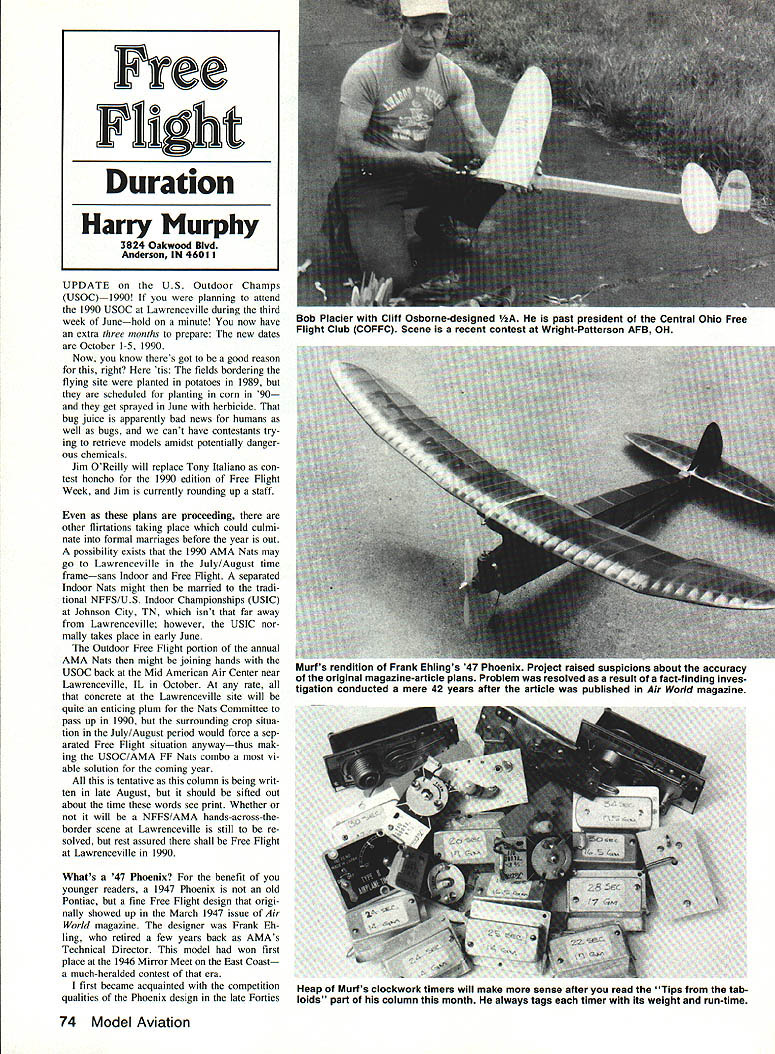
There are other possibilities in flux. The 1990 AMA Nats may go to Lawrenceville in July/August—without Indoor and Free Flight. A separated Indoor Nats might then be joined with the traditional NFFS/U.S. Indoor Championships (USIC) at Johnson City, TN. The Outdoor Free Flight portion of the Nats might then join the USOC back at the Mid American Air Center near Lawrenceville in October. All this is tentative as this column is written in late August, but it should be resolved by print time. Whatever the outcome, rest assured there will be Free Flight at Lawrenceville in 1990.
What’s a ’47 Phoenix?
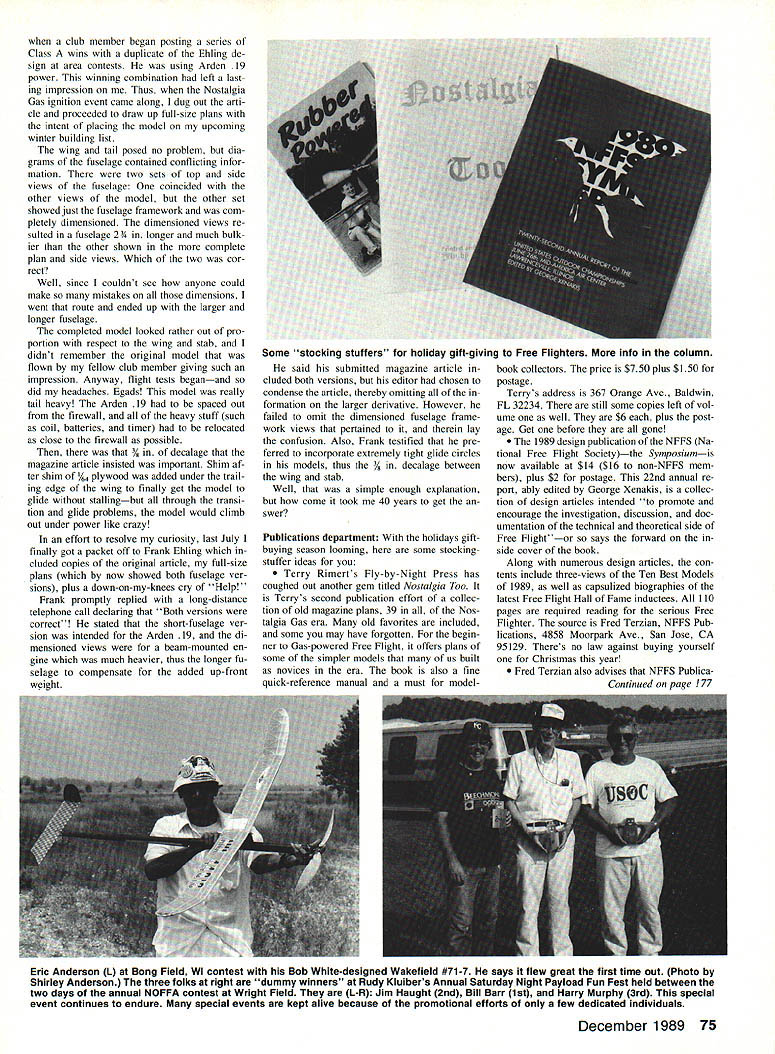
For younger readers: the 1947 Phoenix is a classic Free Flight design by Frank Ehling. It originally appeared in the March 1947 issue of Air Trails magazine and won first place at the 1946 Mirror Meet on the East Coast. Frank Ehling later served as AMA’s Technical Director.
I became acquainted with the Phoenix’s competition qualities in the late Forties. When Nostalgia Gas ignition events came along, I dug out the article and drew full-size plans to build one that winter. Wing and tail posed no problem, but the fuselage diagrams conflicted: two top-side views matched the other model views, while a separate dimensioned fuselage framework produced a fuselage 2-3/8 in. longer and much bulkier. I followed the dimensioned views and ended up with the larger fuselage, which looked out of proportion.
Flight tests gave me headaches—the model was really tail heavy. An Arden .19 spaced out on the firewall was heavy. I moved coil batteries and timer close to the firewall, added shim after shim, and finally four plies of plywood under the wing trailing edge to stop stalling. The model still climbed out under power through the transition.
Last July I got a packet from Frank Ehling that included the original article and full-size plans. They showed both fuselage versions plus a plea for help. Frank explained (by phone): both versions are correct. The short fuselage was intended for the lighter Arden .19; the longer fuselage was for a beam-mounted, heavier engine—hence the longer nose to compensate. The magazine editor had condensed the article and omitted discussion of the larger derivative, but failed to omit the dimensioned framework drawings, causing the confusion. Frank also said he preferred tight glide circles and used 3/8 in. decalage between wing and stab. It took me 40 years to get the answer.
News and Notes
- NFFS is handling Don Ross’ book Rubber‑Powered Model Airplanes. Copies are $12 postpaid to NFFS members, $14 to nonmembers.
- Tips from the tabloids: The Wasatch Flyer reports Jay Jackson experimenting with the new Satellite City User Friendly Odorless (UFO) Hot Stuff cyanoacrylate (CYA). He covered a sheepskin section with 0.7‑oz./sq. yd. fiberglass cloth using thin UFO and found the result added considerable strength with minimal weight gain. Standard thin CYA saturated the wood and added weight; the UFO filled the cloth weave better and allowed a little more working time. Jay recommends PC Skin Shield for hand protection when working with CYA.
Timer Weights (reported)
- 1/2 A Tatone: 16.4 g
- Std. Tatone: 17.1 g
- 1/2 A Seelig: 20.0 g
- FAI Seelig: 37.4 g
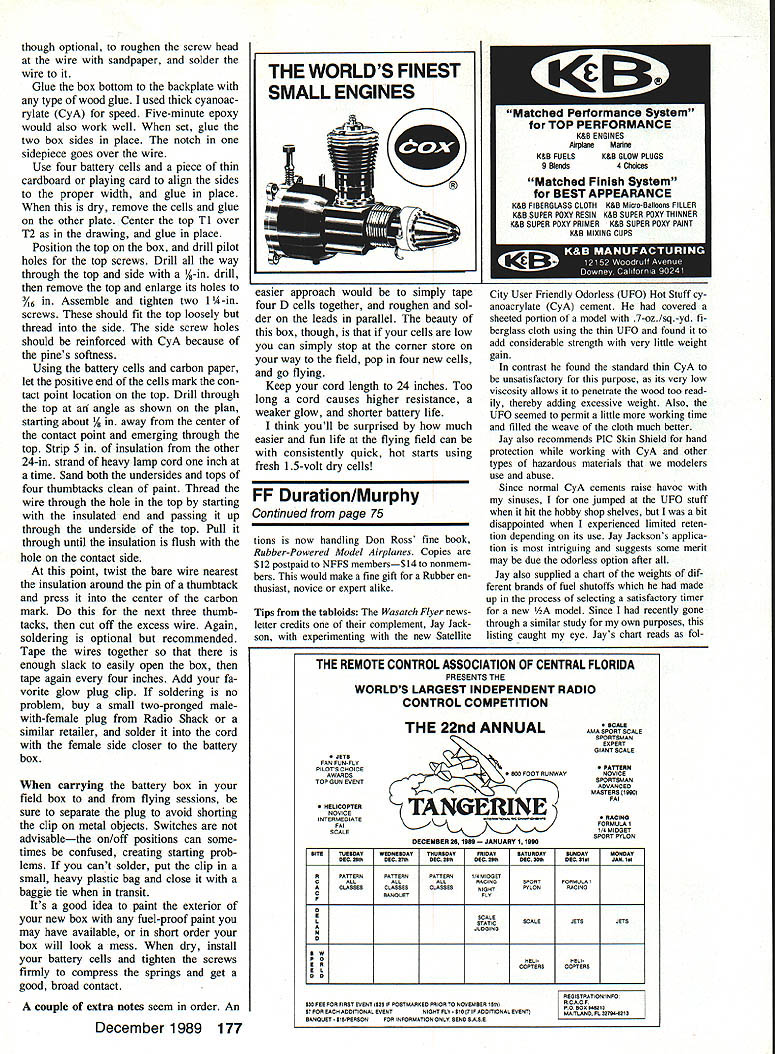
I weighed some timers myself. My 1/2A Tatone matched 16.4 g. Other Tatone timers varied from about 13.5 to 17 g for flood-off styles and 14 to 17.6 g for pinch-off styles; some Tatones used aluminum frames rather than brass, explaining a few grams difference. My two FAI Seeligs weighed about three grams more than Jay’s FAI figure. Converted toy mechanisms (Tomy, etc.) used as shutoffs can get weights down into the six-gram range, depending on design and materials.
A few practical points:
- Weigh all your timers before choosing one.
- Check each timer’s running time—accuracy matters more now with short Category I–III engine-run rules. Most Tatone timers vary between 18 and 32 seconds.
- Any clockwork timer can be made faster by removing counterweight material from the escapement pawl, but only do this if you can completely disassemble and reassemble the mechanism reliably.
Rubber Lubricant Recipe
From the Southern California Aero Team: World Champion rubber flier Bob White uses a three-ingredient lube:
- Equal parts medical-grade green soap and glycerine
- Add 5% castor oil (by volume)
Heat gently until tiny bubbles appear, stirring for about three minutes—no furious boiling. Simple and effective.
A note on craftsmanship: Frank Heeb’s nose-block bearings for rubber models were simply brass tubes filled with solder and drilled out—an old, effective technique. Often it's not exotic materials but workmanship and practice that make champions.
Needle Valves
Phil Hainert makes exact replica needle valves for old Holland Hornets, Atwoods, and Wen-Macs. Price: $2.50 cash plus a 25¢ stamp (no SASE). Valves come without the spring; use a spring from a Bic‑type butane lighter or a ballpoint pen. Address: 10412 S.E. 228th, Kent, WA 98031.
Epoxy Mixing Tip
Bob Beecroft suggests a neat no-mess method for mixing small amounts of two-part epoxy paints:
- Use a plastic soda straw to draw Part A from the can (finger over the top of the straw to hold the liquid), discharge into the mixing container, then use a fresh straw for Part B.
- Alternatively, use two inexpensive plastic spoons marked "A" and "B," wipe them clean after use, and reuse. Both methods avoid messy pouring from cans with pry-off lids.
Temperature/Thermal Indicator Tip
From Moe Whittemore’s CAA Informer: The Radio Shack thermometer/clock (Part #63-841, about $12.95) updates between 0.5 and 1 second and responds to small temperature changes. For greater sensitivity, carefully remove the grid over the air holes and tape down the Temp button for a constant readout. Mount it on a head-high pole and shade it with a cardboard disc covered with aluminum foil.
Special Events: Payload
Special events have long been part of Free Flight—Autogyro, Ornithopter, Helicopter, Embryo Endurance, Rubber Speed, Payload, etc. Some events that were once special have become regulars (Nostalgia Gas, P-30 Rubber, Pee Wee 30). Others, like Payload, retain spotty popularity and are usually seen at large contests.
Payload was originally promoted by Pan American Airways after WWII and included 1/2 A, A, and B Gas classes and Jetex rocket power. When Pan Am withdrew sponsorship in the early Sixties, the NFFS later sponsored the .020-powered single. Payload requires a three-point takeoff (gear and tail-skid) and allows a one-ounce maximum payload.
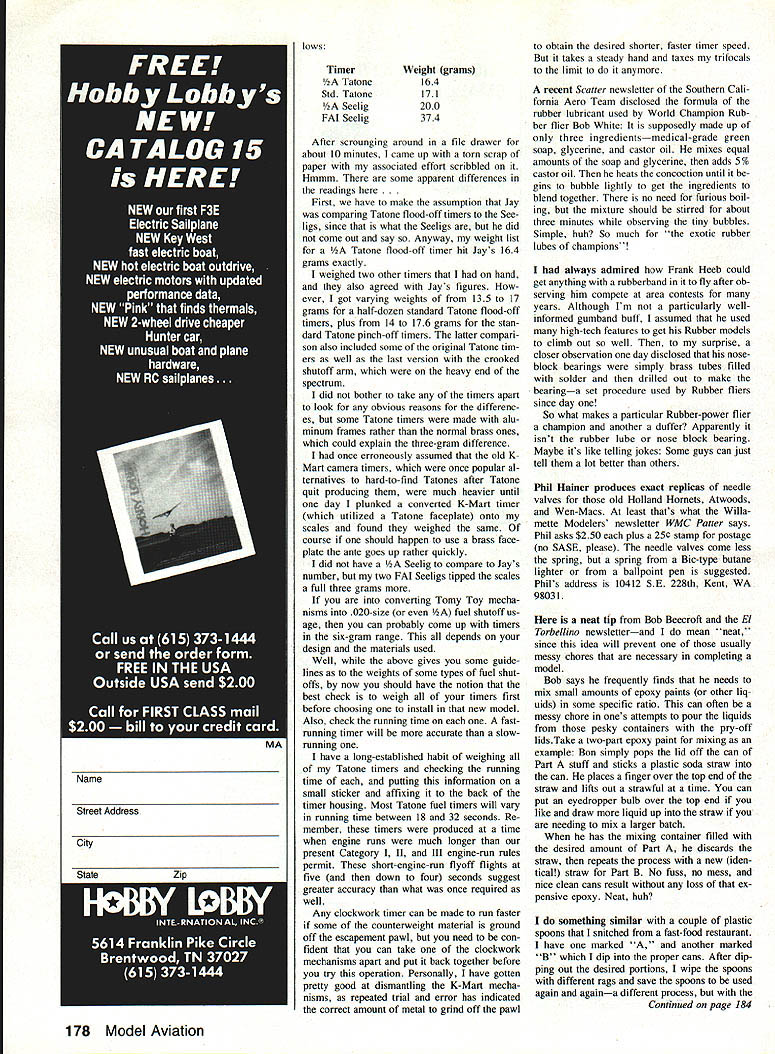
At the Northern Ohio Free Flight Association (NOFFA) two-day contest at Wright Field, Rudy Kluber sponsors the Payload event each year, blowing the starting whistle around 5:00 p.m. on Saturday. It’s a lively, imaginative contest. This year’s NOFFA "Dummy Flyoff" was won by Bill Barr, with Jim Haught and me following. Rudy presented blocks of wood finished to simulate the dummy, complete with painted facial expressions—a lot of fun. Payload also drew 25 entries at the USOC in Lawrenceville, IL.
If you have a passion for a special event, consider promoting it at your club contests.
Last-minute Mail Bag
- Phoenix, CA flying site: After 30 years of use, the Taft, CA Free Flight site may be lost to a penal institution planned for the area, making the site unusable for flying.
Correction and Apology
An apology to Gary and Stan Buddenbohm: I mistakenly credited Bill Gibbons in my October ’89 column as the originator/market seller of the Silly Putty DT system. Gary and Stan are the formal manufacturer (SDT Systems). Gary sells Silly Putty DT kits for small rubber models and hand-launched gliders for $5 each. Address: SDT Systems, 5652 Meinhardt Rd., Westminster, CA 92683. My apologies to the Buddenbohms and to Mr. Gibbons for the confusion.
Closing
As the article suggests, the search for better solutions should be constant—whether dealing with flying sites, building techniques, or everyday problems. That’s all for this trip. I’ll have another chapter in Zeek history next time. See ya downwind!
Transcribed from original scans by AI. Minor OCR errors may remain.

