
Free Flight: Duration
Harry Murphy 3824 Oakwood Blvd. Anderson, IN 46011
NFFS NEWS
Apparently the green light is now burning brightly for both the indoor and outdoor Free Flight portions of the AMA Nationals to be relinquished to the National Free Flight Society (NFFS) in 1990. The plan is for the indoor portion to be combined with the traditional U.S. Indoor Champs at the facilities in Johnson City, TN, on June 7–10, and for the outdoor Free Flight portion to be separated from the July 14–22 RC and CL Nats activities by being moved to the third week of October at Lawrenceville, IL.
The exact October date is under study by Tony Italiano and his team to allow some spacing between the U.S. FAI FF team finals at Lost Hills, CA (rescheduled to September 22–24, 1990). Moving the USOC/AMA FF Nats out a couple of weeks also helps ensure year-end crops around the Mid-American Air Center contest site (near Lawrenceville, IL) are harvested by mid-October.
The October date is not ideal for school-in-session considerations, so all Junior/Senior events will be flown on Saturday. Details will follow and will also appear in the Competition Newsletter section of the magazine.
It appears time for responsible members to support the opportunity to again control the destiny of domestic Free Flight competition. NFFS president Tony Italiano has appointed Joe Foster chairman of the annual Ten Models a Year committee for 1990. Hardy Brodersen will handle the 1990 NFFS Symposium chores. Tony will accept nominations for Free Flight Hall of Fame inductees.
- Design nominations and Ten Models correspondence: Joe Foster, 3771 Timberline Dr., San Jose, CA 95121.
- Papers and articles for the symposium: Hardy Brodersen, P.O. Box 1104, Birmingham, MI 48012.
- Hall of Fame inductee considerations: A.J. Italiano, 1655 Revere Dr., Brookfield, WI 53005.
A lot of work is involved in preparing material for the annual symposium. Please make contributions as early as possible.
FF in New York
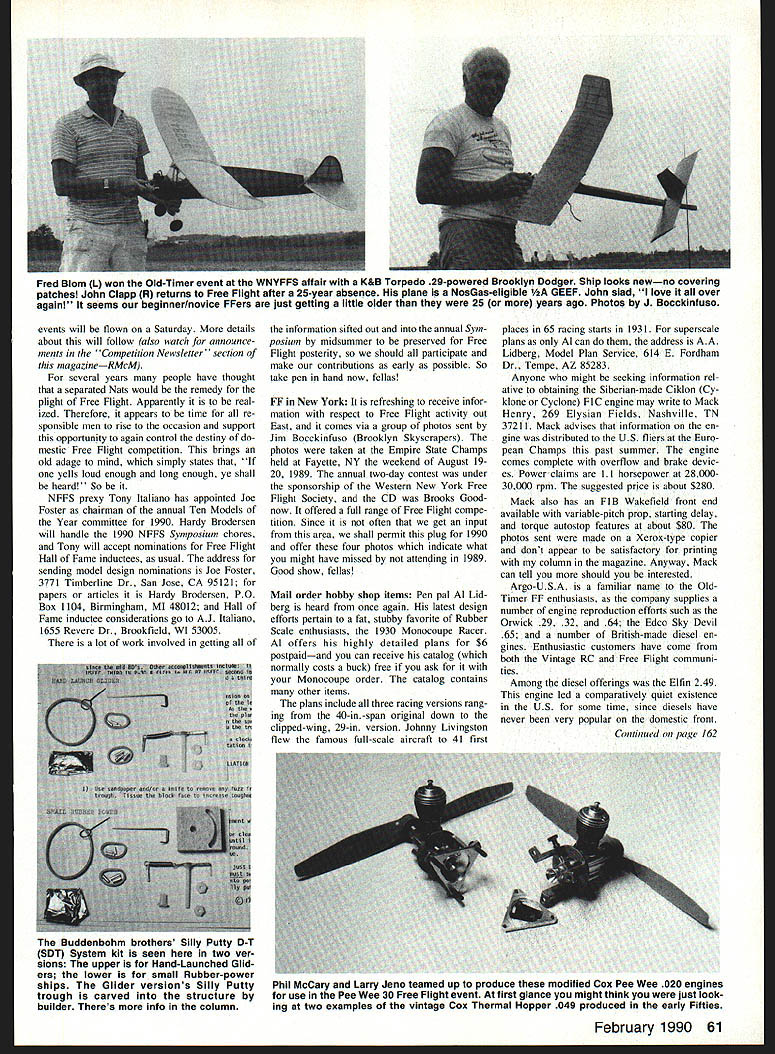
It is refreshing to receive news from the East. Jim Bocckinfuso (Brooklyn Skyscrapers) sent photos taken at the Empire State Champs held in Fayette, NY the weekend of August 19–20, 1989. The two-day contest was sponsored by the Western New York Free Flight Society, with Brooks Goodnow as CD, and offered a full range of Free Flight competition. Since inputs from this area are uncommon, consider this a plug for 1990 — and thanks to the Brooklyners for the photos showing what you might have missed in 1989.
Mail-order hobby shop items
Al Lidberg is again offering plans, this time for the fat, stubby favorite of Rubber Scale enthusiasts, the 1930 Monocoupe Racer. Al offers highly detailed plans for $6 postpaid; request his catalog free with the Monocoupe order (catalog normally costs $1). The plans cover three racing versions from the 40‑in. span original down to the clipped‑wing 29‑in. version. The address: A.A. Lidberg, Model Plan Service, 614 E. Fordham Dr., Tempe, AZ 85283.
For information on the Siberian-made Ciklon FIC engine, write Mack Henry, 269 Elysian Fields, Nashville, TN 37211. Mack reports the engine was shown to U.S. fliers at the European Champs. It comes complete with a power band; claimed output is 1.1 horsepower at 28,000–30,000 rpm. Suggested price is about $280.
Mack also has an F/B Wakefield front end available with variable-pitch prop, starting delay and torque auto-start features at about $80.
Argo-U.S.A. is well known to Old-Timer FF enthusiasts for engine reproduction efforts (Orswick .29/.32/.64, Edco Sky Devil .65, and various British-model diesels). Among past diesel offerings was the Elfin 2.49. Recently the Elfin has surged in popularity in SAM Class A events, being considered more powerful and trouble-free than many ignition contemporaries (Arden .199, Ohlsson .19, Bantam .19, etc.). Due to demand, Argo-U.S.A. reports the diesel will be manufactured in the U.S. by a reliable producer. For price and availability: Argo-U.S.A., 3229 Dianora Dr., Palos Verdes Peninsula, CA 90274.
Pee Wee .020 modification and Hi‑Roller results
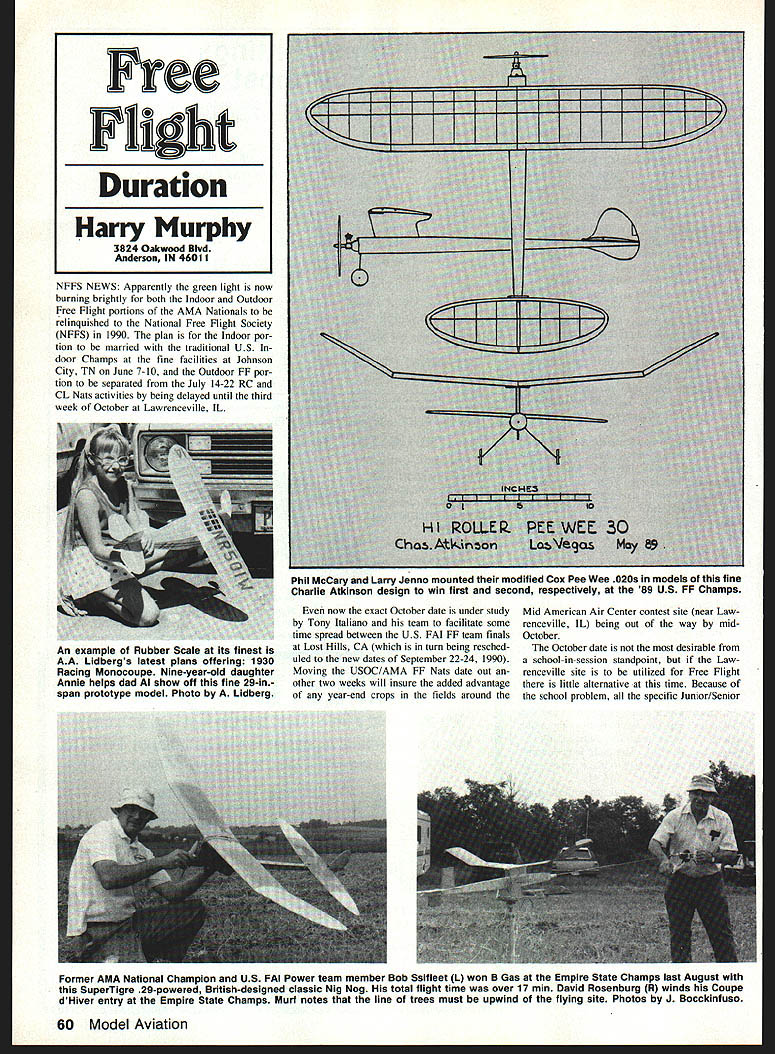
Phil McCary and Larry Jenno have modified the tiny Cox .020 Pee Wee engine to accept a venturi system similar to the old TD thermal hopper, and added a three-prong radial engine mount. The hopped-up engine was mounted in a model called the Hi‑Roller (designed by Charlie Atkinson) and won first and second places at the 1989 U.S. Free Flight Champs; they were the only entrants to max out.
Performance claims: 18,000–20,000 rpm on 40% nitro using a standard .4 x 2 Cox gray plastic prop cut down to .42 x 2, with blades thinned and balanced. Their procedure:
- Start with early thin-walled‑cylinder .020s (better intake/cylinder fits).
- Machine off the reed body/tank and cut down the intake tube.
- Make a collar to fit over the intake tube and thread it to accept a Cox TD .020 venturi and needle valve assembly.
- Machine a three-pronged adapter mount from hard aluminum to replace the tank‑mounting features removed.
For information on the engines or the model, send a SASE to Phil McCary, Jr., 532 College Dr., #212, Henderson, NV 89015.
Pee Wee 30 continues to attract serious competition; it may not be a beginner event in many contest circles. As an example, a stock Cox Pee Wee .020 belonging to Bill Hale (Basic Yeller fame) measured about 19,000 rpm straight from the box with only a needle installed. Stock engines can still be competitive.
Silly Putty DT Systems
Gary Buddebohm sent sample kits of the Silly Putty DT Systems he and brother Stan produce. After nearly 50 prototypes they achieved the current design, now widely used. Kits sell for $5 each for either the HLG or Small Rubber kit (which includes wings of typical dimensions). Address: DT Systems, 3652 Mainhardt Rd., Westminster, CA 92683.
Rubber motor pegs and retention
The sight and sound of a wound Rubber Endurance model are satisfying, but exploding motors and peg failures can destroy a model. Motor pegs have evolved from short wooden dowels to metal tubing (aluminum dural, brass, steel) to resist breakage. Equally important is preventing the peg from slipping out of its retention holes as those holes enlarge with repeated use.
Allan Schanzle (from the Bat Sheet newsletter) secures pegs by cementing appropriately sized O‑rings inside the fuselage around the motor peg hole. His method:
- Mount the O‑ring in a "sandwich box" of 1/16" sheet balsa capped on both sides with 1/64" plywood.
- Drill a hole in the center of the 1/16" balsa to fit the O‑ring's outside diameter.
- Drill smaller center holes in the 1/64" ply caps to admit the motor peg.
- Place the O‑ring in the balsa nest and cement the ply caps to trap it.
- Cement the assembly inside the fuselage so the ply cap opening is centered on the motor peg hole.
The O‑ring’s inside diameter is slightly smaller than the peg, retaining it snugly and hidden when covered.
Bud Brown retains rear motor pegs on a Mulvihill model with small steel C‑rings placed around the peg exterior after the rubber is installed. He uses C‑ring pliers to install and remove them. Hardware or auto parts stores usually carry O‑ and C‑rings and the pliers.
Fiberglass tape and stiffened cloth
Applying lightweight fiberglass cloth neatly can be difficult. Bob Becroft makes his own fiberglass tape for reinforcing wing dihedral joints:
- Stretch a patch of cloth over a hardboard frame.
- Brush on a few washes of dope until the cloth is slightly stiff and the fibers are separated.
- Sand and brush on more dope until the piece is tacky.
- Remove from the frame and cut into strips of the needed width and length.
- The strips handle like ordinary tape and can be applied dry, then made tacky with dope or epoxy and saturated with resin.
The still‑flexible center portion helps on compound surfaces.
Walt Rozelle provided a simple five-step do-it-yourself method for producing doped fiberglass cloth, credited to Rex Hinson:
- Spread newspapers on the garage floor.
- Lay down a yard of fiberglass cloth over the papers, weight the edges (do not stretch the weave).
- Spray a light coat of nitrate dope or clear lacquer to penetrate the yarns and bind the weave points; allow to dry overnight. Roll up the dry cloth for storage.
- Cutting the cloth is then easy with scissors or a steel rule and razor blade; remove any warped portions as you cut.
- Apply cloth cutouts with thinner, dope, epoxy, or cyanoacrylate depending on the undersurface preparation and intended use.
A commercial supply of doped fiberglass tape could save many modelers building time.
Well, even a columnist needs some building time. See you downwind again in a couple of months.
Transcribed from original scans by AI. Minor OCR errors may remain.

