
Free Flight: Duration
Louis Joyner 3657 Brookwood Rd. Birmingham, AL 35223
Foam plus aluminum
Last summer I examined experimental foam-and-aluminum wings being developed by Florida Nordic fliers Dale Elder and Harry Grogan. The wing is a fairly typical D-box construction, except the D-box itself is solid Rohacell foam instead of the usual sheet balsa and ribs. The foam is covered with very thin, hard aluminum similar to that used in FAI Power-plane construction. The resulting wing panel was impressively stiff. The wing is built in three subassemblies:
- Build a massive spruce-and-carbon-fiber spar on a jig.
- Epoxy Rohacell foam to the front of the full-depth spar assembly.
- Add thick balsa end ribs and a balsa leading-edge strip, then sand the foam to shape. (Do not hot-wire Rohacell — it emits deadly fumes when burned.)
To prevent the foam from soaking up too much epoxy, they seal it first by brushing on a lightweight spackling compound thinned with water (modelers report Red Devil One‑Time Spackling works well). After the spackling dries the foam-and-spar assembly is sanded and given a very thin coat of epoxy glue. The thin aluminum — pre-creased for the leading edge — is laid on, and the whole assembly is vacuum-bagged to pull the aluminum tight to the foam. Once the epoxy sets, the aluminum-clad D-box is placed on an undercamber jig and ribs and trailing edge are added in the usual manner. Carbon-fiber caps on the ribs provide warp resistance and torsional stiffness.
Doug Joyce's Rohacell-and-aluminum canard method
FAI Power flier Doug Joyce (New Orleans, LA) uses thin, higher-density Rohacell sheet instead of thin balsa for his aluminum-clad canard wings. His process:
- Cut a sheet of thin aluminum a little over twice the panel chord and slightly longer than the panel; clean it carefully.
- Spread a very thin layer of industrial epoxy over the aluminum using a single-edge razor blade as a squeegee.
- Position two pieces of 1.5 mm Rohacell on the aluminum, leaving a slight gap at the leading edge.
- Vacuum-bag the assembly until the epoxy sets.
- Add ribs and spars, then pull and epoxy the top half in place.
Advantages Doug cites: no seams (Rohacell sheets are available up to 2 × 4 ft) and lighter weight. The thin Rohacell he uses is about 3.1 lb/cu. ft. density — roughly half the weight of light balsa. Rohacell block stock (as used by Nordic glider fliers) is about 1.9 lb/cu. ft. The downside is cost; Rohacell is relatively expensive.
For a detailed explanation of aluminum-and-balsa wing construction, see Randy Archer's article in the National Free Flight Society's 1988 NFFS Symposium.
Rohacell sources and machined wings
A U.S. source known to sell small quantities of Rohacell is Composite Structures Technology, 3701 Inglewood Ave., #268, Redondo Beach, CA 90278-1110.
Joe Maxwell (Scotland) reportedly will offer Wakefield wings machined from Rohacell in addition to the solid-balsa Döring-style wings he has produced for years. Foam wings can be ordered in nearly any airfoil or planform and with specified tip washout. Maxwell also offers custom-machined jigs and forms for making undercambered wings and laminated props.
Contact: J. H. Maxwell, 14 Upper Craig, Stirling FK8 2Q6, Scotland.
When writing overseas suppliers, include a stamped, self-addressed envelope (SASE) for U.S. replies and consider adding a couple of International Reply Coupons (available at U.S. post offices) to cover return postage from foreign countries.
New newsletter: Fritflyvnings-Nyt (Danish Free Flight Union)
Danish Wakefield flier Jorgen Korsgaard edits the new newsletter Fritflyvnings-Nyt. He also produces Indoor News (in English). The drawings in Fritflyvnings-Nyt are especially valuable — Korsgaard is an excellent draftsman whose work has appeared in the French newsletter Vol Libre. Some useful Danish—examples from the newsletter: "vinger" = wing; "hale-bom" = tail boom; "diagonalribber" = diagonal rib.
For information: Jorgen Korsgaard, Ahornvej 5, D-2397 Ellund-Handewitt, West Germany.
New Wake: Bumble Bee 89 (Roger Ruppert)
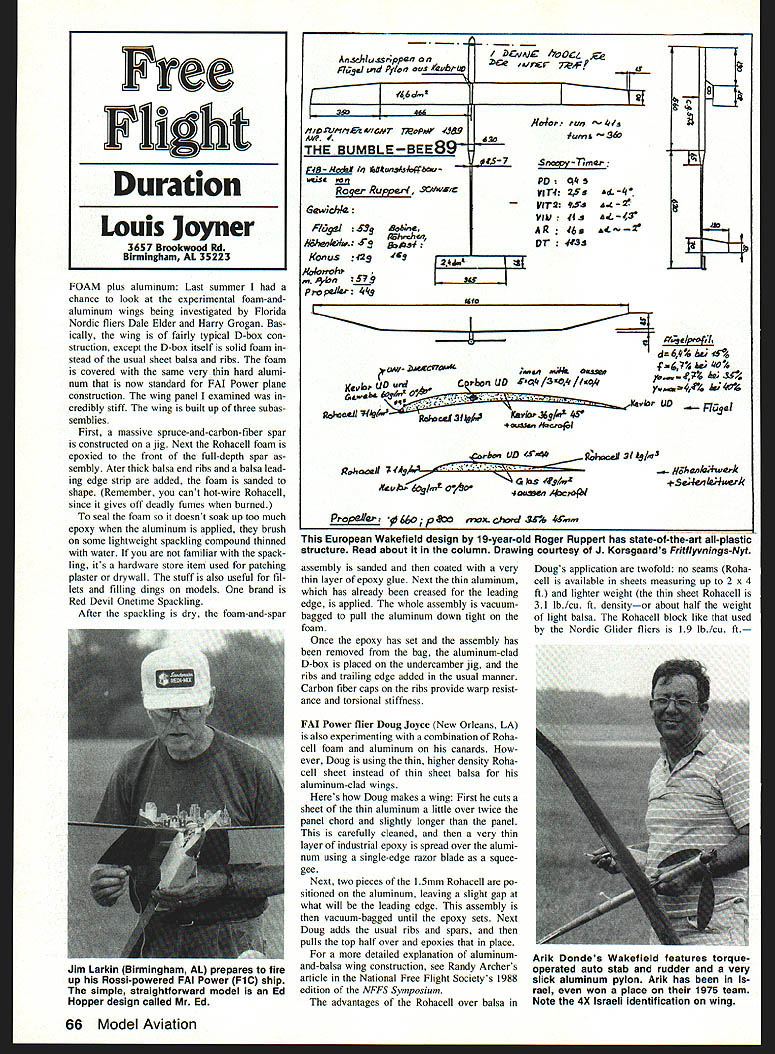
One striking design featured in Fritflyvnings-Nyt is 19-year-old Roger Ruppert's Bumble Bee 89. The model has had several contest wins and has a distinctive all-plastic construction:
- Wing: solid Rohacell with a 36 g/m² Kevlar cloth skin and epoxy; Kevlar applied at a 45° angle for torsional stiffness. A unidirectional, tapered carbon-fiber spar gives bending strength for the 16:1 aspect-ratio wing.
- Stabilizer: similar construction but using light glass cloth instead of Kevlar.
- Weights: wing ~59 g; stab ~5 g.
The model uses a Tomy windup timer (also called a "Snoopy timer" in the UK) to operate a DPR (delayed prop release), two VIT (variable-incidence tailplane) settings, a VIV (variable-incidence wing) at about 11 seconds, AR (autorudder), and DT (dethermalizer).
The variable wing is likely a "wing wiggle" that changes the left-wing incidence partway through the power pattern to help prevent the altitude-robbing dip familiar to rubber fliers. For more on wing wigglers see "The Russian Approach to F1B" by Richard Blackham in the May 1989 NFFS Digest.
New timer: Tomy-based timers
Tomy windup timers have been adapted many ways for model use. An Australian firm, World Free Flight Supplies, Ltd., now markets four different Tomy-based timers. Jim and Joe Smith (Florida) showed examples; the timers are neatly made and extremely light — the heaviest (a triple-function model) weighs only six grams.
Towhooks
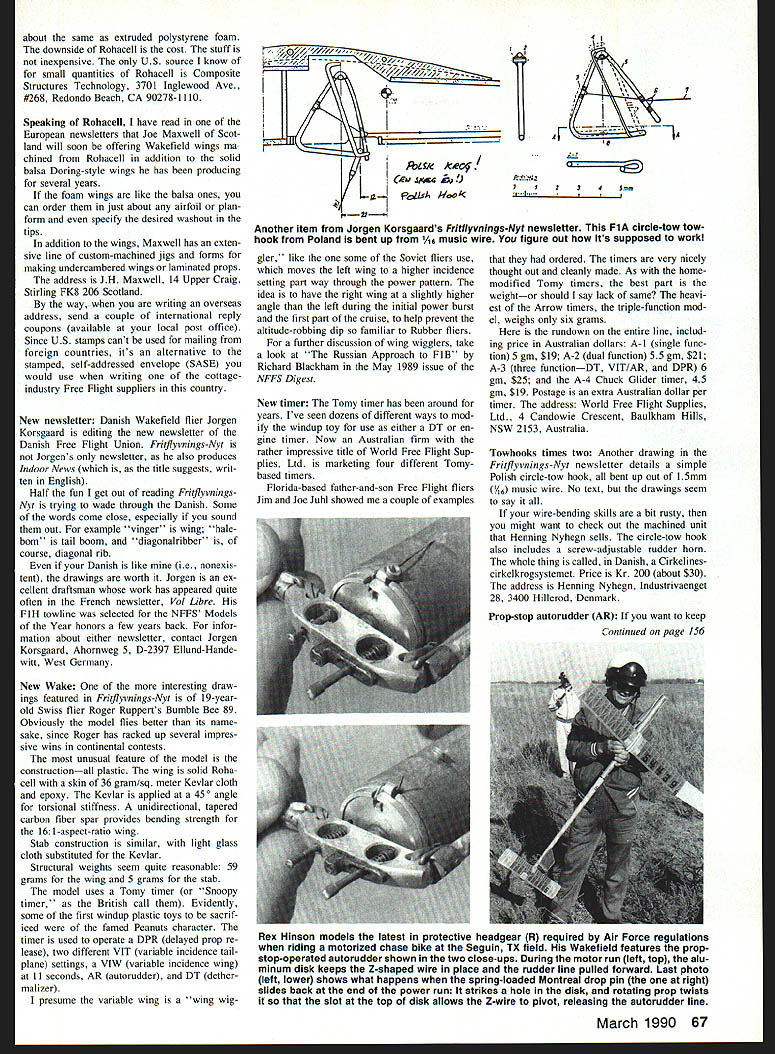
Fritflyvnings-Nyt included a clear drawing of a simple Polish circle-tow hook bent from 1.5 mm music wire. If wire-bending isn't your forte, Henning Nyhgen offers a machined circle-tow unit that includes a screw-adjustable rudder horn. The Danish name is given as "Cirkelløsgrej" (circle-release gear). Price: Kr. 200 (about $30).
Contact: Henning Nyhgen, Industrivaenget 28, 3400 Hillerod, Denmark.
Prop-stop and rudder-trip safety — Rex Hinson's disc
For small-stab Wakefields flying a right-right pattern without a timer, a prop-stop actuated autowinder is often used. However, prop-stop releases can trip prematurely or on launch, causing a dangerous spin. Rex Hinson (Inverness, FL) developed a reliable rudder-trip method:
- Instead of using the Montreal prop-stop drop-pin to directly trip a lever, Rex adds a thin round aluminum disc on the front of a turned aluminum nose block. The disc has a hole for the drop-pin and a slot at the top.
- The rudder-release line is hooked down by a Z-shaped wire pivoted on top of the nose block; the other end of the wire is held down by the aluminum disc. When the drop-pin releases the disc, rubber motor torque runs the disc forward, releasing the Z-wire and allowing the model to go into glide.
Construction notes: Rex uses an aluminum star-stock hub. Hinges are 1/2" wire soldered to short brass-tube sections (~1/16" long). The dowels in each propblade fit into slots for precise blade-pitch setting.
Transcribed from original scans by AI. Minor OCR errors may remain.

