
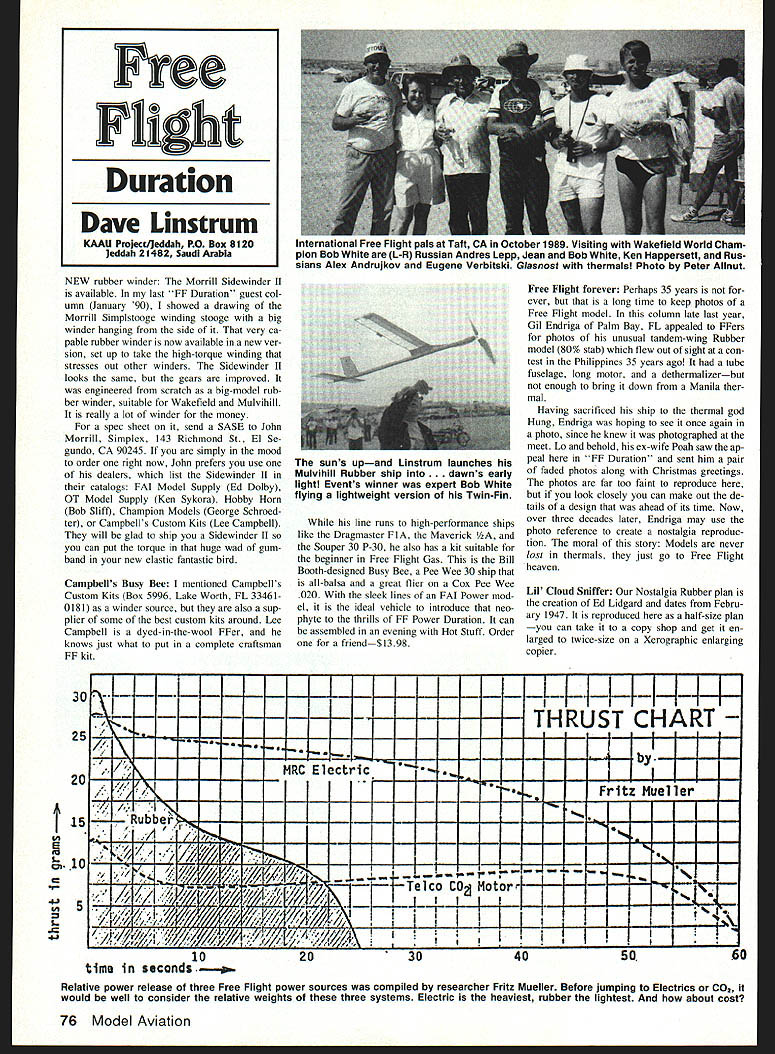
Free Flight: Duration
Dave Linstrum KAAU Project/Jeddah PO Box 8120 Jeddah 21482 Saudi Arabia
New rubber winder
The Morrill Sidewinder II is available. In my last "FF Duration" guest column (January '90) I showed a drawing of the Morrill Simplex winder: stooge with a winder hanging from the side of it. That very capable rubber winder is now available in a new version, set up to take the high-torque winding stresses out of other winders. The Sidewinder II looks the same, but the gears are improved. It was engineered from scratch as a big-model rubber winder, suitable for Wakefield and Mulvihill. It is really a lot of winder for the money.
For a spec sheet, send a SASE to John Morrill, Simplex, 143 Richmond St., El Segundo, CA 90245. If you prefer to order immediately, John prefers you use one of his dealers. The Sidewinder II is listed in the dealers' catalogs: FAI Model Supply (Ed Dolby), OT Model Supply (Ken Sykora), Hobby Horn (Bob Sliff), Champion Models (George Schroedter), or Campbell's Custom Kits (Lee Campbell). They will ship you a Sidewinder II so you can put the torque into that huge wad of gum-band in your new elastic fantastic bird.
Campbell's Busy Bee
Campbell's Custom Kits (Box 5996, Lake Worth, FL 33461-0181) is not only a winder source but also a supplier of some of the best custom kits around. Lee Campbell is a dyed-in-the-wool FFer and knows just what to include in a complete craftsman FF kit.
While his line runs to high-performance ships like the Dragmaster F1A, the Maverick 1/2A and the Souper 30 P-30, he also has a kit suitable for the beginner in Free Flight Gas. This is the Bill Booth–designed Busy Bee, a Pee Wee 30 ship that is all balsa and a great flier on a Cox Pee Wee .020. With the sleek lines of an FAI power model, it is an ideal vehicle to introduce a new pilot to the thrills of FF Power Duration. It can be assembled in an evening with Hot Stuff. Order one for a friend — $13.98.
Free Flight forever
Perhaps 35 years is not forever, but that is a long time to keep photos of a Free Flight model. Late last year Gil Endriga of Palm Bay, FL appealed to FFers for photos of his unusual tandem-wing rubber model (80% stab) which flew out of sight at a contest in the Philippines 35 years ago. It had a tube fuselage, long motor and a thermaler—but not enough to bring it down from a Manila thermal.
Having sacrificed his ship to the thermal god, Hung Endriga was hoping to see it once again in a photo, since he knew it was photographed at the meet. Lo and behold, his ex-wife Poah saw his appeal and sent him a pair of faded photos along with Christmas greetings. The photos are far too faint to reproduce here, but you can look closely and see much of the details of the design. Now, over three decades later, Endriga may use the photo reference to create a nostalgia reproduction. The moral of this story: models are never lost in thermals, they just go to Free Flight heaven.
Lil' Cloud Sniffer
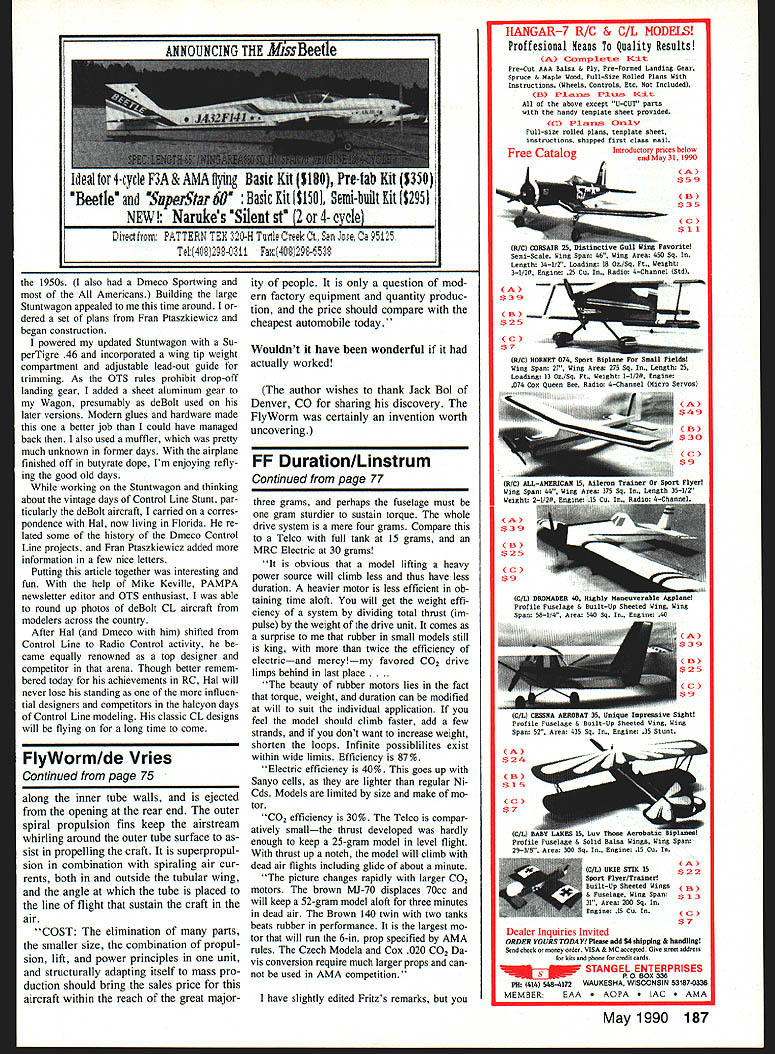
Our Nostalgia Rubber plan is the creation of Ed Lidgard and dates from February 1947. It is reproduced here as a half-size plan—you can take it to a copy shop and get it enlarged to twice-size on a xerographic enlarging copier.
Ed was inspired to create this high flier when he was fantasizing about thermals and brushing dope (nitrate) on one side of a sheet of 1/16" balsa. He brushed and stroked the sheet lazily, not really thinking. When dry, the curl formed an undercambered airfoil. With a little sanding and cutting to shape, he had a great wing.
The simple box body with cutout sides and 1/8"-sq. crosspieces/uprights was developed by Carl Goldberg. Tissue-covered on the body only, the model came out about an ounce in weight—and Ed used 1/2 oz. of T-56 rubber for power.
The plan is self-explanatory. Try one for flying when that ultra-high-tech FAI bird is frustrating you, or when your Mulvihill just seems like too much effort to wind. Enjoy sniffing those clouds.
Silent-power comparisons
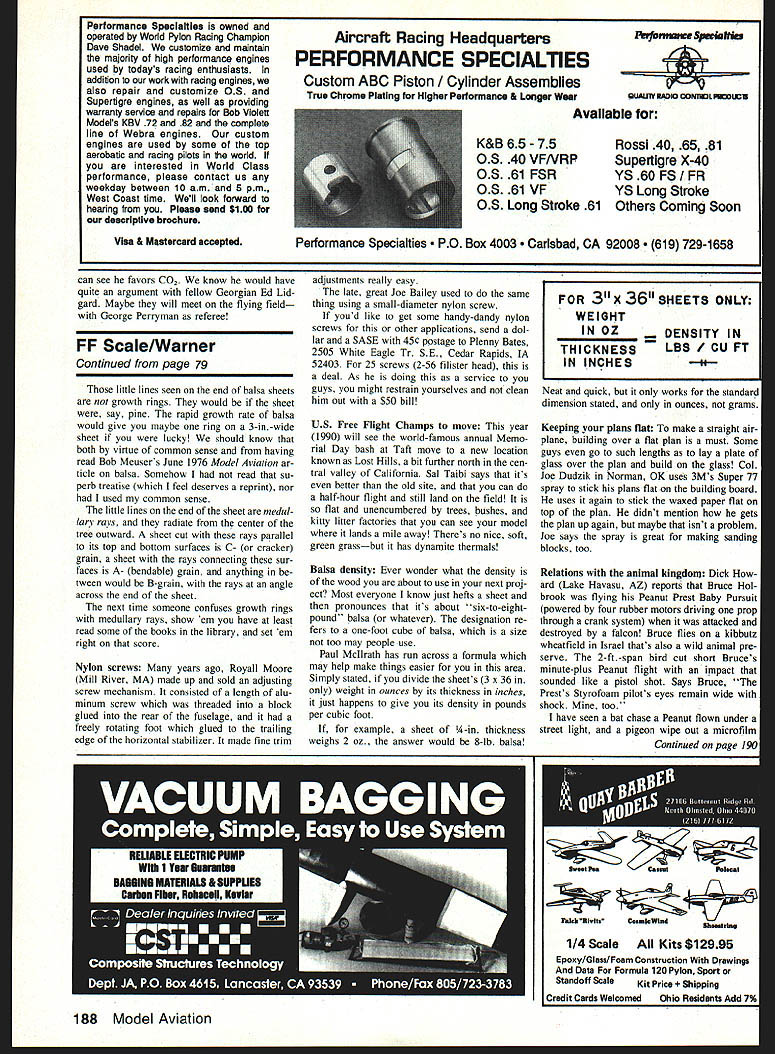
Free flighters like Ed Lidgard have traditionally preferred rubber as a power source, but new technology has brought great interest in CO2 and electric power. In the Thumb Print newsletter of the Thermal Thumbers of Atlanta, GA, researcher Fritz Mueller charts the relative energy release of these power sources. The following summarizes his measurements and commentary.
Fritz says he made a simple test device out of sticks, shafts, clock gears, springs, counterweights… After a week of tinkering, calibrating, and measuring, he came up with three graph lines not to settle the argument, but to evoke new thoughts.
Test conditions:
- Rubber: 600 turns into a foot-long loop of 1/8" FAI rubber turning a 7" plastic prop.
- CO2: standard 2.8 cc–tanked Telco, throttled down for a slow 60-second run.
- Electric: small MRC drive powered by two 50 mAh Ni-Cd cells (VL HY70 performs similarly).
Counting the gridded area under each curve, Fritz got:
- Rubber: 70 squares
- CO2: 91 squares
- Electric: 236 squares
Multiply by 5 to get total thrust yield (impulse), in grams per second:
- 24 x 1/4-in. FAI Rubber . . . . . . . . . . . . . . . . . . . 350 grams/sec.
- Standard Telco CO2 . . . . . . . . . . . . . . . . . . . . . . . . 455 grams/sec.
- MRC or HY70 Electric . . . . . . . . . . . . . . . . . . . . . 1,180 grams/sec.
Why does rubber still look good? The specified loop of rubber with shaft, hook, and bearing weighs only three grams, and perhaps the fuselage must be one gram sturdier to sustain torque. The whole drive system is a mere four grams. Compare this to a Telco with a full tank at about 15 grams, and an MRC electric drive at about 30 grams.
It is obvious that a model lifting a heavy power source will climb less and thus have less duration. A heavier motor is less efficient in obtaining time aloft. You will get the best efficiency of a system by dividing total thrust (impulse) by the weight of the drive unit. It comes as a surprise that rubber in small models still is king, with more than twice the efficiency of electric—and, in Fritz's view, CO2 limps in last place.
Efficiency estimates:
- Rubber: about 87%. Torque, weight, and duration can be modified (add strands or shorten loops) to suit the application.
- Electric: about 40%. Efficiency improves with lighter cells (Sanyo cells are lighter than regular Ni-Cads). Motors are limited by size and make.
- CO2: about 30%. The Telco was comparatively small—the thrust developed was hardly enough to keep a 25-gram model in level flight. Increasing thrust gives a higher initial impulse and a glide of about a minute.
The picture changes with larger CO2 motors. The Brown MJ-70 displaces 70 cc and will keep a 52-gram model aloft for three minutes in dead air. The Brown 140 with twin tanks beats rubber in performance. The largest motors that will run the 6‑in. prop specified by AMA rules are the Czech Modela and Cox .020 CO2 conversions; they require much larger props and cannot be used in AMA competition.
I have slightly edited Fritz's remarks.
Model Dawns Early Light
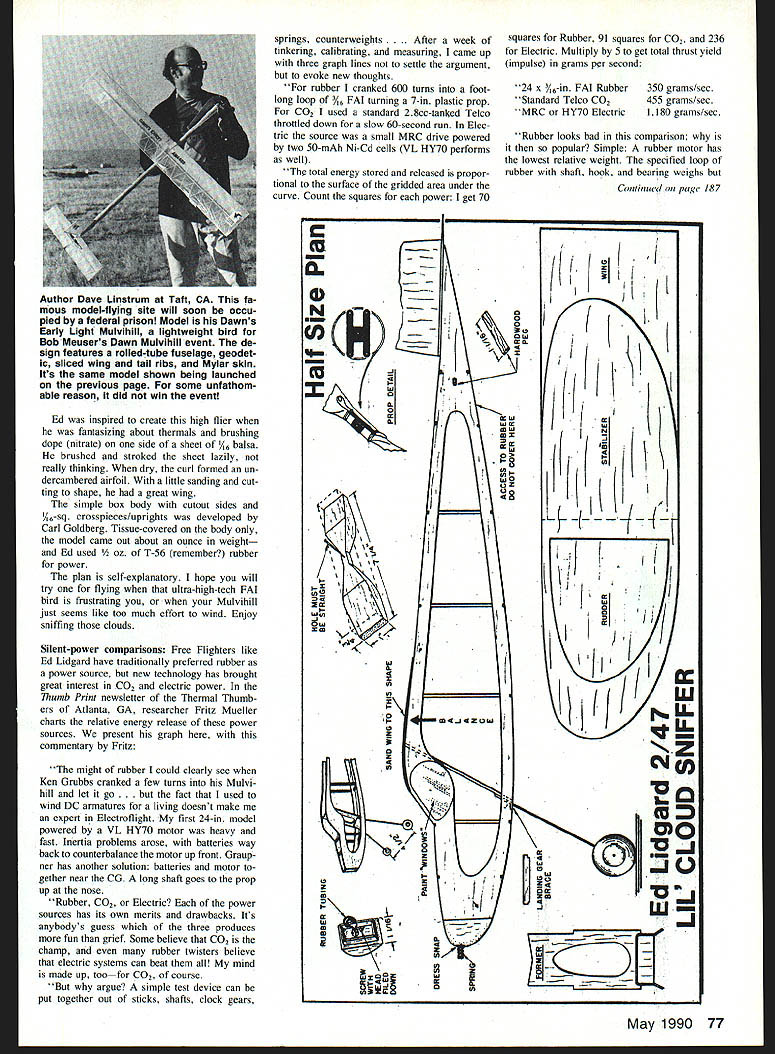
Mulvihill lightweight bird: Bob Meuser's Dawn Mulvihill event design features a rolled-tube fuselage, geodetic-sliced wing and tail ribs, and Mylar skin. It's the same model shown being launched elsewhere in this issue; for some unfathomable reason it did win the event.
Ed Lidgard inspired the creation of a high flier by fantasizing about thermals and brushing nitrate dope on one side of a sheet of balsa. The dry curl produced an undercambered airfoil; with little sanding and cutting he had a very effective wing. The simple box body, with cutout sides and 1/8"-sq. crosspieces/uprights, produced a model weighing about one ounce. Ed used 1/2 oz. of T-56 rubber for power. The plan is straightforward and worth trying when you want a change from high-wind FAI birds.
Transcribed from original scans by AI. Minor OCR errors may remain.

