
Free Flight: Duration
Harry Murphy 3824 Oakwood Blvd. Anderson, IN 46011
New FF Club
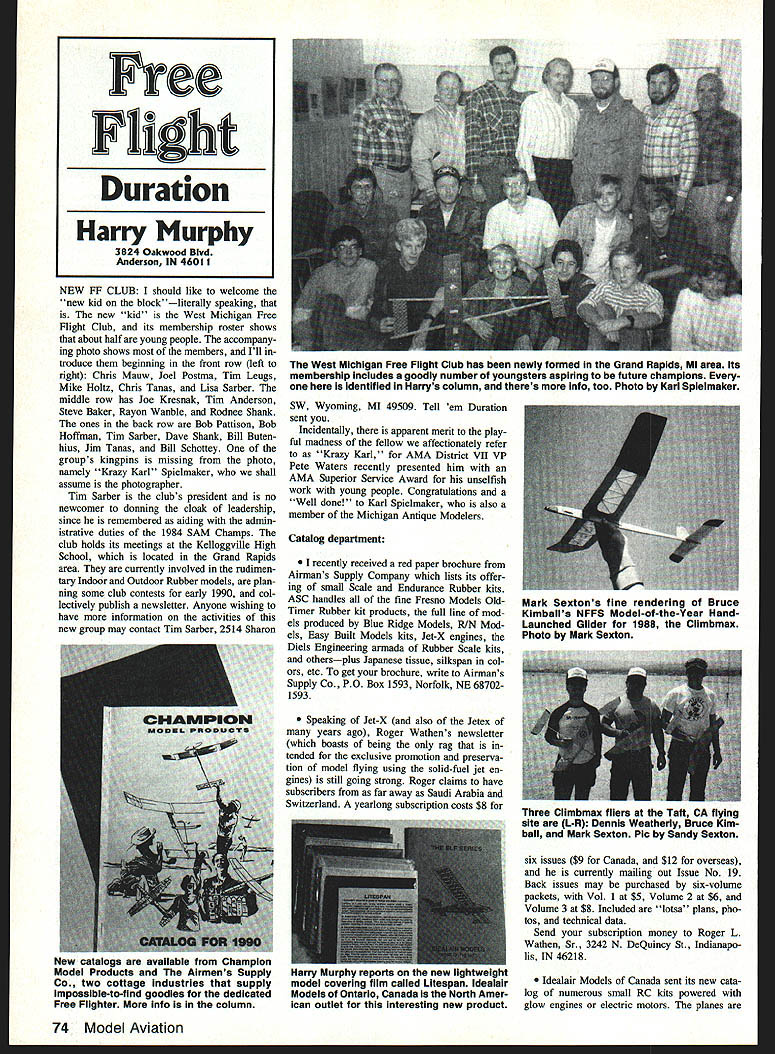
I should like to welcome the "new kid on the block"—literally speaking. The new "kid" is the West Michigan Free Flight Club, and its membership roster shows that about half are young people. The accompanying photo shows most of the members; I'll introduce them beginning in the front row (left to right): Chris Mauw, Joel Postma, Tim Leugs, Mike Holtz, Chris Tanas, and Lisa Sarber. The middle row has Joe Kresnak, Tim Anderson, Steve Baker, Rayon Wanble, and Rodney Shank. The back row includes Bob Pattison, Bob Hoffman, Tim Sarber, Dave Shank, Bill Butenhius, Jim Tanas, and Bill Schottey. One of the group's kingpins is missing from the photo—namely "Krazy Karl" Spielmaker, who we shall assume is the photographer.
Tim Sarber is the club's president and is no newcomer to donning the cloak of leadership; he is remembered for aiding with administrative duties at the 1984 SAM Champs. The club holds its meetings at Kelloggville High School in the Grand Rapids area. They are currently involved in rudimentary Indoor and Outdoor Rubber models, plan some club contests for early 1990, and collectively publish a newsletter. Anyone wishing more information may contact Tim Sarber, 2514 Sharon SW, Wyoming, MI 49509. Tell 'em Duration sent you.
Incidentally, there is merit to the playful madness of "Krazy Karl." AMA District VII VP Pete Waters recently presented him with an AMA Superior Service Award for his unselfish work with young people. Congratulations and a "well done" to Karl Spielmaker, who is also a member of the Michigan Antique Modelers.
Catalog department
I recently received a red paper brochure from Airman's Supply Company which lists its offering of small Scale and Endurance Rubber kits. ASC handles Fresno Models Old-Timer Rubber kits, the full line of models produced by Blue Ridge Models, R/N Models, Easy Built Models kits, Jet-X engines, the Diels Engineering armada of Rubber Scale kits, and others—plus Japanese tissue, silkspan, colors, etc. To get their brochure, write to Airman's Supply Co., P.O. Box 1593, Norfolk, NE 68702-1593.
New catalogs are available from Champion Model Products and The Airmen's Supply Co., two cottage industries that supply hard-to-find goodies for the dedicated Free Flighter.
Speaking of Jet-X (and the old Jetex), Roger Wathen's newsletter—dedicated to the promotion and preservation of model flying using solid-fuel jet engines—is still going strong. Roger claims subscribers as far away as Saudi Arabia and Switzerland. A yearlong subscription costs $8 for six issues ($9 for Canada, and $12 overseas); he is currently mailing Issue No. 19. Back issues may be purchased by six-volume packets: Vol. 1 at $5, Vol. 2 at $6, and Vol. 3 at $8. Included are many plans, photos, and technical data. Send subscription money to Roger L. Wathen, Sr., 3242 N. DeQuincy St., Indianapolis, IN 46218.
Idealair Models of Canada sent its new catalog of numerous small RC kits powered with glow engines or electric motors. Harry Murphy reports on the new lightweight model covering film called Litespan. Idealair Models of Ontario, Canada is the North American outlet for this product.
Litespan covering film (review and application notes)
The semitransparent Litespan film comes in red, yellow, blue, and orange. It has a tissue-like grain finish that even looks like pre-doped tissue or silkspan. There are also opaque colors for more scale-like usages in antique (cream), black, olive, white, and silver. The product line also includes a brush-on adhesive called Balsaloc to affix the material to the structure.
Application and form techniques (practices from modelers)
- After soaking the sheet, Stan wraps it on the form with the beveled edge inside, using rubber-model silkspan instead of tissue, and allows the edges of the wider blank to overlap on the form.
- After baking the assembly in the kitchen oven, he cuts through the tissue at the overlap using a straightedge as a guide. The resulting edges of the glue seam then fit perfectly, requiring less glue for a good joint.
- Before making the joint, he pre-glues the surfaces to be mated using very thin glue applied with an artist's brush. The resulting joint is almost invisible.
- Use shrinkable Teflon tubing (available from electronics suppliers) on the motor-stick form so the glued motor tube won't stick to the form during assembly.
- Before removing the tube from the form, add a spiral wrap of boron fiber under tension to improve torsional strength. The boron is attached using nitrocellulose cement. (Using boron is not for the novice—extreme care must be used when cutting it and preventing minute broken particles from escaping the work surface.)
Prop trim and surface grinding
- Stan's props are checked for balance, pitch angle, and tracking to assure wobble-free operation. Individual pieces are matched for weight and strength to ensure static balance. Precisely checking blade angle is the major anti-wobble factor, followed by tracking to ensure both blades are in the same plane.
- Surface grinding: U.S. indoor wood suppliers produce smooth, clear balsa sheets, but Stan Chilton uses a surface grinder to smooth both sides of each balsa sheet and make them slightly thinner. He grinds finished sheets to 0.010–0.015 in. for F1D models and about 0.010 in. for Indoor Stick. This technique also corrects uneven-thickness sheets and can yield lighter, stiffer, and stronger balsa.
My personal trial with Litespan I used Litespan on a Pee Wee 30 wing with a semisymmetric construction as a test. I found Litespan easy to apply and quite resistant to high heat (unlike some films). The material did not shrink much, so most wrinkles or loose areas had to be stretched while heat-sealing the perimeter of each panel to the framework.
I tried Balsaloc, shellac, and thinned white glue and found little difference in adhesive properties. You can reheat a few times to remove residual wrinkles. The film does not become as taut as I would like, but on a relatively small, rigid wing this was not consequential.
Applying trim and markings One particularly satisfactory feature was applying my AMA license numbers using opaque black Litespan. Instructions say trims made from different colors of Litespan may be applied directly to the base covering using the same Balsaloc adhesive. I taped a 4-in. square of opaque black to my bench, brushed the center patch with adhesive and let it dry (about 10 minutes), then cut out letters and numbers with cardboard templates and a sharp razor. Ironing the cut pieces in place produced no wrinkles or bubbles—they are not coming off. It's neat stuff; try it.
Champion Model Products catalog
The 1990 Champion Model Products catalog is now available. They produce the Champion Coupe, Up Shot Mulvihill, and Wake-Up Wakefield competition endurance Rubber kits, plus many associated supplies: rubber, winders, cements, balsa, rubber tubes, prop kits, tissue, silk, timers, electronic scales, and more.
Proprietor George Schroeder reported a 40% increase in 1989 over the previous year—proof that Free Flight isn't dead. Get their catalog by writing to Champion Model Products, 880 Carmen Court, La Verne, CA 91750.
Enya engines for Nostalgia Gas
Model historian Bob Larsh compiled a useful chart that sorts Enya engines and notes which are eligible or ineligible for Nostalgia Gas (NosGas) use. The chart was compiled from magazine articles, engine reviews by Peter Chinn, and factory specification sheets and owner's manuals.
Key points from the chart:
- Beginning in 1950, Enya identified its .09- and .15-size engines with a "series" designation. The .19, .29, and .35 sizes were assigned four-digit model numbers, with the last digit referring to series.
- For example, an Enya .29 marked "Model 5102" on the bypass port would be a Series II engine.
- One exception: the Series III .35 produced in 1963 was also designated Model 5224—the same as the Series IV .29 of 1963. The Series III .35 (Model 5224) had a rounded intake by 1970 but retained the "Model 5224" casting.
- All engines listed in Bob's table are plain-bearing designs. Enya produced ball-bearing glow engines after 1962, which is beyond the NosGas eligibility cutoff.
- Enya produced a 15-size diesel in 1955 and a revised version after 1957; both used ball bearings, and the later model is not NosGas eligible. The earlier model had a 90° front intake; the later had a slanted intake located further forward on the cylinder.
- A noteworthy specialty engine is the Enya Series I .06, which can be mounted glow or diesel and incorporates a rear-intake reed-valve fuel system similar to the Cox reed-valve Babe Bee. It is NosGas eligible.
Bob's chart should be a fine reference for engine collectors and NosGas enthusiasts. Bring a copy to your next swap meet.
Safety first: Catapult Glider events
The Outdoor Catapult Glider event (solid-balsa gliders flapped into the air by a rubber slingshot) has two basic forms currently in use.
Provisional AMA event
- Described in the AMA rule book (page 18). The suggested launch device is a 3/4-in.-diameter, 6-ft.-long metal tube set over a stake and supported by guy wires anchored to the ground.
- The slingshot launcher is a 30-in. loop of 1/4-in. flat rubber attached to a swivel at the top of the pole. A 24-in. cord loop attaches to the free end of the rubber; the other end hooks to the glider.
- The contestant hooks the glider to the cord loop, walks backward to stretch the rubber, and releases. Because of the elaborate setup and the high speeds involved, there are real safety concerns: failure of any part (pole, guy wires, swivel, rubber loop, cord loop), or an errant trajectory hitting a passerby, could cause serious damage.
Anecdote and concern I received a call from glider flier Bill Schlarp (South Bend). While practicing, he set up his launcher about 35 ft from his car, stretched the line, and the model shot into his car’s side window, smashing the model and cracking the windshield. He worried, “What if I had hit someone instead?” A realistic concern—precautions are warranted.
Hand-Held Catapult Glider (safer alternative)
- The unofficial hand-held event has grown in popularity. The 1989 USOC meet drew 28 entries.
- Rules used are those initiated by the Central Indiana Aeromodelers (CIA). John Voorhees (Sidney, OH) originated the concept, aided by the Sky Hawk series of small foam-wing Rubber models.
- The hand-held launcher is simple: a short hardwood dowel (about 6 in.) with a loop of flat rubber attached to one end. Many fliers prefer a shorter rubber loop for best results (approximately 6 in.).
- Models are usually smaller than those in the AMA event. The launching area is less hazardous, the flier has better control over direction and attitude, and the launcher is simpler to construct.
My view is that the CIA hand-held concept is a practical, safer alternative to re-examine the Provisional event with safety in mind. Others may disagree, and I have already invited scorn, but safety merits attention.
The Zeek chronicles—Part VI
In the preceding five installments (Aug 1988—Part I; Dec 1988—Part II; Apr 1989—Part III; Jun 1989—Part IV; Aug 1989—Part V) we traced the evolution of the Zeek design from Lew Mahieu’s initial efforts through the Bill Cranford/Ray Downs involvements, and finally the mid-Fifties purchase of the Zeek business and tooling by Midwest Models.
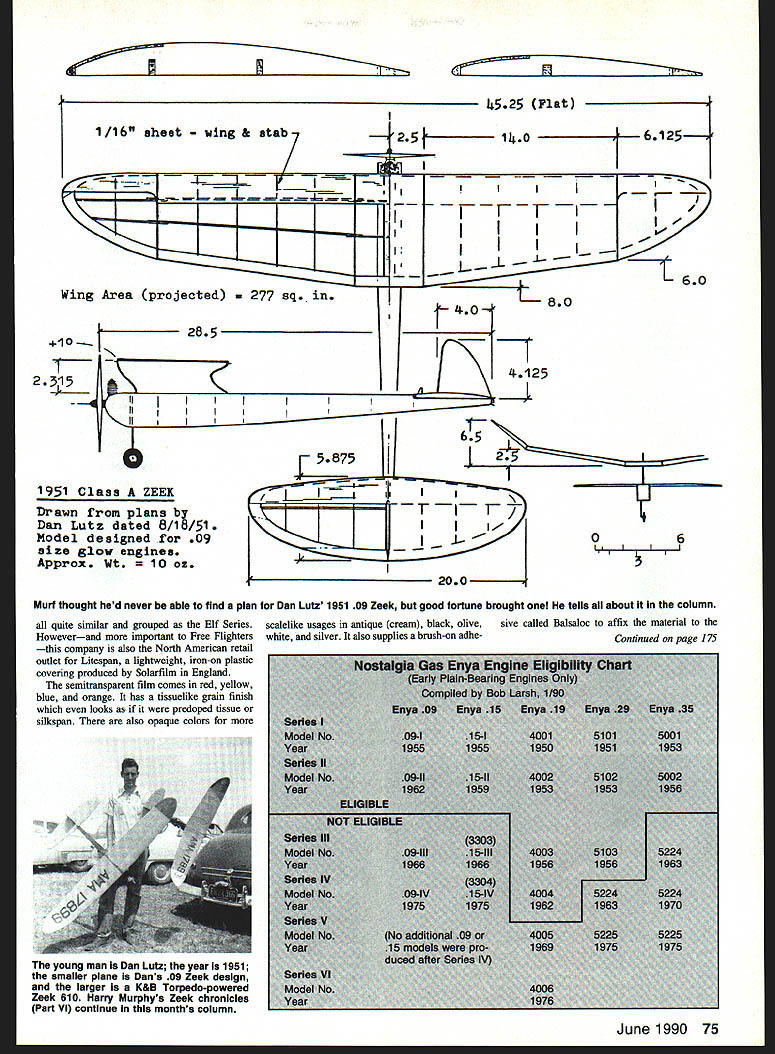
We could have quit there, but that would leave the stories of a couple of important design spin-offs untold. In this chapter we cover a significant .09-size version instigated in 1951 by Dan Lutz, who later worked at K&B Mfg. and Kraft Systems.
Dan Lutz’s 1951 .09 Zeek
Dan's .09 Zeek came along after the flat-bottom-airfoil 575 Zeek had made its mark. The design differs from other Zeek-scaled-up variants in several ways: sheeted leading edges on the wing and stab (top only), and a short-span center panel in the five-panel wing.
Russ Hansen (designer of the T‑Bird) built two of Dan's models in the Fifties and ranked Dan's .09 and the 575 ahead of the A/B offerings in performance. According to Russ, those models had a "fantastic glide"—so much so that they sometimes had to be shot down to recover them.
Dan's plans (dated 8-18-51) list the .09 (.099) power options: McCoy .098, O.K. Cub .074 and .099, and the Royal .065—brands likely available then. A small pneumatic-action Spitfire fuel shutoff timer is shown installed immediately behind the 1/2A plywood firewall. The firewall supports the radially mounted engine and the landing gear with its single 1-1/2-in.-diameter wheel.
Fuselage construction and dimensions
- Typical Zeek sheet-balsa box construction with 3/16 x 3/16-in. spruce longerons; sides are 1/16-in. sheet.
- Fuselage measures 2-3/8 in. high and 1-1/4 in. wide at the firewall cross section, tapering from the rear of the pylon to 3/4 in. at the front of the stabilizer.
- All formers are 1/16-in. sheet. The pylon is extra-hard 1/4-in. sheet balsa and sports a 3/32-in. sheet wing platform.
- The pylon is installed into the top of the fuselage after the wing and tail are covered and the engine and timer are installed, to establish the center of gravity at 6% rearward from the wing leading edge.
- The top of the 1/8-in. sheet stabilizer platform is located 3/8 in. below—and parallel to—the top of the fuselage; the only decalage is the positive incidence afforded by the pylon.
- The sides of the completed fuselage box are sanded to 1/16 in. at the rear to lighten the tail.
Wing, stabilizer, and fin
- Wing and stab are typical Zeek construction except for the sheeted top surfaces between the two centerline wing ribs extending to the trailing edge.
- Leading edges for wing and stab: 3/16 x 1/4 in.
- Wing spars: 1/8 x 1/8 in., with front tip spars 3/16 x 3/16 in. and rear tip spar 1/8 x 1/8 in.
- Wing trailing edge: 1/4 x 3/8 in. tapered stock; contoured parts cut from 1/8-in. sheet.
- All ribs for wing and stab: 1/16-in. sheet.
- Stab single center spar: 1/8 x 1/8 in.; contoured parts from 1/16-in. sheet.
- Vertical fin: 1/16-in. sheet balsa sanded to a symmetrical airfoil.
These construction details should enable building a 1951 Dan Lutz Class A .09-size Zeek.
Approval and closing
We owe thanks to Dan and Russ for bringing this Zeek derivative back into view for Nostalgia Gas enthusiasts. The remaining step is formal approval by the NFFS No-Gas Design Eligibility Committee; with dated plans and the 1951 license plate visible in the photo, verification should be straightforward.
By the time this column prints, I will have instigated an information packet through the proper channels, and it is hoped approval will follow so full-size plans can be made available.
The next episode of the Zeek chronicles will be the last, covering the final—and probably most elusive—derivative of the Zeek family of the Fifties: the flat-bottom-airfoil, 575-sq.-in. Zeek and its associate, the 610. Till then, see ya downwind!
Transcribed from original scans by AI. Minor OCR errors may remain.

