
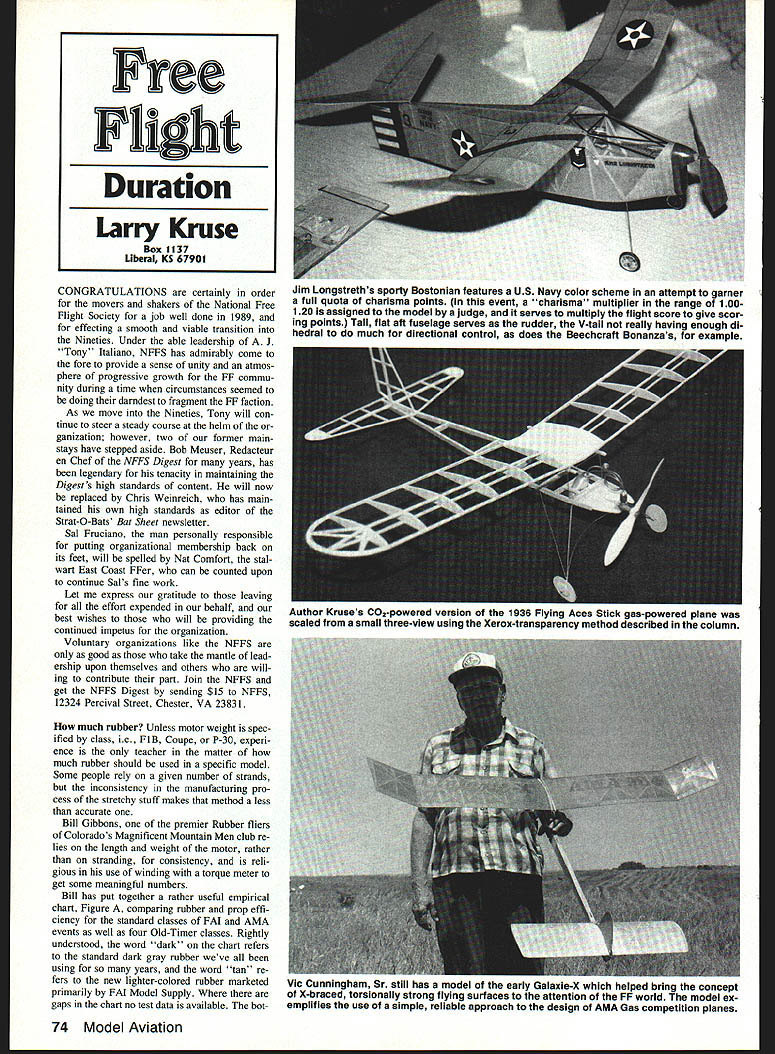
Free Flight: Duration
Larry Kruse Box 1137 Liberal, KS 67901
CONGRATULATIONS are certainly in order for the movers and shakers of the National Free Flight Society for a job well done in 1989, and for effecting a smooth and viable transition into the Nineties. Under the able leadership of A. J. "Tony" Italiano, NFFS has admirably come to the fore to provide a sense of unity and an atmosphere of progressive growth for the FF community during a time when circumstances seemed to be doing their darndest to fragment the FF faction.
As we move into the Nineties, Tony will continue to steer a steady course at the helm of the organization; however, two of our former mainstays have stepped aside. Bob Meuser, Redacteur en Chef of the NFFS Digest for many years, has been legendary for his tenacity in maintaining the Digest's high standards of content. He will now be replaced by Chris Weinreich, who has maintained his own high standards as editor of the Strat-O-Bats' Bat Sheet newsletter. Sal Fruciano, the man personally responsible for putting organizational membership back on its feet, will be replaced by Nat Comfort, the stalwart East Coast FFer, who can be counted upon to continue Sal's fine work.
Let me express our gratitude to those leaving for all the effort expended on our behalf, and our best wishes to those who will be providing the continued impetus for the organization.
Voluntary organizations like the NFFS are only as good as those who take the mantle of leadership upon themselves and others who are willing to contribute their part. Join the NFFS and get the NFFS Digest by sending $15 to NFFS, 12324 Percival Street, Chester, VA 23831.
How much rubber?
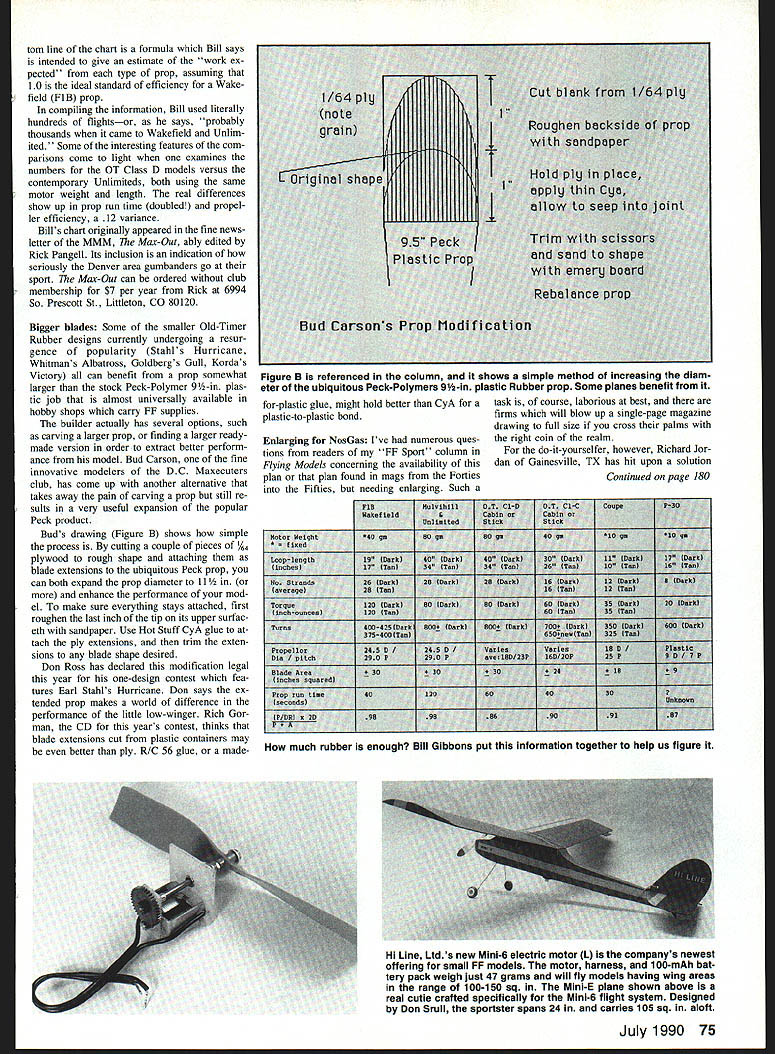
Unless motor weight is specified by class (i.e., F1B, Coupe, or P-30), experience is the best teacher in deciding how much rubber to use for a specific model. Some people rely on a given number of strands, but inconsistency in rubber manufacturing makes strand-counting unreliable. Bill Gibbons, one of the premier rubber fliers of Colorado's Magnificent Mountain Men (MMM) club, relies on motor length and weight rather than stranding for consistency, and he is religious about using a winding torque meter to get meaningful, repeatable numbers.
Bill put together an empirical chart (Figure A) comparing rubber and prop efficiency for standard FAI and AMA events as well as four Old-Timer classes. In the chart, "dark" refers to the traditional dark-gray rubber and "tan" to the newer lighter-colored rubber marketed primarily by FAI Model Supply. Gaps in the chart indicate no test data was available.
The bottom line of the chart is a formula intended to estimate the "work expected" from each type of prop, assuming 1.0 is the ideal standard of efficiency for a Wakefield (F1B) prop. Bill compiled the data from literally hundreds — he says probably thousands — of flights, especially for Wakefield and Unlimited classes. Interesting comparisons emerge, for example Old-Timer Class D models versus contemporary Unlimiteds using the same motor weight and length: prop run time can be doubled, and propeller efficiency can vary by about 0.12.
Bill's chart originally appeared in the MMM newsletter The Max-Out, edited by Rick Pangell. The Max-Out can be ordered (no club membership required) for $7 per year from Rick Pangell, 6994 S. Prescott St., Littleton, CO 80120.
Bigger blades
Some smaller Old-Timer rubber designs that are enjoying a resurgence (Stahl's Hurricane, Whitman's Albatross, Goldberg's Gull, Korda's Victory) can benefit from a prop somewhat larger than the stock Peck-Polymers 9-1/2-in. plastic prop available in most hobby shops. The builder has several options:
- Carve a larger prop.
- Find a larger readymade prop.
- Use an alternative modification to expand the popular Peck prop.
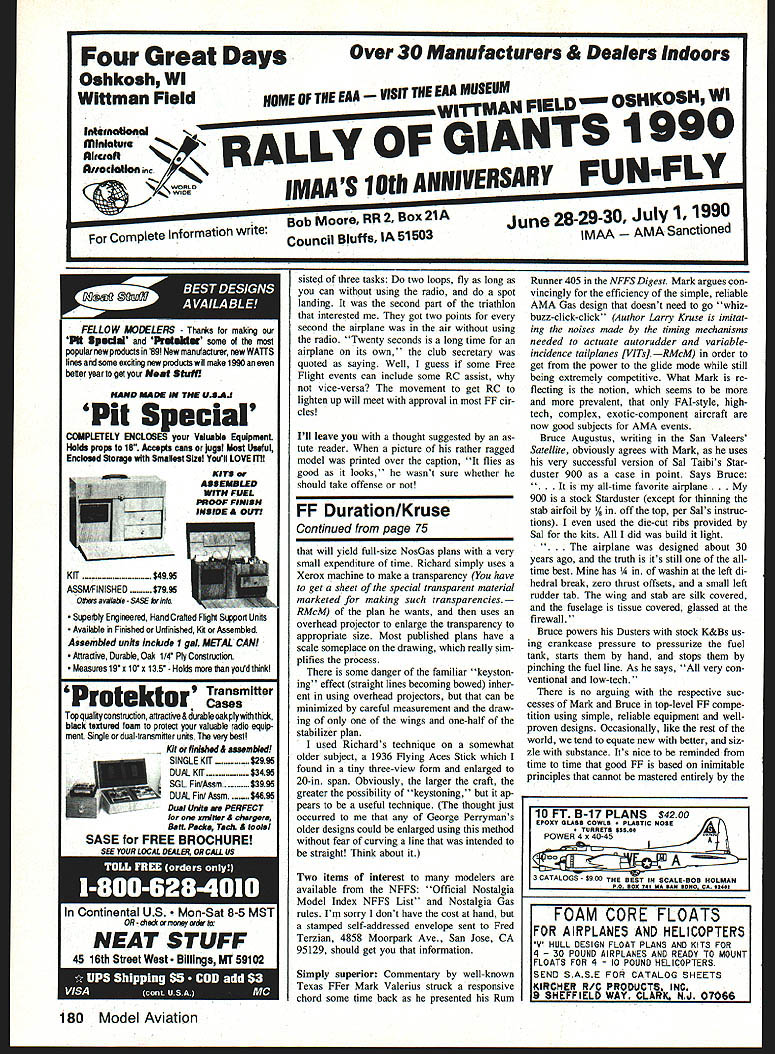
Bud Carson (D.C. Maxecuters club) devised a simple method (Figure B) to extend the Peck prop without carving: glue on small pieces of 1/64-in. plywood as blade extensions to increase the diameter to about 11-1/2 in. (or more). Procedure: roughen the last inch of the tip on the upper surface with sandpaper, glue the ply extensions with Hot Stuff CA, and trim the extensions to the desired blade shape.
Don Ross has declared this modification legal for his one-design contest featuring Earl Stahl's Hurricane; he reports the extended prop makes a considerable performance difference. Contest director Rich Gorman suggests blade extensions cut from plastic containers may be even better than ply; in that case use a plastic-to-plastic adhesive such as R/C-56 or a glue formulated for plastics rather than CA.
Figure B (referenced in the column) shows the simple method of increasing the diameter of the ubiquitous Peck-Polymers 9-1/2-in. prop. Many planes benefit from it.
Enlarging for NosGas
Readers have asked about enlarging plans from magazines of the Forties and Fifties for NosGas and other Old-Timer reproductions. While commercial services will blow up a single-page magazine drawing to full size for a fee, a do-it-yourself method works well and is inexpensive.
Richard Jordan of Gainesville, TX, uses this approach: make a transparency of the plan on the special transparent sheets sold for copiers, then use an overhead projector to enlarge the transparency to full size. Most published plans include a scale on the drawing, which simplifies determining the required enlargement.
I'll leave you with a thought suggested by an article reader: when a picture of his rather ragged model was printed over the caption "It flies as good as it looks," he wasn't sure whether to take offense or not!
New products and such
Electric power is gaining acceptance as a free-flight power source as motors get smaller and batteries get lighter and more powerful. A few notable offerings:
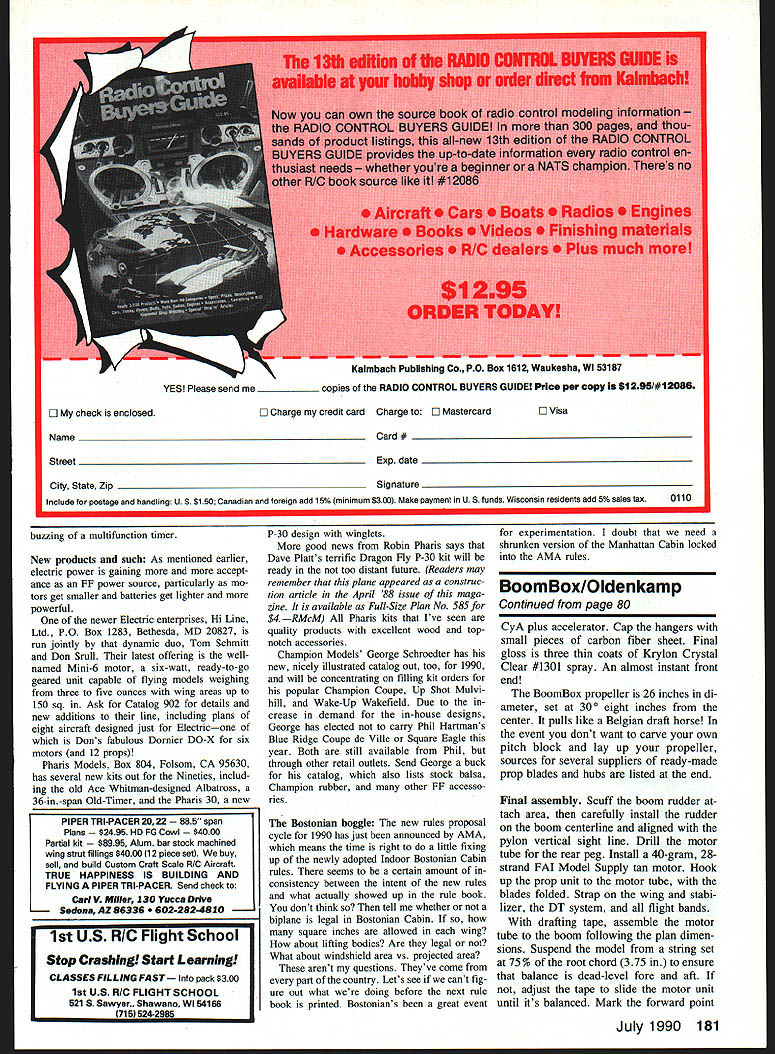
- Hi Line, Ltd., P.O. Box 1283, Bethesda, MD 20827 (Tom Schmitt and Don Srull) — their Mini-6 motor is a six-watt, geared unit capable of flying models weighing about 3–5 ounces with wing areas up to ~150 sq. in. Ask for Catalog 902 for details and other electric additions, including plans for eight electric aircraft (one is Don's Dornier Do-X for six motors and 12 props).
- Pharis Models, Box 804, Folsom, CA 95630 — new kits for the Nineties include the Whiteam-designed Albatross (36-in. span Old-Timer) and the Pharis 30, a new P-30 with winglets. Dave Platt's Dragon Fly P-30 kit is expected soon (the plane appeared as a construction article in the April 1988 issue; it is available as Full-Size Plan No. 585 for $4). Pharis kits are noted for quality wood and accessories.
- Champion Models — George Schroeder's 1990 catalog lists in-house kits (Champion Coupe, Up Shot Mulvane, Wake-Up Wakefield), stock balsa, Champion rubber, and other FF accessories. Due to demand, George is not carrying Phil Hartman's Blue Ridge Coupe de Ville or Square Eagle this year; those are still available through other outlets. Send George a dollar for his catalog.
The Bostonian boggle
AMA's proposed rules for 1990 have highlighted ambiguities in the newly adopted Indoor Bostonian Cabin rules. There appears to be a gap between the intent of the rules and the printed wording. Questions coming from around the country include:
- Is a biplane legal in Bostonian Cabin?
- If a biplane is legal, how many square inches are allowed in each wing?
- Are lifting booms permitted or prohibited?
- How should blind-sided area versus projected area be treated?
Bostonians have been a great event for experimentation; clarifying these points before the next printing of the rule book would be helpful.
Transcribed from original scans by AI. Minor OCR errors may remain.

