
Free Flight: Duration
Dave Linstrum KAAU Project/Jeddah, P.O. Box 8120 Jeddah 21482, Saudi Arabia
MISTER NATS' Unofficial Events
Those FFers who enjoy the less popular events—Payload, Cargo, Rubber, Speed, Helicopter, Autogyro, Biplane Rubber, etc.—can thank Terry Rimert of Florida for running those events at the AMA Nats in recent years. He deserves recognition for his largely unsung efforts. Competition often makes us forget the planning and organization required to run even a simple event—and Contest Directors rarely get the fun of flying in events they run.
Terry began FF modeling at age seven, building Comet kits independently. In high school he was attracted to Control Line models, an activity that continued into his Navy days. After a brief time racing motorcycles, he returned to Control Line and FF Hand-Launched Glider. He has run the Nats unofficial events for the National Free Flight Society (NFFS) since 1979—a decade of dedication.
Terry also publishes FMA News, a newsletter with building and trim tips, a recent series on electric power, Nostalgia plans, and more. You get six issues a year for $4. Send your check—and a thank-you note—for Unofficial Event sponsorship to:
Terry Rimert 367 Orange Ave. Baldwin, FL 32234
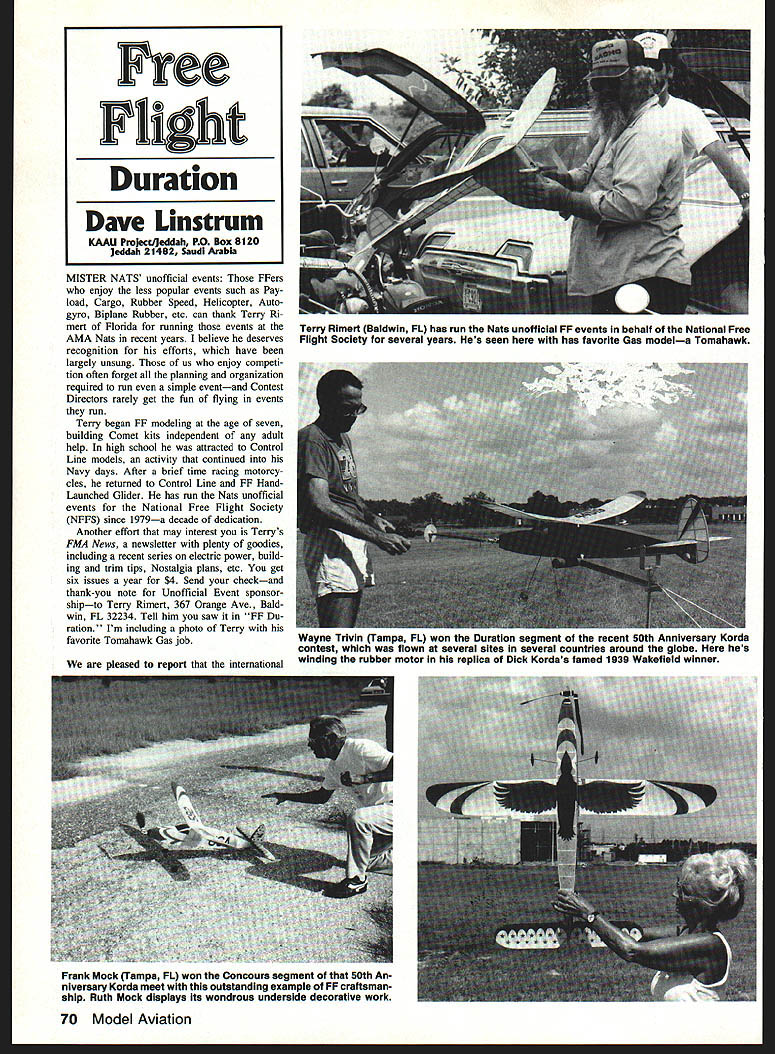
Tell him you saw it in "FF Duration." (I'm including a photo of Terry with his favorite Tomahawk gas job.)
11th Anniversary Korda Event
The 11th Anniversary Korda Event held last summer (co-conspirators Dave Platt and John Oldenkamp) was swept by the boys from Florida. Held on the anniversary of Dick Korda's 1939 Wakefield win in Akron, the contest took place at widely separated sites—Melbourne, FL; Mile Square, CA; and England—hosting fliers with replicas of the 1939 Korda. The event was dominated by Florida fliers and was won by two Tampa contestants: Frank Mock (Concours) and Wayne Trivin (Duration). I present their photo here for the memories.
Pharis for beginners
If veteran FFers are to keep the sport alive, we must introduce newcomers to Free Flight. Sophisticated, high-tech machines built for ultimate performance won't do, nor is a simple Delta Dart or HLG always enough.
Military aircraft have universal appeal to newcomers, so Robin Pharis has released three new No-Cal kits designed to give the neophyte instant success. While Pharis offers high-performance kits (Pharis P-30, Ace Whitman Albatross, Corben Super Ace, etc.), these new all-balsa profiles are ideal for getting a new face into Free Flight. They are simple enough to be built on the flying field or in an evening at home.
With 16-inch wingspans, they fly well on small fields and are sturdy enough to take hard landings. They are $4.95 each from:
Pharis Models Box 804 Folsom, CA 95630
Choose one from the illustration and give it to a beginner—you may hook him on FF.
Vol Libre, mon ami
"Vol libre, mon ami" — Free Flight, my friend. Our sport is truly international; as Frank Zaic said, "a friend for life." Language matters little when the common bond is the thrill of flying free.
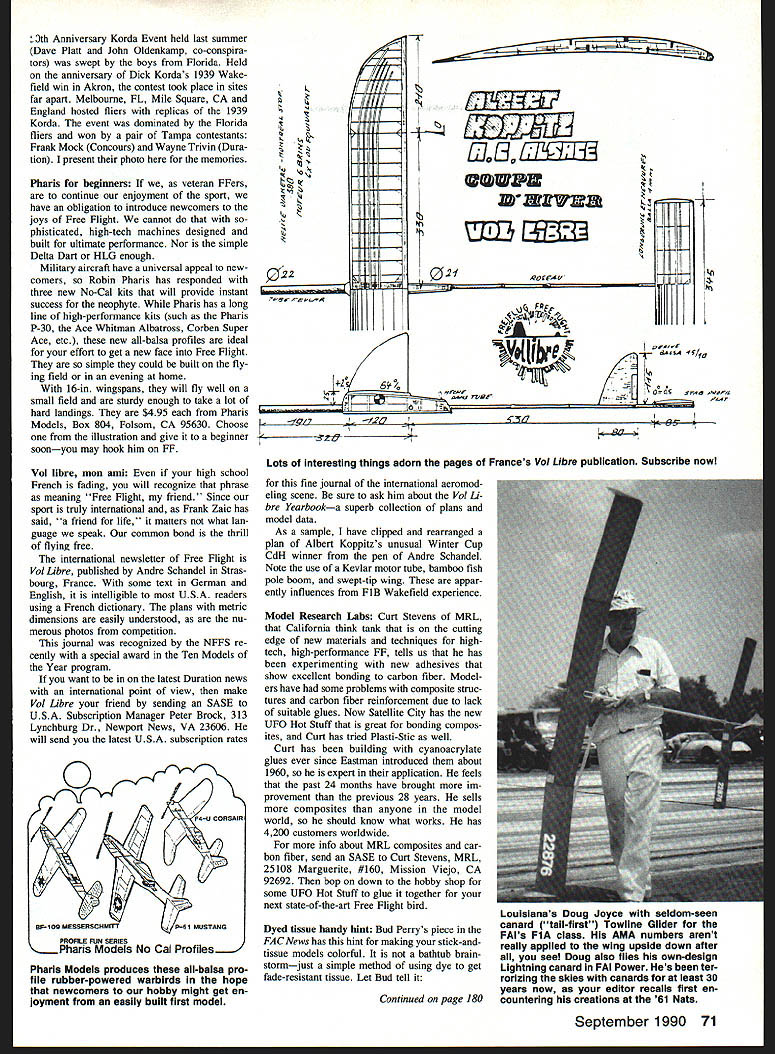
The international newsletter of Free Flight is Vol Libre, published by Andre Schandel in Strasbourg, France. With some text in German and English, it is intelligible to most U.S. readers with a French dictionary. Plans with metric dimensions are straightforward, and the journal contains numerous competition photos.
Vol Libre was recently recognized by the NFFS with a special award in the Ten Models of the Year program. To subscribe from the U.S.A., send an SASE to U.S.A. Subscription Manager:
Peter Brock 313 Lynchburg Dr. Newport News, VA 23606
Ask him about the Vol Libre Yearbook—a superb collection of plans and model data.
As a sample, I have clipped and rearranged a plan by Andre Schandel of Albert Kopitz's unusual Winter Cup CdH winner. Note the use of a Kevlar motor tube, bamboo fish-pole boom, and swept-tip wing—apparently influences from F1B Wakefield experience.
Model Research Labs
Curt Stevens of Model Research Labs (MRL) in California is on the cutting edge of new materials and techniques for high-performance FF. He has been experimenting with adhesives that bond well to carbon fiber—an area where modelers have had problems with composite structures and carbon-fiber reinforcement due to lack of suitable glues.
Satellite City now carries the new UFO Hot Stuff, which is excellent for bonding composites; Curt has also tried Plasti-Stik. Curt has used cyanoacrylate glues since Eastman introduced them around 1960, and he feels the past 24 months have seen more improvement than the previous 28 years. He sells more composites than anyone in the model world and has about 4,200 customers worldwide.
For more information about MRL composites and carbon fiber, send an SASE to:
Curt Stevens, MRL 25108 Marguerite, #160 Mission Viejo, CA 92692
Then drop by the hobby shop for some UFO Hot Stuff to glue it together for your next state-of-the-art Free Flight bird.
Dyed tissue — handy hint
Bud Perry's piece in the FAC News gives a handy method for coloring stick-and-tissue models with fade-resistant dye. I have been using this method for years. It is inexpensive and effective.
Steps:
- Buy Rit powdered dye (available at food markets and fabric outlets). You can blend colors to get the exact shade you want.
- Use baby food jars for mixing. Pour a few beads of Rit dye into the jar, then add some dope thinner or acetone. The thinner quickly dissolves and pulls color from the dye.
- Test with raw balsa sticks against a color sample until you get the match you want.
- Once satisfied, add about 20% clear dope to the mix.
- Apply a couple of thin coats of clear dope on the model first to prevent creeping, then apply the dye mix. Rit gives a lively color, and saving a little in the jar allows later patching—just add thinner.
It takes longer to describe than to do!
Olive Drab color confusion
In March 1979 there were three 34087 color chips to choose from. In January 1984, 34087 reappeared as the original shade, but the gloss and semigloss versions of OD were the dark brown version of 1979 (14087 and 24087).
In June 1984 the GSA issued a change notice stating that "the color chip for 34087 dated March 1979 is the wrong color and shall not be used," and that "colors 14087, 24087, and 34087 represent different colors." The colors were renumbered as follows: 14087 became 14084, 24087 became 24084, and 34087 became 34088. This results in five matte olive drabs: pre-1964 34087, post-1964 34087, March 1979 34087 (the wrong color), 1984 34087, and 1984 Change Notice 34088 (same as the later 34087).
You get the idea—we're spoiled for choice.
Miscellaneous notes
I remember flying with the guys in southern France who often packed their model boxes on their cars after sunset.
Plastic vs. rubber: I've heard rumors that rubber stored in plastic containers may deteriorate at an accelerated rate, possibly due to uptake from the plastic. If you have stored rubber in plastic containers for any length of time under typical conditions (average temperature or heat), check it and let me know if any harm seems to have been done. Other readers would appreciate knowing whether this is a safe storage method for precious rubber motors.
Well, until next time, guys and gals—always remember: don't dope models in sandstorms, and things won't be too rough.
Transcribed from original scans by AI. Minor OCR errors may remain.

