
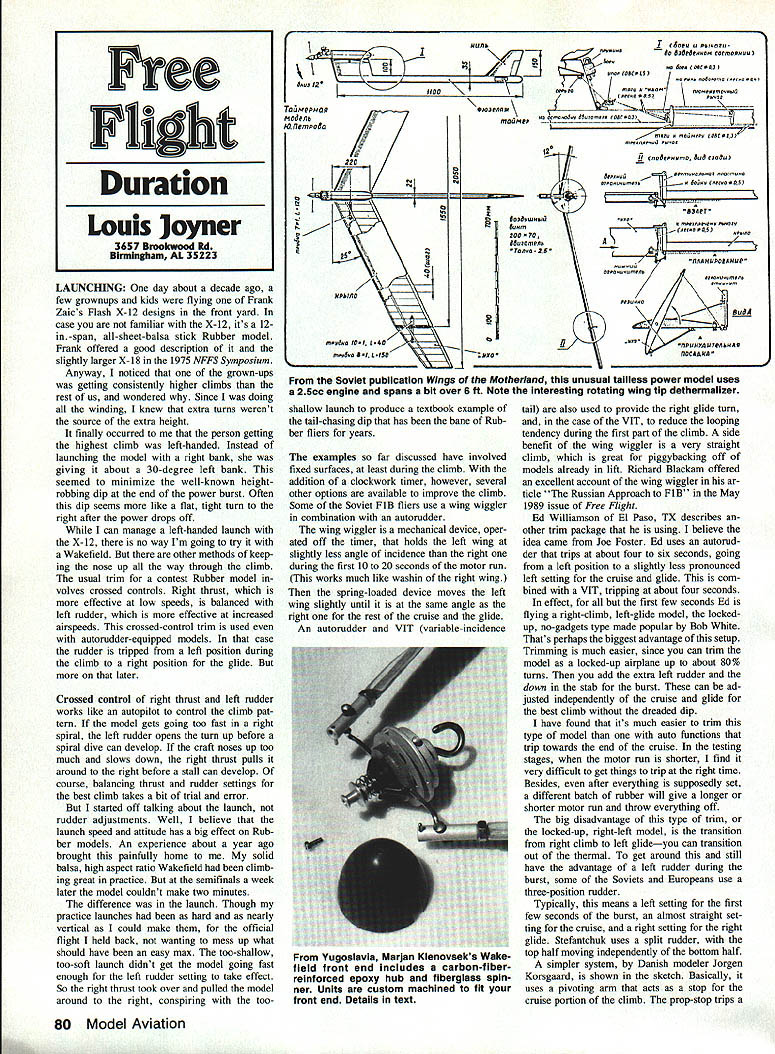
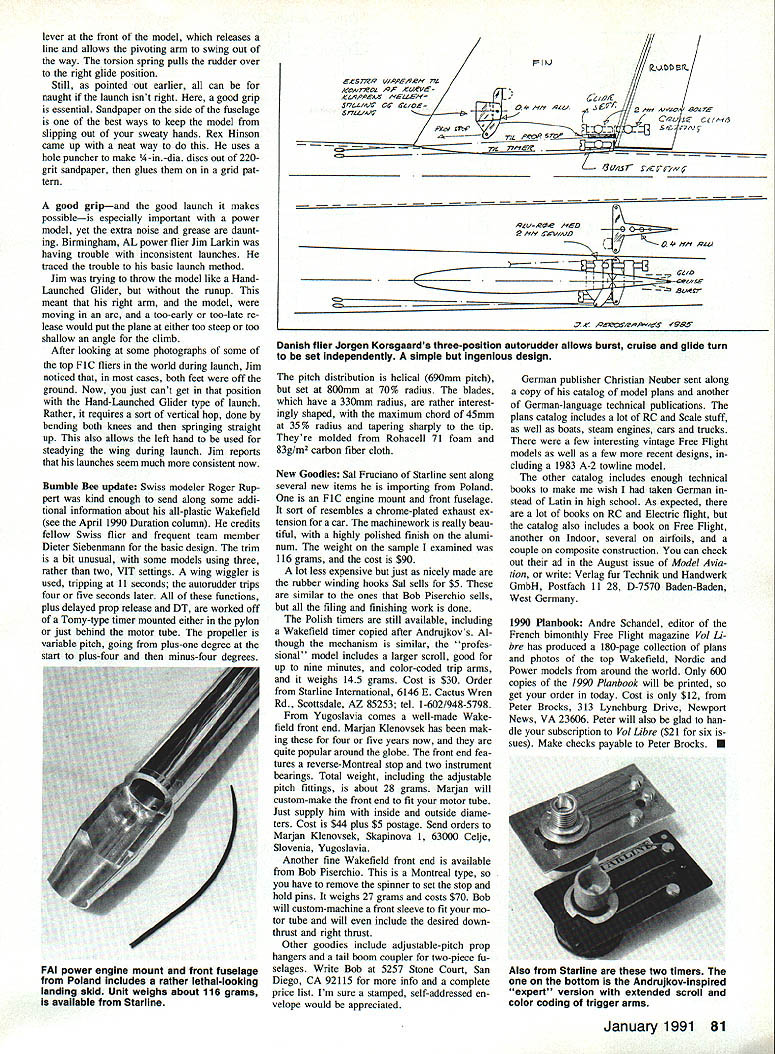
Free Flight: Duration
Louis Joyner 3657 Brookwood Rd. Birmingham, AL 35223
Launching
One day about a decade ago, a few grownups and kids were flying one of Frank Zaics's Flash X-12 designs in the front yard. In case you are not familiar with the X-12, it's a 12-in.-span, all-sheet-balsa stick rubber model. Frank offered a good description of it and the slightly larger X-18 in the 1975 NFFS Symposium.
I noticed that one of the grown-ups was getting consistently higher climbs than the rest of us, and wondered why. Since I was doing all the winding, I knew that extra turns weren't the source of the extra height. It finally occurred to me that the person getting the highest climb was left-handed. Instead of launching the model with a right bank, she was giving it about a 30-degree left bank. This seemed to minimize the well-known height-robbing dip at the end of the power burst. Often this dip seems like a flat, tight turn to the right after the power drops off.
While I can manage a left-handed launch with the X-12, I’m not going to try it with a Wakefield. There are other methods of keeping the nose up all the way through the climb. The usual trim for a contest rubber model involves crossed controls: right thrust, which is more effective at low speeds, is balanced by left rudder, which is more effective at increased airspeeds. This crossed-control trim is used even with autorudder-equipped models. In that case the rudder is tripped from a left position during the climb to a right position for the glide.
Crossed control of right thrust and left rudder works like an autopilot to control the climb pattern. If the model gets going too fast in a right spiral, the left rudder opens the turn before a spiral dive can develop. If the craft noses up too much and slows down, the right thrust pulls it around to the right before a stall can develop. Of course, balancing thrust and rudder settings for the best climb takes a bit of trial and error.
I started off talking about the launch, not rudder adjustments. I believe that the launch speed and attitude have a big effect on rubber models. An experience about a year ago brought this painfully home to me. My solid-balsa, high-aspect-ratio Wakefield had been climbing great in practice. But at the semifinals a week later the model couldn't make two minutes. The difference was in the launch. Though my practice launches had been as hard and nearly vertical as I could make them, for the official flight I held back, not wanting to mess up what should have been an easy max. The too-shallow, too-soft launch didn't get the model going fast enough for the left rudder setting to take effect. So the right thrust took over and pulled the model around to the right, conspiring with the too-shallow launch to produce a textbook example of the tail-chasing dip that has been the bane of rubber fliers for years.
Timer-driven gadgets: wing wiggler, autorudder and VIT
With the addition of a clockwork timer, several other options become available to improve the climb. Some Soviet F1B fliers use a wing wiggler in combination with an autorudder.
The wing wiggler is a mechanical device, operated off the timer, that holds the left wing at slightly less angle of incidence than the right during the first 10 to 20 seconds of the motor run (this works much like wash-in of the right wing). The spring-loaded device moves the left wing slightly until it is at the same angle as the right one for the rest of the cruise and the glide.
An autorudder and VIT (variable-incidence tail) are also used to provide the right glide turn; the VIT reduces looping tendency during the first part of the climb. A side benefit of the wing wiggler is a very straight climb, which is great for piggybacking off models already in lift. Richard Blackam offered an excellent account of the wing wiggler in his article “The Russian Approach to F1B” (Free Flight, May 1989).
Ed Williamson of El Paso, TX, describes another trim package—an idea I believe came from Joe Foster. Ed uses an autorudder that trips after about four to six seconds, going to a left position and a slightly less pronounced left setting for cruise-glide, combined with VIT tripping after about four seconds to affect the first few seconds. In effect, for all but the first few seconds Ed is flying a right-climb, left-glide model—the locked-up, no-gadgets type made popular by Bob White. That's perhaps the biggest advantage of the setup. Trimming is much easier since you can trim the model as a locked-up airplane for about 80% of the turns and add the extra left rudder and downstab for the burst; these can be adjusted independently for cruise and glide.
I have found that this type of trim, or the locked-up right-climb/left-glide model, tends to make the transition from right climb to left glide almost a straightening of the climb for the cruise. To get around this while retaining the advantage of a left rudder during the burst, some Soviets and Europeans use a three-position rudder—typically a left setting for the first few seconds of the burst, an almost straight setting for the cruise, and a right setting for the glide. Some use a split rudder, with the tip half moving independently of the bottom half.
A simpler system, by Danish modeler Jorgen Korsgaard, uses a pivoting arm that acts as a stop for the cruise portion of the climb. The prop-stop trips a lever at the front of the model, releasing a line and allowing the pivoting arm to swing out of the way. The torsion spring then pulls the rudder over to the right glide position.
Still, as pointed out earlier, all of these gadgets can be for naught if the launch isn't right.
Grip and launch technique
A good grip is essential. Sandpaper on the side of the fuselage is one of the best ways to keep the model from slipping out of sweaty hands. Rex Hinson came up with a neat way to do this: he uses a hole punch to make 1/4-in. discs out of 220-grit sandpaper, then glues them on in a grid pattern.
A good grip—and the consistent launch it enables—is especially important with power models, yet the extra noise and grease are daunting. Birmingham, AL power flier Jim Larkin was having trouble with inconsistent launches and traced the trouble to his basic launch method.
Jim was trying to throw the model like a hand-launched glider, but without the runup. His right arm and the model were moving in an arc, and a too-early or too-late release would put the plane at either too steep or too shallow an angle for the burst. After looking at photographs of top F1C fliers during launch, Jim noticed that in most cases both feet are off the ground. You can't get into that position with the hand-launched-glider type of launch. Instead it requires a vertical hop—bending both knees and springing straight up. This also allows the left hand to steady the wing during launch. Jim reports that his launches are much more consistent now.
Bumble Bee update
Swiss modeler Roger Ruppert sent additional information about his all-plastic Wakefield (see the April 1990 Duration column). He credits fellow Swiss flier and frequent team member Dieter Siebenmann for the basic design. The trim is a bit unusual: some models use three, rather than two, VIT settings. A wing wiggler trips at 11 seconds; the autorudder trips four or five seconds later. All of these functions, plus delayed pop release and DT, are worked off a Tomy-type timer mounted either in the pylon or just behind the motor tube.
The propeller is variable pitch, going from +1 degree at the start to +4 and then -4 degrees. The pitch distribution is helical (690 mm pitch), but set at 800 mm at 70% radius. The blades have a 330 mm radius, with the maximum chord of 45 mm at 35% radius and tapering sharply to the tip. They are molded from Rohacell 71 foam and 83 g/m2 carbon-fiber cloth.
New Goodies
- Sal Fruciano of Starline is importing several items from Poland:
- An F1C engine mount and front fuselage (resembles a chrome-plated exhaust cone). Beautiful metalwork, polished aluminum. Sample weighed 116 grams; cost $90.
- Rubber winding hooks, nicely finished, $5.
- Polish timers, including a Wakefield timer copied after Andrujkov's. The "professional" model includes a larger scroll (good for up to nine minutes), color-coded trip arms, and weighs 14.5 grams. Cost $30.
- Order from Starline International, 6146 E. Cactus Wren Rd., Scottsdale, AZ 85253; tel. 1-602-948-5798.
- From Yugoslavia: Marjan Klenovsek makes a well-made Wakefield front end (reverse-Montreal stop and two instrument bearings). Total weight with adjustable-pitch fittings is about 28 grams. Marjan will custom-make the front end to fit your motor tube—supply inside and outside diameters. Cost $44 plus $5 postage. Send orders to Marjan Klenovsek, Kipsanjova 1, 63000 Celje, Slovenia, Yugoslavia.
- From Bob Piesrichio: another Wakefield front end, Montreal type (remove spinner to set stop and hold pins). Weighs 27 grams; cost $70. Bob will custom-machine a front sleeve to fit your motor tube and include desired down-thrust and right thrust. Other items include adjustable-pitch prop hangars and a tail boom coupler for two-piece fuselages. Write Bob at 5257 Stone Court, San Diego, CA 92115 for more info and a price list.
- German publisher Christian Neuber sent catalogs of model plans and German-language technical publications. The plans catalog includes RC and scale models, boats, steam engines, cars and trucks, vintage free flight models, and a 1983 A-2 towline model. The technical catalog has books on RC, electric flight, free flight, indoor, airfoils, and composite construction. Check their ads in Model Aeronautics (August issue) or write: Verlag für Technik und Handwerk GmbH, Postfach 11 28, D-7570 Baden-Baden, West Germany.
1990 Planbook
André Schandel, editor of the French bimonthly Free Flight magazine Le Vol Libre, has produced a 180-page collection of plans and photos of top Wakefield, Nordic and power models from around the world. Only 600 copies of the 1990 Planbook will be printed. Cost $12 from Peter Brooks, 13 Lyngsbo Road, Newport News, VA 23606. Peter will also handle subscriptions to Le Vol Libre ($21 for six issues). Make checks payable to Peter Brooks.
Transcribed from original scans by AI. Minor OCR errors may remain.

