
Free Flight: Duration
Harry Murphy 3824 Oakwood Blvd. Anderson, IN 46011
KITS
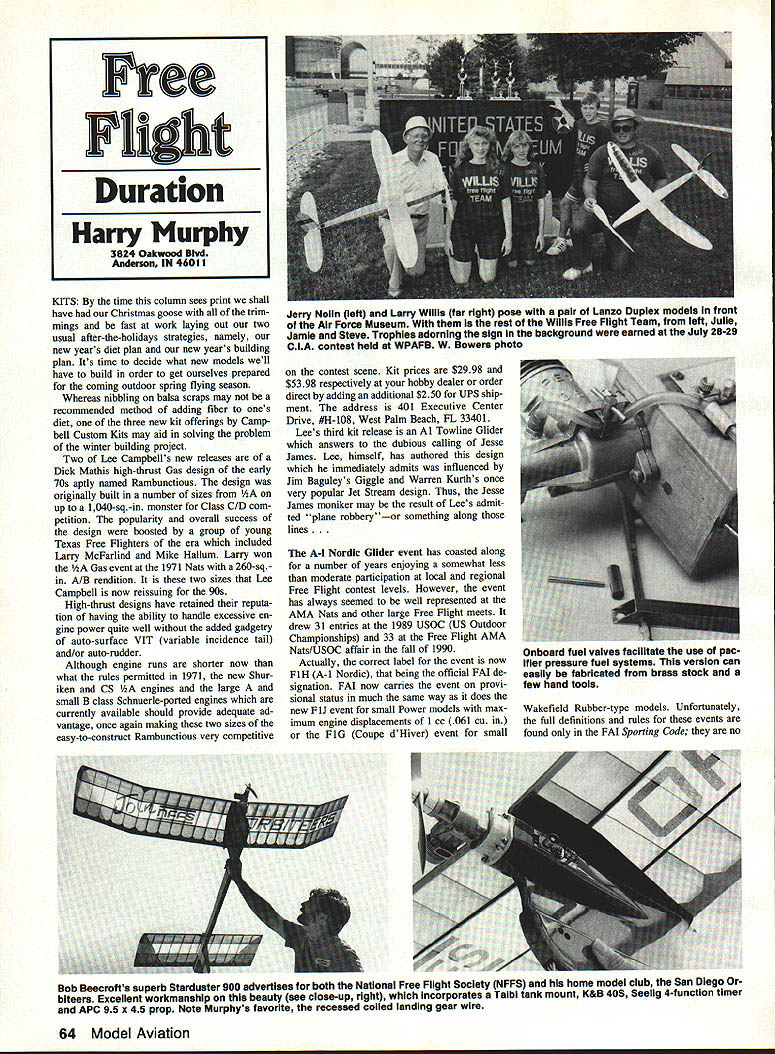
By the time this column sees print we shall have had our Christmas goose with all of the trimmings and be fast at work laying out two usual after-the-holidays strategies: our New Year's diet plan and our New Year's building plan. It's time to decide what new models we'll build to get ready for the coming outdoor spring flying season. Whereas nibbling balsa scraps may be a recommended method of adding fiber to one's diet, three new kit offerings from Campbell Custom Kits may help solve the winter building project problem.
Two of Lee Campbell's new releases are reissues of Dick Mathis's high-thrust gas design from the early '70s, aptly named Rambunctious. The design was originally built in many sizes, up to a 1,040-sq.-in. monster for Class C/D competition. Its popularity was boosted by a group of young Texas free-flighters of the era, including Larry McFarland and Mike Hallum. Larry won the 1/2A gas event at the 1971 Nats with a 260-sq.-in. A/B rendition. Lee Campbell is now reissuing two popular sizes for the '90s. High-thrust designs have a reputation for handling excessive engine power without requiring auto-surface VIT (variable incidence tail) or auto-rudder gadgetry.
Although engine runs are shorter now than the rules permitted in 1971, the new Shuriken and CS 1/2A engines and the available Schnuerle-ported A and B class engines should provide adequate advantage, making these two easy-to-construct Rambunctious sizes competitive on the contest scene.
- Kit prices: $29.98 and $53.98 (add $2.50 for UPS if ordering direct)
- Order direct: Campbell Custom Kits, 401 Executive Center Drive, #H-108, West Palm Beach, FL 33401
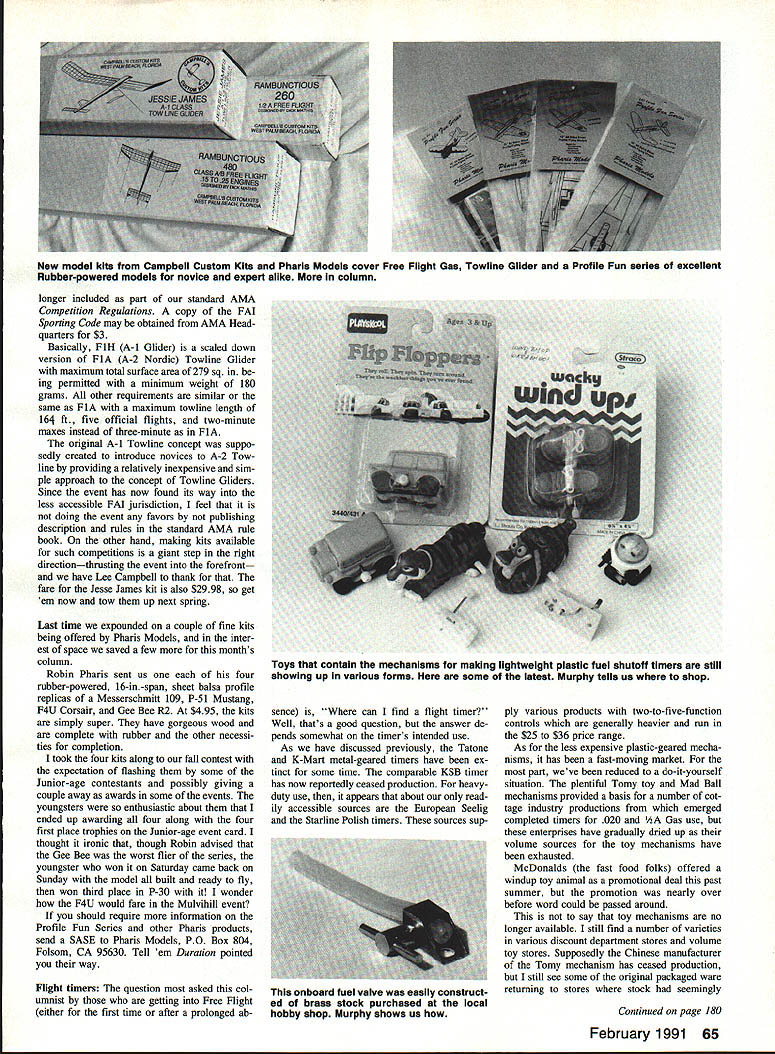
Lee's third kit release is an A-1 towline glider called Jesse James. Lee authored the design and admits he was influenced by Jim Baguley's Giggle and Warren Kurth's once-popular Jet Stream — hence the tongue-in-cheek "plane robbery" name.
A-1 / F1H (Nordic) Towline Glider
The A-1 Nordic Glider event has enjoyed steady, if modest, participation at local and regional free-flight contests and is well represented at larger meets. It drew 31 entries at the 1989 USOC and 33 at the 1990 AMA Nats/USOC event.
The event is officially designated F1H (A-1 Nordic) under FAI, currently on provisional status (similar to F1J and F1G). Full definitions and rules are in the FAI Sporting Code; a copy may be obtained from AMA Headquarters for $3.
Key F1H (A-1) rules (summary):
- Maximum total surface area: 279 sq. in.
- Minimum weight: 180 grams
- Maximum towline length: 164 ft (same as F1A)
- Flights: five official flights with two-minute maximums (vs. three minutes for F1A)
The original A-1 concept was intended to introduce novices to towline gliding via a relatively inexpensive, simple approach. Publishing a description and rules in the AMA rule book and making kits available for the event are steps in the right direction.
Pharis Models — Profile Fun Series
Robin Pharis sent samples of his rubber-powered, 16-in. span, sheet-balsa profile replicas: Messerschmitt 109, P-51 Mustang, F4U Corsair, and Gee Bee R2. At $4.95 each, the kits are excellent: attractive wood and complete with rubber and necessary accessories.
Look for these kits at fall contests; they're great for Junior flyers (and make nice giveaway awards). I awarded all four along with three first-place trophies at a Junior contest. Although Robin warned the Gee Bee was the worst flier of the series, a youngster built one and then won third place in P-30 with it.
For information on the Profile Fun Series and other Pharis products, send a SASE to:
- Pharis Models, P.O. Box 804, Folsom, CA 95630
Tell them "Duration" sent you.
Flight timers
One of the most-asked questions from newcomers and returning free-flighters is, "Where can I find a flight timer?" The answer depends on the intended use.
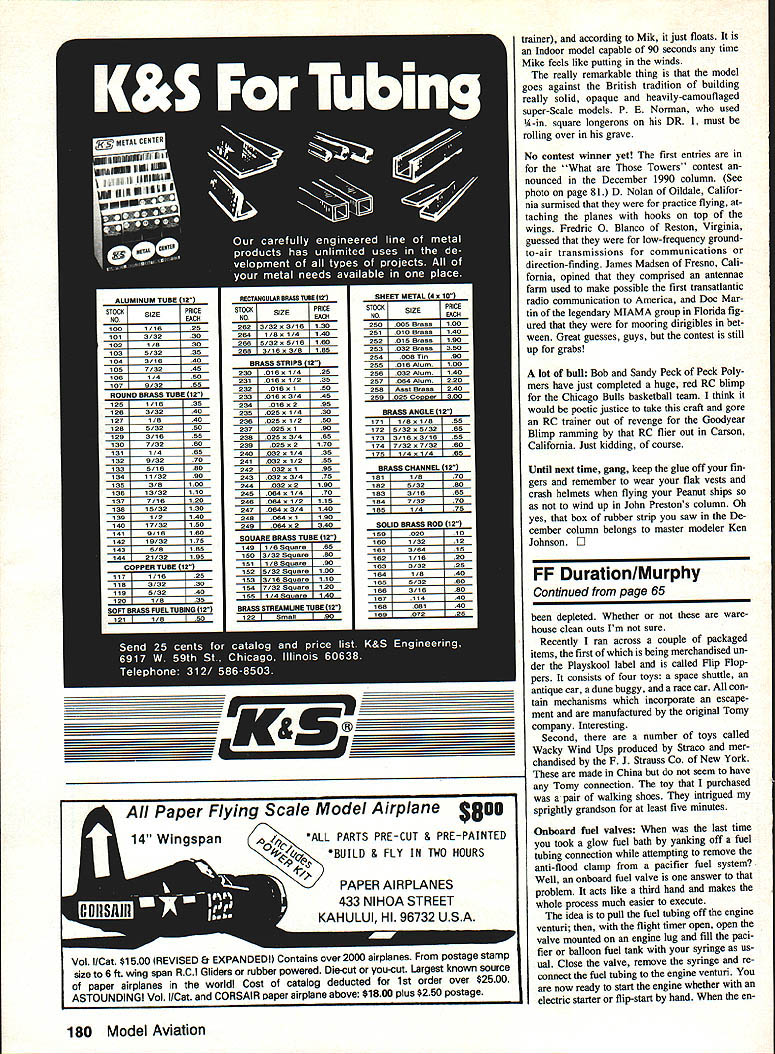
- Heavy-duty timers: The Tatone and K-Mart metal-geared timers have been extinct for some time; KSB reportedly ceased production. Readily accessible heavy-duty sources appear to be the European Seelig and the Polish Starline timers. These offer multiple-function controls, are generally robust, and run in the $25–$36 range.
- Plastic-geared mechanisms: This market has been fast-moving and somewhat DIY. Toy mechanisms from Toyco, Mad Ball, Tomy, etc., provided a basis for cottage-industry timer productions for .020 and 1/2A gas use, but many of those operations have dried up as supply sources were exhausted.
- Recent finds: Playskool's Flip Floppers (space shuttle, antique car, dune buggy, race car) use Tomy-manufactured escapement mechanisms. There are also Wacky Wind Ups produced by Straco and merchandised by the F. J. Strauss Co. These are made in China and not necessarily Tomy-derived. I recently purchased a walking-shoes wind-up that worked well for a short time.
If you need a timer for regular contest use, plan on spending for a Seelig or Starline unit; for occasional or experimental use, hunt toy mechanisms in discount and volume toy stores.
Onboard fuel valves
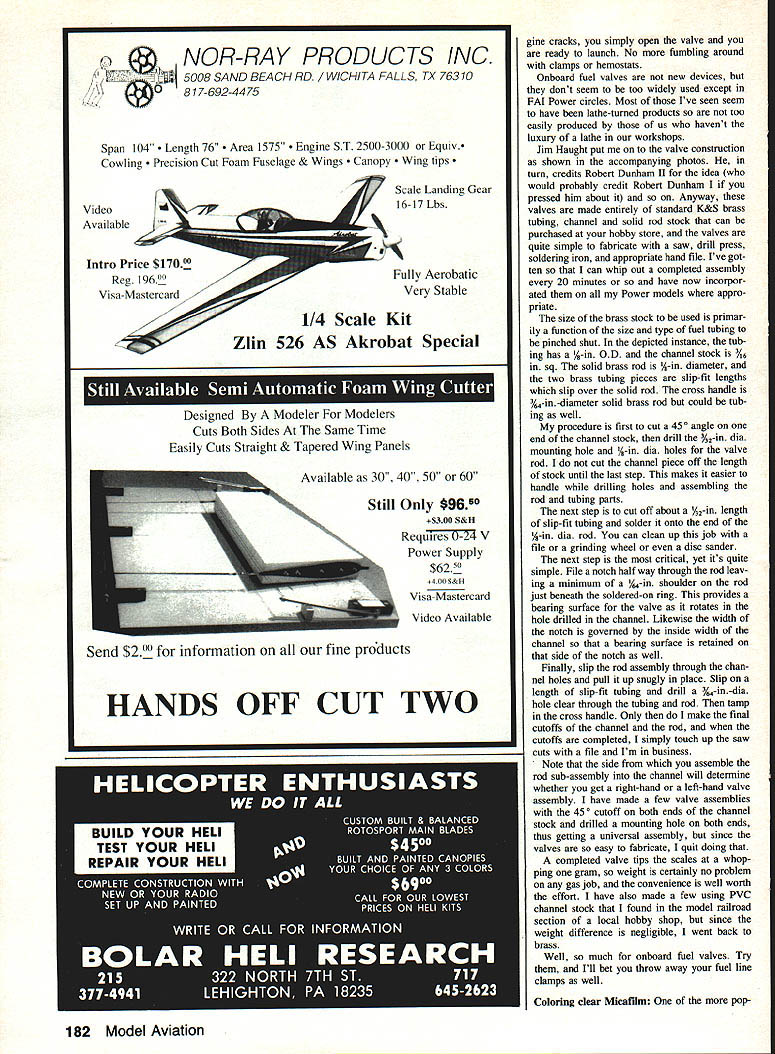
Have you ever taken a glow-fuel bath by yanking off a fuel tubing connection while trying to remove an anti-flood clamp from a pacifier fuel system? An onboard fuel valve solves that problem by acting like a third hand, making filling and handling much easier and less messy.
Basic procedure:
- Pull the fuel tubing off the engine venturi.
- With the flight timer open, open the onboard valve mounted on an engine lug.
- Fill the pacifier valve with fuel using a syringe, then close the valve and remove the syringe.
- Reconnect the fuel tubing to the engine venturi.
When you're ready to start the engine, open the valve to allow fuel to flow to the venturi. The onboard valve prevents spills during filling and handling, simplifies starting, and reduces the chance of fuel-coated fingers and clothes.
Micafilm dyeing and covering tips
Micafilm (sold by Coverite) is a lightweight, clear covering film favored for lightly built frameworks like large Mulvihill rubber models. Its slick side can be applied inward to resist grease-like rubber lubricants. The clear film is easy and forgiving to apply and can be painted; the rough (grainy) side accepts dyes and color dopes.
Joe Macay dyes Micafilm by thinning marker ink with dope and brushing it onto the outside of fuselages. I experimented with a concentrated, permanent marker ink method:
- Break open a permanent marker (Pilot or Faber-Castell 1000), pour the ink into a Badger spray-gun bottle, add rubbing alcohol, and stir.
- Lay the Micafilm rough side up on newspaper and spray the dye mixture onto the absorbent (rough) side.
- Let the alcohol evaporate; the dye remains. Apply the film rough-side down so the dyed side is protected.
- Iron on as usual — the dye adhered and withstood the iron heat without separation.
Notes and cautions:
- Use permanent-marker ink (concentrated) for best results.
- The liquid dye is messy and hard to remove from skin — handle carefully.
- Colored Micafilm is available but tends to be heavier and less forgiving on contoured surfaces than clear film.
Newsletter spotlight — TOPMAC FF Topics
TOPMAC FF Topics is the newsletter of the Topeka Model Aircrafters Club. Editor Jack Koehler reports the third-year club includes novices, retreads, and CL switch-hitters. The newsletter is well formatted and full of indoor and outdoor activity info, plans, and event schedules.
1990 club officers:
- Jack Koehler — President & Newsletter Editor
- Todd Lee — Vice President
- Tom Kelley — Club Scribe
- Travis Taylor — Treasurer
Dues and subscription:
- Juniors: $2
- Seniors: $5
- Open-age: $10
- Family subscription: $15
- Silver Eagle (age 65+): $5
For information or to receive the newsletter, send inquiries and/or remittance to:
- Travis Taylor, 3201-H Randolph Avenue, Topeka, KS 66611
Tell them where you heard about their activity.
Transcribed from original scans by AI. Minor OCR errors may remain.

