
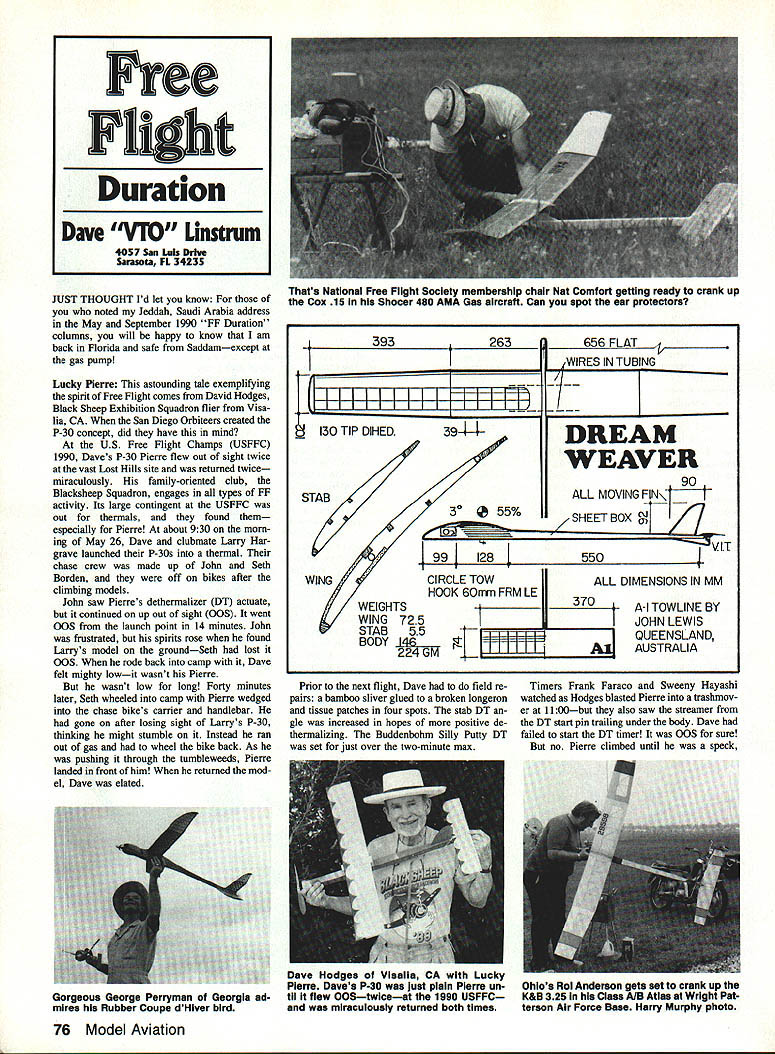
Free Flight: Duration
By Dave "VTO" Linstrum
4057 San Luis Drive Sarasota, FL 34235
Note
Just thought I'd let you know: For those of you who noted my Jeddah, Saudi Arabia address in the May and September 1990 "FF Duration" columns, you will be happy to know that I am back in Florida and safe from Saddam—except at the gas pump!
Lucky Pierre — Black Sheep Squadron
Lucky Pierre: This astounding tale exemplifying the spirit of Free Flight comes from David Hodges, Black Sheep Squadron flier from Visalia, CA. When the San Diego Orbiteers created the P-30 concept, did they have this in mind?
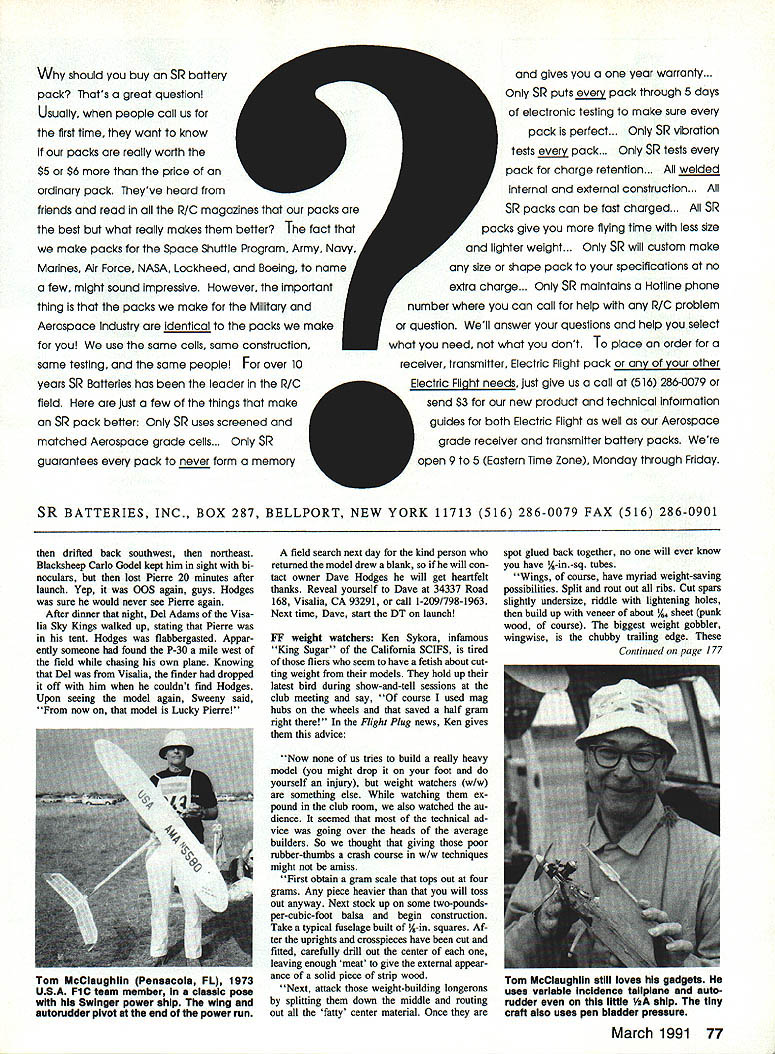
At the U.S. Free Flight Champs (USFFC) 1990, Hodges's P-30 Pierre flew out of sight twice at the vast Lost Hills site and was returned twice—miraculously. His family-oriented club, the Black Sheep Squadron, engages in all types of FF activity. Its large contingent at the USFFC was out for thermals, and they found them—especially for Pierre!
At about 9:30 on the morning of May 26, Dave and clubmate Larry Hargrave launched their P-30s into a thermal. Their chase crew was made up of:
- John Borden
- Seth Borden
John saw Pierre's dethermalizer (DT) actuate, but it continued on up out of sight (OOS). It went OOS from the launch point in 14 minutes. John was frustrated, but his spirits rose when he found Larry's model on the ground—Seth had lost it OOS. When John rode back into camp with it, Dave felt mighty low—it wasn't Pierre, it wasn't low long.
Forty minutes later, Seth wheeled into camp with Pierre wedged in the chase bike's carrier handlebar. He had gone on after losing sight of Larry's P-30, thinking he might stumble on it. Instead he ran out of gas and had to wheel the bike back. As he was pushing it through the tumbleweeds, Pierre landed in front of him! When he returned the model, Dave was elated.
Prior to the next flight, Dave did field repairs: a bamboo splinter glued to a broken longeron and tissue patches in four spots. The stab DT angle was increased in hopes of more positive dethermalizing. The Buddenbohm Silly Putty DT set just over the two-minute max.
Timers Frank Faraco and Sweeny Hayashi watched as Hodges blasted Pierre into a trash mover at 11:00—but they also saw the streamer from the DT start to pin trail under the body. Dave had failed to start the DT timer! It was OOS for sure! But no. Pierre climbed until he was a speck. Then it drifted back southwest, then northeast. Blacksheep member Carlo Godel kept him in sight with binoculars, but then lost Pierre 20 minutes after launch. Yep, it was OOS again, guys. Hodges was sure he would never see Pierre again.
After dinner that night, Del Adams of the Visalia Sky Kings walked up, stating that Pierre was in his tent. Hodges was flabbergasted. Apparently someone had found the P-30 a mile west of the field while chasing his own plane. Knowing that Del was from Visalia, the finder had dropped it off with him when he couldn't find Hodges. Upon seeing the model again, Sweeny said, "From now on, that model is Lucky Pierre!"
A field search the next day for the kind person who returned the model drew a blank, so if he will contact owner Dave Hodges he will get heartfelt thanks. Reveal yourself to Dave at 34337 Road 168, Visalia, CA 93291, or call 1-209-798-1963. Next time, Dave, start the DT on launch!
FF weight watchers — Ken Sykora
FF weight watchers: Ken Sykora, infamous "King Sugar" of the California SCIFS, is tired of those fliers who seem to have a fetish about cutting weight from their models. He holds up the latest bird during show-and-tell sessions at the club meeting and says, "Of course I used mag hubs on the wheels and that saved a half gram right there." In The Flight Plug news, Ken gives them this advice:
Ken's crash-course in weight-saving techniques:
- Obtain a gram scale that tops out at four grams. Any piece heavier than that you will toss out anyway.
- Stock up on two-pounds-per-cubic-foot balsa and begin construction.
- For a typical fuselage built of 3/32 in. squares: after uprights and crosspieces have been cut and fitted, carefully drill out the center of each one, leaving a solid strip of wood.
- Attack weighty longerons by splitting them down the middle and routing out the fatty center material; spot-glue them back together to disguise the modification.
- For wings: split and rout all ribs; cut spars slightly undersize and add lightening holes, then build up with veneer of about 3/64 in.
- Replace the chubby trailing edge by building it up (like a tiny wing) with a leading edge (LE), trailing edge (TE) and tiny wedge-shaped ribs. Cover with tan balsa-colored tissue and carefully random-stripe with a fine felt-tip pen to mimic A-grain solid balsa.
- For covering: weigh about 200 sheets of tissue to find the lightest; dye variance from sheet to sheet adds up.
- For finishing: spray some very thin clear dope into a closed room, then walk through quickly carrying the model overhead (just once).
- Detail components: never use music wire for landing gear legs—aluminum tubing will suffice. Painted black, it will ward off inspectors.
Ken concludes with the immortal words of contest-winning modeler Herman "Ladanoes" Schmedick: "Damn the weight, full thermals ahead!" He explained in retirement that he had seen light models and heavy models—but he had never seen a thermal weigh a model before it whisked the ship away.
Swinger salute — Tommy McLaughlin
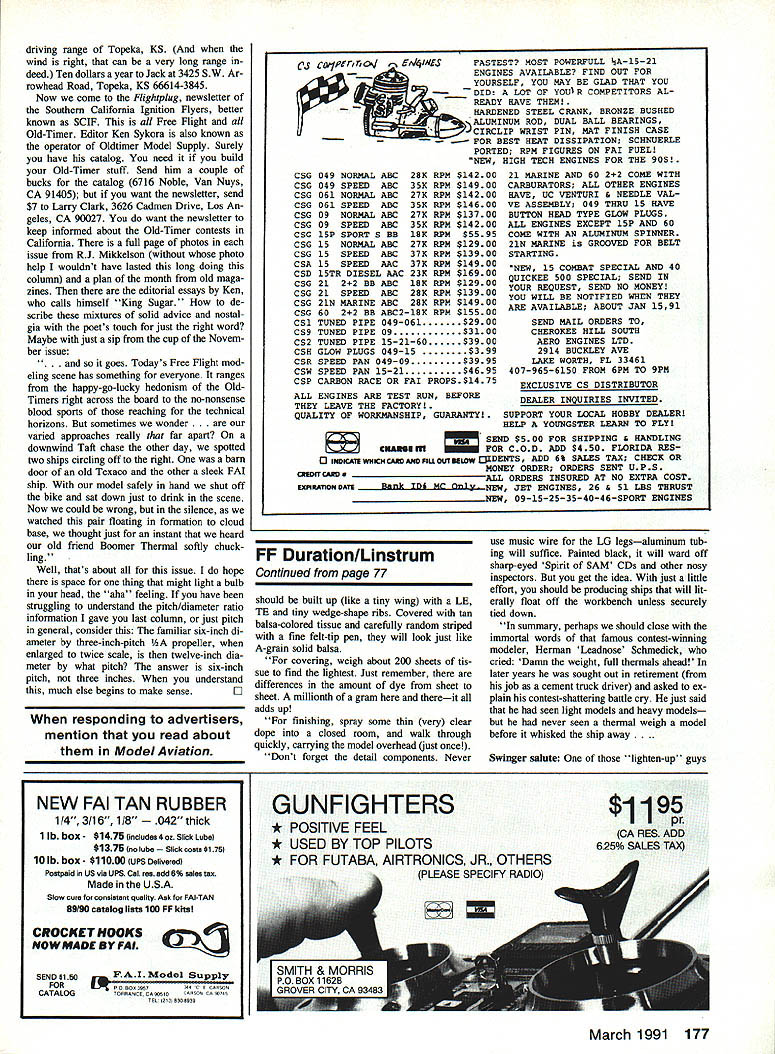
Swinger salute: One of those "lighten-up" guys Ken speaks of is Tommy McLaughlin of Pensacola, FL. We salute him and his series of Swinger designs developed over a decade of flying in the U.S.A. FAI FF team trials. Tommy is now an octogenarian, but he is as spry as ever and can recount tales of many a World Championship. He was on the U.S.A. FAI IC Power team in 1971 and 1973 when your author was Team Manager.
Tommy's FAI Swinger design has many light features, including a sheeted wing and Mylar-covered tail. It also has a folding prop of his own design and a high-revving Rossco .15. The ship gets its name from the swing action on the wing, which occurs (along with variable-incidence tailplane—VIT—and autorudder—AR) at the end of the motor run when the model enters its glide mode.
We tip our FF hat to McLaughlin, certainly the elder statesman of FAI Power worldwide. Thermals, Tommy!
Superior Props — Ed Wickland
Superior props: Are you looking for the best in laminating prop forms, ready-made prop blades, or old-time machine-cut balsa prop blanks? You can have it all from Ed Wickland's Superior Props in Pensacola, FL. Ed has spent his career designing machine tools and now creates computer-generated coordinate props and forms of exceptional accuracy and quality.
He started with forms to serve Wakefield fliers, generating torque-burning shapes such as the Schwartzbach, Doring, Larabee and Andruskov. For the more common man, he can even produce replica pitch. Special cuts are available.
Options:
- Balsa blades formed on hardwood forms
- Entire prop assemblies with Z-bar hubs (normally two blades)
- Special single-blade hubs for OT models
- Z-bars sold separately
- Machine-cut folding props and freewheeler blanks (three- or four-bladed, left- or right-hand, or pushers)
Avoid balsa chips on your workshop floor. Send a long SASE to Superior Props, 2412 Tucson Ave., Pensacola, FL 32526 for the latest catalog.
FAI tan is it!
Looking for dynamite gum band to string up to your Superior prop? In the competition field of the Nineties, the rubber of choice is FAI tan. Specially formulated by Ed Dolby and made in the U.S.A., this rubber has proven to be excellent in energy release since its late-spring 1989 debut. It is a bit easier to break than the old FAI gray and has a different power curve with less burst torque—suitable for everything from Indoor to P-30 to Wakefield. Even monster Mulvihills are seen with a tan snake inside.
Ordering:
- Strips .042 in. thick by widths: 1/8, 3/16, 1/4 or 1/2 in. (sold by the pound)
- One-pound box: $13.75 (or $14.75 with a four-ounce bottle of Slick lube), postpaid via UPS in the U.S.A.
- To get the latest catalog (includes kits and exotics such as Crottet winding hooks), send $1.50 to:
FAI Model Supply Box 3957 Torrance, CA 90510
When you write Ed, tell him you saw it in Model Aviation.
Lost Hills applause
Reporter/flier John Oldenkamp had kudos for the new Lost Hills FF site in his USFFC Report in the September 1990 Model Aviation, and we would like to add that the access remarks by other experienced fliers are warranted. We all may miss Taft, but who wants to fly in a federal prison yard? Or even DT into it?
San Diego Observer
President Bob Beecroft: "The results are in — the new site is first rate and I join John in praising those responsible."
Transcribed from original scans by AI. Minor OCR errors may remain.

