
Free Flight: Duration
Harry Murphy 3824 Oakwood Blvd. Anderson, IN 46011
NFFS News
At this writing, the National Free Flight Society (NFFS) is undergoing an organizational overhaul intended to allow it to exercise a more representative role for the free flight community within the AMA structure. The new plan is being designed to open better two-way communications between the NFFS membership and its officials, thus creating a more democratic organization to support Free Flight activities throughout the nineties and beyond.
In a nutshell, the current plan is to divide the country into four basic sections: Northeast, Northwest, Southeast and Southwest. The actual boundaries are yet to be drawn, but consideration as to where they may eventually fall will be based on geography and regional concentrations of the various Free Flight disciplines (FAI, Indoor, Nostalgia Gas, etc.).
Each of the four sections shall be permitted a single representative who shall be elected to office by the membership of their respective section. These four electees (or Vice Presidents) shall then sit on a Central Council which is to be chaired by the President of the NFFS — who shall become an elected official as well. It is intended that this arrangement be implemented with officials elected and placed in office by January 1, 1992. Thus, the NFFS shall have an elected governmental unit with its electees serving four-year terms on a staggered basis for continuity and efficient performance.
Whereas the above five officers shall be elected individuals, the remainder of the NFFS taskmasters shall remain appointive/volunteer positions as in the past. This would include a technical advisor, the treasurer and the various service departments such as Digest Editor, Membership, Plans, Publications, Symposium and other committees.
One very active committee is to be expanded so that each Section may contribute with equal representation as soon as possible. The current Nostalgia Gas Design and Engine Eligibility Team is to be redesignated the NFFS Nostalgia Gas Advisory Board. It will be made up of four members, one member from each of the four Sections. The plan is to add the two additional representatives by immediate Presidential appointment, with subsequent vacancies being appointed by the VP of the Section where the vacancy occurs. This board would report to the Central Council with direct Presidential contact permitted as well.
Essentially, this new plan offers bright avenues of communication to the membership in charting the future course NFFS should take in representing its membership. NFFS members asked for a more representative organization. Now it's up to all of us to make it work.
If you are not yet an NFFS member, you may stand up to be counted by sending $15 to NFFS, 12324 Percival Street, Chester, VA 23821. Become involved in the new NFFS. Make it your flag bearer in 1991.
Nostalgia Gas News
While the NFFS is molding new by-laws, the Nos Gas Design and Engine Eligibility Team of Ralph Prey and Bob Larsh are busy issuing new releases themselves. First off, the Cranford/Mahieu 575 ZEEK and the 1951 Lutz/Mahieu ZEEK saw extensive review last year and have been officially declared design-eligible for NFFS Nostalgia Gas competition. This should be good news to ZEEK lovers everywhere.
Also on the consideration docket is a proposal to add a few more engines to the official NFFS Engine Eligibility Listing. The specific engines involved are later-model types which have been carefully evaluated as producing equivalent power levels to those engines originally produced within the designated Nostalgia Gas time frame. The committee has always felt power-equivalent engines are just as important to maintaining the credibility of the movement as the permitted designs, which are more visible representations of the era.
At any rate, the following post-1962 engines are being considered for approval:
- Testor-McCoy Custom Series (19, 29, 35, 40)
- K&B Stallion Series (.049 and .35)
- Johnson .09 Bulldog
- Last production OS PET .09 (the one with die-cast fins)
- All Wen Mac .049s (including Hot Shots)
- Testors McCoy .049
- ENYA .049
Also under separate study is the concept of making the Cox Medallion Series eligible. This raises a moot point about vintage competition events: with regimented design and engine restrictions, over time certain designs may become labeled as truly competitive or one or two engines may rise to the top as most desirable. The eventual results can become most frustrating.
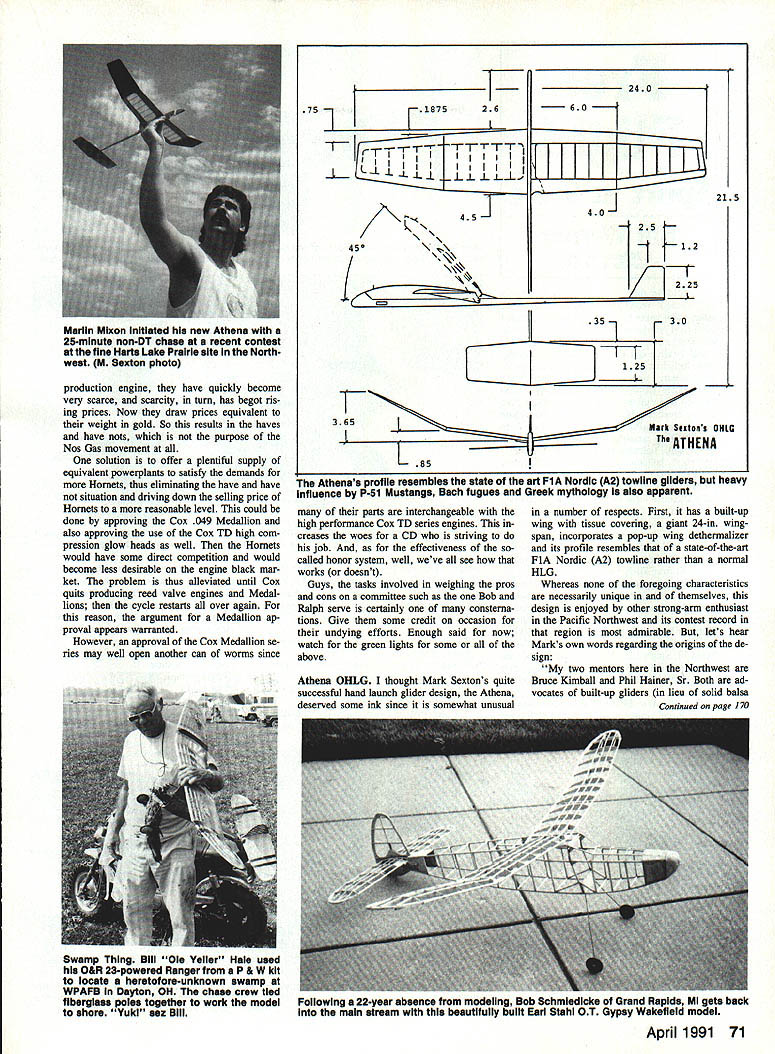
Take the Holland Hornet .049, for instance. Universally considered as retaining performance potential a cut above other eligible engines in its class, the Hornet has become the most sought-after powerplant for 1/2A Nos Gas events. Because it is out of production, Hornets have quickly become scarce, and scarcity in turn has driven prices up. This results in haves and have-nots, which is not the purpose of the Nos Gas movement.
One solution is to offer plentiful equivalent powerplants to satisfy demand for Hornet-level performance, thus eliminating the have/have-not situation and driving down Hornet prices. This could be done by approving the Cox .049 Medallion and approving the use of Cox TD high-compression glow heads as well. Then Hornets would have direct competition and become less desirable on the engine black market. The problem is alleviated until Cox stops producing reed-valve engines and Medallions; then the cycle restarts. For this reason, the argument for Medallion approval appears warranted.
However, approval of the Cox Medallion series may open another can of worms since many of their parts are interchangeable with the high-performance Cox TD series. This increases the challenges for Contest Directors who strive to do their jobs. The tasks involved in weighing pros and cons on a committee such as the one Bob and Ralph serve on are certainly cause for consternation. Give them some credit for their undying efforts. Watch for the green lights on some or all of the above.
Athena OHLG
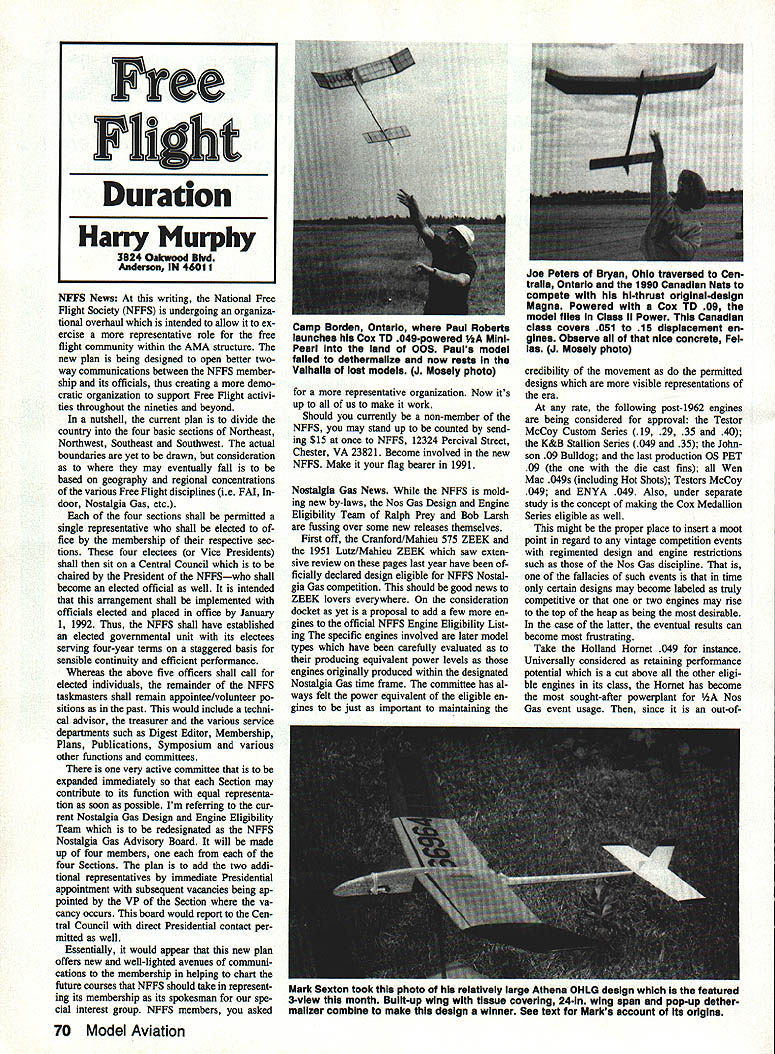
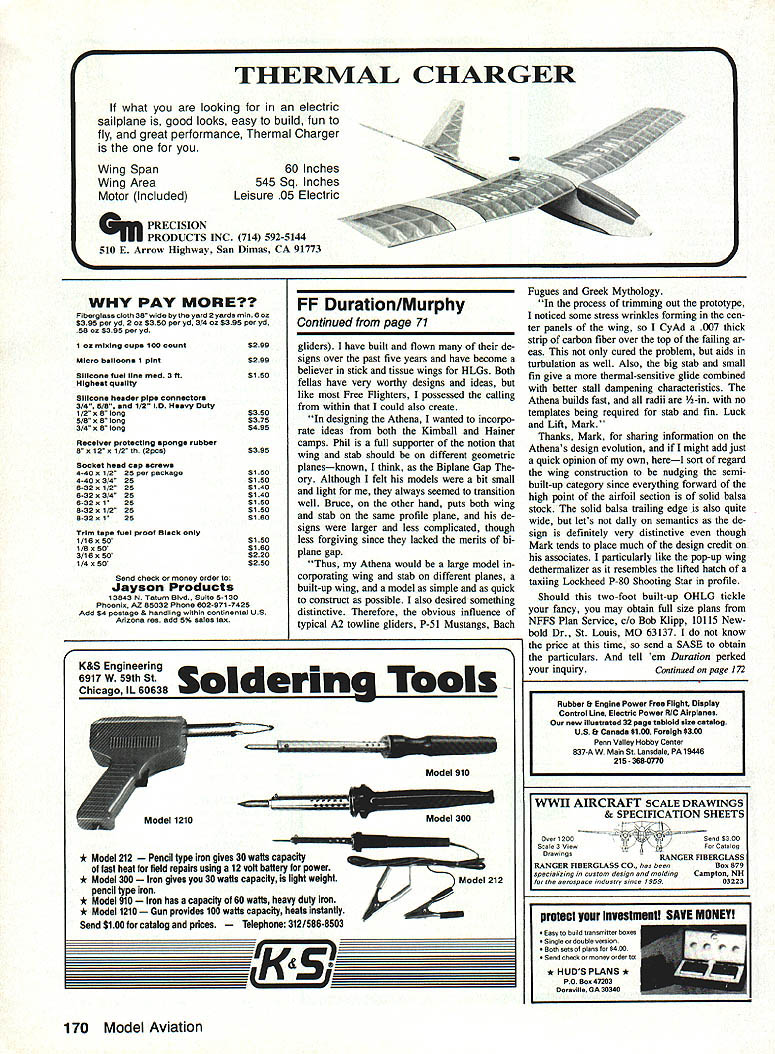
I thought Mark Sexton's quite successful hand-launch glider design, the Athena, deserved some ink since it is somewhat unusual in several respects. It has a built-up wing with tissue covering, a giant 24-inch wingspan, incorporates a pop-up wing dethermalizer, and its profile resembles that of a state-of-the-art F1A Nordic (A2) towline rather than a normal HLG.
Although none of the foregoing characteristics are necessarily unique by themselves, this design is enjoyed by other strong-arm enthusiasts in the Pacific Northwest and its contest record in that region is admirable. Here are Mark's own words regarding the origins of the design:
"My two mentors here in the Northwest are Bruce Kimball and Phil Hainer, Sr. Both are advocates of built-up gliders (in lieu of solid balsa gliders). I have built and flown many of their designs over the past five years and have become a believer in stick-and-tissue wings for HLGs. Both fellas have very worthy designs and ideas, but like most Free Flighters, I possessed the calling from within that I could also create.
"In designing the Athena, I wanted to incorporate ideas from both the Kimball and Hainer camps. Phil is a full supporter of the notch; wing and stab should be on different geometrical planes — known, I think, as the Biplane Gap Theory. Although I felt his models were a bit small and light for me, they always seemed to transition well. Bruce, on the other hand, puts both wing and stab on the same profile plane, and his designs were larger and less complicated, though less forgiving since they lacked the merits of the biplane gap.
"Thus, my Athena would be a large model incorporating wing and stab on different planes, a built-up wing, and a model as simple and as quick to construct as possible. I also desired something distinctive. Therefore, the obvious influence of typical A2 towline gliders, P-51 Mustangs, high-lift cambered sections, and a somewhat aggressive planform found their way into the final design.
"In the process of trimming out the prototype, I noticed some stress wrinkles forming in the center panels of the wing, so I cycled a .007" thick strip of carbon fiber over the top of the failing areas. This not only cured the problem, but aided torsional stiffness as well. Also, the big stab and small fin give a more thermal-sensitive glide combined with better stall-dampening characteristics. The Athena builds fast, and all spars are 1/8" with no templates being required for stab and fin. Luck and lift, Mark."
Thanks, Mark, for sharing information on the Athena's design evolution. My own quick opinion is that the wing construction nudges the semi-built-up category since everything forward of the high point of the airfoil section is solid balsa stock. The solid balsa trailing edge is also quite wide, but let's not dally on semantics — the design is distinctive and effective. I particularly like the pop-up wing dethermalizer as it resembles the lifted hatch of a taxiing Lockheed P-80 Shooting Star in profile.
If this two-foot built-up OHLG tickles your fancy, you may obtain full-size plans from NFFS Plan Service, c/o Bob Klipp, 1015 Newbold Dr., St. Louis, MO 63137. I do not know the price at this time, so send a SASE to obtain particulars.
Lost Hills Site Purchased
As most of you may know, Curt Stevens of Model Research Labs, along with others, has been instrumental in soliciting sufficient funds to purchase a slice of the Lost Hills, California desert to ensure Free Flight will have a contest site there past the year 2002. Over $60,000 had been collectively donated by last fall, and preparations were being made to purchase the first chunk of the desired 630-acre parcel.
Suddenly, and practically unannounced, a benefactor stepped up and offered to buy the entire land parcel and then hand it over to a supervisory group free of charge. Details of the transaction are now being worked out and the original $60,000 is to be returned to the donors. We understand the gracious gentleman would prefer to remain anonymous, but the situation certainly brings an old cliché to mind — "Who says there ain't no Santa Claus?"
More Toy Timer Tips
Our designated Mad Ball King, Hank Nystrom, recently advised of an interesting situation he had with a customer who had purchased one of his fabricated engine timers made from mechanical Mad Ball toys. It was the only complaint Hank had received about all the timers he shipped. The fellow said his timer would stop when he launched his 1/2A Free Flight model and the engine would run until fuel was exhausted — the model D/T never triggered first. Hank sent him another timer and the same thing happened.
Finally, Hank learned that the fellow was left-handed and had installed the timers on the right side of the fuselage, causing the weighted escapement to hang down rather than stick upright out of the mechanism. Once Hank visualized that installation, he could see why the timer might quit ticking when mounted that way.
Good point to investigate. Check your timer installations before heading to the flying site this spring — especially you lefties.
Also, an after-Christmas note from Mack Barker flagged that those Teenage Mutant Ninja Turtles (Stock No. 5611) contain Tomy toy-type mechanisms with escapements incorporated. The mechanism powers a swinging right arm in these toys, but the drawback is that the toys sell for about $6 or $7.
I am still finding different brands of toys in department stores now and then which contain usable mechanisms for fabricating timers. My latest find was a ladybug and a skull sold through Phar-Mor stores.
Hints from Bob Schlosberg
Ever try a potato peeler to shape leading edges on larger models? Bob says it works great. He also uses a hair dryer to coax striping tape around sharp bends and to affix it to the model surface. He cuts Carl Goldberg striping tape or pin-striping tape by sticking it down to a plastic cutting sheet and using a metal straightedge to get the right width. Striping gives many of Bob's models a classy look.
For dummy engine representations on rubber models of prototypes that had radial engines, Bob draws one cylinder and Xeroxes it as many times as necessary to make up the entire engine front. The paste-up can then be copied as often as desired. The two-dimensional drawing can be jazzed up with aluminum pushrods, partial Williams Bros. cylinders, thick electrical wire with insulation for collector rings, and smaller copper wire for spark plug leads.
On finishes, Bob uses Sig Lite-Coat dope thinned with three parts thinner to one part dope. Spraying the dope keeps finishes lighter and more professional looking. He prefers thinned white glue to dope for attaching tissue, taking care to avoid the inside edge of the wing or stab to prevent tissue from pulling down behind the structural member. India ink in a technical pen provides control-surface outlines.
On the field, Bob and Jane are scientific in their flight testing. They strive for consistency by keeping records of each model's performance in a special notebook. Their models fly well and often. Their house is often the meeting place for the Cactus Squadron (Phoenix area), and Bob does a fine job as Contest Director. Besides being meticulous craftspersons and excellent fliers, Bob and Jane are warm and unselfish people — my nomination for Modeling Couple of the Year.
Broom Straws
Dave Smith of the Cactus Squadron passes along a hint useful to corkballers: use broom straws from an ordinary kitchen broom for many model applications. J. F. Frugoli in France and Ulises Alvarez in Uruguay have long used this smooth, strong and free material. I have also used dried straw of larger dimension slit down one side to cover and fatten up wire undercarriage and cabane strutting. Start collecting a box of various sizes and types of straw and you'll be amazed at how many uses you'll find for it, from axles to tail skids.
Windshield Problems?
The Scale Watch newsletter from the Great Pacific Northwest passes on a tip from John Stewart: Elmer's CA-T contact cement dries clear and can be worked with water. If windshields are your nemesis, you might give it a try.
Custom-Printed Tissue
A few years ago the late Walt Mooney wowed us with the nifty decorations on his Kunkaldo that he had done directly on tissue with a color Xerox machine. Now and again some brave soul will run a sheet of Japanese tissue into a copier only to have it jam up inside.
Transcribed from original scans by AI. Minor OCR errors may remain.

