
Free Flight: Duration
John Oldenkamp 3331 Adams Avenue San Diego, CA 92116
Staying Up
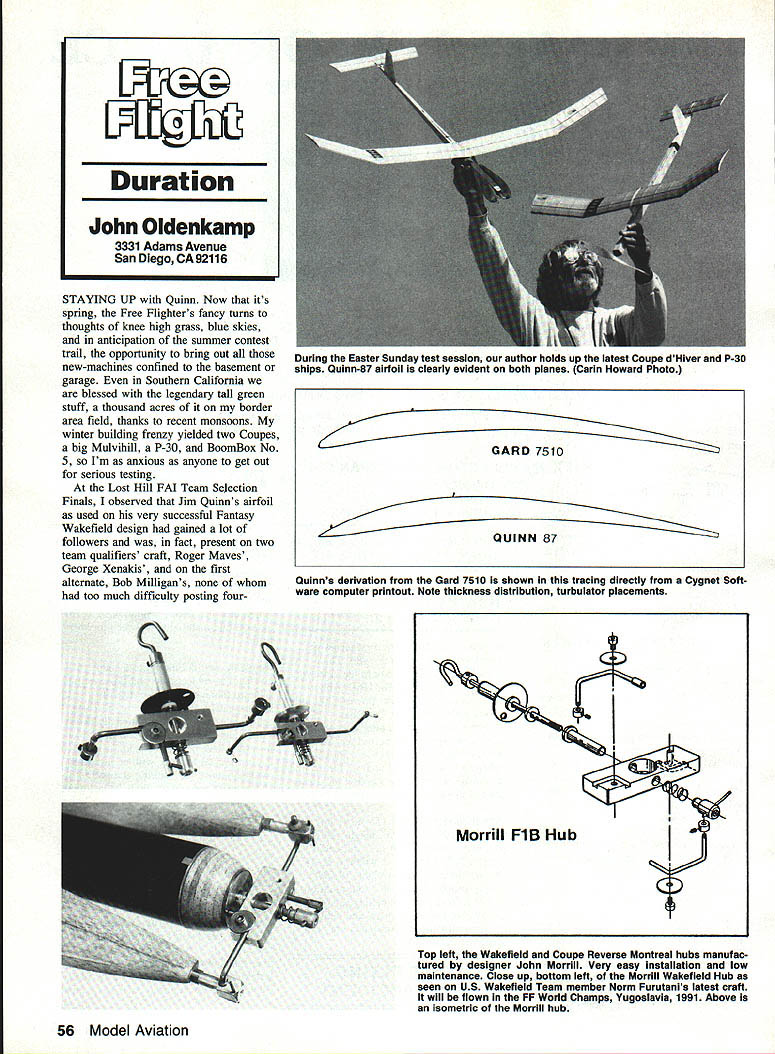
Now that it's spring, the Free-Flighter's fancy turns to thoughts of knee-high grass, blue skies, and — in anticipation of the summer contest trail — the opportunity to bring out new machines long confined to the basement or garage. Even in Southern California we are blessed with the legendary tall green stuff — thousands of acres on my border-area field thanks to recent monsoons. My winter building frenzy yielded two Coupes, a big Mulvihill, a P-30, and BoomBox No. 5, so I'm anxious to get out for serious testing.
Observations at Lost Hill / Early Experiments
At the Lost Hill FAI Team Selection Finals I noticed that Jim Quinn's airfoil, used on his very successful Fantasy Wakefield, had gained many followers. Variants of it were on the ships of two team qualifiers (Roger Maves and George Xenakis) and on first alternate Bob Milligan. All posted four-minute flights under very marginal lift; altitudes under power were impressive and the glides superb.
Intrigued, I retreated to the workshop and built five planes with chords ranging from 3.6 in. to 5.8 in. to see whether I could improve on my USA 5 cum Simplex reverse 7% bottom foils. The results were dramatic: direct, powerful climbs, much improved glides, and greater confidence on the starting line. If only I could wind to max torque and find those silly thermals!
The Quinn-87 Airfoil
The Quinn-87, as illustrated, is a modification of the popular GARD 7510. Key features:
- Forward upper camber is much reduced.
- Lower 70% of the section is thickened somewhat to provide added structural integrity.
- Leading edge is as sharp as practical; trailing edge is relatively blunt and thick to accommodate either a rectangular or monocoque format.
Caveats and handling notes:
- Fly the airfoil at about a 65% balance point (CG).
- The section should be turbulated as shown in the illustrations.
- Use a stabilizer with a rounded or Phillips-entry leading edge; otherwise you may encounter significant stalling behavior in turbulence.
Cottage-Industry Samplings
As mentioned in the BoomBox piece (Model Aviation, July 1990), a flock of new products has become available.
#### Foiled Again (Cygnet Software)
- Authors/designers: Pauline and Bernard Crowe, doing business as Cygnet Software.
- Address: 24843 Del Prado, Suite 141, Dana Point, CA 92629.
- The updated "Foiled Again" program contains several hundred public-domain airfoils, including Quinn-87 and GARD 7510. It runs on IBM-compatible PCs and can output to dot-matrix printers. Functions include plotting, straight/diagonal plotting, thickening, trimming, and menu-driven outline modification.
- Mail-order price: $44.95 plus California sales tax (for residents).
#### Fuselage and Electrification Notes Before committing to electrification, examine the fuselage design closely:
- Some models have short nose moments, which can make obtaining the correct final balance difficult. Consider moving the front former forward to shift the battery pack as needed.
- Cabin-area fuselage sides are often not parallel; many are shapely with bowed sides. Use side rails to immobilize the battery laterally and employ a shaped pack or pack saddles to control fore-and-aft movement.
- Secure the pack with Velcro straps or RTV silicone adhesives.
Radio compartment and installation tips:
- The radio compartment is typically aft of a 1/8-in. balsa former. With a larger electric installation there is usually room for normal-sized servos; mount them on a 1/8-in. birch ply tray glued to two 1/4-in.-sq. balsa rails. Glue the rails to the fuselage side verticals and to the 1/8-in. former in front and the doubled fuselage verticals at the trailing edge location.
- The receiver pack (example: 250 mAh) can be fastened to the 1/8-in. former at floor level with double-sticky Velcro (Radio Shack part number 64-2345), with the receiver attached above the pack. Before applying Velcro, coat wood surfaces with Ambroid or similar glue, let dry, and sand lightly to improve adhesion.
- Install a hatch (bottom or topside as suits your model) for access to motor wiring, charge jack, switch, and speed control. The speed control can be Velcroed in place to the front of the sandwich former.
Seniorita-specific notes:
- I modified the top forward cabin structure by adding balsa stock above and below the fuselage piece FF and shaping it, rather than using the shapely balsa blocks supplied in the kit.
- Substitute 1/4-in. hold-down dowels for the 3/16-in. ones supplied. Because the electrified plane is heavier than originally intended, strengthen and ensure all glue joints in the wing-attachment area are well fitted and sound.
#### Accessories and Products of Interest
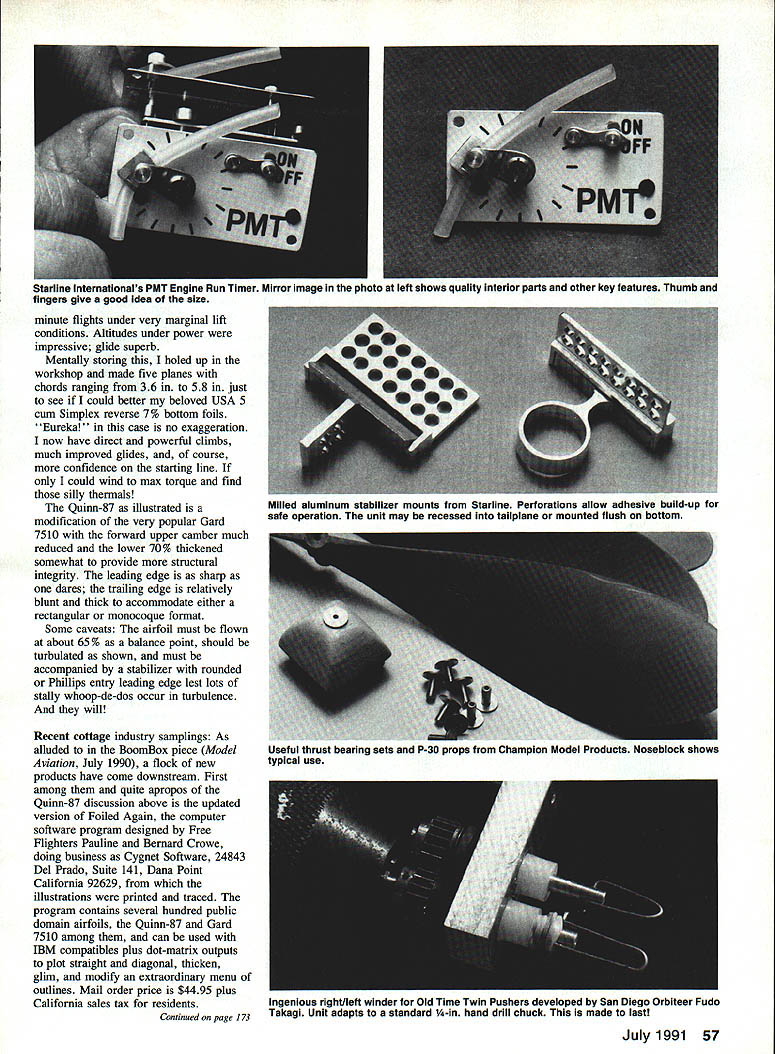
- John Morrill Miniature Engines: Carefully crafted folding props (field-strippable in under a minute) are available. Prices noted: $24.50 for Wake props, $19.50 for Coupe props. Order from John Morrill Miniature Engines, 143 Richmond Street, El Segundo, CA 90245.
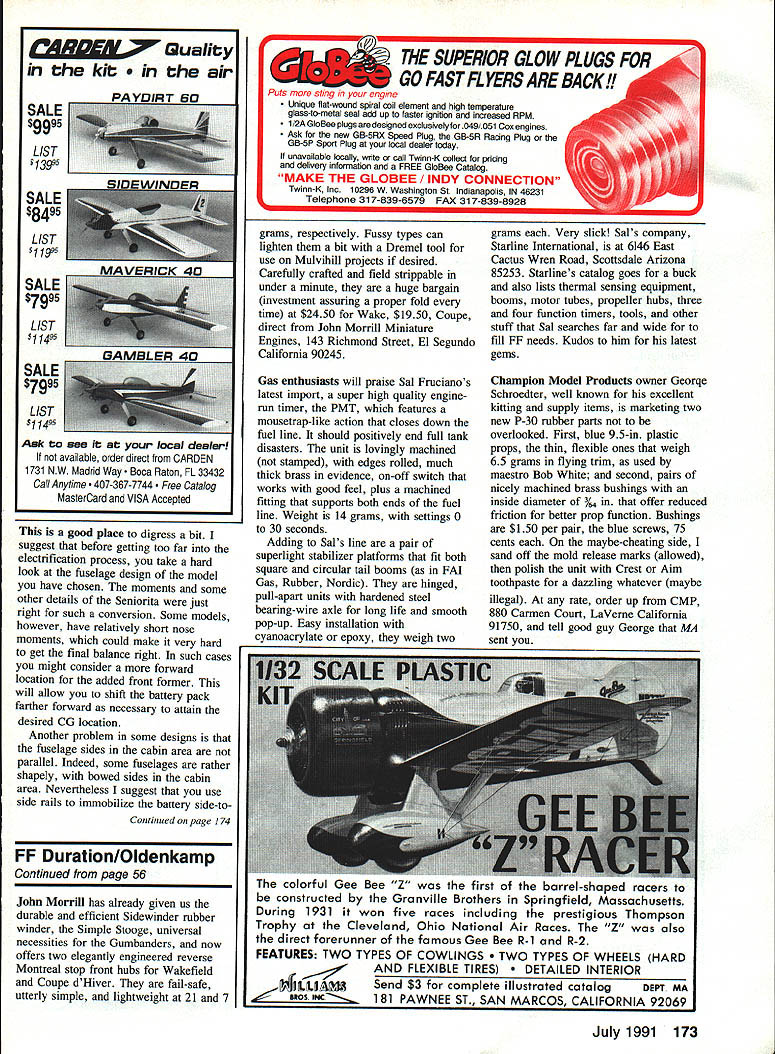
- PMT Engine-Run Timer (Sal Fruciano): A high-quality timer with a mousetrap-like action that cuts the fuel line to prevent full-tank runaways. Machined construction, rolled edges, brass fittings, an on-off switch with good feel, and a machined fitting that supports both ends of the fuel line. Weight ~14 grams; settings 0 to 30 seconds.
- Starline International (Sal Fruciano): New superlight stabilizer platforms that fit both square and circular tail booms (suitable for FAI Gas, Rubber, Nordic). Hinged, pull-apart units with a hardened steel bearing-wire axle, easy to install with cyanoacrylate or epoxy; weigh about 2 grams each. Starline International, 6146 E. Cactus Wren Road, Scottsdale, AZ 85253. Their catalog (lists timers, motor tubes, prop hubs, sensors, tools, etc.) is available for $1.
- Champion Model Products (George Schroedter): New P-30 rubber items include blue 9.5-in. plastic props (thin, flexible, ~6.5 g in flying trim, as used by Bob White) and pairs of machined brass bushings with a 3/16-in. inside diameter to reduce friction for better prop performance. Prices: bushings $1.50 per pair; blue props $0.75 each. Tip: sand off mold-release marks and polish with wet toothpaste for a clean finish.
Closing
Quinn's airfoil family and the recent stream of cottage-industry products are providing useful options for duration free flight. With careful attention to CG, turbulation, stabilizer shape, and secure battery installation, these advancements can yield better climbs, improved glides, and greater confidence on the contest line.
Transcribed from original scans by AI. Minor OCR errors may remain.

