
Free Flight: Duration
Jim Haught 3069 Sovereign Drive Cincinnati, OH 45251
Power Fliers Don't Publish / NFFS Resource Book on Power Models
POWER FLIERS don't publish: So says Keith Hoover, who seeks to solve the problem by editing the 1992 NFFS Resource Book on Power Models — The State of the Art. If the press release I recently received is any indication, this will be quite a formidable effort.
It's Keith's intent to cover virtually every aspect of power flying, from the winning current designs to the classics — Satellites, Pearls, Stardusters, etc. Also featured will be sections on individual components and techniques, such as adjustment, finishing, innovative design, international design, props, and fuels.
The proposed format is reminiscent of that used so successfully by Frank Zaic in the classic Yearbook series, even to the point of soliciting a call for papers: "You are invited to review your power modeling experience and submit a contribution," says Keith. "Articles, models and plans, and ideas will be assessed for aptness, originality and value to power fliers."
It has been many years since a project of this scope has been attempted, and there should be plenty of worthy material. Submit proposals to Keith Hoover, 1 South 224 Rochdale, Lombard, Illinois 60148.
Free Flight Hall of Fame
Tony Italiano, Chairman of the NFFS Hall of Fame Committee, announces the 1991 inductees:
- Joseph Ehrhardt (deceased) — One of the early wide-awake modelers who applied his ideas to a winning formula. He won the Wakefield in 1930 with a time of 2:58 and won again in 1931 with a flight of 4:51.
- M. William Gieseking — An experimenter in advanced technology. Bill has been a pathfinder in variable-geometry surfaces, including flapped wings and folded/extendible wings.
- Milton L. Huguelet (deceased) — An aggressive, thorough champion. As a young Chicago Aeronut, he made it a personal challenge to learn all he could from his peers. His contest wins are impressive, and his designs have been published.
- Richard W. Obarski — A versatile fellow with excellence in both indoor and outdoor activities. Also a Chicago Aeronut with a long list of contest wins. As an engineer, he developed a new type of product test equipment as well as products for the model trade.
- Carl R. Wheeley — A quiet, thoughtful individual. He upgraded Model Aviation magazine into a respected forum for all modeling interests, including balanced coverage from beginner to expert levels. His credentials include winning the World Championships in 1954 with his Senator FAI Power model.
New Products
- Bradley Model Products (1337 Pine Sap Ct., Orlando, FL 32825) has released a new catalog featuring composite materials, towhooks, timers, and accessories.
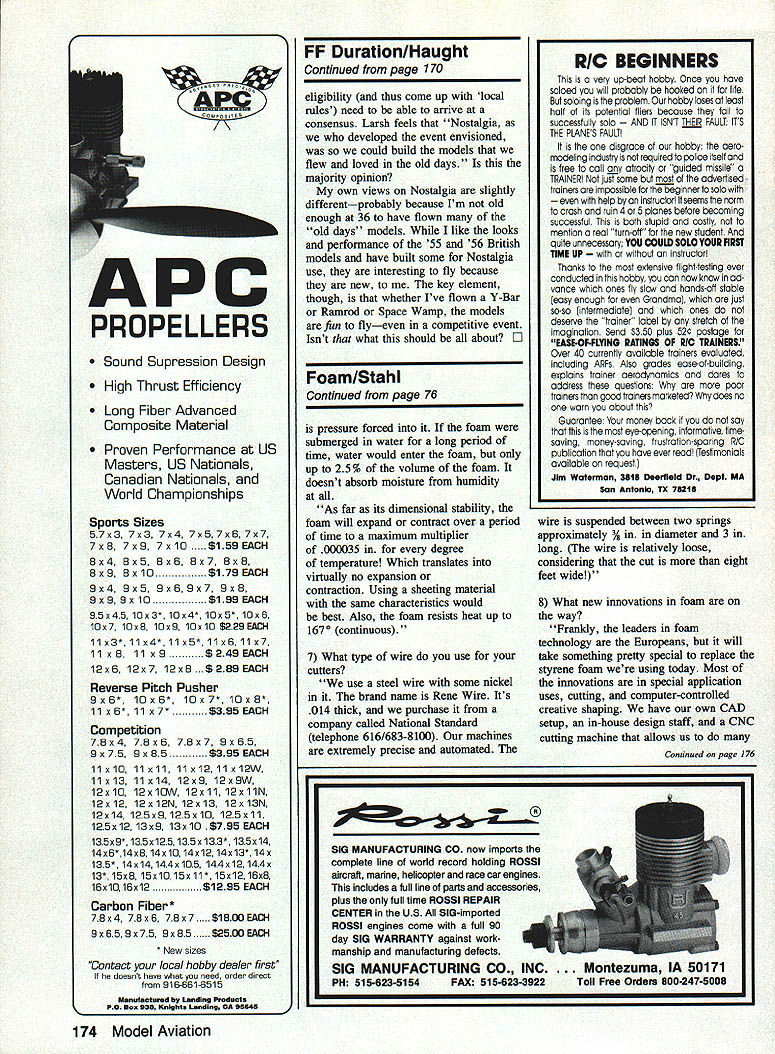
- Latest addition: the mold TH-01 injection-molded towhook. The towhook is molded from a hard plastic; the only metal parts are the springs, towhook shaft, adjustment screw, and latching arm. The entire hook assembly is very light (15 grams, including mounting shell) and is suitable for either A-1 (F1H) or A-2 (F1A).
- Other featured products: various sizes and forms of carbon fiber, Kevlar, fiberglass, and many glider-related items (tailbooms, towline, tow reels, and an electronic DT timer). Send a SASE for the full catalog.
- Doug Galbreath (3408 Topsail Place, Davis, CA 95616) reports several new products to be released over the next few months as they are prepared:
- A metal F1C front-end assembly designed for the Nelson .15 engine, featuring engine mount, brake, fuel system, and cowl. This is a joint venture with Ed Keck (New York). Price to be determined as they work to reduce man-hours while maintaining prototype quality.
- An audio tach with a 50–50,000 rpm range, time-delay on-off switch, and a "hold" feature to view peak rpm for a run. This item is in pre-production, expected to be available sometime in 1992. Price is expected to be around $175.
- Currently experimental: a reworked Holland Hornet for AMA 1/2A use. A Hornet case is used with newly crafted piston, wrist pin, and crankshaft.
More on 1/2A
My September 1991 column on high-dollar 1/2A has sparked a number of opinions on what the future holds for this event.
Bob Beecroft (Carlsbad, CA) pointed out that there now exists a plain-bearing Shuriken, thus making my proposal to reclassify ball-bearing engines obsolete. Bob has also done extensive testing on Shurikens vs. Tee Dees (see Flyoff No. 15 for results), and he touches on an idea common among the letters I've received:
"I don't know what the answer is. My Shuriken runs great," he notes. "But I'll still use Cox motors until I start getting beat regularly with this or a CS (Competition Engines). How 'bout a Tee Dee-only class and then 'Unlimited'?"
Florida's Chuck Stanley agrees: "The Tee Dee is still king in Florida. Even though I have ordered the Shuriken, I am not planning to use it until I can no longer be competitive—or I'll use it for F1J."
Doug Galbreath takes a slightly different approach: "Without a rules change, making a new class like 3/4A or Super 1/2A, we are going to be using these engines. I think we should address this problem; possibly a handicap on the ball bearing engines would be okay. This one is easy to do, does not add an event, and could solve the problem.
"However," Doug notes, "I don't think most guys who are trying to use these engines anymore have seen any great improvement in their flying. To get good climb performance one simply makes the airplane the size he can handle without problems. Really, to handicap the ball bearing engines would probably kill their use by most of us."
My observation over this contest season is that the new engines are gradually becoming more common, but those using them are still in the minority, and the percentage of top fliers using them is smaller still. There are performance and availability problems to be solved with both the Shuriken and CS; when these are overcome, I would expect many of those currently "on the fence" to begin using the new engines.
Whither Nostalgia
The Nostalgia events continue their rapid increase in popularity, but not without some "growing pains." Rules are not yet consistent across the country, and this confusion has led to some rather heated disagreements, both on and off the flying field, about what is or isn't a Nostalgia-legal model, and what the event is supposed to represent.
Bob Larsh has been one of the leaders in attempting to establish some unified Nostalgia rules, and he offers his thoughts on some of the problems faced by Nostalgia fliers and contest directors:
"I guess the 'anything to win' guys will always be with us. They look for the very end-of-the-spectrum models to build, put the very latest engine in that the law allows, pop in 60% nitro, and go for broke. They really aren't too far off being modern AMA, are they?"
In particular, Bob is outspoken about British designs of the 1955–56 period, which feature rear fins, long tail moment, and high pylons.
"I just fail to see anything nostalgic about these ships," he says. "I guess as long as we have competitions, we will have this situation unless we were to ban such models! I know this would be a drastic measure, but maybe it's time we decided what we want Nostalgia to mean to us."
What should Nostalgia represent? Its gain in popularity clearly indicates that it is here to stay and that the conflicting factions, who argue over engine/design eligibility (and thus come up with "local rules"), need to be able to arrive at a consensus. Larsh feels that "Nostalgia, as we who developed the event envisioned, was so we could build the models that we flew and loved in the old days." Is this the majority opinion?
My own views on Nostalgia are slightly different—probably because I'm not old enough at 36 to have flown many of the "old days" models. While I like the looks and performance of the '55 and '56 British models and have built some for Nostalgia use, they are interesting to fly because they are new to me. The key element, though, is that whether I've flown a Y-Bar or Ramrod or Space Wamp, the models are fun to fly—even in a competitive event. Isn't that what this should be all about?
Transcribed from original scans by AI. Minor OCR errors may remain.

